Transcript
[00:00:00] Announcer: You’re listening to the Fizzics Ed Podcast. For hundreds of ideas, free experiments, and more, go to fizzicseducation.com.au. And now, here’s your host, Ben Newsome.
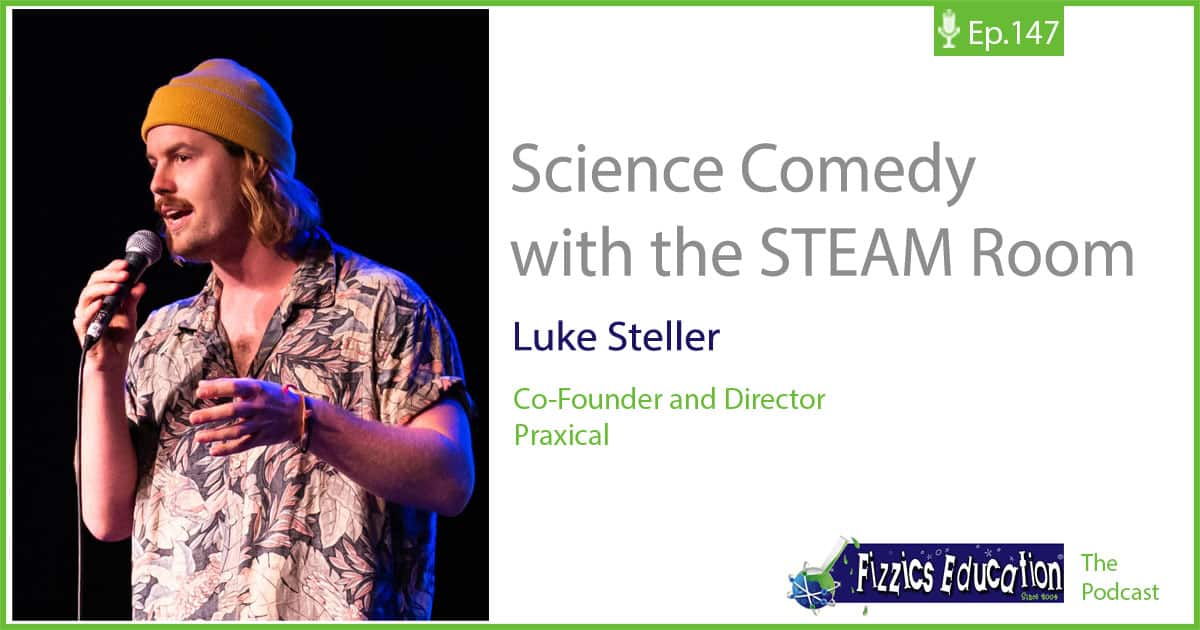
[00:00:17] Ben Newsome: G’day, welcome to another Fizzics Ed Podcast. Glad to have you again, no matter where you are around this world. In this particular case, we are chatting with Luke Stellar, who is from the Australian Centre for Astrobiology at UNSW as a PhD candidate, but he’s also a co-founder and director of Praxical. What Praxical has done is really, really fun. They have organised science and comedy together. Yes, The Steam Room. What an idea for going into an amazing way to teach STEM to a whole brand new audience. The 2023 Steam Room science comedy programme is coming up, and Luke Stellar has dropped by to tell us just what tweaked his ideas around why we should be doing science and comedy together, and how you can get involved. So let’s go find out.
[00:01:04] Announcer: This is the Fizzics Ed Podcast, for all about science, edtech and more. To see 100 fun free experiments you can do with your class, go to fizzicseducation.com.au. That’s physics spelled F-I-Z-Z-I-C-S and click 100 free experiments.
[00:01:23] Luke Stellar: My name is Luke. I’m first and foremost, though it doesn’t feel like it sometimes, a PhD student at the University of New South Wales. The work I do there is all about trying to figure out basically how life formed on Earth and using that to try and find aliens, which is a lot of fun, honestly. I spend a lot of time thinking about a very simple self-replicating system, just a little bit of RNA or DNA inside a bubble in a hot spring somewhere. That’s what we think of when we think of first life.
[00:01:50] Luke Stellar: I’m trying to say, could that form in a hot spring? Could that form in a lake? Are there hot springs on Mars? Those kind of questions are what I’m looking at. So that’s my 9-to-5 job at the moment. But outside of that, I do a whole bunch of scicomm, which is a lot of fun as well.
[00:02:16] Ben Newsome: Absolutely. That is an interesting research area, I’ve got to say. Before we even go into The Steam Room that’s coming up, I’m just curious, what are the sort of questions that you get from people around the place about what astrobiology actually is?
[00:02:30] Luke Stellar: It’s interesting. I do a bit of a comedy skit around this, because a lot of people—and I’m a bit of a hippie, for anyone watching the visuals you’ll see I’ve got a bit of long hair and a nose ring—people either think I’m studying astrology, which opens up a lot of really fun questions around that. Most of the time, I find it’s a topic that people don’t know a lot about, and as scientists we hardly know anything about how life formed as well, and if there’s life out there. Honestly, it’s such a new field.
[00:03:00] Luke Stellar: But people always seem to have an idea about it. They’re like, “I’ve read something once about hydrothermal vents deep under the ocean,” or “Didn’t they find life on Mars a couple years ago?” or “I swear I saw an alien the other day.” It seems to be something that people have experienced or thought about, at least in a very abstract way. That was the main reason, honestly, why I picked this research. I had some of the analytical science skills to do the work, but I’ve always been passionate about chatting to people about science and about what excites them, and it always seems to be when you tell people, “I’m trying to find aliens for a job,” it does stimulate some fun conversations, which is always nice.
[00:03:46] Ben Newsome: Oh, I totally know that. I just say I blow stuff up for a living and people are quite happy with that, and then you can dig into it a little bit deeper as you go. Fantastic. So you went ahead and you formed Praxical. Tell me a bit about Praxical, what’s that all about?
[00:04:04] Luke Stellar: Praxical is a collective of emerging science communicators and artists who are trying to engage our broader community in STEM. It’s really a platform. I created it with another fellow PhD student, Bonnie Teece, and an amazing science communicator, Shane Hengst. We basically made it in the middle of lockdown, because we were like, “How do we shift online and how do we engage people in an online space?” We made a few online workshops that are still out there that are really fun.
[00:04:44] Luke Stellar: From that, it’s really been a container to help us work with artists. I use Praxical to create this comedy show that we’ll talk about. I’ve used it to work with contemporary dancers to think about how the origin of life is shaped through movement. How can we understand it better through movement? Talking with artists, graphic designers, mural artists, and street artists. It really is a tool for me to have fun chats and work on cool projects with creatives.
[00:05:15] Ben Newsome: Well straight up is communication. If we just simply preach to the choir, well we only get the same songbook, right? It’s good to get out of it.
[00:05:24] Luke Stellar: That’s a good way to put it. I am lucky enough a lot of my friends and people in my life outside of academia are amazing creative artists, performers, and producers. I just see that they bring such exciting interest and novelty when they think about their audience and who they’re engaging with. It’s something as a scientist—and even I would call myself a science communicator—I wasn’t thinking in that way. It really is just a way to get outside of your standard science attendees for events.
[00:05:57] Ben Newsome: Which is fantastic. So I heard this year you had seven people running around to all sorts of events doing comedy programmes on stage with live people in front of us laughing, or potentially not, but I suspect they were very cool stories.
[00:06:12] Luke Stellar: Couple of good laughs. We had seven amazing scientists. They all ranged from an undergraduate person studying veterinary science to an associate professor from Macquarie Uni. We had a whole range of academic skills. We had people who work in startups who left uni years ago, growing lettuces and cabbages in vertical horticulture.
[00:06:46] Luke Stellar: And we basically just put them in a room with a whole bunch of comedians and gave them a couple of weeks to write some fun material. We got them up on stage. We had Dr Karl there, Beck Melrose, who’s a brilliant comedian, she writes for Gruen and all these amazing ABC shows. AJ Lamar and all these amazing comedians on stage with our seven scientists, and they just had a lot of fun. It was a great night.
[00:07:04] Ben Newsome: What a fantastic way to improve communication skills. Comedians, it’s one of the hardest gigs around. Trying to make a hundred people or more laugh on cue with your timing, that little bit of nuance, and connection. If you can connect with that broad range of people, you’re doing really well. In this case, you’re doing it with science, it’s fantastic.
[00:07:25] Luke Stellar: Totally. And it is incredibly terrifying, it’s daunting, it’s horrible, and it is really difficult. People have different views on this. Some people say that people are just funny or they’re not, you can’t do anything about it.
[00:07:42] Luke Stellar: But I think once you actually do the training and you sit down with people who write comedy for a living, and they shadow-write for all these amazing comedians you see on TV. We’re not saying that they write the jokes for our scientists, but there is a skill to saying, “You’ve got a funny story that works well when you’re down with your friends at a birthday party, you tell them a mishap in the lab or what you do for research and it gets a few laughs. How do you turn that into something that you can deliver in a really succinct, beautiful way that will get people laughing on cue on stage?” So it can be done.
[00:08:16] Ben Newsome: 100%. I was just thinking about, even if you have a dry piece of science, there’s got to be an angle. I suppose the comedian’s brain, they’re firing so quickly.
[00:08:26] Luke Stellar: Which is great. But it was funny, I think the comedians were obviously brilliant and gave us a lot of advice and support. But the scientists wrote all their own material. They just got a bit of feedback, but they really—I think if you watch enough comedy, you kind of get what happens. You see, you pause right here. Honestly, the pauses are the best thing. The longer you pause, the more it builds up this tension.
[00:08:52] Luke Stellar: And I think the fun thing as well, doing it live, people are going there expecting to laugh. Especially as the whole show was seeing scientists do comedy for the first time, they’re not going to be there to heckle and see some huge name do something big. They’re going to screw up, they’re going to be a bit nervous, but they’re there for that authentic reaction seeing a scientist do something they’ve never done before. That creates a really nice wholesome atmosphere. Everyone went there ready to laugh, ready to be supportive.
[00:09:26] Luke Stellar: We only had one heckler, and it was one of the scientists’ mums halfway through the show. This scientist was telling a story about her dog at home and something that happened, and her mum was like, “She’s exactly right, that’s exactly what happened!” and was trying to boost her up for her story. So only supportive heckling happens with us.
[00:09:44] Ben Newsome: That’s fantastic. Now you said that you did a routine as well?
[00:09:47] Luke Stellar: Yeah, I had a bit of fun. I couldn’t convince scientists to do one of the most terrifying things, which is comedy, without putting myself in the furnace myself. I’m probably going to do it again. It was terrifying, but exciting. As a communicator, I saw the skills it gave me were incredible. It really was an amazing opportunity to view presentations and conversation and dialogue in a whole new light. That really excited me.
[00:10:20] Ben Newsome: So I’m curious, did you do the comedy around astrobiology or somewhere else?
[00:10:24] Luke Stellar: I did. It really was the whole—because you only have four minutes, it’s very tight. But it really was this whole idea of when you don’t look like the type of scientist that you’re meant to be. Doing astrobiology, I go to a lot of hippie music festivals and just telling people you study astrobiology, you get really different reactions from them and just playing off a few characters that I’ve met over my time.
[00:10:50] Ben Newsome: You’ve got me thinking. I was at a school today and the kids dressed up as a scientist. Predictably, a lot of them were in white lab coats. I wonder if they’d been challenged as to what an astrobiologist would look like?
[00:11:03] Luke Stellar: It would be interesting. I think it’s like what does a scientist look like in general. There is this stereotype—obviously stereotypes around gender and race that are luckily changing because they’re obviously in no way representative of what science actually is. But also lab coats, also being serious.
[00:11:21] Luke Stellar: Like we had seven amazing scientists up on stage, and most of them were telling stories about… one was telling a story about how she used to work as an underwater news reporter. She would go underwater scuba diving and then give a visibility report for scuba divers. She was a scientist, she had a marine biology degree. We had one talking about failed Tinder dates, or one worked in sperm and was talking about all the fun of working in a sperm lab where you have to get samples. They really showed the diversity of experiences that you can have in science. I think that’s a really good way to engage people in it.
[00:12:00] Ben Newsome: Oh, it’s fantastic. So there is a bigger, wider event. Let’s be honest, this podcast does last for a while, so I know we’re going to be talking about next year’s one. Are you looking to get in 2023 the same number of people on stage, or are you looking to really pump it up next year?
[00:12:17] Luke Stellar: So we’re definitely looking to pumping it up. I can’t say too much yet because there’s a few embargoes out there, but we’ve definitely got a much larger venue in Sydney. This year we had 500 people at the Factory Theatre and then we sold out another show at the Comedy Store, which is another 300. But looking to probably triple that this year. It will be a huge audience, which would be daunting but also if you’ve got an appetite to get in front of a lot of people and talk about your work, it’s very exciting.
[00:12:41] Luke Stellar: There’s also a lot of opportunity to go interstate as well. We’d love to get down to Melbourne and up to Brisbane and a few other places that we can definitely talk about once that’s all released.
[00:12:56] Ben Newsome: I was actually just thinking… I was lucky enough to have a chat with some really fantastic people and a number of them have done some TEDx talks. Those red letters are powerful and it’s a place where you can speak for 14 minutes well about something. Wouldn’t it be cool with The Steam Room where it was Steam-X? That sounds a bit odd. But that could be really interesting and something that could be done globally.
[00:13:26] Luke Stellar: Definitely. And I think it’s a funny thing where I’m working with, so The Steam Room now it’s an amazing partnership with myself and Ru Halawah and Tom Stevenson. They were the comedic MCs and basically the trainers for the last show, and we’ve collaborated together to make The Steam Room bigger and better this time around. They’re great because they bring… I think I’m a funny guy, I’m probably not, but I’m nowhere near the skills that a comedian has. Not only in performing and writing, but producing a show and how do you balance acts on stage and how do you reach out and create flyers and posters and attract a certain crowd. That’s stuff that I’ve dabbled with and I’ve produced public lectures and that kind of stuff. But to attract 500 people who aren’t scientists to a show requires something more than just a good idea. You have to really have skills in that event management side.
[00:14:01] Luke Stellar: So as I was saying, working with them, we have lots of chats around how do you protect the integrity of a concept of a show. Because we’re like, “Let’s bring this everywhere and we can train up a scientist for five hours or two hours and get them on stage.” But if the comedy’s not good, if the people don’t feel confident they’re going to make people laugh, they feel nervous, they feel really crappy about it, people walk away saying, “I hated seeing someone squirm on stage because the jokes didn’t land.” It’s not a good experience.
[00:14:31] Luke Stellar: So it will be awesome and I think there’s definitely space to expand it massively, but people have to be aware you do have to have quality control, you do have to have time, you do have to have commitment to make sure that it’s an incredible experience.
[00:15:07] Ben Newsome: Great, it matters.
[00:15:08] Luke Stellar: Honestly, yeah. And I think that my biggest fear or regret would be if a scientist goes on stage and we haven’t given them the full training that they require and then they walk off stage feeling like they could have done a better job or they felt their jokes didn’t land properly. We know every comedian did it with us, walked off stage absolutely beaming, just jokes were flying, laughter was going all around, and that’s what you want to see keep happening. We definitely can keep doing that with all the training we’ve got.
[00:15:43] Ben Newsome: Oh gosh. And actually it brings to the point like the training, it’s clearly in-depth. You’re not throwing them to the wolves so to speak. What are the sort of things that the comedians consistently say to all the people to be able to help them out when they’ve got to present live?
[00:16:03] Luke Stellar: It’s an interesting one. The best advice… I’ve been a three-minute thesis finalist and I’ve been giving talks at schools for years, I’ve done the whole presenting on stage thing for a while now. But I learned so much from working with comedians. The thing that landed with me that really captured me was that any presentation you do, any time you communicate with someone, it’s a two-way dialogue.
[00:16:28] Luke Stellar: And I think as a scientist or as a teacher or whatever you’re in, you’re used to getting up there and saying, “It’s my chance to word vomit on someone for 25 minutes about what I think,” and it’s usually very exciting. Space and aliens and space and looking for life on Mars and NASA and rovers. It’s all very fun, but I just kind of see it as a tap that I’m pouring into someone’s mind and giving them all these words.
[00:16:54] Luke Stellar: Where really, even if there’s no audience participation, even if it’s not asking questions, it’s still a dialogue. You’re watching them. You’re watching if people are squirming. You’re watching them if they’re laughing, if they’re pausing. Are they sitting back in their chair? Are they engaged and leaning forward? You should be tweaking your presentation based on that. That’s what I got out of it, was that you’re really constantly having a conversation with the people sitting in front of you even if they can’t say anything. Or if they can just laugh.
[00:17:28] Ben Newsome: That’s solid advice. Absolutely. I guess the room is wide, broad and big. Trying to reach each person, it can be partly just moving around the stage, partly connecting with them.
[00:17:41] Luke Stellar: Honestly, yeah. And you see the best comedians, they will mix it up, especially in a huge venue, they talk to the person in the back of the room and everyone feels like they’re there. But they’ll pick out one person at the front and deliver jokes to them. They’ll pick someone that they know other audience members can see. If they see them laughing or squirming, they can make a comment on that. Then you get into crowd work, you get into actively engaging with your audience and making up new material on the spot, which is incredibly difficult and something I haven’t tried yet. But people do it really well.
[00:18:16] Ben Newsome: I guess, from a scale point of view, if this was running enough times, eventually someone might be interested in potentially bringing their performance to a regular comedy night.
[00:18:28] Luke Stellar: Honestly! Well, yeah, so we’ve had a few of our comedians, our science comedians by the way, look at doing open mics and looking to regular comedy nights.
[00:18:47] Luke Stellar: Off the back of what we did, Dr Karl’s doing an hour-long special at the Comedy Store, which is brilliant! He’s bringing that out to a bigger audience. Because when we did it with him we had a very tight schedule and he’s like, “I’ve got all this material!” He’s a natural comedian, he’s incredible. He had all these ideas. I’m like, “Mate, we’ve only got 10 minutes for you, we’ve got to keep it real nice and sharp.” I think he’s looking forward to having that space to really explore some amazing stuff. His show’s on at the end of September. So definitely check him out at the Comedy Store for anyone who’s interested.
[00:19:10] Ben Newsome: I’ve got to ask straight up. Were you doing comedy prior to this?
[00:19:13] Luke Stellar: No, I wasn’t. Honestly, I was very lucky. As I said, I had a lot of friends who were in comedy and a good friend of mine runs a weekly comedy experience in Sydney. I would go to these things and just see comedians on stage. I never thought I would do it. I never thought I could do it. I just saw that it was a unique style of engagement that scientists really did lack. And I thought that it would be cool.
[00:19:48] Luke Stellar: But you see someone on stage and they’ll be like, “Hey, how we doing?” And everyone’s just like, “Whoa, what’s next?” There’s this captivation of an audience with a few words or with a few one hook-line at the beginning, everyone’s leaning in.
[00:20:01] Luke Stellar: And once you’ve sat through enough boring lectures at uni from some old professor sometimes, you’re like, “Why can’t they be comedians? Why can’t this be more fun?”
[00:20:15] Ben Newsome: And hello to all you lecturers out there. We love you.
[00:20:18] Luke Stellar: No, we do love you! Sorry, that was very… but use this as an opportunity, upskill. Any professors out there who want to have people at the edge of their seats in their lectures, sign up, do the show.
[00:20:30] Ben Newsome: It could be fun as comedy duos too. If you’ve got the professor who is very well learned in an area and an undergraduate or a high school student.
[00:20:41] Luke Stellar: Yeah, that could be really fun. And we do have a few. Last time we sandwiched—we had one science comedian, one regular comedian up on stage. That was great. But I think looking back now, there’s such a buzz and such a hype around the show, the numbers we’re getting and the venues we’re booking out. A lot of comedians who either have science backgrounds or they’re really interested in science, they’re like, “I’ll come on and I’ll write a whole bunch of new material based on some science.”
[00:21:08] Luke Stellar: So now we’re looking at, hey, we’re going to put comedian and scientist together in a room. They can have a chat and maybe this comedian makes a whole new caricature of that scientist, or explores what they view from that. So for this next round it’ll be a lot more of not just scientists learning from comedians, but comedians holding up a mirror to what they think science is, which I think could be a lot of fun.
[00:21:32] Ben Newsome: Oh that is awesome. Hey, that actually brings up the point. How on earth can people who are listening to this get involved?
[00:21:38] Luke Stellar: Definitely. So at the moment we’re in our recruitment stage. We’re looking for excited, I like to say STEM-adjacent people. So science, tech, engineering, maths, medicine, but we’ve got nurses who are applying. We have people who are STEM educators who never even studied science but they end up in journalism started reporting a lot on that. We’re very broad and open to the style of people that we have applying.
[00:22:08] Luke Stellar: And if they Google Sydney Science Comedy Praxical, which is P-R-A-X-I-C-A-L, there will be a little website that will pop up which will have an apply now button, and before the end of September in 2022 they can go on and apply and just put their name down, let us know why they love it, why they want to learn these skills. Next year we’re gearing up for a big huge show around the sort of festival season. That’d be like March, April, May next year we’re going to bring it out and have some fun with it.
[00:22:38] Ben Newsome: Fantastic. And I guess give it a shot?
[00:22:42] Luke Stellar: Honestly, yeah. I think give it a shot, and the thing that excited me was getting a whole range of people applying, especially people who weren’t just PhD students. Obviously PhD students are brilliant, we had a lot of great students in our programme, but it was getting startup researchers, it was getting an associate professor, Michelle Power, brilliant, brave, funny woman, amazing person, and she really showed us that you’re never too established in your career to learn new stuff.
[00:23:16] Luke Stellar: And even Dr Karl, who I would say is one of the funniest scientists out there, he turned up to training sessions, he was like, “I want to learn more.” He sat down with comedians and went over his material and I think that there’s a real humility in saying I have space to engage a new audience, my audience is changing and so should I. You can always find new ways to shake it up. And that’s really exciting. So jump on in.
[00:23:41] Ben Newsome: Absolutely. So I’ll definitely Google it. And then by the way, as usual, we put all those links in the show notes so you can click away. Or seriously, Sydney Comedy Science, pretty particular, pretty niche down, I reckon you’ll find them.
[00:23:55] Luke Stellar: Good search engine optimising words there.
[00:24:00] Ben Newsome: Yeah, fantastic. Look, I’m really looking forward to seeing what lineup you produce. It’s going to be fantastic.
[00:24:04] Luke Stellar: Should be really good. Maybe you could jump on stage sometime, Ben?
[00:24:08] Ben Newsome: I think like many of the communicators, I will need some more training.
[00:24:16] Ben Newsome: But it should be good fun. Look, Luke, thank you so much for popping on for this. And if you’re listening in, it doesn’t matter if you are on the other side of the planet, maybe keep an eye out. Potentially there just might be a science comedy night being organised by your local university or something like that. They’re popping up. There’s lots of different ones getting involved.
[00:24:29] Luke Stellar: Definitely. Keep your eye out.
[00:24:35] Ben Newsome: Or if again, if you’re on the other side of the planet and you aren’t seeing anything, why not create something?
[00:24:43] Luke Stellar: Totally. All it takes is… and I will say that I think doing it with comedians in my mind is the key. To me, I see a lot of people jumping into science engagement, science art kind of stuff and they’re not acknowledging that there are experts in this space already doing it. The comedians are so fun, so collaborative, so excited to work together. If you’re in the city, if you don’t see any science comedy where you’re at, shoot them an email and say, “Let’s make something fun.” Good luck.
[00:25:14] Ben Newsome: Do it with earnest. Look, thank you so much, Luke.
[00:25:17] Luke Stellar: Too easy. Thanks Ben, catch ya.
[00:25:19] Announcer: We hope you’ve been enjoying the Fizzics Ed Podcast. We love making science make sense. Why don’t you book us for a science show or workshop in your school? If you’re outside of Australia, you can connect with us via a virtual excursion. See our website for more.
[00:25:36] Ben Newsome: So wouldn’t it be fun to get involved with Luke Stellar’s programme with Praxical and the Steam Room science comedy programme. It is coming up for 2023 and no doubt if you’re listening to this after that year, they’ll be doing this for a very long time. If you want to get involved with this, I really recommend going over to praxical.com.au. Go look up the Steam Room and find out how to apply and get involved.
[00:26:03] Ben Newsome: If you don’t want to be up on stage, I reckon you’d have a bunch of fun turning up and watching people going at it and getting people to laugh, and also learning a little bit about the work they do in their science area. I hope you enjoyed this particular chat. I really, really did. I hope you can hang out with me yet again. This is Ben Newsome from Fizzics Education. This is the Fizzics Ed Podcast, and I hope to catch you another time.
[00:26:27] Announcer: You’ve been listening to another Fizzics Ed Podcast. We’re excited about science. Subscribe to us on iTunes to download the next episode as soon as it’s released. And don’t forget, for hundreds of ideas, free experiments, our new Be Amazing book and more, go to fizzicseducation.com.au. That’s physics spelled F-I-Z-Z-I-C-S.
[00:26:55] Announcer: This podcast is part of the Australian Educators Online Network. aeon.net.au
Frequently Asked Questions
What is The Steam Room science comedy programme?
The Steam Room is a unique initiative that trains scientists in the art of stand-up comedy. It brings researchers out of the lab and onto the stage to share their work through humour, often appearing alongside professional comedians and high-profile science communicators like Dr Karl Kruszelnicki.
Do I need previous performance experience to apply for the programme?
No prior comedy or performance experience is required. The programme is designed to take scientists who may only have experience giving academic presentations and provide them with the specialised training and mentorship needed to deliver a polished comedy set.
How does comedy help in communicating complex scientific research?
Comedy acts as a bridge to new audiences who might not otherwise engage with STEM. By utilising humour and vulnerability, scientists can break down stereotypes, making their research more accessible, relatable, and memorable for the general public.
Who is eligible to participate in The Steam Room?
The programme is open to a broad range of ‘STEM-adjacent’ individuals. This includes PhD candidates, established professors, undergraduate students, medical professionals, and even STEM educators or journalists who want to find fresh ways to talk about science.
Is the programme limited to scientists based in Sydney?
While the initial shows were held in Sydney at venues like the Factory Theatre and the Comedy Store, the programme is looking to expand. Plans are underway to bring the science comedy experience to other major cities such as Melbourne and Brisbane in future seasons.
Extra thought ideas to consider
Communication as a Two-Way Dialogue
A key takeaway from comedy training is that every presentation is a dialogue, not a lecture. Even without verbal audience participation, a communicator must constantly read the room—monitoring laughter, body language, and silence—to tweak their delivery in real-time. This feedback loop is essential for genuine engagement.
The Power of Vulnerability in STEM
Comedy requires a level of authenticity and vulnerability that is often absent in academic settings. When scientists share their ‘lab mishaps’ or personal experiences, they humanise the scientific process. This helps the audience recognise that science is conducted by real people, fostering a deeper level of trust and curiosity.
Discussion points summarised from the FizzicsEd Podcast, verified and edited by Ben Newsome CF