Transcript
[00:00:00] Announcer: You’re listening to the Fizzics Ed Podcast. For hundreds of ideas, free experiments and more, go to fizzicseducation.com.au. And now, here’s your host, Ben Newsome.
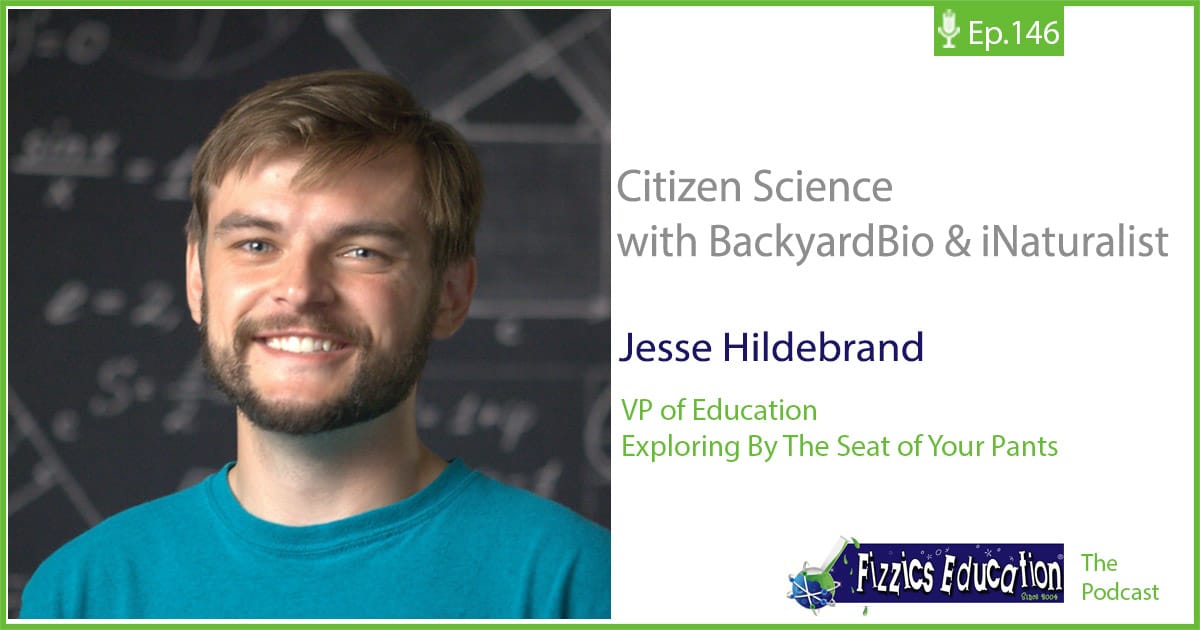
[00:00:19] Ben Newsome: You’ve booked in again for the Fizzics Ed Podcast. Glad to have you, and no matter where you are in the world, you can definitely listen and watch and learn from Jesse Hildebrand, who is the Vice President of Education for Exploring By The Seat Of Your Pants. This is a global education non-profit that connects scientists, explorers, mountaineers, divers, astronauts, conservationists and more through 40-plus monthly live free interactive programmes. Seriously, Exploring By The Seat Of Your Pants has a massive, massive library of 2,500 interviews. It’s so inspiring for kids and students of all ages. By the way, Jesse’s also the lead on their Backyard Bio global nature campaign, which is run every May and it gets kids outdoors observing, documenting and doing all the things that good biologists do, and importantly, it’s through social media with the hashtag #backyardbio. Today is an inspiring chat with someone who truly is passionate about science education in many, many ways. Let’s listen on in.
[00:01:17] Announcer: This is the Fizzics Ed Podcast. For all about science, ed tech, and more. To see 100 fun free experiments you can do with your class, go to fizzicseducation.com.au. That’s physics spelt F-I-Z-Z-I-C-S and click 100 free experiments.
[00:01:35] Ben Newsome: Hey Jesse, welcome to the Fizzics Ed Podcast.
[00:01:38] Jesse Hildebrand: Thank you so much for having me, Ben. I’m so thrilled to be here.
[00:01:41] Ben Newsome: I’m really stoked to have you because I was hanging out with Meredith only a little while ago, who you do know, and she said, “You know what, man, you’ve got to have a chat with him.”
[00:01:51] Jesse Hildebrand: I appreciate Meredith’s recommendation very much and I’m thrilled to be here to explain a little bit about some of the fun stuff I’ve been up to and reach your amazing audience. And kudos to you before we joined live, just saying how incredible it is that you’ve got this network all around the world, so I’m thrilled to be here.
[00:02:07] Ben Newsome: I’m really happy to be here with you actually hanging out because sometimes it’s like we’re both educators, it comes down to it. We’re educators and we like doing the stuff, and it’s great to know that there’s people around the world who have that same passion, which is kind of cool.
[00:02:20] Jesse Hildebrand: There’s so much innovative stuff going on too. People in every country around the world are doing all these neat things and we have the chance to learn from each other and share and steal ideas on occasion and partner up, and it’s been a really exciting last couple of years especially as people have come up with new tactics and tricks to reach audiences in a new and impactful way.
[00:02:39] Ben Newsome: Totally, and speaking of innovative and making things happen, hey, you’ve been doing some interesting stuff, tell us all about it.
[00:02:49] Jesse Hildebrand: Yeah, so my bread and butter, my day job so to speak, is as Vice President of Education. It’s very easy to be a vice president in a two-person organisation, at something called Exploring By The Seat Of Your Pants. And so this was founded by a teacher in Ontario where I came from, and he just started bringing in cool speakers and explorers and scientists into his classroom virtually through originally Google Hangouts and then Zoom and all the platforms slowly but surely. And he found that really had a big impact to entice students with a geographical education from around the globe. He actually had a lot of speakers come from Australia and talk about some of the shark issues associated with that, and to have that direct experience talking with these amazing people is really amazing.
[00:03:32] Jesse Hildebrand: I personally grew up with Steve Irwin as my hero and having the chance of having Steve Irwin in my classroom live where I could ask him questions, I would have given my left arm for that. And so I got involved from the get-go of this when it started being rolled out to classrooms across North America. And so we do 40 to 50 broadcasts every single month with amazing scientists and explorers around the globe for free. And they’re all recorded, so there’s a library of 2,500-plus past broadcasts with everything from cave divers to particle physicists and live at the zoo with a giraffe over the person’s head, and it’s a wonderful thing.
[00:04:05] Ben Newsome: Oh man, that’s an extraordinary amount of work behind the scenes.
[00:04:10] Jesse Hildebrand: It is, as you said, we’re both educators, and so work is a loose term. I’m not in a classroom so I don’t have the daily need to build up a curriculum, to work with students, and so I get this thrill of getting to find new speakers and new opportunities for classrooms every day and to do the registrations and make sure everyone comes in. And so yeah, it’s a lot, but it doesn’t feel like a lot of work. At seven years now, we’ve got it down to a science and we can book in 40 programmes in a month lickety-split, no problem at all.
[00:04:39] Ben Newsome: Wow, that is a massive amount of really authentic content that students can learn from and it’s recorded.
[00:04:48] Jesse Hildebrand: It’s recorded and it’s live, it’s free. And free is really important, and I think your audience will know this, classes in Sydney and Toronto and New York and London can afford to have cool people come in or they have resources like museums, science centres, zoos, aquaria, all nearby that they can send their classes to. If you are in rural Iowa or in the Northern Territory or in who knows where, that’s an opportunity that is not afforded to you. And so we make it free and constantly accessible and it means that anyone can join in and learn from these amazing people and watch them forever. I watch programmes we’ve done six years ago to see some of these experts because I’d pay a hundred dollars for a ticket to see them and that makes it so worthwhile.
[00:05:33] Ben Newsome: Wow. So where do you find that many people per month? That’s a lot.
[00:05:38] Jesse Hildebrand: It is a lot. So we have a few legacy people and groups that have been involved with us for a very long time. The Toronto Zoo’s been a big partner of ours. Both of us originally started in Ontario, so we built up a lot of relationships with groups there. Ripley’s Aquarium where there’s sharks going over your head has been really nice. Partnerships with governments, so Parks Canada did this incredible 20-part series with us last year. And outside of that, it’s word of mouth. If we find a speaker, they’ll almost always recommend our programme as a digital outreach tool to their colleagues and to their friends. And I cold call everybody. I have sent, I think 15,000 emails over the last seven years to every person I can think of that deals with things that interest me. If I love dinosaurs, I think kids are probably going to love dinosaurs too, so I’ll reach out to all the dinosaur experts in the world on a particular topic and see who’s willing to come on. And most scientists love to talk about their work and they come on for a 45-minute programme. So yeah, that’s the name of the game.
[00:06:33] Ben Newsome: That’s amazing. Absolutely. And I love how thick your skin can be, because you can get a lot of nos amongst that.
[00:06:39] Jesse Hildebrand: Oh, so many nos. 90% no. And that’s okay. I’m used to that in my other roles I’ve had in the past too. You know what, I think most people are willing to say yes, and because I’ve been at this for so long, people will say no, and if you keep harassing them every few months for years, they’ll eventually just give up and say yes and join you. And some of the best programmes we’ve ever had have been from things like that.
[00:07:00] Ben Newsome: That’s amazing. It’s like the erosion effect, I’ll just keep on going. That’s fantastic. So you’ve got all these things that kids can watch at all different ages. And that’s a lot of scope. If you’re an educator and you jump on your site and say they want to learn about dinosaurs, can they search for only the dinosaur programmes or that sort of thing?
[00:07:28] Jesse Hildebrand: So the best way to do that is the YouTube channel. The YouTube channel has everything that we’ve ever done. The site we don’t keep all the past programmes there because it would get a little unwieldy. The site we use to advertise things that are coming up soon. So it’s October, there’s 40 programmes, you can see a calendar, you can register your class, click a few buttons and you’re in, we’ll send you the link and lickety-split, you’re good. If you wanted to find dinosaur programmes or you wanted to find a specific speaker, go to our YouTube channel, type that in and everything we’ve ever done will pop up. So particle physics, you can be really unique. You can say Toronto Zoo if you’re keen on those things that I talked about, and they’re all there. We should probably spend some more time narrowing it down and cutting them a little bit and making them a little more cohesive, but we’re too busy making new ones to do that. So it’s a good problem to have.
[00:08:11] Ben Newsome: So when you think about the speakers, some people are highly engaging, they’re natural speakers, and some people aren’t, but their content is amazing. So what are some things that can really help? If there’s scientists listening to this, if they needed to communicate their content in a way that’s accessible to the general audience, what are some tips and things that you go, “You know what, this really works?”
[00:08:36] Jesse Hildebrand: Yeah, one of the simplest things, and it sounds so ridiculous, is to watch other effective science communicators. We all learn by seeing great people in action, whether we’re an educator, whether we’re a scientist learning from other scientists as mentors, and I think that works for science communication too. You’re right, a lot of scientists don’t have that training, they don’t have the backdrop, they’d love to be better communicators but they’ve never had the opportunity to do so. And I say watch Carl Sagan, Neil deGrasse Tyson, Steve Irwin, David Attenborough. These people and the way that they go about presenting things, if you learn that and you watch it as a craft, it can really go a long way to help in it. The second is to avoid jargon. There’s a lot of sciences like particle physics, like intense zoology, that have difficult elements to them, and I think it’s important to start with your audience with the assumption that they know very little and keep things as visual and openly engaging as possible.
[00:09:28] Jesse Hildebrand: Because an audience will always fill in what they’re interested in, in a question and answer period. And I think this is where science communication has shifted generally, from these hour-and-a-half long talks, the speaker walks out, gives the presentation and walks off the stage, to more of a relationship where they come out, they chat, they learn what the audience is keen on, there’s a big question period. That’s really, really helpful. So keep it simple, learn from the best, read on how to do that, and increasingly there are training programmes. Universities, government agencies, independent contractor groups will offer that training to people, and that’s huge. I’ve gone through things like that in the past through some of the programmes that I’ve done and I’ve watched a lot of people and practice makes perfect, but that’s a very long-winded group of answers for you Ben.
[00:10:15] Ben Newsome: No, it helps. Well, I was actually thinking here that for our students, and it doesn’t matter what age they are, being able to speak in front of people is challenging for a start. And then if you have to speak about a subject, hopefully you’ve got to be able to communicate it in such a way that people can actually understand it. That is a skill, and honestly, as classroom educators, we want them to know the content, but honestly, this is a skill that’s transferable across every industry.
[00:10:42] Jesse Hildebrand: Yep. And I think, again, practice is the best part of this. You can actually, because our library is there, you can watch the first broadcast I did. It was with a Victoria Bug Zoo in Victoria, British Columbia. And seven years ago I look like a little boy. It was Google Hangouts and it was way before the pandemic, so everything’s really blurry, sounding like 240p. But you get better and I think it was my 50th broadcast I was like, “Okay, I’ve got this down,” and now I’ve done 1,200. And so you slowly but surely work up to that as a classroom teacher, as an educator, and that really does go a long way to making you more effective.
[00:11:17] Jesse Hildebrand: And secondly, and I’ve been noticing this among educators generally around the world, they’re willing to admit that they don’t necessarily always know the best way of communicating something. So they’ll guide students to incredible resources like Crash Course, which is just a fantastic online resource of all sorts of topics. Khan Academy in some cases, there’s these online courses and resources that are really effective supplements to what teachers are teaching in a classroom and that really does help a lot.
[00:11:43] Ben Newsome: Massively. I’m going to actually ask an unfair question because hey, I do that occasionally. 1,200 broadcasts, is there one that sticks out and you go, “Oh my God, that was just amazing and blew my mind?”
[00:11:55] Jesse Hildebrand: So it’s funny because I have several for me personally, but the best one we’ve ever done as an organisation I didn’t host and I’m kind of sad about that. It’s a two-man team but my colleague did. And it was called Rhino 911. And it literally begins with the speaker in a helicopter with his cell phone in Kenya and he’s flying along and they pull out a darting rifle and they dart a rhino. And they land the helicopter, this is all live on film, and the ground team comes with a jeep and they come out with a chainsaw and they cut off its horn, which is a really radical anti-poaching solution, but the most metal, incredible thing we’ve ever featured on the programme. And then they go into this talk about why they’re doing this, how important it is. And it’s just mind-blowing.
[00:12:35] Jesse Hildebrand: So that’s one of the things that really differentiates us in general, is that we love these from the field. We’ve been live in a river in Gabon with a fish expert. We’ve been in Antarctica many times. We were on the Endurance ship, Endurance 22, looking for Shackleton’s lost wreck. We did like 20 programmes live from the ship last year. And that was amazing. So that all really jumps out. I have some favourite speakers of all time and I can send that to your audience and give it to you if you want to pass it along, but it’s just, every day’s a bit of a gift. I really pinch myself daily. I’m very lucky.
[00:13:08] Ben Newsome: Oh, that’s so authentic. And I love the fact that it’s live, real and raw. Like that to me is amazing. Because the number of times we do presentations and people are really concerned, oh we need the perfect lighting, we need the perfect sound, we need the perfect whatever that is. And I’m going, in some ways it sometimes takes away from it.
[00:13:25] Jesse Hildebrand: It can. And kids notice this really, really well. It’s interesting because we’ve partnered a lot with governments, and this is a classic example of this. Some government departments are really great. They’re like, “Hey, we’re going to do it, come what may, we’re going to prepare but it’s going to be live and raw and authentic like you said.” And others are like, “We’re going to have the banner just so, and we’re going to say this exact line here.” Everyone picks up on how fake that is. And so it’s really important to make sure that you’re talking to, kids have just as good questions as adults, usually better questions, they’re super vested, and they have no time for nonsense. And it’s funny because so much effort is put into trying to make it this polished, perfect experience, and it always works better when you have that human connection and something goes wrong.
[00:14:08] Ben Newsome: Straight up. And actually if you’re listening on in, and if you’ve been listening for long enough, you know full well that I just ramble for good reason, because it’s real.
[00:14:15] Jesse Hildebrand: Me too, don’t worry. We’ll take this longer than usual.
[00:14:19] Ben Newsome: Yeah, but actually, of course a professional sense will actually spend a little bit of time, but the reality is that the best questions are here and now, you follow the rabbit hole as you go. I was listening to an interesting conversation on radio yesterday afternoon. So our ABC channel, they have this music show, it’s been going for many years, it’s called Spicks and Specks.
[00:14:44] Ben Newsome: And anyway, they were chatting with the host who now is in Britain, he’s doing his own thing now. They’re doing this comeback series. And they were asking, “what’s it like preparing? Do you do much rehearsal?” And this is like a comedy show combined with music. And they’re going, “well the thing is that we work with our writers and we’ve got all these cool jokes, and then I’m constantly apologising to our writers that oh I’m sorry we didn’t use the joke because our guest on the show just had this great story, we had to go down that line.” And I’m going, you know what, that’s great. It’s not rigid. And as long as people can put their ego in a box for a little bit, you can bring up the joke another time. They’re doing it as authentically as possible. And it matters.
[00:15:18] Jesse Hildebrand: It makes such a world of difference. Listen, hey, I’m so glad to find someone who feels the same way. So this is good. We should do a programme together. And vice versa, come on Exploring By The Seat Of Your Pants.
[00:15:27] Ben Newsome: I tell you what, if I can be on a Shackleton expedition in Antarctica or in an adventure in Africa with rhinos, wow, ok, I’m in.
[00:15:34] Jesse Hildebrand: Our goal slowly but surely is to try and worm our way onto those expeditions. We get to broadcast them live from the studio, but both of us have had the chance to go on an expedition or two as a result of the partnerships we’ve garnered, but I was chatting today earlier with the Atlantis research vessel, which has Alvin the submersible, one of the only, I would say alongside Hubble, one of the only two named well-known science instruments in the world, and we’re doing a broadcast with them next week. And so I would honestly, I would skip anything. I have my wedding coming up, I might skip my wedding just to go be with Alvin if they offered me the chance to. We’ll postpone it, honey, we’ll postpone it. Once in a lifetime.
[00:16:13] Ben Newsome: Oh, the best bit, that’s even recorded, so there you go. Now we’re ok. But that’s awesome. That’s fantastic. So really, you’re in there like a kid in a candy store.
[00:16:22] Jesse Hildebrand: Yes. I am the happiest person on earth. When I was four, truly, Steve Irwin, I had Steve Irwin birthday parties. I went to the local reptile zoo, we’d have all my friends over, I’d be like, this is what this is, and that’s what that is. And I know this because I’m watching Crocodile Hunter. I had posters on my wall. So when I was four and five, I knew that I wanted to be a science communicator because what better role is there in the world than getting to share your enthusiasm about science and nature with people where you can trigger that reaction, you can tell them about something amazing and watch them go, wow, how cool is that? And I get to do that every day, and I get to find the coolest people in the world and bring them on to do that with audiences too. Like that is, I don’t know, is there a better role than that on earth? I haven’t found it.
[00:17:01] Ben Newsome: That’s amazing. Tell you what, there are times when we visit schools, and we visit a lot of them, and you see some students who, they might be ten, but you can see they’ve got unbridled enthusiasm for this. And I say hey, curate it, grow it. Give them the skills so that maybe they are going to be the next Steve Irwin, the next Carl Sagan or whoever. They grow up at some point.
[00:17:25] Jesse Hildebrand: Yeah. So the two things that I find are most effective, one is as a resource, I always guide people to the library. So my parents were the best. Neither of them completed high school, but they were so vested in public resources and education, and so if I was interested in aeroplanes, they’d say, let’s get 50 books and a bunch of DVDs on aeroplanes, and you can learn all about them. And I found out, eh, aeroplanes aren’t for me, and they’re like, ok, we’ll take them back, it’s free. There in almost every community in the world is a library, or at least fairly close by, and if they’re not, there needs to be. Come back from the school. So that’s huge.
[00:18:00] Jesse Hildebrand: And second is to really make sure kids know that that level of passion is something that is important and is valued in society. You notice this of course with kids. Our bread and butter is 10 through 13-year-olds. They love being enthusiastic. And then 16 through 18, they’re like, it’s not cool, I got to lean back here, keep it mixed. Making sure that they know, whether it’s shoes or fashion or hip-hop or science, that it’s really important to be that excited, and it leads to great things for you in life.
[00:18:24] Ben Newsome: Totally so. I mean, we can be self-conscious, but there comes a point in time where you just do it anyway.
[00:18:31] Jesse Hildebrand: Yes. I think that confidence for most people comes quite a bit later though, and I think it’s great if you can instil that and keep it around from that 16 to 18 range, because that’s when people are making these decisions about whether they’re going to go for extra schooling or what career path they’re going to do. And people lose it then. And so we really try, when we can do high school programmes and highlight career paths and how diverse they can be, I think that that’s a really valuable thing for students at that age to hear particularly, so.
[00:18:56] Ben Newsome: Absolutely. So as you look forward to the work that you’ve been doing, is there anything coming up or new ideas on the way or something that’s hidden away that we can kind of go, hey, this is coming. Just curious.
[00:19:08] Jesse Hildebrand: Well, so I mean, this is for your international audience, but particularly for your Australian audience. So one of my favourite things that we’ve done in the last few years and is going to be back in a really big way this coming May, is something called Backyard Bio. And so a couple years ago we ran the Global Biodiversity Festival. It was 60 programmes in three days with all the world’s leading conservationists, it was crazy, we didn’t sleep at all, we brought on all these people. And as a throwaway thing we said, “Hey, if you’re watching or if you’re a speaker, take your phone and go take a picture of some living thing near you and share it with #backyardbio.” We had a speaker live in Kenya, he finished his talk, he walked a hundred feet away and he took a picture of a lion because that’s his backyard. And we had a hornbill in Uganda. And then kids were starting to share robins and snakes and lizards, and the feedback was so tremendous that I mean, for me, it was just like manna from heaven, and I said, “Okay, this is my baby now, like this is what I want to be doing.”
[00:20:00] Jesse Hildebrand: And so over the last two years we built it up where again, the whole month of May long, it’s a pretty good month. It’s autumn for the Southern Hemisphere, it’s spring, there’s still life, there’s not too much snow, nothing’s on fire. It’s good. And so it’s this wonderful time when there’s a lot of biodiversity all over the world, and we say look, go outside with your class or with your family, take a picture, sketch what you find and share it with the world. With social media, #backyardbio. The iNaturalist and Seek apps, which are the greatest apps of all time, if people take nothing else away from this talk, everyone should download Seek because it’s like Pokemon Go for nature and you can go explore everything. And so I’m trying to find way more ways of insinuating this into classrooms year-round because it’s just the coolest programme of all time.
[00:20:41] Jesse Hildebrand: And my favourite is direct teacher connections. Because we feature these amazing experts. So you have a guy in Brazil and he’s bushwhacked through the Amazon, he’s amazing and he’s telling you how cool he is, and that’s fantastic. You know what’s better than that is to have Brazilian kids talking to Canadian kids and Australian kids, where they’re all joining in this shared love of wildlife. And so all May long we set up those connections. You can go to backyardbio.net and if you’re an Australian class, you’re in Sydney and you’re Grade 4, you can sign up and say that, and we’ll put you in touch with a class in Toronto and London and Seoul. And then you can all do Backyard Bio together and kids can be like, “Oh, what do you have? Oh, how is that different from what we have?” And kids adore this, it’s the most fulfilling thing professionally I’ve ever done. And so, last May, I must admit I was moving across Canada buying a house and planning a wedding, so my brain was a little elsewhere, but this coming May, I’m trying to make this like the global nature campaign for youth on this planet and get people excited. I think it’s a low barrier to entry, it’s free, it’s fun, and allows people to connect. So that’s the biggest thing coming up, and I’m really excited about that prospect.
[00:21:44] Ben Newsome: That’s fantastic. And what I also like about this is that from a simplistic “Hey, it’s going to be the world-leading programme on this”, which is a great way to actually approach any programme when you think about it. “Why do something small if you can do it large?” Especially something like this that’s transferring globally. And it’s so simple. Taking a photo, I mean, especially with BYOD, not everyone has access to a phone, but a lot of kids do.
[00:22:14] Jesse Hildebrand: Yeah. And so it gives them this built-in opportunity to use it for something good. And I mean if they don’t have a phone, we try and offer things like sketching. Just draw what you find, and then your teacher can send an email. If they happen to have a connection, or use the public library for that. Or frankly, if you don’t have any of those resources, just take that time to be mindful of the things that live near you, because whether you’re in the Amazon rainforest or the heart of New York City, there’s life teeming around you. I mean, you just have to look for it. And that’s such a, for us that know this sort of thing, it’s such a special thing to go through an area and just be amazed at the biodiversity around us. So.
[00:22:49] Ben Newsome: Oh, absolutely. So Jesse, look, thank you so much for hanging out with me. It’s a really good, it’s quite an invigorating chat. I notice the afternoon coming to the evening for you, but I’m now well awake.
[00:23:00] Jesse Hildebrand: I’m trying. That’s my goal. I’m glad I succeeded.
[00:23:03] Ben Newsome: Fantastic. So I mean, a takeaway from this chat, definitely we have to go to iNaturalist and Seek for sure. And by the way, those links are always, as always in the show notes. However, if you had a bunch of educators in front of you and you were saying, how could we start improving kids’ enthusiasm for nature? What would you say are a couple of things to do?
[00:23:26] Jesse Hildebrand: I mean in terms of our programmes, exploringbytheseat.com, you have access to that YouTube channel, you can hear from some of the coolest experts in the world on any topic imaginable from 95 countries. So we’ve had speakers come from all over the world, I think that that’s a really enriching thing. Seek and iNaturalist, you said you’re going to put it in the thing, and I really do, I love those tools, I find them so useful. If I was a boy and they had come out, I would have done little else with my time.
[00:23:55] Jesse Hildebrand: And public and school libraries and librarians. I mean, I’m going to be married to a librarian soon so I’m hopelessly biased, but really, these are people that are in a world where it can be really difficult to navigate between truth and fiction and a lot of things, librarians are people that are trained to help people guide through that process and point them in the direction of the best possible resources. So there’s this whole group of people in the world that their whole job is to make your life richer and give you what you need to learn and grow. And I think that that is something that we’re increasingly seeing in Canada and the US is this teacher-librarian hybrid. And so any teacher that’s willing to share that message I think is the best possible advice I could give for anybody.
[00:24:28] Ben Newsome: Fantastic. Jesse, have a fantastic evening mate. It’s been awesome having a chat.
[00:24:33] Jesse Hildebrand: Thank you so much, Ben, have a wonderful day, and thank you so much for giving me the opportunity with your audience today. I appreciate it.
[00:24:40] Announcer: We hope you’ve been enjoying the Fizzics Ed Podcast. We love making science make sense. Why don’t you book us for a science show or workshop in your school? If you’re outside of Australia, you can connect with us via a virtual excursion. See our website for more.
[00:24:55] Ben Newsome: Gee it was so fantastic just hanging out with someone who truly loves their education in so many ways. Jesse, I love your work. And I also love that after that chat that you sent across all these really handy great books that you recommend that people should read. So here we go. Get a pen everyone. Check out Regeneration. Check out Drawdown. Check out An Immense World. And also Under a White Sky, that one’s for adults only by the way.
[00:25:25] Ben Newsome: And the best general science book ever written, and Jesse, I do agree, A Short History of Nearly Everything by Bill Bryson. I love that book. It is well-dog-eared and well-loved by me absolutely. Love it. So I hope you got a bit out of it. And by the way, go to those links again. Go to backyardbio.net as well as inaturalist.org. Find out about all the different things that you can do no matter where you are on this planet. So that’s enough of this particular chat on the Fizzics Ed Podcast. I hope you enjoyed it. You’ve been listening to me, Ben Newsome from Fizzics Education. This is the Fizzics Ed Podcast and I hope to catch you another time.
[00:25:56] Announcer: You’ve been listening to another Fizzics Ed Podcast. We’re excited about science. Subscribe to us on iTunes to download the next episode as soon as it’s released. And don’t forget, for hundreds of ideas, free experiments, our new Be Amazing book and more, go to fizzicseducation.com.au. That’s physics spelt F-I-Z-Z-I-C-S.
[00:26:24] Announcer: This podcast is part of the Australian Educators Online Network. AEON.net.au
Frequently Asked Questions
What is Exploring By The Seat Of Your Pants?
Exploring By The Seat Of Your Pants is a global education non-profit that connects classrooms with scientists, explorers, and conservationists through live, interactive video broadcasts. The goal is to bring the world into the classroom, allowing students to ask questions directly to experts in the field.
How can my school join a live broadcast?
Educators can visit the official website to view a monthly calendar of upcoming events. Registration is simple: browse the calendar for the desired programme, click to register, and you will receive a joining link. These programmes are provided at no cost to schools.
Is there an archive of past interviews available?
Yes, there is a massive digital library of over 2,500 past broadcasts available on their YouTube channel. This covers an incredible range of topics, including particle physics, marine biology, archaeology, and space exploration, featuring experts from over 95 countries.
What is the BackyardBio campaign?
BackyardBio is an international nature campaign held every May. It encourages students to get outdoors, observe local wildlife, and share their findings via social media using the hashtag #BackyardBio. The initiative also facilitates direct connections between classrooms in different countries to compare local biodiversity.
Which apps are recommended for nature exploration?
Jesse recommends using ‘Seek’ by iNaturalist, which he describes as ‘Pokemon Go for nature’. It allows students to identify plants and animals in real-time. iNaturalist is also highlighted as a vital tool for documenting species and contributing to global citizen science data.
Extra thought ideas to consider
The Value of Authenticity in STEM
One of the key takeaways from Jesse’s experience is that students respond more deeply to ‘raw’ and ‘live’ content than to overly scripted presentations. Seeing a scientist in the field—whether they are in a helicopter in Kenya or a river in Gabon—creates a human connection that inspires students to see themselves in similar careers.
Leveraging Teacher-Librarians
In a world of vast digital information, teacher-librarians play a crucial role as guides. They help students navigate between truth and fiction and point them toward high-quality educational resources. Integrating these specialists into science planning can significantly enrich the classroom experience.
Discussion points summarised from the FizzicsEd Podcast, verified and edited by Ben Newsome CF