Transcript
[00:00:00] Announcer: You’re listening to the Fizzics Ed Podcast. For hundreds of ideas, free experiments and more, go to fizzicseducation.com.au. And now, here’s your host, Ben Newsome.
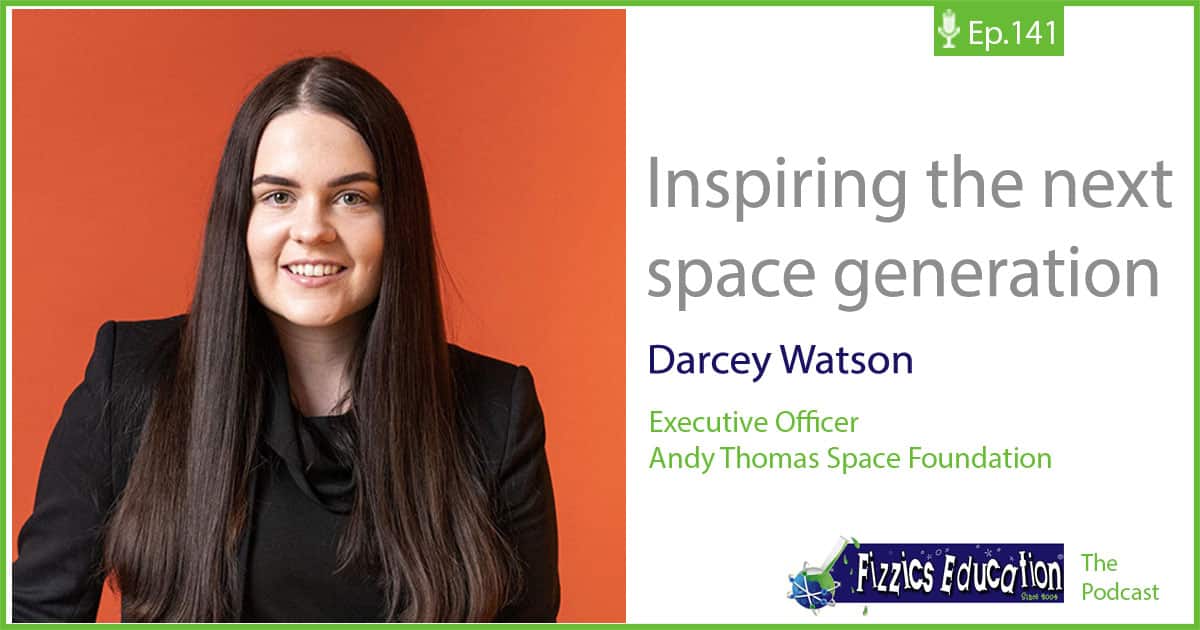
[00:00:18] Ben Newsome: Yes, welcome again for another Fizzics Ed Podcast. Glad to have you again for another chat around STEM. In this particular case, we are hanging out with Darcey Watson, who is the executive officer at the Andy Thomas Space Foundation, which is an amazing foundation which works with schools and space industries to help students understand real career pathways into space. And I can tell you, by 2030, Australia really is looking to get 20,000 STEM graduates right into the space industries in Australia. And guess what? The Andy Thomas Space Foundation has a serious role to play with this. Now, by the way, Darcey Watson really loves her STEM in many different ways. She actually proudly serves as the chair of the Spence Club Board of Directors and is a team coordinator of the Astra Programme. She’s also the co-founder of the Collab Society and the co-host of the Collab Society Podcast, where they talk about all sorts of career pathways when it comes to the field of science. So, Darcey’s got a bit to talk about, and let’s head on right into it.
[00:01:13] Announcer: You’re listening to the Fizzics Ed Podcast. Why don’t you book us for a science show or workshop in your school? We love seeing students get excited about science, and you will too. Go to fizzicseducation.com.au and click on “Schools” for more info.
[00:01:30] Darcey Watson: Thank you so much for having me. I’m so excited to be here.
[00:01:34] Ben Newsome: I’m having a bit of a déjà vu. We only just hung out a little while ago.
[00:01:38] Darcey Watson: It hasn’t been too long. No, beginning of March, down in Adelaide.
[00:01:42] Ben Newsome: Down in Adelaide. That was really cool. I had not been to Adelaide, certainly to that forum, the Australian Space Forum is very, very cool. And we are going to talk about that for sure. But you get to do lots of spacey stuff.
[00:01:53] Darcey Watson: Yes. I would definitely consider myself very, very lucky. Every day is something to do with spacey stuff, if you will. But no, lots of new innovation, lots of crazy bits going on in the space world in Australia, so excited to be involved.
[00:02:06] Ben Newsome: 100%. And you’re kind of right in the thick of it. So maybe let people know, so Darcey, I know you, but some people may not. So what is it that you do?
[00:02:16] Darcey Watson: Yeah, absolutely. So my name is Darcey Watson and I am the executive officer at the Andy Thomas Space Foundation. So just in case nobody is aware of the Andy Thomas Space Foundation or really what we are or what we do, we’re Australia’s national space charity. So we support the outreach and education goals of the Australian Space Agency, which is really exciting and we get to get our hands in lots of different avenues of education and outreach, which is amazing.
[00:02:46] Ben Newsome: It’s fantastic. And by the way, as a heads-up for people overseas, Andy Thomas kind of was involved as an astronaut at one point, yeah?
[00:02:52] Darcey Watson: No, absolutely. So he was one of Australia’s first astronauts. He flew with NASA over in the US, which is really exciting and he is the entire reason why the Andy Thomas Space Foundation came into being. So he’s one of our founding members and of course, we did it in honour of him and his incredible work in space previously.
[00:03:10] Ben Newsome: Now, the Foundation was very much involved with the Australian Space Forum, and it wasn’t its first forum, by the way. I mean, this is growing and growing and growing. And I believe, and this is time-stamping this conversation, but that’s happening again in October, I believe, in 2022. Very, very cool. You’re right in the middle of it. So I mean, how does a charity become Australia’s space charity? Like, that’s such an interesting title.
[00:03:33] Darcey Watson: No, for sure. So essentially, the Andy Thomas Space Foundation, we run the Australian Space Forum, which happens twice a year, but we work really closely with the Australian Space Agency and lots of different groups and different industry, academia, really any different sector around Australia that has anything to do with space. So we’re trying to get involved with other groups, even other groups that are also space charities as well in Australia, which I believe there might be a couple of others that are involved in that space. So we try and get involved with as many partners as we can, just try and raise that profile of education here. So yeah, lots of different spots that we’re involved in.
[00:04:12] Ben Newsome: I’m really interested in what the Foundation does beyond the Space Forum. I mean, I got to meet some of your partners just prior to the main event, very STEM education-focused and developing some genuine leaders. I’d love to just learn a bit more about the sort of projects you’ve been involved in.
[00:04:26] Darcey Watson: No, absolutely. So each year, so the Andy Thomas Space Foundation is actually quite new. So a lot of folks think that we’ve been going for years and years and years, but we’re actually only in our second year of operations. So as part of that, we have just released our second round of our education fund. So every single year we release a group of programmes, which are a collection of scholarships, prizes, different awards for individuals that are interested in space studies really. So we have programmes that are available for primary schools, high schools, undergraduate, postgraduate and early researcher.
[00:05:01] Darcey Watson: So essentially, this year we have nine programmes valued up to $300,000. And these involve, you know, 3D innovation with local technology startups like Makers Empire. We’ve got some high schools involved, which is really exciting. They go through what we call our Giant Mars Map programme. So they’ll be learning about how to get to Mars and how to also have habitation on Mars moving forward and how that could look in a couple of years time. And then of course we go through the university stages. So that’s different students looking down various avenues. We’re big believers in cross and multidisciplinary STEM studies. So even if they’re coming from a slightly less traditional space background, there’s plenty of job opportunities and future opportunities in that space for them to make their little spot. So very encouraging of that. And then we’ve also just released our first international programme this year, so with a group in the Netherlands called Cosine, which is really exciting.
[00:05:55] Ben Newsome: Oh, really cool. What’s all that about?
[00:05:57] Darcey Watson: Absolutely. So the one with the Netherlands group, so Cosine, so they are actually a satellite instrument manufacturer. So the programme with them will be looking to get PhD students involved in hyperspectral analysis and different algorithm creation just to support some of the work that they’re doing. And we’re also hoping, COVID allowing, that we’ll also be able to get the student that wins that award over to the Netherlands to actually meet with the company, be on-site, and also bring back some of those learnings to Australia.
[00:06:29] Ben Newsome: What I really like about what you guys are doing is you’re actually creating real career pathways. Like actual real ones that are connecting with the people who do the things and put them into space, etc. I mean, you kind of look at some of the programmes that are out there, and as well-meaning as they can be, they’re kind of siloed into a particular school grade level or whatever it is. And we try and make a bridge to an industry group, but sometimes maybe it’s fleeting or partly so. But actually being able to work directly with the people who are doing this, that’s got to make a huge difference. Especially when kids go, ‘What is hyperspectral analysis?’ and now they know because they’re actually working on it, which is cool.
[00:07:07] Darcey Watson: Of course. And I think that’s the thing, is there’s so many niche studies within the space industry that there’s so many students that think, ‘Does anyone even know what I really do?’ because it’s so niche. But it needs to be celebrated, it needs to be spoken about, and we want to provide that platform where they can not only share their work, but find industry members that are begging for things that are in that area or begging for people that have those expertise that could one day join their team. So I think with the Australian space community, it’s so tight-knit that we’re very lucky to have this ability to really, as you said, connect those students straight through to industry or academia members that could really pave for the rest of their career, or even just the start of a career for them, depending on where they’re at.
[00:07:48] Ben Newsome: Well actually, if you’re any student listening in Australia particularly, there’s actually a hairy audacious goal been thrown out by 2030 to get 20,000 new STEM placements into the space industry here in Australia. Now, that’s a bit of a call. You kind of think about it, that’s 20,000 kids who in eight years’ time will not be kids and they’ll be involved. That’s quite an effort considering how that’s going to be. I suspect that you’re working with the Australian Space Agency, you’re going to hold a big part of this.
[00:08:18] Darcey Watson: Well absolutely, we’re hoping to really shape that next generation of space leader. And I like to think that there’s a lot of students out there, maybe listening even right now, that are in primary school and they think about space like we all used to think about space. But when we were younger and we were thinking about space, it was, ‘Could I move to America and work for NASA?’ or the ESA, CSA, JAXA, all of these amazing groups around the world. But now it’s right here. It’s in Australia. We can go and we can see it in all of the different states and territories, which is incredible. So I think being able to actually show students that we’ve got the whole pathway sorted for you and we’ve got the jobs at the end, if you do do the studies in it, you will find a spot and it will absolutely flourish in the direction you want to take it in.
[00:09:03] Ben Newsome: Well, that’s one of the things, and if you’re a teacher listening in, have a chat with the kids and get them to even draw a picture: what does a space person do? And you can guarantee they’re going to create some, usually a guy, in an old Apollo-era spacesuit. And you kind of think about, hang on, that was the sixties. And not only that, even during the Apollo era, there’s thousands of people who are involved in all sorts of different stuff, making the machines and all the rest. I mean, you think about what’s happening in the Australian space industry, we’re not putting people directly into space from this land, from this continent. There is a lot of stuff going on, everything from mapping the weather through to satellite technology, autonomous robots. I mean, we’re going to be involved in the Artemis missions, which is going to be interesting in our own little way. It’s very, very cool.
[00:09:48] Darcey Watson: Oh, absolutely. And I think that’s the exciting part is that we have been involved as a nation for quite a long time but in that really supportive capacity. And now we’re sort of coming up and finding our own sovereign capabilities and pushing that in different directions. I mean, even looking at the downstream effects of some of the things that the space industry is doing, mapping bushfire areas and trying for different preventative methods, even with the most recent floods up in Queensland, seeing how maybe these technologies of earth observation could have actually played a really big role in that and maybe reduced the impact that it had on everyday civilians in Australia. So I think there’s a lot of exciting pathways that we’ll find and lots of avenues for students to get involved.
[00:10:29] Ben Newsome: So I’m going to just ask, because I actually know John and the team at Makers Empire pretty well. Hi, John, if you’re listening on in. But I’m just curious, so what were the 3D printing things that were related to space? What were they sort of doing?
[00:10:46] Darcey Watson: Absolutely. So with our programme with Makers Empire, I actually find it incredibly interesting the way that it’s structured so that it gets really every aspect of a young student’s life involved. So we have professional development days with the teachers that Makers Empire runs. And they run the teachers not only through how to use the 3D printing machines that the school then gets to keep on-site, but they also show them how to really inspire students about space and how to feel comfortable doing so. It’s not really part of any teaching curriculum at the moment, so it could be quite confronting for teachers not knowing exactly how to sell it, if you will, or just really inspire students. So as part of that, Makers Empire goes through with them all of the different curriculum and how it can apply, and then they discuss with teachers how it would apply directly to their class. So that’s based on the kids’ personalities, based on what year level they’re at, what they are actually in the middle of studying that would match up against curriculum for that time.
[00:11:35] Darcey Watson: So one of the really interesting projects that I heard about, and this was actually with a reception class, so very, very young students who space is such a crazy big concept, so it might have been hard to palate at times, but they managed to relate it to their animal studies section. So looking at the ways that animals could be tracked using satellites, and also how their different habitats could actually be analysed and assessed for deforestation or different human-involved issues with degradation of environments, which I thought was a really, really interesting application. The students got so much from it. They had a bit of a showcase day where they can show off their creations and they were all so passionate speaking about what they made. So it was great to see.
[00:12:23] Ben Newsome: That’s really cool. Especially, you know, we’re talking six-year-olds here.
[00:12:25] Darcey Watson: Absolutely. So starting them off really, really young, getting them inspired about that. And that’s the importance of having sort of that ongoing, well from our perspective, that education fund. But even within schools, having that knowledge for teachers so that it can be an ongoing conversation. It’s not a class that you have in reception and then move on from. It’s every year you can have a chat about that if you’re still passionate and you’re interested, so you can really scope out your whole future from there.
[00:12:51] Ben Newsome: What I love about space is it’s so unifying. I mean, everyone looks up and you see a dark sky with shiny things in it. And then we all get to have our own stories around it and think about what might be up in space and what the possibilities are. But it’s unifying. And considering that we have, for example, the space station flying around our globe every 90 minutes and we know that there’s actual real experiments happening up there and we can talk to people, that is really, really cool.
[00:13:17] Ben Newsome: And now when we think about this current generation and looking forward as we move towards the moon and then take further steps into Mars, and at some point it’s going to happen regardless of when that might be, that’s really, really comforting to know that we’ve got this big cohort of people, this groundswell happening from not just this country but all over the world, that’s really going to lead the way and actually eventually focus that knowledge back at us, back to our land to improve our climate, to improve our forests, our crops and all the rest. That’s kind of neat.
[00:13:44] Darcey Watson: Oh, absolutely. And I think for me, one of the most important things, because I don’t really come from a space background myself. I used to do biomedical science, but I just really love the industry. I always have been super passionate about it and wanted to see sort of that interface of where you can bring different STEM backgrounds into the industry to expand it. So coming from sort of my background, I was really passionate about how that could maybe affect health and different bits like that for humans even here on earth. So seeing just how focused these space industries are on not only exploration, but also fixing what is on earth at the moment was really, really encouraging.
[00:14:19] Ben Newsome: Totally so. I mean, as you mentioned the medical stuff, I ran into a group of researchers from the University of Adelaide talking about their work they’re doing with putting pharmaceuticals in space and looking at what happens when they degrade over time, or can they stop that degrading? Because you kind of think about it, you can’t go down the local pharmacy if you’re stuck on Mars.
[00:14:31] Darcey Watson: Not quite, no.
[00:14:52] Ben Newsome: Not quite. Or I mean, I guess that also begs a question over time. Like, if we’re looking at 3D printing, I mean, at some point potentially we might need to create manufactured medicines at our whim because we can’t wait for a rocket for nine months. Like, we need it now.
[00:15:21] Darcey Watson: Absolutely. Absolutely. And I think that’s the exciting thing as well is we’ve got the idea, everyone’s got the idea that humanity’s going to go to Mars at some point, even if it’s just for a mission. I mean, who knows where it will end up. But how do you keep those civilisations going on-site? Because as you said, it’s impossible to expect deliveries to be there the next day. It’s not like Amazon here, unfortunately. It can’t show up that quick. So you do need to come up with those alternative methods of really keeping a society safe, happy and healthy.
[00:15:39] Ben Newsome: Actually, good point. And actually, everyone here around the globe, if you’re someone who experiences delivery and you saw a delay in your delivery because of the pandemic, imagine that on the moon or on Mars. You’d be more than sending a one-star review because it’s going to be an issue. That’s cool. So what is coming up? So you’ve got with the Foundation, you’ve got this one coming up with the Netherlands and you’ve got these nine projects. So ’23, ’24, is this something that you can see expanding further and further? I mean, what is on the horizon, so to speak?
[00:16:00] Darcey Watson: No, absolutely. A brilliant question. So we have so many exciting things on the horizon at the moment. And as I mentioned, it is only our second year of operations. So the plan is to really continue to grow what we’ve already done and expand on it greatly. So as I mentioned, this year we’ve offered $300,000 worth of education programmes. But if you look at everything we’ve offered so far, our first year was about $230,000 as well. So we are increasing that every year as we can and as we’ve got some brilliant, brilliant supporters behind us as well. So at the moment, we’ve officially donated over $500,000 to our education fund. Now, of course, we want to grow that, but we’re also growing our outreach programmes as well.
[00:16:50] Darcey Watson: So trying to get involved in some other programmes that students or just individuals around the country are beginning and show some support behind them as well for some of the great work that they’re doing. We’re currently looking into lots of different groups that have approached us or are doing very interesting work and just want to get behind them and give them a chance to speak. And we’re also bringing in some more events even around the Australian Space Forum. For example, Ben, you attended our first-ever education mixer. So that was our opportunity to try and get some education specialists in STEM, but also not even in STEM, together to share different ideas and methods and teaching styles, different programmes that are running just so that groups around Australia can be on the same page but also have their own innovative methods. We’re also hoping to expand those a little bit. We’ve got some startup workshops happening at the next forum, as well as some of our student showcases. So it’ll be a great opportunity to show off some of their work at the Australian Space Discovery Centre, which is just at Lot Fourteen, which will be super exciting for students. But yeah, lots of exciting things to come.
[00:17:41] Ben Newsome: Yeah, it’s definitely on the way, absolutely. And so right, if you’re in front of a bunch of teachers who could not get to Lot Fourteen, they could not get down to the Space Discovery Centre, can’t get to the Space Forum, what could they do? How could they start getting their kids inspired on potentially joining the space industry that’s growing in Australia?
[00:17:59] Darcey Watson: Absolutely. So I think one of the important things to remember as well is that the space industry is growing, but it’s still so open, it’s still so relatable. The people who are in it are just wanting other people to be as inspired as they are. So definitely feel free to lean on those experts that are around you and say, ‘You know, I’ve got a class that wants to hear from someone for 10 minutes.’ And as a foundation, that’s something that we’re working on as well, is trying to find ways of actually interacting with rural and remote communities and maybe schools that don’t have the ability to come to places like Adelaide or into the bigger cities, groups like that. So we are working on that. But at the same time, I would say, just open a discussion. You don’t necessarily have to give a super informative presentation, but just open the world for kids and see how they respond and really build off of what they say.
[00:18:50] Darcey Watson: Because who’s more imaginative than a child? Let’s face it. They’ll have some brilliant ideas and you can really bounce off of what they say. YouTube, different things like that, they are really a wealth of different videos and bits that can start that inspiration method. And then absolutely reach out to people in the industry because everyone’s more than happy to get involved.
[00:19:12] Ben Newsome: So guess what? I think you should reach out to Darcey. So how do they get in touch with you and the Foundation?
[00:19:18] Darcey Watson: No, absolutely. So we do have our website, so andythomas.foundation, just over on Google if you just Google us there. Otherwise, you can follow us on LinkedIn, Instagram, Twitter, Facebook, we’re across it all. Or feel free just to even reach out to us via email. So we’ll drop some links, I’m sure, in the description below. But yes, please feel free to reach out. We’re more than happy to have a chat and see how we might be able to help.
[00:19:43] Ben Newsome: 100%. And if you are listening in as an educator and you just happen to know someone who might be within large organisations who might be able to support said charity, maybe flick this podcast across to them. Maybe get them a chance to have a listen about what on earth they’re actually getting up to and how we’re trying to get off-earth, or near-earth, somewhere near that vicinity, either way.
[00:20:03] Darcey Watson: No, absolutely.
[00:20:11] Ben Newsome: Alright, Darcey, it’s really good to hang out yet again. Talking space and potential and possibilities is really interesting.
[00:20:18] Darcey Watson: No, and thank you so much, Ben, for having me again. It’s lovely to catch up and I’m sure I’ll talk to you again soon.
[00:20:21] Announcer: This is the Fizzics Ed Podcast. For all about science, ed-tech and more, to see 100 fun free experiments you can do with your class, go to fizzicseducation.com.au. That’s physics spelled F-I-Z-Z-I-C-S and click 100 Free Experiments.
[00:20:41] Ben Newsome: Well there we go, we just heard from Darcey Watson who you can really tell loves her science, but also just quite passionate when it comes to space exploration in general. Now of course if you want to find more about this foundation, drop into andythomas.foundation, you’ll be able to find all sorts of bits and pieces about it. And you can find all that about their education fund, how you can support it, maybe about their announcements and also about the Australian Space Forum.
[00:21:05] Ben Newsome: And trust me, it is well worth going to the Space Forum if you have a chance to duck on down out in Adelaide. It is quite wild and a lot of interesting people coming in from all over the globe. So hope you can put that in your calendar if it’s possible. So anyway, this is the end of this particular podcast. As usual, more coming up. You’ve been listening to me, Ben Newsome from Fizzics Education. This is the Fizzics Ed Podcast and I’ll catch you another time.
[00:21:30] Announcer: You’ve been listening to another Fizzics Ed Podcast. We’re excited about science. Subscribe to us on iTunes to download the next episode as soon as it’s released. And don’t forget, for hundreds of ideas, free experiments, our new Be Amazing book and more, go to fizzicseducation.com.au. That’s physics spelled F-I-Z-Z-I-C-S.
[00:21:58] Announcer: This podcast is part of the Australian Educators Online Network. aeon.net.au
Frequently Asked Questions
What is the Andy Thomas Space Foundation?
The Andy Thomas Space Foundation is Australia’s national space charity. It supports the outreach and education goals of the Australian Space Agency by connecting schools, academia, and industry to foster the next generation of space leaders.
How does the Foundation support STEM in schools?
The Foundation manages an Education Fund that provides scholarships, prizes, and specialised programmes. This includes initiatives like the “Giant Mars Map” for high schools and 3D innovation projects with Makers Empire for primary students as young as six years old.
What is the “20,000 by 2030” goal?
Australia has set an ambitious target to create 20,000 new STEM-related jobs within the domestic space industry by the year 2030, highlighting the massive growth and career potential for current students within the country.
Does a career in space always mean becoming an astronaut?
Not at all. The Australian space sector focuses heavily on “downstream” applications such as satellite manufacturing, hyperspectral analysis for Earth observation, bushfire and flood monitoring, and even space medicine and pharmacology.
How can teachers integrate space science into the classroom?
Teachers can use 3D printing to model space habitats or relate space technology to existing units, such as using satellites to track animal migrations or monitor deforestation. Reaching out to industry professionals for short virtual talks is also a great way to inspire students.
Extra thought ideas to consider
Space Technology for Earth’s Benefit
Consider how space-based assets like Earth observation satellites are becoming critical for managing terrestrial challenges. In Australia, this includes real-time bushfire mapping, flood impact analysis, and agricultural efficiency, proving that space science is vital for life on the ground.
The Multi-disciplinary Nature of Space
The future of space exploration requires more than just rocket scientists. To build sustainable off-world colonies or long-term missions, we need experts in 3D printing, pharmacy, law, data analysis, and biomedical science to manage health and infrastructure in remote environments.
Discussion points summarised from the FizzicsEd Podcast, verified and edited by Ben Newsome CF