Transcript
[00:00:00] Intro Announcer: You’re listening to the Fizzics Ed podcast. For hundreds of ideas, free experiments and more, go to fizzicseducation.com.au. And now, here’s your host, Ben Newsome.
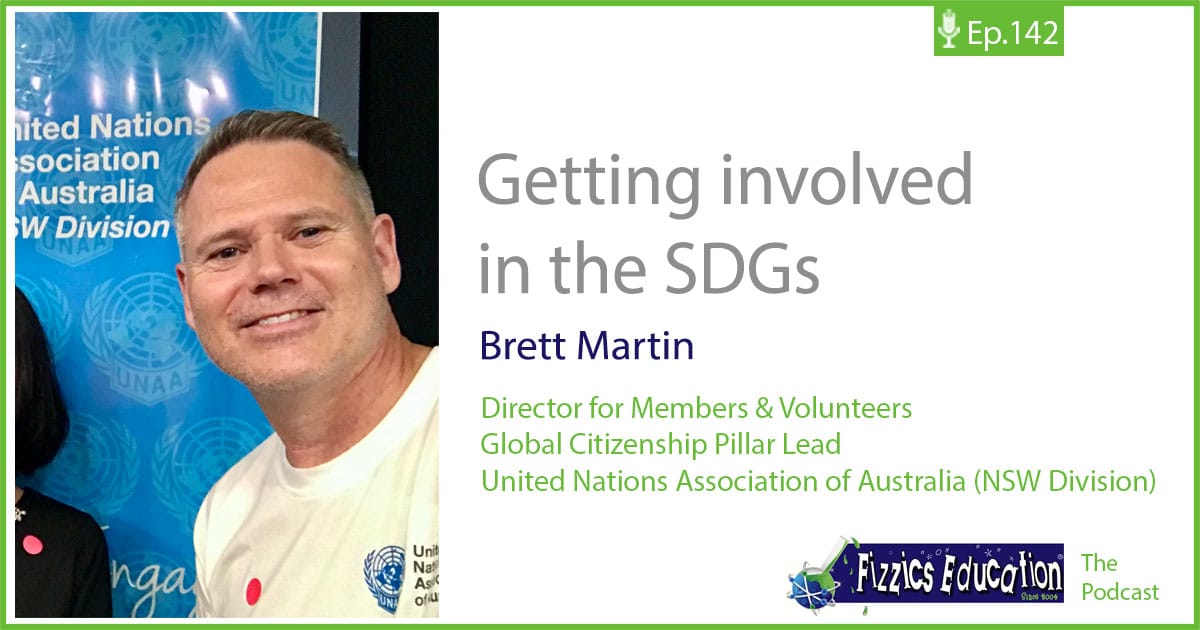
[00:00:19] Ben Newsome: Yes, welcome again to the Fizzics Ed podcast. Glad to have you. And in this particular chat, we’re talking about the United Nations Sustainable Development Goals and, importantly, how you can get involved. And I can tell you this, our next guest truly knows how to get involved with the UN SDGs. Brett Martin is the Director of Volunteering and the Global Citizenship Pillar Lead with the United Nations Association of Australia, New South Wales Division. His role involves supporting volunteers right across New South Wales, developing partnerships, and coordinating monthly meetups to raise awareness about the UN aims and the 2030 Sustainable Development Goals. So important. Now, by the way, the UNAA New South Wales purpose is to inform, inspire, and engage Australians to create a safer, fairer, and more sustainable world through a wide range of activities. They really do get involved in a lot, including the current UN Day campaign with New South Wales schools. They do run the United Nations Diploma, which is kind of interesting, and they host a wide range of events and projects that you can get involved in. And so Brett is going to help us really understand what he does and, importantly, how you can get involved. Let’s hear from him.
[00:01:25] Announcer: This is the Fizzics Ed podcast. For all about science, ed tech and more. To see 100 fun free experiments you can do with your class, go to fizzicseducation.com.au. That’s Fizzics spelt F-I-Z-Z-I-C-S and click 100 free experiments.
[00:01:43] Brett Martin: G’day Ben, great to be here. Thanks so much for having me.
[00:01:46] Ben Newsome: Oh mate, especially on a late week. We’re about to hit into the weekend. But hey, we got to hang out a little while ago on Bondi Beach, and that’s a whole other story I suppose, but gosh, you get into some interesting things.
[00:02:01] Brett Martin: Yeah, look, you’re right. We were at the Bondi Ocean Lovers Festival and it was all around promoting sustainability and ocean protection. Really enjoyed hearing about what you’re doing with Fizzics Education. And so a bit about me. I’ve kind of got two jobs really. I’ve got my day job, which is with the New South Wales Department of Communities and Justice, working with early intervention across New South Wales.
[00:02:30] Brett Martin: But really what I’m here today for, and what is connected still, is my work with the United Nations. And so, for people that aren’t aware, obviously, the United Nations is formed after World War II, pretty much every country in the world is a signatory bar a couple, so we’re talking like 194 or something.
[00:02:56] Brett Martin: And supporting all that process is the United Nations Association, which is a global association. And Australia has a national UN association and then, much like our federated system, our states and territories have associations. So I’m part of the New South Wales one. So pretty much we’re doing that thing where we’re trying to think global and act local in our own backyard.
[00:03:29] Ben Newsome: Nice. It’s fantastic. I mean I like that, act local. Act being a very operative word rather than just talking about it. And honestly, a lot of us have heard, and if you haven’t, go check it out, the Sustainable Development Goals, the SDGs. These things have turned up in a rapid way right around the globe. What does the association do with that?
[00:03:54] Brett Martin: Well, absolutely. I mean, the SDGs were kind of born after the Millennium Development Goals, which preceded them, but basically, they’re 17 goals which kind of cover social, economic, and environmental outcomes.
[00:04:11] Brett Martin: And they’re really aimed at messaging everyone in society, so you know, governments, non-governments, private sector, and of course, ourselves as citizens as well, to basically be aware of these really important things to do with ending poverty, creating gender equality, protecting the oceans, protecting the land, and giving us resources and tools on how we can make our own contribution. So, you know, very much our work with the UNAA New South Wales is about promoting those sustainable development goals.
[00:04:49] Brett Martin: And as you’re probably aware, they call this decade the Decade of Action because those goals have a timeframe of 2030. So, we’re in the Decade of Action. In fact, we’ve really got eight years left to achieve what we can for those goals. And in summary, we’ve got a lot to do. In Australia particularly, around the environmental challenges, we don’t rank very well in the world on those measures. So, yeah, you’re right. The SDGs is very much a big part of what we do.
[00:05:28] Ben Newsome: Yeah, totally. And I mean one thing I like about goals is they produce metrics, and you can’t really improve what you don’t measure. And I mean, of course, people can cut it in different ways. But the only problem that produces a double-edged sword is that sometimes it can feel so vastly huge a problem that what’s little old me going to do in my local community? And I suppose you’re really about changing that.
[00:05:53] Brett Martin: Yeah, that’s right. I mean, my role within UNAA New South Wales is Director of Volunteering. So, very much my focus is on how do we help people bring their skills and talent and knowledge and experience, whatever that is, to recognise that the decisions they make every day, which are small, actually, of course, accumulate across people, across countries, and ultimately the world to have an impact.
[00:06:27] Brett Martin: And so, I think that’s one of the big aims we have, is just helping people make that mindset shift that, “Oh yeah, okay, what I do is important, it does matter.”
[00:06:40] Brett Martin: My other role within UNAA New South Wales is lead of one of our four strategic pillars, which is called Global Citizenship. And so obviously a lot of synergy between those two roles, you know, because people very much identify as being part of their nation. You know, we think of ourselves as Australians or Americans or whatever. And really, as the world has got smaller and through technology and education, we’re all starting to realise that besides those identities, we are actually global citizens and that the decisions we make and the actions we take are very connected to global issues.
[00:07:33] Ben Newsome: So I’d love to know a bit about some of the projects that your volunteers have been involved in because I suspect it’s quite diverse.
[00:07:40] Brett Martin: That’s right. Look, yeah, there’s a real mixture. We have ongoing roles, you know, as part of the four pillars. The other ones are Peace and Security, Human Rights, and Sustainability. And so, you know, all the work that goes in just to run events and promote those pillars and the work underneath them.
[00:08:03] Brett Martin: But we also offer volunteers very much a tailored approach, because people are at different stages of life, different responsibilities, they have different availability. You know, some just want to commit to a few hours a month working from home online, and we can offer that through things like social media campaigns or maybe a research project.
[00:08:28] Brett Martin: Other people have the opportunity to participate much more broadly, and so basically, I spend my time often just thinking, “Okay, what do you need as a volunteer?” and try to work with that, rather than just kind of say, “Look, hey, we’re doing this and make everybody fit into what we’re doing.” Because as I said at the start, I mean these global goals mean that a lot of the work is just recognising how what we do already is important.
[00:09:04] Ben Newsome: Oh, totally. I mean, act locally, right? I mean, how can you act locally if someone 3,000 kilometres away is telling you what to do? It doesn’t… I mean, obviously, having some structure and scaffolding helps, but community-led action is where it’s really at because the communities know the local issues, always have, always will be. And that actually brings to a thought. I mean, a lot of people who listen to this are community leaders. They are school teachers, school educators, they’re educators in different places and different organisations around the planet. They are leaders in their own right in their community. And so I guess I’d love to know, how could they engage with the UNAA?
[00:09:43] Brett Martin: Well, at the moment, we have a campaign which is particularly for schools. So, each year on the 24th of October is United Nations Day. We have a campaign where schools can participate with that.
[00:10:02] Brett Martin: And essentially, one of our… she’s a Director of Education, Shysta, she’s developed this resource kit which is free for school teachers. It essentially has a few different options of what teachers and students and schools can do to participate. It could be as simple as just having like a mufti day where everyone wears blue for the United Nations. It could be where you pick one of the 17 Sustainable Development Goals and decide, “Okay, in our school, we’re going to try and do this activity, measure it, and report it.”
[00:10:48] Brett Martin: It could be something to do with climate change. Things like recycling and reusing are very popular. You know, kids are very conscious of that, much more conscious of that now and want to do those kinds of activities which really help. They actually have a measurable short-term impact of, “We collected this much rubbish” or “We collected this much e-waste” or “We recycled this amount of product.” And it’s a great way to raise awareness. And so schools can absolutely participate in that, and it’s as simple as looking at our website, unaansw.org.au, and they can find out all about it.
[00:11:32] Ben Newsome: You got me thinking about actually what we saw at the Ocean Lovers Festival. Many different events and programmes happening throughout that weekend. But one of them just got me thinking about their Litterati festival—Litter Art, basically, Litterati. Nice. But the idea is that, of course, you can collect rubbish and you can put it in a bin and you can recycle it in different ways, but what if you upcycle it in some way, shape, or form and potentially have it make a statement?
[00:11:58] Ben Newsome: I mean, it gets me thinking about the sort of things that school communities do throw out. What if the school community actually gets some of that trash and turns it into some form of artwork? Whether it’s maybe there could be an exposition because one thing that can happen with these sort of programmes is that if we’re looking in our classrooms and we’re teaching the kids, “You’ve got to look after the SDGs, one, two, three, four, five, six, seven,” etc., but it’s inward-looking and potentially doesn’t produce additional impact, additional ripples across the world if it’s not communicated. And I think what Litterati did, it does that job.
[00:12:31] Brett Martin: Yeah, absolutely. I mean, it looked like a lot of fun. You know, seeing the final products of all that effort was fantastic, you know, all that display of rearranging rubbish essentially to create these beautiful artworks. And the stories that went with it were so inspiring.
[00:12:52] Ben Newsome: Yeah, absolutely. So, I mean, if you had some people hanging out wanting to, I don’t know, just say there’s an association not set up or potentially it needs a bit more acceleration in their own country, their own community, their own region. What are some steps to be able to really engage community and then really build capacity within the organisation, doing what you do?
[00:13:14] Brett Martin: Well, yeah, I mean, we work with pretty much everyone. And we either form partnerships or we just align our effort. One of the tools I find really helpful is called the SDG Impact Assessment Tool. And it’s kind of a simple process where you follow some steps that say, “Well, we’re doing this, and this is the impact it has on the SDGs.” It could be positive, it could be neutral, it could be negative. I mean in a negative situation, you just want to reduce that negativity.
[00:13:52] Brett Martin: Uh, but at the end, it kind of produces just a simple PDF that sort of becomes a really powerful communication tool to say, “Well, look, this is our work, this is our association, this is our sector, this is what we’re doing.” And that can be used to create a whole lot of conversations with other people, particularly if people are looking for funding, looking for strategic partnerships with other organisations, or they’re just trying to build their own network.
[00:14:25] Ben Newsome: Got me thinking. So, you’re Director of Volunteering with the UNAA New South Wales Division and you got involved in some way, shape, or form, but how did you…? Did you just come across an event and put your hand up saying, “I want to get involved”? Like how did you get involved with this?
[00:14:38] Brett Martin: That’s exactly what happened, actually.
[00:14:40] Ben Newsome: Ah, there you go. Funny that.
[00:14:42] Brett Martin: Yeah, yeah. I mean the backstory is, you know, I’ve always worked in youth work and family support and human services. And after about sort of, I don’t know, maybe 15, 20 years of very much frontline work, I started to really ask those deeper questions around, you know, what’s happening systemically and structurally in society? Why are people ending up so vulnerable and relying on crisis intervention?
[00:15:21] Brett Martin: And it got me thinking, so I went back and studied and I chose a social work course. Did a Master of Social Work and it really clicked for me because it was talking in a language that I wasn’t familiar with in the work I was doing, which is, you know, human rights, social justice. A lot of the work I was doing was either framed in legislation, say child protection legislation, or the mission of the particular organisation I was working with. But here, social work talks about a much bigger picture.
[00:16:00] Brett Martin: And so yeah, I did end up stumbling across a United Nations Association event and went along and said, “Wow, this is fantastic,” thought to myself. Started going along and just helping out doing whatever they needed to set up tables and whatever. And then one day the Director of Volunteering said, “Well, I’m going, and I reckon you should put your hand up.” And that was pretty much what happened.
[00:16:26] Ben Newsome: Wow, roll it forward. It’s funny how a number of people who have been on this podcast have said similar things. It’s amazing what happens when you take a step.
[00:16:34] Brett Martin: Right. Exactly. Yeah, that is so true. We do these monthly meetups where we’ve partnered with Western Sydney University, and so we kind of meet there now. And you know, it’s fascinating exactly that, the people you meet who just say, “Look, I didn’t know this sort of universe existed.” You know, they’re interested, they want to do something, they just don’t know what to do and how to do it. And finding yourself just interacting with other people who are thinking similarly can create a lot of open doors. Much like we met through the Ocean Lovers Festival, right?
[00:17:12] Ben Newsome: Oh, that’s right, absolutely. I mean, I’m a science educator, you come from Communities and Justice, I mean, and yet we have a shared mission, which is actually directly hitting some of the SDGs wherever possible. It’s really cool. And honestly, you just never quite know what happens sort of next. So, I got to ask, what is happening next? What things do you have coming up through the UNAA for the next year or so?
[00:17:36] Brett Martin: Yeah, well we just had our planning meeting, actually. So we’ve got a pretty packed schedule. I mentioned the monthly meetups. They’re really important for connecting with our members and volunteers and they’re open to the public. So, you know, be great to meet anyone that’s listening and can make it to those. We’re trying for hybrid as well, so you can connect online for those.
[00:18:05] Brett Martin: Um, we have regular international days throughout the year that we schedule events for. So you know, a lot of planning goes into running those. Say you know, every year for UN days all around, you know, recognising peacekeepers around the world that have lost their life. And so we do a lot of events like that.
[00:18:31] Brett Martin: Um, we’ve got the UN Day schools programme which I mentioned, so people are very much invited to participate in that. We also have an online diploma, United Nations Diploma, which is a 20-week course. And I’ve done it, it’s fantastic. You learn all about the history of the UN, all those different agencies. You also pick up three competencies such as project management. And yeah, I really recommend people check that out.
[00:19:06] Brett Martin: So yeah, look that’s kind of a summary. Again, it all comes under our four-pillar strategy, so pretty much things to do with Peace and Security, Sustainability, Human Rights, and Global Citizenship.
[00:19:19] Ben Newsome: Nice, I love how you just find out new things. I had no idea about that diploma.
[00:19:23] Brett Martin: Yeah. Yeah, it’s great.
[00:19:25] Ben Newsome: What a great idea. And it’s deliverable online, which means you’ve got internet, can travel.
[00:19:30] Brett Martin: Absolutely. Yeah, yeah, you meet a whole bunch of good people.
[00:19:34] Ben Newsome: Ah, fantastic. So, if people want to go find out about this information and jump online, etc., they’ve got to go somewhere. So, where do they need to go?
[00:19:42] Brett Martin: unaansw.org.au.
[00:19:46] Ben Newsome: Easy as, Brett. Look, thank you very much for hanging out with me. Especially as we’re coming in… I was actually listening in going, “Well, this is kind of peaceful. We’re talking about sustainability things,” and I could hear magpies in the background calling.
[00:19:56] Brett Martin: Yeah, no, I’m on beautiful Gadigal land in the inner west of Sydney and um, yeah, just the working from home thing does have its benefits.
[00:20:07] Ben Newsome: 100%. I’m hanging out in Western Sydney on Dharug country. Very, very nice out this way as well. Look, thank you very much and have a fantastic weekend as we enter it.
[00:20:16] Brett Martin: Thanks Ben, it’s a real pleasure to be part of this. Hope to catch up soon.
[00:20:21] Announcer: We hope you’ve been enjoying the Fizzics Ed podcast. We love making science make sense. Why don’t you book us for a science show or workshop in your school? If you’re outside of Australia, you can connect with us via a virtual excursion. See our website for more.
[00:20:39] Ben Newsome: Well, there we go. We just heard from Brett Martin, who is the Director for Members and Volunteers and the Global Citizenship Pillar Lead for the United Nations Association of Australia’s New South Wales Division. And I reckon you should go check out their events and potentially get involved. Check out their website, unaa.nsw.org.au, and check it all out and subscribe to the newsletter because there’s always more and more events coming on up.
[00:21:00] Ben Newsome: So, I hope you enjoyed this particular chat all about the SDGs and, importantly, how you can get involved, even if it’s at a simple level right through to the sort of work that Brett is getting involved in. Love his work. So, look, as usual, we have more guests coming on to the Fizzics Ed podcast in all different areas of science education, STEM education, and, in this case, sustainability and development.
[00:21:18] Ben Newsome: Really love these chats and I hope you’re enjoying them as we go along. You’ve been listening to me, Ben Newsome from Fizzics Education. This is the Fizzics Ed podcast and I hope to catch you another time.
[00:21:35] Announcer: You’ve been listening to another Fizzics Ed podcast. We’re excited about science. Subscribe to us on iTunes to download the next episode as soon as it’s released. And don’t forget, for hundreds of ideas, free experiments, our new Be Amazing book and more, go to fizzicseducation.com.au. That’s Fizzics spelt F-I-Z-Z-I-C-S.
[00:22:01] Announcer: This podcast is part of the Australian Educators Online Network. aeon.net.au
Frequently Asked Questions
What are the United Nations Sustainable Development Goals (SDGs)?
The SDGs are a collection of 17 interconnected global goals designed to be a blueprint to achieve a better and more sustainable future for all. They cover a wide range of social, economic, and environmental issues, including ending poverty, improving gender equality, and protecting life below water and on land.
What is meant by the “Decade of Action”?
The United Nations has designated the period leading up to 2030 as the Decade of Action. This is because the target date for achieving the SDGs is 2030, and there is an urgent need to accelerate sustainable solutions to all the world’s biggest challenges, ranging from poverty and gender to climate change and inequality.
How can my school participate in United Nations Day?
Schools can engage with the UNAA NSW through their annual UN Day campaign on 24 October. Activities can be as simple as a blue-themed mufti day or as involved as specific projects tied to one of the 17 SDGs, such as e-waste collection, recycling drives, or climate change awareness sessions.
What is the United Nations Diploma?
The United Nations Diploma is a 20-week online course offered by the UNAA. It provides students with a deep dive into the history and agencies of the UN while helping them develop professional competencies such as project management and strategic communication.
How does the SDG Impact Assessment Tool work?
This is a tool used to help individuals and organisations evaluate how their activities affect the Sustainable Development Goals. By identifying positive, neutral, or negative impacts, users can generate reports that serve as communication tools for building partnerships and securing funding for sustainable projects.
Extra thought ideas to consider
The Power of Global Citizenship
While most people identify primarily with their nationality, the concept of global citizenship encourages us to recognise that our local actions have global consequences. Consider how your everyday consumer choices or community volunteering efforts create ripples that affect global sustainability targets.
Upcycling and the “Litterati” Movement
Rather than simply recycling or disposing of waste, upcycling involves turning rubbish into something of value or beauty. Using art to make a statement about pollution—such as the “Litterati” artworks seen at the Ocean Lovers Festival—can be a more powerful communication tool than data alone for engaging the public in environmental protection.
Discussion points summarised from the FizzicsEd Podcast, verified and edited by Ben Newsome CF