Transcript
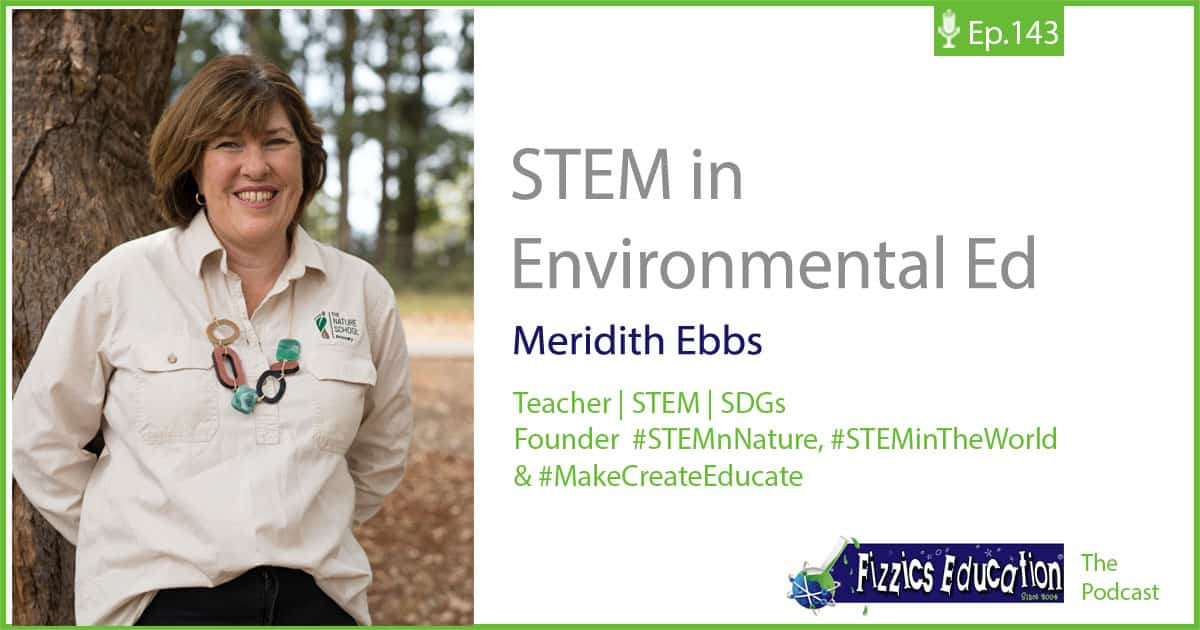
[00:00:00] Ben Newsome: Welcome again to the Fizzics Ed Podcast. Glad to have you again, and in this particular chat, we are talking about STEM in the outdoor environment and how you can make it happen. I tell you what, Meridith Ebbs can certainly guide us along that path. She is a massively experienced teacher with a background in education, environmental science, and digital technologies, and has worked for four years previously as a CESA Digital Technologies coach on the Digital Technologies project, where she was instructional designer, documented computer systems, and created training manuals. She’s also accredited as a Makey Makey ambassador, an Apple teacher, an Apple teacher in Swift Playgrounds, a Sphero lead educator, and she will guide us right through how you can use micro:bits and very much more in this chat. So, let’s head on in and listen to how Meridith has been making outdoors really work when it comes to STEM.
[00:00:23] Ben Newsome: You’re listening to the Fizzics Ed Podcast. For hundreds of ideas, free experiments and more, go to fizzicseducation.com.au. And now, here’s your host, Ben Newsome.
[00:00:59] Meridith Ebbs: My name’s Meridith. I am a primary-trained teacher with a science degree, so I’m a fairly unusual species. I actually did my degree in land management and physical geography, focusing on soils, ecology, and biology. I’ve had a very varied background, with education being the common theme.
[00:01:46] Ben Newsome: I’ve got to ask straight away, you chose primary? That’s interesting.
[00:01:50] Meridith Ebbs: That’s what everyone says.
[00:01:51] Ben Newsome: Why did you do that?
[00:01:53] Meridith Ebbs: That’s what the lecturers said. “Why would you do that?”
[00:01:56] Ben Newsome: I love that because honestly, three-quarters of my work is working with primary kids, so I’m totally with you here. But I just want to know, why did you do it?
[00:02:02] Meridith Ebbs: I think it was the age group. I wasn’t fussed on years nine and ten; they’re scary. My favourite year group to teach is year three and four. That’s my happy space. They can read, spell, and use a ruler after a little bit of practice. They still have respect for authority and they’re not hormonal, I like that.
[00:02:39] Ben Newsome: You can say that, we’re all educators here. We’ve all dealt with different age groups and we all have our favourite. I do understand, definitely grades three and four for sure. Yes, they can hold scissors, that’s a handy thing.
[00:02:51] Meridith Ebbs: They can hold scissors, they get excited about stuff, and they’re not too cool for school. They’re very excitable in that you can draw them into new concepts and new ideas quite easily.
[00:03:07] Ben Newsome: Totally. I must say, what’s great about what you get to do is that you teach science outdoors in lots of different ways, and that must lean on some of your background.
[00:03:18] Meridith Ebbs: The last three years, I have really resurrected a lot of knowledge from my science degree. I’m teaching a year four straight class and we spend a lot of time outside. We have to teach outside one session a day, and once a fortnight we’re off-site. We go to the beach, the bush, or different outdoor spaces for outdoor inquiry.
[00:04:00] Meridith Ebbs: I’ve had to reinvent all of my STEM knowledge. Some people might know me through the CESA project with the University of Adelaide, where I was teaching teachers how to use digital technologies. Coming back into a classroom, I’ve had to rethink how I teach STEM and digital technologies outside.
[00:04:20] Meridith Ebbs: We still have a lot of technology and access to different devices, but being outside changes everything. In the last couple of years, being outside has proven good for your well-being and health, so we are exploring those things. Micro:bits are probably my go-to tool with teaching STEM outside.
[00:04:41] Ben Newsome: Micro:bits are fantastic. Firstly, they’re accessible and the costs are low, but they do lots of great stuff. If you haven’t seen a micro:bit, just type in microbit.org. It’s an amazing set of tools. I do like what you’re saying about bringing technology outside. I have a background in environmental biology, so that’s definitely my thing. If you ask a kid what technology looks like, they think of things in a room, protected from the outside so it won’t get wet. But you’re actually putting stuff outside where things move and change. That’s important.
[00:05:38] Meridith Ebbs: Being outside, I’ve had to rethink everything because a lot of the STEM projects are targeted for being done in a large school hall or your classroom, with lots of practical coding on a browser. What we do is code in the classroom and design our projects, which are usually very simple. A lot of the projects I use are found on the microbit.org website because my focus isn’t extensive coding; my focus is how we make STEM real and investigate real-world problems. I’ll give you an example.
[00:06:18] Ben Newsome: Please, I was going to ask straight away.
[00:06:20] Meridith Ebbs: We did a really simple thing with a counter, and we designed it so on button A press, add a number, and on button B, reset the counter. It introduced variables, a very simple loop, and simple code. For years three and four, you’re not really talking difficult code; you’re talking concepts. That’s what we’re teaching.
[00:07:00] Meridith Ebbs: We took our counter to the beach. You could do this in a playground, you don’t have to go off-site. I gave the students different living things that they had to survey. When we got there, it was raining. We don’t cancel excursions because it’s raining, so we just go out in it. We had to adapt because there were no birds or lizards around. So we changed it to arachnids and a type of banksia that is quite common in that space.
[00:07:45] Meridith Ebbs: When we got there, we saw a pod of twelve dolphins, and one of my shark experts in the class believes it was a white pointer. Then we saw three bull sharks in a rock pool. They left the rock pool before the tide was too low. The students ended up counting sea animals.
[00:08:26] Ben Newsome: What I love about that is the tool you made is useful in nearly every school. If your school doesn’t have a lot of insects because they spray every holidays, you could do it with plants. Especially when you think about biological sampling techniques, you could have a quadrat set up. If you’re not sure what a quadrat is, just type it in; it’s a particular-sized square that you place, hopefully gently. As a heads-up, if you’re dealing with grade threes and fours, they won’t always be gentle, so make it strong.
[00:09:05] Ben Newsome: The idea is to reduce your bias in your sampling, and then you count the stuff you’re seeing. Mark and recapture would be really handy as well. It depends on how much time you have and what you are marking in a way that doesn’t hurt the animal, but creating an estimation of relative abundance can be done at this level with a very simple formula and a counter made out of a micro:bit.
[00:09:34] Meridith Ebbs: You could. I have known that there are sharks on the mid North Coast of New South Wales, but I’ve never seen them. I’ve lived on the coast all my life and never seen any sharks. The irrational fear of sharks is quite irrational because I’ve been at the beach for fifty years and never seen one. It just happened on an overcast day, and we were there all day. We saw this over a period of time, and I think they were just observing and looking.
[00:10:11] Meridith Ebbs: With the quadrat, we actually have done an activity like that. Citizen science is something that your listeners might be interested in as well. I use an app called iNaturalist, and we went to the bush quite a lot last year because of social distancing. One day we focused on the Australian native violet. They had to find it, understand where it lives, and what it looks like. They had to draw it, and I’d taken a stack of 30-centimetre rulers. Each group was given rulers and they had to work out how many violets grow in a 30-centimetre by 30-centimetre square.
[00:11:13] Meridith Ebbs: They had to identify the habitat. We went for a walk through the bush, and where we sit generally is quite moist, near a swamp. Then you walk up a hill and end up in a dry sclerophyll eucalypt forest. The violets only grow in the moist space; they don’t grow up in the dry space. They had to identify the habitat, why they are there, how big the plant is, and the fact that it has runners and grows as a ground cover.
[00:11:51] Meridith Ebbs: Then they gave me some search terms and we used my phone to look up information about the Australian violet. They all have a little A5 nature journal, and they had to write down the scientific name. We talked about how we would describe it. I found some facts and read them out, and they had to write down their favourite fact.
[00:12:17] Meridith Ebbs: The next day we came back, collated our data, did some graphs, and talked about the size. They had to Google their own facts about the plant they’d studied and draw pictures. I had printed out some photos and gave them to the students. They had to create a poster, and once again, we made it into a book.
[00:12:41] Ben Newsome: You can totally make it educational. If I’m thinking of the same violet, Viola hederacea off the top of my head, they look like Lisa Simpson’s head.
[00:12:50] Meridith Ebbs: It does. During the backyard BioBlitz in May, which is another iNaturalist project, my class were connected with two American classes and two Canadian classes. We were uploading using Flipgrid, sharing videos of animals in our space. Somebody uploaded a violet from America, so my kids uploaded our violet, and then they could talk about the different features, how they were similar and how they were different. It was a really exciting activity for the class. The kids loved taking videos of our plants and animals and doing a Steve Irwin type of presentation: “This is a wattle tree and this is an acacia.” It was really exciting for them to be connected with other countries.
[00:13:44] Ben Newsome: That gets me thinking. You only briefly mentioned Flipgrid, but this small point-and-shoot off your phone, asynchronous video of what you’ve been doing… you could create a grid where it was Day 1 of sampling, Day 2, 3, 4, 5, 6, where kids describe what’s going on. I like how it’s not about the tech, it’s about the outcome.
[00:14:09] Meridith Ebbs: It is. It’s always about the outcome. Being outside, some of the other projects I’ve done include testing light levels using a micro:bit, looking at why light is important. They had to do research on what light is and why it’s important. Stephen Heppell has some great information on his webpage about light levels and how in England they shut down jails if the light levels are too low because inmates become violent.
[00:14:48] Meridith Ebbs: We were talking about light levels and first started with the classroom. They decided that our light levels probably aren’t as high as they should be. They’re not low, but they’re not as high as the recommendation for classrooms.
[00:14:59] Meridith Ebbs: Then we went outside and asked, what’s the light in direct sun, what’s the light under the shadiest tree we could find, what’s light under a gum tree? We explored different light levels and talked about how important it is for sun and vitamin D. The investigation goes quite a long way, but you’ve got this technology underlying how you found your information.
[00:15:28] Ben Newsome: You could use the light levels to assess whether your fluorescent lamps are actually as good as an incandescent globe, and explore if we’re getting an energy saving while still getting the same light levels.
[00:15:41] Meridith Ebbs: That’s right. There are lots of different ways. Something I haven’t explored yet is drones, but the licencing is changing. There’s a limit; they’ve changed the rules on how many drones you can have in a space, and that makes it a little bit different. I wouldn’t mind getting a drone with a camera so we could fly over our outdoor space and look at what we can see from a bird’s-eye view.
[00:16:12] Ben Newsome: You can use drones in lots of different ways. I always thought about a drone being used when you teach space with the sun, Mercury, Venus, Mars, etc. You could have ground level be the sun, and then if you use an AU, astronomical unit, you could go up to represent the different planets’ distances from the sun. It could be really helpful because usually people just get kids to stand on an oval.
[00:16:43] Meridith Ebbs: I’ve done that with year five. Pluto doesn’t fit, and it’s not a planet anyway. But if you start at the sun, it’s funny to see on an oval that all the inner planets are really close together, and then you jump to Saturn, Jupiter, and Uranus. What we did was set it up so the kids had big posters, put the posters over their heads with a picture of their planet, and we flew a drone along the oval. We all stood on one side and the drone was on the other side, because you can’t fly a drone over the top of you. The kids actually had to work out the astronomical units. It was a hard activity for them, but it’s not impossible because Uranus has 99.
[00:17:35] Ben Newsome: Yeah, it works out nicely.
[00:17:36] Meridith Ebbs: It does. It fits beautifully on the oval. I think that’s on my YouTube from a long time ago.
[00:17:42] Ben Newsome: That’s good fun. It’s surprising what kids think. When people see orreries, they think the solar system is going to be regular, and it’s not. If you’re listening in, challenge your students to think of all the satellites above our atmosphere and then think about the distance to the moon. Say, “Righto, where are most of the satellites?”
[00:18:10] Ben Newsome: Get two kids to stand, one on the moon, one as Earth, and then you stand in the middle or close to the moon and ask, “Hands up, where are most of the satellites?” You watch them, and most put their hands up at halfway. Yet space starts at 400 kilometres above our head; that’s where the International Space Station is. There are satellites at 36,000 kilometres away, but consider this: it only takes eight minutes to get to space, but it took three days to get to the moon.
[00:18:43] Meridith Ebbs: It is, and it’s hard for kids to visualise and think. There’s a good website that shows all the space rubbish in our atmosphere or around our planet that we have left behind. When they finish with a rocket, they just leave it there. It’s really sad actually.
[00:19:05] Ben Newsome: Which is an interesting point when we’re talking about doing STEM outdoors. Inevitably there’s a sustainability bent. We’ve just randomly gone down this rabbit hole of talking about space junk, but there is junk out in our environment, and I suppose with your micro:bits, they could count said junk and hopefully clean up as they go along.
[00:19:25] Meridith Ebbs: This is plastic-free July. One of the projects I’ve put forward for the school is to go to the beach to collect and identify microplastics. I went to Coogee last year for a beach volleyball tournament, and I was horrified by how much microplastic was along the shoreline. I don’t know if it’s because it just wasn’t cleaned recently, or if there was a current, but I haven’t noticed that much microplastic where I am.
[00:20:11] Meridith Ebbs: Since the storms and all the flooding, I have noticed a big increase in the amount of plastic on the beaches. Even though our council does clean it up, there’s still a lot of plastic around. That was something I thought would be very relevant for schools on the coast. Even if they have a large dam or a river nearby, they could go and do microplastic sampling.
[00:20:45] Meridith Ebbs: They can divide it up, work out what types of plastic are the source of the rubbish, and identify if it is cigarette butts. In the ’90s, cigarette butts were the largest pollutant, but I think smoking isn’t as commonplace now. So, is that still the largest pollutant, or is it other forms of plastic?
[00:21:12] Meridith Ebbs: Doing scientific reasoning for kids is important. We don’t want them to go in there with a predetermined answer; we need them to find the data first. You can collect and sort your plastic waste and work out the source. Is there a pattern to where the plastic is? If there is a drainage space on your beach, is it coming out of the drain from the street, or is it along the shoreline coming in from the ocean? It’s a handy way to start citizen science.
[00:21:55] Ben Newsome: I was thinking as you were describing the sharks, if you’re in Australia, there’s this great platform called Redmap. Redmap basically lets you say, “Hey, I’ve seen these fish out in this area,” and it collates it. It’s a bit like the FrogID app.
[00:22:13] Meridith Ebbs: I love that one.
[00:22:15] Ben Newsome: It’s a good one, absolutely. I guess we could look at rubbish. It’d be interesting to see if there is a citizen science rubbish app, which I don’t know if there is.
[00:22:25] Meridith Ebbs: Litterati, I think.
[00:22:28] Ben Newsome: Ah!
[00:22:29] Meridith Ebbs: Litterati. There’s quite a lot of digital citizen apps. I use iNaturalist, that’s my main one. iNaturalist is great because you can take a photo of a plant, animal, insect, or even fungi, upload the picture, and someone else identifies it for you. It creates a map of all the plants and animals found by any user, so you can see what has been found around you.
[00:23:13] Meridith Ebbs: In our school, we have a project specifically for our peninsula. We back onto bushland and a lake, but our housing estate cuts into a bit of bushland. We have a project for our school only that I’ve set up, and our staff are now actively taking photographs and uploading them. Every time you upload a photo, it goes to the project you’re a member of. I’ve now got a map of all the animals and plants we have found in our playground.
[00:23:51] Meridith Ebbs: That includes everything from koalas and lace monitor lizards to little red ruby cap fungi which is about a centimetre high. We’ve got this range, and I love it because it’s colour-coded. The kids now know that if they find something in the playground, they come and find me. They’ll say, “Meridith, come take a photo of this one, look what I found, this great caterpillar.” That’s something we do every time we go out.
[00:24:31] Ben Newsome: What’s great about this is that all the students know to come to you to show stuff in the first place, but it also allows the opportunity for temporal data. Looking at year-on-year changes over time can make a huge difference for kids’ understanding of what’s actually going on in their environment.
[00:24:49] Meridith Ebbs: It can. You can extract the data from iNaturalist into a spreadsheet. I’m still processing how to make that work. How can I use that data in a visualised way offline? At the moment, it’s a map on my phone, or on the iPad of whoever is taking the photos. With iNaturalist, you have to be over 13. There is a Seek version, which is for under 13, but they do need Wi-Fi to take the photo and identify the spot. When you upload it to the app, it automatically records your latitude and longitude if you have the app open.
[00:25:34] Ben Newsome: Got it. And that also brings in the privacy issues, because it’s saying, “Hey, I’m here right now.”
[00:25:40] Meridith Ebbs: Yes. It also allows members of the public to comment and identify your species, which is why it’s on the teachers’ phones. You can do it on an iPad with Seek, but you have to have Wi-Fi to identify your location. We do have Wi-Fi into the playground, but not right to the back, which is where most of the kids find the interesting caterpillars and things because we don’t spray.
[00:26:12] Ben Newsome: Years ago, prior to education, I used to work doing bushland surveys and regenerating bushland. I wish I had this particular app. There’s one called PlantNet that uses AI, not humans, to actually identify what a plant is. Of course, bad data in means bad data out, so you need people to identify it correctly enough times. But I have had a play with it on Australian native flora that I genuinely know, and it’s right. Even from weird different angles, it’s still right.
[00:26:56] Meridith Ebbs: There you go. That’s great. This is just one way you can incorporate citizen science. There are lots of specific projects you can find. Last year we participated in a Dead Tree project. The bushland we go to, I’ve been going there for three years, and when I first started, there was one dead tree. When were the fires? 2020?
[00:27:32] Ben Newsome: December 2019.
[00:27:34] Meridith Ebbs: We had fires from July 2019 till February 2020. We actually started burning a long time before everywhere else. Back then, there was only one or two dead trees. What I’ve noticed in the last two or three years, especially when we did the project last year, was a significant increase in dead trees.
[00:28:00] Meridith Ebbs: Where the fire went through the wetlands, a lot of those trees haven’t regrown because they were paperbarks. Paperbarks aren’t necessarily fire-resistant because they’re swamp-based.
[00:28:22] Meridith Ebbs: Since then, we’ve noticed that in the spot where we sit, there’s another very large tree that has died. It’s good if they have hollows for animals, but the risk is it’s just going to fall. We participated by mapping. I made an outline map and we walked through the bushland, and the kids had to identify all the different dead trees on the map. I then logged that with the citizen science project.
[00:28:51] Meridith Ebbs: Another project that’s on this month, July, is moths and butterflies. It’s out of Canberra, so I’m not sure if it extends elsewhere. The problem is they don’t actually know all the caterpillar species, and they don’t necessarily know what butterflies and moths they turn into. There’s a lot of opportunity there for kids to catch caterpillars on the plant they’re on, put them in a fish tank, wait till they hatch, photograph the caterpillar, photograph the moth or butterfly, and let it go.
[00:29:26] Ben Newsome: Isn’t that really good for kids to understand that even though it’s 2022, we still don’t know something as basic as that for species we encounter every day?
[00:29:42] Meridith Ebbs: I was shocked. I thought, unless somebody takes the time to catch and release, you’re not going to know. I’m going to put it out there, is it the same for frogs?
[00:29:58] Ben Newsome: Yeah. You are reminding me of years ago, they are still trying to declutter the dinosaur bone collections because they’ve been misidentified like seven times.
[00:30:08] Meridith Ebbs: Oh wow.
[00:30:10] Ben Newsome: Some of them. It’s a genuine issue that’s actually happened. Different sets of people identify different things, and there’s a big argument about which is what. Science can actually be messy, and it’s a good thing for kids to understand.
[00:30:24] Meridith Ebbs: Yeah. Another app that’s great is the FrogID app, which you’ve already mentioned. During lockdown, I sent that home as a project for the kids to do when they were doing walks with their families. If you hear a frog, you record the frog sound. Sadly, sometimes it comes back and says it’s a cricket or an insect. Don’t give up, keep going. They can’t get out to look for frogs, and apparently there’s a large problem with frogs dying from disease. I think it’s the Australian Museum.
[00:30:59] Ben Newsome: It is.
[00:31:01] Meridith Ebbs: Australian Museum. They are identifying frog locations based on the recordings that people send, and they want you to do it all year round so they can work out when the frogs are active. If you hear frogs, you can take photographs and a recording. If you find a frog that doesn’t look very healthy, they also want those photos so they can identify diseases and work out why frogs are dying.
[00:31:33] Ben Newsome: The good news about this is that some schools are BYOD, others aren’t, and we understand why. But teachers, as long as you’re allowed to hold said phone, you have a device to collect things.
[00:31:45] Meridith Ebbs: That’s right. For high school, this is a great practical use for phones in class time. It’s a legitimate science activity that could be done with all ages, from Kindy right through to year 12.
[00:32:09] Ben Newsome: It’s cluttered, but they’ve still got to do first-hand investigations as part of it. They’ve got no choice. Even if it’s not just for the apps, there are some great apps. I’m a big fan of Google Science Journal. There’s a lot of stuff on your phone, and it’s not just the camera. There’s a magnetometer. You could actually work out how magnetic a rock is.
[00:32:38] Meridith Ebbs: And the compass is another great tool. There are a lot of uses for your digital technologies. Your micro:bit can also be used as an accelerometer, a clinometer, for light, and as a basic counter. I’ve used it as a pedometer in maths.
[00:33:15] Meridith Ebbs: I think people think STEM has to be expensive, with rockets and all these fancy things that you have to buy. A micro:bit is $30 that you can use to build a project in your space. For example, I participated in a webinar last month on shade. How much shade is in your school, and measuring surface temperature related to climate change?
[00:33:48] Meridith Ebbs: You could take longitudinal recordings of temperature in different spaces around your school, and you could measure the percentage of your playground that is covered by shade, which is actually really important in Australia to have a shaded playground.
[00:34:15] Meridith Ebbs: You could map it, do cross-sections, and work out how much shade is in your playground. It’s practical STEM, science, and maths. What are we determining shade to be in terms of light levels, and how much is sun-safe? Where I live, you can stand in the shade and it’s not cooler because it’s humid, but it is sun-safe.
[00:34:42] Ben Newsome: It’s got me thinking that we could be prescriptive as teachers saying, “Right, we’re going to do said lesson because I’ve got this micro:bit that will measure a thing.” That’s a good start, but maybe we consider it as a scaffold and say, “Righto kids, you know it can measure this, what else could we do?” Let them decide, and they’re more likely to be keen to study it because they came up with it in the first place.
[00:35:10] Ben Newsome: It’s very cool catching up with you and learning a bit about what you’ve been doing with STEM outdoors. I always love to find out what people think. Imagine you have a bunch of undergraduate primary teachers in front of you who are going to start teaching their science units very soon because they’re about to graduate. You’ve got thirty of those teachers in front of you and they’re thinking, “How do I integrate STEM in my classroom to go outdoors?” What’s the simplest step that you could give as advice to get them going?
[00:35:51] Meridith Ebbs: I would say buy yourself a micro:bit, $30. The newer one has a speaker as well and a few more features. Run through some of the projects yourself. Be creative. Think about how you can integrate all the subjects in your class rather than separate English, maths, science, history, and geography. I can use digital technologies to teach maths. I can make a dice with a micro:bit and run a probability lesson using the dice I made yesterday.
[00:36:42] Meridith Ebbs: Think beyond a textbook. We barely use worksheets. It’s practical hands-on learning. We still have maths talks and teach all of the New South Wales syllabus, but how can you teach it so it’s engaging and practical and has a use, so you don’t get that chat of “when am I ever going to use this?”
[00:37:18] Meridith Ebbs: The key thing for teaching STEM is to have a go yourself first. If you’re going to teach a novel, you read the novel. If you have to teach coding, do the project first. It doesn’t take much, and you will work out some of the problems you might come across in the classroom. The microbit.org site does have most of the projects I’ve talked about. Always go back to your syllabus or curriculum and work out exactly what you have to teach.
[00:37:58] Meridith Ebbs: We sometimes over-teach. We go too deep, and that’s great if the kids are interested, but if you’re time-poor, go back to what you actually have to teach. With coding, it’s actually not a huge amount; it’s more the concepts and the process. Let’s get a really practical process so kids can learn through hands-on activity.
[00:38:18] Ben Newsome: I love that. I guess don’t recreate the wheel. If someone’s made a really nice round wheel, learn to roll it.
[00:38:28] Meridith Ebbs: That’s right. Don’t be afraid. A lot of people say, “Let the kids explore,” and that’s great if that philosophy works for you. For me, I like to know that I can teach the bottom half of the class. The kids who are going to have to sit there and go, “Right, everybody click on the pink menu, now grab out the on-button A press, now grab the blue menu.”
[00:39:09] Meridith Ebbs: I have to be able to teach those kids. I have kids in my class who are like, “Can we go and do something else?” Yes, you can make it more complicated if you want to, but you have to be able to teach the kids who don’t know how to do it by themselves. You can’t always just rely on the kids working it out, because some of them can’t. It might be a lack of confidence, and they will always need you to go step-by-step. But I never hold back the ones that want to go further.
[00:39:44] Ben Newsome: I actually think that’s a great way to wrap up just good teaching, and in this case, teaching outdoors.
[00:39:52] Meridith Ebbs: Yeah. Thanks Ben.
[00:39:54] Ben Newsome: Thank you very much for hanging out with me. It is a Friday evening, so it’s good to chat for sure. Is there anything coming up in the next year or two that you wish you could do?
[00:40:11] Meridith Ebbs: I’m always looking for great projects. Something I’m really excited about is Girls Day Out in STEM. That’s coming up in Science Week. It will be their fourth year I think.
[00:40:26] Ben Newsome: It’s Petriea Skitek?
[00:40:28] Meridith Ebbs: Yeah, we’re best buddies. So that’s a really great activity. It’s predominantly for girls, it’s an online activity, and this year the focus is on glass and the properties of glass. That started in Port Macquarie in 2019 with 300 girls at CSU, which I was very proud to be part of.
[00:40:55] Meridith Ebbs: The last two years it’s been online, so this year it’s online again, which is great because it goes international. If you don’t catch it live, you can still catch it afterwards, and it’s free because it’s sponsored. It’s a really great project for kids to get involved in.
[00:41:19] Ben Newsome: Love it. Well, I’m interested to see what you come up with. It should be really cool.
[00:41:22] Meridith Ebbs: I’m looking forward to sharing. I’ll come back to you if I find something exciting.
[00:41:27] Ben Newsome: Awesome. Thanks very much for hanging out with me. Have a fantastic evening.
[00:41:31] Meridith Ebbs: You too.
[00:41:33] Ben Newsome: We hope you’ve been enjoying the Fizzics Ed Podcast. We love making science make sense. Why don’t you book us for a science show or a workshop in your school? If you’re outside of Australia, you can connect with us via a virtual excursion. See our website for more.
[00:41:51] Ben Newsome: Well, I really enjoyed that chat with Meridith. Hearing about how she’s making outdoor education really sing with her students by incorporating STEM must resonate with them and take that subject matter to a whole another level. By the way, you can hang out with her on social media using a couple of hashtags. She facilitates the hashtag #steminnature and #stemintheworld.
[00:42:20] Ben Newsome: She’s often sharing knowledge and ideas through her handles @imerynet and @makecreateeducate. As usual, we have all the different links in the show notes where you can check out all the resources and projects mentioned today. I hope you enjoyed this conversation. We’ve got more STEM educators coming onto the Fizzics Ed Podcast. You’ve been listening to me, Ben Newsome, from Fizzics Education. Enjoy wherever you are, until we catch you another time.
[00:42:53] Ben Newsome: You’ve been listening to another Fizzics Ed Podcast. We’re excited about science. Subscribe to us on iTunes to download the next episode as soon as it’s released. And don’t forget, for hundreds of ideas, free experiments, our new ‘Be Amazing’ book and more, go to fizzicseducation.com.au. That’s physics spelled F-I-double-Z-I-C-S.
[00:43:21] Ben Newsome: This podcast is part of the Australian Educators Online Network. AEON.net.au.
Frequently Asked Questions
Why should I take my STEM lessons outdoors?
Taking STEM outdoors allows students to engage with real-world problems and recognise science in their everyday environment. It promotes well-being and provides opportunities for authentic inquiry that a classroom simply cannot replicate, such as surveying local biodiversity or measuring actual environmental variables in changing conditions.
What is a low-cost way to integrate technology into outdoor learning?
The micro:bit is a highly recommended tool, costing approximately $30. It can be utilised as a light meter, a pedometer, a temperature sensor, or even a simple counter for biological sampling. It is durable enough for field use and simple to code via a web browser before heading outside.
How can my students contribute to real scientific research?
Students can participate in Citizen Science by using apps like iNaturalist or FrogID. By uploading photos of plants or recordings of frog calls, they contribute to massive global and national data sets used by specialised researchers to track species distribution and environmental health.
What if it rains on the day of an outdoor lesson?
Rain provides a unique scientific enquiry opportunity. As Meridith suggests, don’t cancel the session; instead, change the focus. Students can investigate how different weather conditions affect animal activity, such as looking for arachnids instead of birds, or measuring how light levels drop during a storm.
How do I manage students with varying levels of technical confidence?
It is important to scaffold the learning. For those who need more support, use a step-by-step approach (e.g., “click the pink menu, grab this block”). For more advanced students, provide the freedom to analyse more complex variables or add extra features to their code once the basic project is functional.
Extra thought ideas to consider
Leveraging Temporal Data
Encourage students to look at year-on-year changes in their local environment. By extracting data from iNaturalist into a spreadsheet, students can visualise how the flora and fauna in their own school playground change over time, helping them understand the long-term impacts of climate and urban development.
Identifying the Source of Microplastics
Use outdoor sessions to investigate sustainability. By sampling sand or soil for microplastics, students can analyse whether the pollution is coming from local drainage systems (street waste) or the ocean (shoreline waste), allowing them to propose targeted community solutions.
Discussion points summarised from the FizzicsEd Podcast, verified and edited by Ben Newsome CF