Transcript
[00:00:00] Speaker: You’re listening to the Fizzics Ed Podcast. For hundreds of ideas, free experiments, and more, go to fizzicseducation.com.au. And now here’s your host, Ben Newsome.
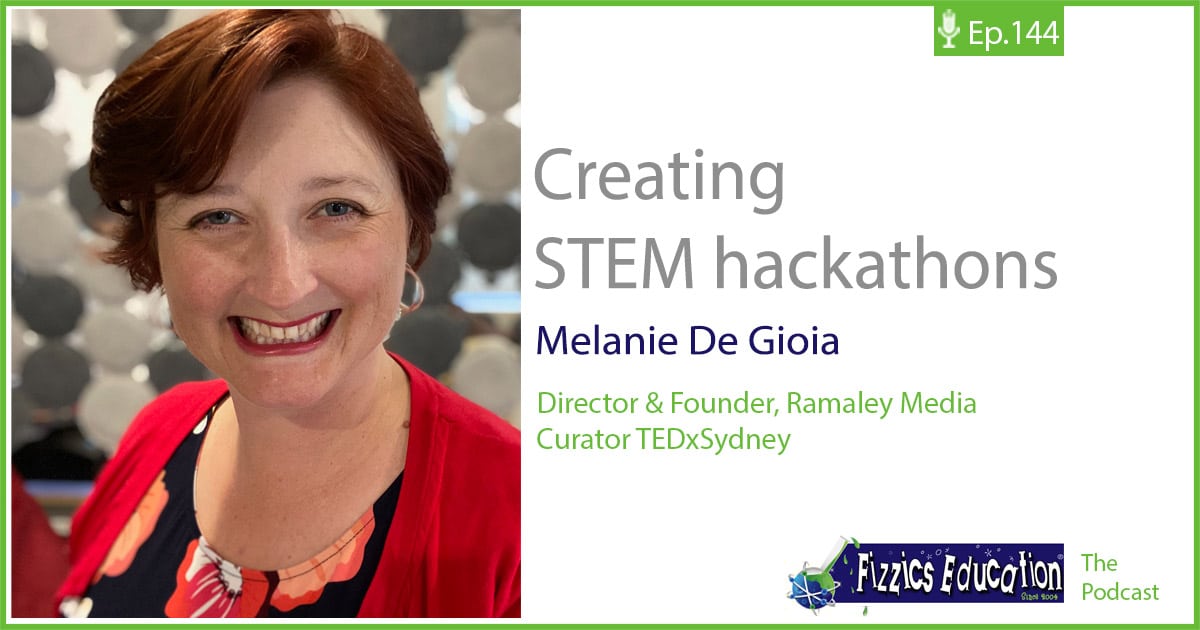
[00:00:15] Ben Newsome: So Melanie’s passionate about getting engineering, STEM, and all that sort of thing out to as many people as possible. She’s very much about inspiring innovation, and I tell you what, she very much does this. In fact, she’s worked with the World Federation of Engineering Organisations, UNESCO, she’s involved with TEDx Sydney, she’s involved with AusIndustry and Engineers Australia, and the University of Sydney, and really helps deliver projects that promote STEM in many, many different ways. In this particular chat, we’re going to talk about her inside knowledge about what makes a hackathon work, which is really important when you think about as an educator, how can we do these things ourselves in our own organisations or schools? Very, very important. So let’s get into this; Mel’s got a lot to share.
[00:00:58] Speaker: Thanks for listening to the Fizzics Ed Podcast. Sign up now for our fortnightly email newsletter. It’s loaded with details on new experiments you can do, STEM teaching articles, new gadgets, exclusive offers, and upcoming events. Go to fizzicseducation.com.au, scroll to the bottom, and add your email.
[00:01:17] Melanie De Gioia: I’m at heart a project manager, and that kind of perfectly fits my skill set. My superpower, I always like to call it, is taking chaos and making it organised—so, organising chaos. I actually just had a weekend where I’ve just run a hackathon for 48 hours more or less straight, with a few small sleep breaks in there. So yeah, I’m just coming down off a very busy time at the moment.
[00:01:51] Ben Newsome: Extremely caffeinated, and at least you’re coherent. You’re doing well.
[00:01:56] Melanie De Gioia: Well, it’s been two days, so I am. And also I ran a 24-hour live stream at the beginning of the year, and I discovered that along with my great organisation skills, I am also able to be awake for over 36 hours without losing too much comprehension and brain capacity. I was working with somebody and she just lost it towards the end, whereas I’m like, “Come on, let’s keep going.” I did 10-minute power naps and everything. I’ve just learned that it could be being a mother of three young kids that also helps with that.
[00:02:40] Ben Newsome: True. You like these opportunities to learn about yourself. Well, I think I would be a puddle on the floor at the 36 hours.
[00:02:46] Melanie De Gioia: I honestly felt drunk. I can understand why you don’t drive while you’re tired, but it was like a pleasant drunk where I didn’t feel like I was going to vomit. So that was quite a nice experience.
[00:03:04] Ben Newsome: Oh gosh, the things you get into. So let’s find out a bit more about that hackathon and a 24-hour event. What was the hackathon on? Because there can be lots of different ways that people approach this.
[00:03:16] Melanie De Gioia: So, the most recent one was the Humanitarian Innovation Hackathon. That was what was going on just last weekend. This was its fourth year. I’ve been involved in that hackathon since its inception. It was kind of my vision come to life. I took somebody else’s words and plans and ideas and made it a reality—that was my role as the project manager there. That was a competition for Australian undergraduate students attending any Australian university to participate in an opportunity to create an innovative solution to some real-world humanitarian issues.
[00:04:05] Ben Newsome: And that’s broad, too, because humanitarian can cover a lot of things.
[00:04:12] Melanie De Gioia: It does. We partner with RedR, which is kind of Australia’s humanitarian arm. So if there was something that Australia wanted to help out with, RedR is there in the field. It helps us narrow our focus by having that partnership.
[00:04:27] Melanie De Gioia: And one of the important things I find with hackathons is if you want to have a key focus, you need to have a partner. The 24-hour event at the beginning of the year, that was World Engineering Day. I was working for the UNESCO agency World Federation of Engineering Organisations, and I was the person activating the 24-hour day.
[00:04:47] Melanie De Gioia: That involved a hackathon—World Engineering Day Hackathon—that was running from January to March. That hackathon was partnered with Engineers Without Borders. From an industry perspective, you kind of need a partner. I find that works one of the best ways.
[00:05:27] Ben Newsome: I’m really curious, because what this actually does—so you’re working with tertiary students, yeah?
[00:05:39] Melanie De Gioia: Yes, for the Humanitarian Innovation Hackathon, it is university students.
[00:05:44] Ben Newsome: Yeah. So they’re still at university, they’re doing their courses, and yet they’re involved in a hackathon where they’re interacting with not just ideas and other teams but other organisations who are actually doing it for real. What are the outcomes of a hackathon that came out of this?
[00:06:09] Melanie De Gioia: The key thing I find with this particular hackathon—it depends on how you align the competition. We’re specifically aligning this hackathon with the concept that an undergraduate student is a well-educated individual. If they’re participating in this hackathon, they already have a desire to help humanity. They also have a desire to be innovative in their way of helping the world.
[00:06:34] Melanie De Gioia: Our main outcome is actually to show them a door. If you care about the future of humanity, use your degree, and here’s a way that you can help. Half the time I don’t even care about what their solution is; all I want them to realise is that their degree can be used for something more than just what that piece of paper says.
[00:07:05] Melanie De Gioia: If you want me to go into detail, I received a response from one of the hackers today in my email. She was so blown away from doing the event. She’s come up with an idea, she’s very innovative, so the hackathon strummed her heartstrings. She’s currently studying Bachelor of Biomedicine at University of Melbourne, and she’d always wanted to do something in the area but be an entrepreneur.
[00:07:30] Melanie De Gioia: She said by participating in this hackathon, a startup idea she has now inspired her to turn it into a reality. Before that, she was just kicking around ideas, but she said the hackathon really allowed her to exude her creativity and innovate such brilliant ideas that will make a lasting impact on others. It really does show students that there’s more than one way they can use their degree to help others.
[00:08:14] Ben Newsome: One hundred percent. What a way to focus it. I was just thinking as you were saying that, a lot of these things get a sponsor, and it’s about career pathways into that particular organisation. But what just crossed my mind was she’s looking at setting up her own organisation. These larger organisations, they need partners with startups and the innovation community. This could be 5, 10, 20, 30 years or who knows. It’s a lifestyle; it’s a heart change in a way.
[00:08:50] Ben Newsome: Yeah, that’s fantastic. I do love it, and we have had past guests who have done Engineers Without Borders. Fantastic programme, by the way. So if you’re listening in, definitely check out Engineers Without Borders. And if you’re an engineer, maybe sign up because it’s actually worth it. Such a passionate group, those guys.
[00:09:10] Ben Newsome: Oh, totally. Yeah, so that’s awesome. So Ramaly Media does a lot of different stuff, right?
[00:09:15] Melanie De Gioia: Yes, Ramaly Media is my own little umbrella to house anything I want to do in the STEM space, really. Be it projects, everything comes back to projects, because my skill set is projects. I consider podcasts a bit of a project, any hackathons that I come under can again come under Ramaly. Activating World Engineering Day as well, the amount of organisational skills I needed to coordinate international engineering institutions to get across the line was huge. At the end of the day, Ramaly Media is kind of like my own personal project management company, but with a very strong STEM focus.
[00:10:07] Ben Newsome: For sure, and you’re working with some really diverse partners here. Working with UNESCO, what was that like?
[00:10:14] Melanie De Gioia: They are really lovely. My main contact was with World Federation of Engineering Organisations, which is an institution of UNESCO, so that’s their engineering arm. They’re just so passionate and it was a thrill. Having a UNESCO day is just a buzz. It started off with podcasts through a contact of mine. So it’s been built over a number of years and to be part of an international day… I couldn’t have imagined three or four years ago to be so involved in it.
[00:11:03] Ben Newsome: And I love the outcomes that come out of it and they are, cliché, sliding doors that come out of these particular programmes. You never quite know who you might be working with next, and the fact that we’re working in the STEM community and I work in STEM education, you just don’t know the impact.
[00:11:21] Melanie De Gioia: You know it’s there. That’s the magic of networking, I have to say. I wouldn’t have done World Engineering Day work if I hadn’t have been working at University of Sydney doing the hackathon, because my direct line connection there was we invited Dr. Marlene Kanga to be a judge. We chatted, we got on. She was the President of WFEO and created World Engineering Day.
[00:11:53] Melanie De Gioia: Even thinking about it now, I wouldn’t have actually met Marlene if I hadn’t started my podcast “Beer with an Engineer”, because I just wanted to interview her. It’s networking, and it is a small little world sometimes, the world of STEM, and who you can meet.
[00:12:15] Melanie De Gioia: And everyone’s just so willing to help each other because it feels like we’ve all got this massive common goal to get more people working in STEM and to get everybody thinking about the best future we can all make together. Pretty much every project I work on is geared towards that.
[00:12:34] Ben Newsome: That’s fantastic. And you’re right, the sentiment’s real, very much so. I’ve often talked about how people just swap badges but they’re still doing the same job. They go to different organisations, they change their shirt, but they’re still doing the same job. I’m just curious, what are some of the aspects that you’d say, “You know what, that hackathon will sing? I know it’s going to work because it’s got these things in it.” And what makes them not work?
[00:13:16] Melanie De Gioia: I think one of the things that makes it work is having some sort of partnership with the challenge, having a connection. These hackathons have to have a real-world challenge that the students are presented with. I remember the first hackathon I ever experienced was during COVID, and it was all about how we’re going to pivot everything. There was a medical stream, a manufacturing stream—and all of it was about COVID. There were hundreds of people involved in that hackathon.
[00:14:05] Melanie De Gioia: For the Humanitarian Innovation one, the key thing is it’s a real-world problem. It makes the students connect easier. When you’re at high school, you learn all these things, and I was one of those people that had no idea what I wanted to be when I grew up. I couldn’t see how it could connect in the real world, whereas I find successful hackathons give that connection.
[00:14:58] Melanie De Gioia: It’s not just a fluid little thing; it’s hardcore. This plus this equals real world. And I think that’s a real key to the success. It’s hard to say what makes a successful hackathon as well, because is it numbers? Is it the fact that somebody comes out of this and actually creates the innovative solution they came up with? I think that is a measure of success.
[00:15:39] Melanie De Gioia: Honestly, if you have a hackathon with 10 students and you’ve changed one person’s life because of it, I think that as well is an important reward. I haven’t really run across that many unsuccessful hackathons. What would make an unsuccessful one? Is it a pretend challenge? Or it’s not connected to society or where we are.
[00:16:18] Ben Newsome: It’s fanciful.
[00:16:19] Melanie De Gioia: Yeah. And it’s hard work. It’s not as if you join the hackathon just to have a snoozefest. You’re pushing them into uncomfortable positions and saying, “You’ve got to achieve this in a small amount of time.” We saw participants fold during the hackathon. It wasn’t pretty. But we stress test.
[00:17:00] Melanie De Gioia: The way I set the weekend hackathon was I give them a challenge that they have to do in the very first hour: they have to create a 15-second promo video and upload it. That pretty much stress tests my entire hackathon process. It stress tests the teams—can they deliver a video in one hour? They don’t even need to do any research. Just put your names out there, put it into a video, and upload it into our portal. I do this because of my background in IT where I kind of stress test the whole process in one hour.
[00:17:33] Melanie De Gioia: I had one mentor come back to me and go, “One poor kid, he just couldn’t handle it.” He had three screens open and there were time constraints, and he just folded. The mentor ended up having to work closely with that team to help him out. But all the teams learn within that first hour what the weekend’s going to be like.
[00:18:30] Melanie De Gioia: I do that on purpose so that they learn that this life can be stressful. If you don’t have that connection to, “This is a reality, this is a real-world thing,” then that could possibly not make people as passionate to give up their time to deliver on the project.
[00:18:35] Ben Newsome: For sure. And I must say, the 15-second thing is handy, not only from a judging aspect but it really forces you to hone your message. You’ve got 15 seconds, you better use every second wisely. It’s tricky for kids.
[00:18:43] Melanie De Gioia: Exactly. And it was a simple task of just create a team promo video. So all you had to say is, “It’s Team Redwing and we’re made up of one, two, three people. Yay, go Team Redwing!” That’s all you need to do.
[00:18:57] Ben Newsome: That’s kind of fun. But it’s interesting because my instance, as soon as you describe that, I go, “Oh, that’s fun, that’s easy.” But for others who would be highly skilled, the idea of being in front of a camera would be challenging.
[00:19:11] Melanie De Gioia: Exactly. I’ve got a Dip Ed as well, so the way that I structure a lot of things, you build up to the main project, or you break the curriculum down into bite-sized worksheets or activities. So for me, that little challenge at the beginning is just a tester to see how far we’ve got to go.
[00:20:05] Melanie De Gioia: That’s kind of why I threw it in there. Not every hackathon does that; this is just my one that I’ve had a lot of freedom to create because in a way I’m the client as well as the project manager, which is quite a rare position.
[00:20:36] Ben Newsome: Well, one of the things I do like about this is your background in project management. That is key to delivering a STEM outcome. If you can’t manage your project, get your resources together on time, on spec as required, well, you don’t really have a thing to solve. Just knowing that you’ve got resources at hand and there’s a timeline coming, it’s important for students, absolutely, irrespective of their age.
[00:21:03] Melanie De Gioia: Exactly. I like the fact that they’re undergrad students because you learn when you’re at university, you learn more than just the topics that you’re being taught. You learn how to structure yourself, you learn how to submit to deadlines, you’ve learned all those other soft skills that are important in grown-up work.
[00:21:19] Ben Newsome: Well, actually it gets me thinking about—you wear a lot of hats, you do. You’re involved with TEDx Sydney, and so you would have seen a well-structured pitch, a well-structured talk, and others that are rather messy.
[00:21:58] Melanie De Gioia: Yeah. This is a new role for me, so I’m still feeling it. But I love the concept of TEDx Sydney. I love anything that blows my brain. To have been invited to be a curator was just like, “Oh, I get to see behind the curtain.” We’ve got a TEDx event coming up on the 5th of August, which is a great programme. Unfortunately, none of my speakers got across the line.
[00:22:33] Melanie De Gioia: One of them, it was just because she didn’t have that extra push. She was very well educated and she loved her work, but the talk just wasn’t TEDx specific. It’s showing me that there’s just that extra polish that you need to get to that TEDx level.
[00:23:01] Ben Newsome: Well, if anyone’s listening in on this, there is actually TEDx training to help this. A lot of this comes down to how you structure your talk and its connection to story. How does this really resonate with my audience, who in this case, you’re talking like millions of people. How do they connect to what you’re talking about?
[00:23:41] Melanie De Gioia: Yeah, they really do. To bring it back to the hackathon as well, one of the things I push always in my criteria marking is the communication. How do they communicate their solution? To do this while you’re at uni and then to be involved in TEDx as well, there is a very strong line there. You’re a STEM communicator as well, so you know all about taking a complex issue and being able to convert that into everyday language so people understand.
[00:23:59] Melanie De Gioia: That’s what we’re trying with the hackathons, that’s what we’re expecting them to do with TEDx. From my projects, that’s what I do. I always have a vision and how do I break that down into work chunks so that people can deliver.
[00:24:36] Ben Newsome: That’s fantastic. Hey, look, this has been great hanging out for this time. What if you had a bunch of undergraduate students, or high school students and they were about to enter a hackathon? What are some of the things that they should do to get themselves ready, skill up to be able to do really well?
[00:25:11] Melanie De Gioia: Two key things. Definitely work as a team. Some of my hackathons, as an organiser I form the teams, and I think that is the most challenging way. But I do that for this humanitarian one because in real life, if you’re a humanitarian and you go on site, you don’t get to pick who you work with. You actually have to use your skill, bring it to the table, and work as a team and do that whole forming, norming, storming process.
[00:25:58] Melanie De Gioia: Even if it’s a team of people that you know and respect already, you need to learn how to work with a team. Know what your skills are and what you can bring to that table. And then the second thing is be innovative. Learn. Sometimes I read something and it just inspires me and stretches my brain.
[00:26:23] Melanie De Gioia: I think that’s so important in these competitions: do not go in there knowing the answers. Go in there expecting that you’re going to need to work as a team and think outside that box. I hate that box so bad, so try to work out how you can bring innovation to the table.
[00:26:30] Ben Newsome: I like that. And in distilling it, the way I interpret it is two words really: What if?
[00:26:31] Melanie De Gioia: Yeah, I love that.
[00:26:34] Ben Newsome: Nice and simple. If you have that in back of your head, you should be fine.
[00:26:55] Melanie De Gioia: That’s a mantra for me. “What if we do it this way?” I always think of multiple ways of doing things in my everyday life. It’s always Plan A, B, C, D… and that lends itself to innovation.
[00:27:01] Ben Newsome: One hundred percent. And actually, I suppose, being comfortable with awkwardness. It’s not quite right yet.
[00:27:53] Melanie De Gioia: Yeah, exactly. I mean, I am not a perfectionist, and I feel sorry for anyone who is, because there’s never a perfect thing. So don’t be afraid to make mistakes and just relish in it. I make mistakes all the time, but I learn from them and I don’t shy away from those mistakes. I stare at them and go, “What could I have done better? What could I have done differently?” Those mistakes actually help show you a way. On the footpath, they’re the buffers.
[00:27:58] Melanie De Gioia: So don’t be afraid of mistakes because they’re very important. I don’t think anyone who ever browbeats you because you’ve made a mistake gets it. They’re missing something in life if they think mistakes are bad.
[00:28:15] Ben Newsome: Well, that’s right. If you aren’t creating mistakes, you’re not doing anything innovative, are you?
[00:28:29] Melanie De Gioia: No. I love the WD-40 story. “This is my 40th go at getting this right.” That someone’s so methodical that they’ve actually kept count of every step of the way, and it only took 40 goes to get it right.
[00:28:50] Ben Newsome: Absolutely. And it happens with STEM and innovation, it happens in business. Unicorn business in Australia, Canva. The founders of Canva pitched and pitched and pitched hundreds of times. And for them, it was data.
[00:29:02] Melanie De Gioia: Yeah. You just need to be able to pivot when those things happen, being able to recognise and change course. That keeps life interesting, those mistakes or those barriers keep life interesting.
[00:29:48] Ben Newsome: Absolutely. What a nice way to finish. There you go, I feel all warm and fuzzy. Well done with what you’re doing. What is coming up next?
[00:30:44] Melanie De Gioia: What’s coming up next? Well, we’ve got TEDx in a week and a half, which I’m really looking forward to. It’s my first one, so I’m going to some of the rehearsals and I’ve talked a bunch of friends into coming with me, so we’re all making a whole day of it. I know some of the talks already, and I’m just so excited to hear those talks. I’m also doing two hackathons for Engineers Australia this year. One launches the week after TEDx; that’s an undergrad one for climate-smart infrastructure.
[00:31:05] Melanie De Gioia: And then I’m doing another hackathon for Engineers Australia, which we’re loosely calling “GradHack” at the moment. That one’s in October. We haven’t actually nailed the theme yet, EA is just getting a partner for that. But that one’s for graduate engineers. I’m curious to see how that one goes, because a lot of my hackathons have been for undergrads. This one’s more for grads, which apparently are very time-poor individuals. So we’ll see how they handle themselves.
[00:31:22] Melanie De Gioia: And a few more things, EA and a podcast I’m starting up for AusIndustry, so that’s all about innovation and Australian businesses. Yes, a lot on, but I love being busy.
[00:31:26] Ben Newsome: So how do people get in touch with you?
[00:31:27] Melanie De Gioia: The best way is to connect with me on LinkedIn. Don’t just connect with me and leave it, always put a little note, “Hey, I heard you on this podcast.” Let me know why you listened to me. I’m pretty easy to find—De Gioia is not a very common name. I am not Italian, it’s a married name. But definitely find me and leave a message and connect with me. I always love to talk about projects and STEM and podcasts. LinkedIn is the best way.
[00:31:50] Ben Newsome: Yeah, awesome. Mel, thanks so much for hanging out with me. Loved chatting with you.
[00:31:55] Melanie De Gioia: Thank you so much for having me, Ben.
[00:31:57] Speaker: This is the Fizzics Ed Podcast.
[00:31:59] Ben Newsome: Well, I hope you enjoyed that chat with Melanie De Gioia. I certainly did and I’ll tell you what, she’s got some real insights about how to make hackathons truly work. And if you want to go find out a little bit more, and you should, head on over to ramaly.media. So R-A-M-A-L-Y dot media and you can find out all about what she’s been getting up to and you can also check out some of the podcasts for the curious because she’s a specialist in sharing STEM stories. So definitely well worth your time. That is the end of this particular episode. I hope you enjoyed it and as usual we have more coming up. You’ve been listening to me, Ben Newsome from Fizzics Education. This is the Fizzics Ed Podcast and I’ll catch you another time.
[00:32:35] Speaker: You’ve been listening to another Fizzics Ed Podcast. We’re excited about science. Subscribe to us on iTunes to download the next episode as soon as it’s released. And don’t forget, for hundreds of ideas, free experiments, our new be amazing book and more, go to fizzicseducation.com.au. That’s Fizzics spelled F-I-double-Z-I-C-S.
[00:32:45] Speaker: This podcast is part of the Australian Educators Online Network. AEON.net.au.
Frequently Asked Questions
What exactly is a hackathon in a STEM context?
A hackathon is an intensive, short-duration event (often 48 hours) where participants work in teams to solve a specific, real-world challenge. In a STEM context, it focuses on technical innovation, rapid prototyping, and collaborative problem-solving to address complex issues, such as humanitarian crises.
Why are real-world partnerships important for successful hackathons?
Connecting a challenge to a partner organisation, such as RedR or Engineers Without Borders, ensures the problem is grounded in reality. This authentic connection motivates students, as they can see how their solutions might actually impact people on the ground rather than being a theoretical exercise.
What is the purpose of ‘stress testing’ participants during the event?
Melanie uses a 15-second promo video task in the first hour of a hackathon to stress test the process. This forces teams to immediately align, communicate effectively, and deliver under pressure. It provides a realistic preview of the intense weekend ahead and helps mentors identify teams that might need extra support.
How do hackathons help students with their future careers?
Participating in a hackathon shows students that their degree is more than just a piece of paper. It opens doors to entrepreneurial paths, develops project management skills, and helps them recognise how their technical knowledge can be applied to diverse global challenges beyond their traditional field of study.
What should a student do to prepare for their first hackathon?
Students should focus on two key areas: teamwork and an innovative mindset. Being prepared to work with strangers (forming, norming, and storming) is essential, as is adopting a ‘What if?’ attitude. They should enter the competition ready to experiment, make mistakes, and pivot their ideas based on what they learn.
Extra thought ideas to consider
The Power of Networking through Media
Melanie’s journey highlights how starting a project like a podcast can lead to significant international opportunities. By interviewing industry leaders, you build a professional network that can bridge the gap between local projects and global organisations like UNESCO and the World Federation of Engineering Organisations.
Project Management as a ‘Superpower’
STEM success isn’t just about technical expertise; it’s about the ability to organise chaos. Integrating project management principles into classroom STEM activities—such as setting strict milestones and managing limited resources—prepares students for the reality of professional engineering and innovation environments.
Embracing Productive Failure
The stories of WD-40 and Canva remind us that innovation is often a result of repeated failure and persistence. Educators can foster this by rewarding the process of pivoting and learning from mistakes rather than just focusing on the final, ‘perfect’ output of a challenge.
Discussion points summarised from the FizzicsEd Podcast, verified and edited by Ben Newsome CF