Transcript
[00:00:00] Voiceover: You’re listening to the Fizzics Ed Podcast. For hundreds of ideas, free experiments, and more, go to fizzicseducation.com.au. And now, here’s your host, Ben Newsome.
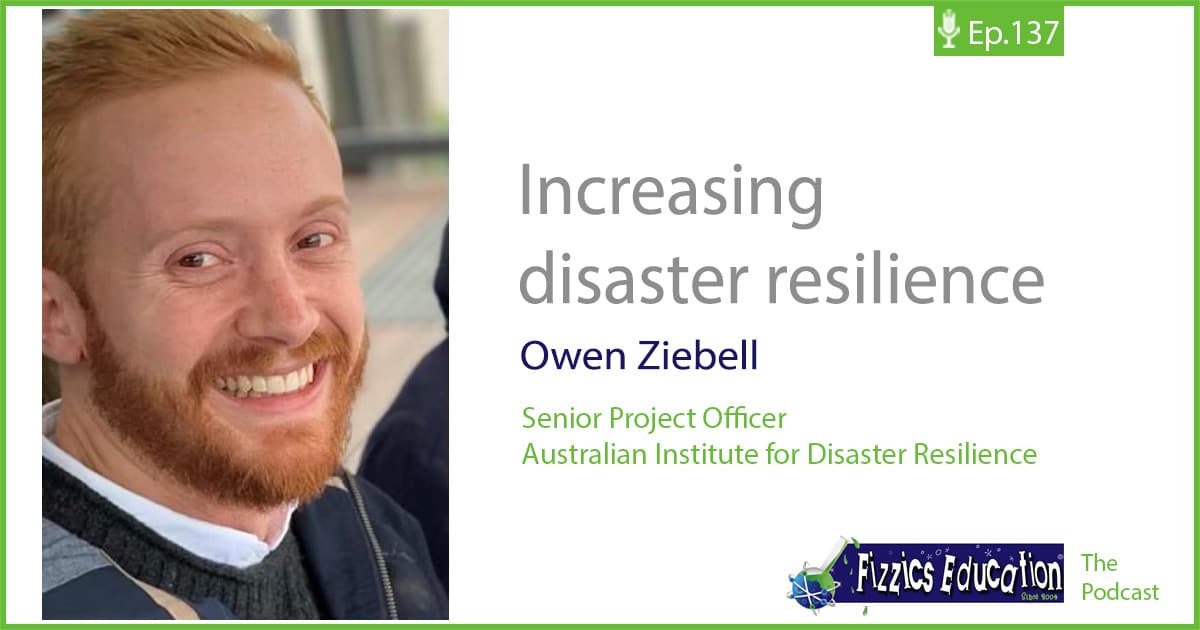
[00:00:19] Ben Newsome: Welcome again to another Fizzics Ed Podcast. I’m glad to have you again for another chat around science and STEM. No matter where you are on this planet, this is an important topic to consider. The Australian Institute for Disaster Resilience is an important national institute for disaster risk reduction and resilience. Today, we’re hanging out with Owen Ziebell, who is a senior project officer for educating kids. The programme works with young people, educators, emergency services, community organisations, researchers, and more to help our kids develop their knowledge, skills, and solutions for a disaster-resilient future. As a former teacher and police officer, Owen brings a whole bunch of knowledge into his role to help communities build their resilience and their ability to reduce risk when it comes to disasters. Let’s go hang out with Owen to learn a little bit more.
[00:01:13] Voiceover: This is the Fizzics Ed Podcast. For all about science, edtech, and more, to see 100 fun free experiments you can do with your class, go to fizzicseducation.com.au. That’s physics spelled F-I-double Z-I-C-S, and click 100 free experiments.
[00:01:29] Owen Ziebell: My name’s Owen, and I work for an organisation called the Australian Institute for Disaster Resilience. We are the national institute for disaster risk reduction and resilience. We’re a not-for-profit, fully funded by the federal government. We work closely with the new government organisation called the National Recovery and Resilience Agency. We work across a range of different areas to develop a more resilient Australia.
[00:02:00] Owen Ziebell: For me, my side of the work is with our education for young people programme. I try to get disaster resilience education into schools, community groups, and into the hands and minds of young people any way I can. Outside of work, I’m a former teacher and former police officer. I come from a bit of an eclectic background, or as my mother would put it, I’ll never get long service leave because I bounce around.
[00:02:33] Ben Newsome: Don’t they always say that?
[00:02:35] Owen Ziebell: On plus many more things, I’m sure. I come from a teaching background. I taught in urban Melbourne and out in the country for quite a few years, primarily across P-12 and secondary schools. I was a police officer in Victoria for a few years. When I’m not at work, I try to get out of Melbourne as much as possible. I’m actually going camping this weekend, which will be great.
[00:03:02] Ben Newsome: Fantastic. Especially coming into a hot summer.
[00:03:07] Owen Ziebell: Exactly. It’s going to be an interesting summer. It looks like there will be a lot of storms and floods coming through and not as many fires, touch wood.
[00:03:19] Ben Newsome: Doesn’t that tie in well with what we’re about to talk about? It really does. Teacher, police officer, now disaster resilience. That’s quite a trajectory. How did that come about?
[00:03:40] Owen Ziebell: When I finished my arts degree, I didn’t have any idea what I was going to do, like many arts students. I did teaching and loved it. I taught down the coast in a small school. That’s where I first started working in wellbeing. Because it was a small school in a town of only 1,000 people with 250 kids, every teacher did 50 different jobs. I started running the wellbeing programmes in the school.
[00:04:15] Owen Ziebell: Then I had this little voice in the back of my head that said I had to do something different. I joined Victoria Police and worked there for a while, but left because shift work was tough. I have the utmost respect for anyone who can find that balance, but I never could. An opportunity came up at the Australian Institute for Disaster Resilience working in this realm that brought my emergency services experience and school experience together. I took it with both hands, and that’s how I ended up here at AIDR.
[00:04:51] Ben Newsome: That’s fantastic. I love those sliding door moments in your career. You work in the education team helping kids understand disaster resilience. What do they picture disaster resilience to be? Do they even know it?
[00:05:13] Owen Ziebell: Young people?
[00:05:15] Ben Newsome: Young people, yes.
[00:05:16] Owen Ziebell: It’s one of those things that’s potentially in the back of their minds, but not at the forefront. For us, disaster resilience education is about learning about natural hazards in the local environment and ways to keep communities safe from harm before, during, and after an emergency. If you break down what a disaster-resilient young person is, they are able to recognise natural hazards in their local environment. They understand the harmful impacts of those hazards on people and their community.
[00:05:50] Owen Ziebell: They can demonstrate strategies for staying safe and seeking help. They are able to share their learnings and participate in action following disasters. A lot of young people already have these abilities, but they’re in the back of their mind. It’s amazing to see how they engage with the content when looking at natural hazards. They realise they have that inherent resilience. It’s about connecting it to natural hazards and how they can prepare to benefit themselves, their families, and their communities.
[00:06:21] Ben Newsome: That’s a really rich area you can dive right into. As a science educator, I’m thinking everything from climate change to seismology. There are all different versions of science that link towards disasters. Do you find that students have this superhuman power thinking, “This won’t happen to me, it’s so far off, it’s some other kid in another country”?
[00:06:56] Owen Ziebell: Yes, people do have those thoughts. Often, especially in metropolitan areas, there’s an idea that bushfires don’t impact them. But if we look back to the 2019-2020 bushfires, which heavily impacted the East Coast of Australia, the impacts went all the way across to Perth. The logistics infrastructure across Australia was so heavily impacted that people in Perth felt it. It’s really important to understand that even if you don’t live in a rural area, you may still be impacted.
[00:07:40] Owen Ziebell: Melbourne recently had really extreme storms about three or four months ago, and the eastern suburbs were heavily impacted. It’s crucial for everyone to understand that natural hazards occur. There’s no way to stop hazards like storms or floods, but we can become more resilient, recover more quickly, cope with them, and mitigate the risk. That’s how we potentially avoid disasters.
[00:08:18] Ben Newsome: That’s fantastic. What do you end up teaching the students during your programmes?
[00:08:24] Owen Ziebell: We work with a range of government bodies from local through to federal, and different emergency services across the country. We’re based in Melbourne, so we work with Fire Rescue Victoria, the CFA, QFES in Queensland, and DFES in WA. We work with those organisations to help them develop programmes or practices that benefit schools. We don’t often work directly with young people.
[00:09:00] Owen Ziebell: We are trying to influence change. We provide and share resources and good practice through our networks. We enable teachers or community educators working with young people to implement disaster resilience education into their schools and workplaces.
[00:09:25] Ben Newsome: When should disaster education start? What age?
[00:09:32] Owen Ziebell: You can start from the very beginning. There’s an amazing group in Queensland, the Queensland Centre for Perinatal Health, that has a resource called Birdie’s Tree. It’s a series of novels for preschool-aged children about different natural hazards like floods, cyclones, and fires. They just put one out about COVID. It teaches young children about hazards and how they can stay safe.
[00:10:15] Owen Ziebell: Even in the Australian curriculum, there are areas from the foundation level—Prep in Victoria or Kindergarten in New South Wales—where you can teach simple things like calling triple zero or learning their address to tell someone in an emergency. It’s important to start at a young age, and there are a myriad of possibilities across the curriculum up into Years 11 and 12.
[00:10:45] Voiceover: You’re listening to the Fizzics Ed Podcast. For hundreds of ideas, free experiments, and more, go to fizzicseducation.com.au. And now, back to the conversation.
[00:10:57] Ben Newsome: 100%. We run a natural disasters workshop focusing on the main disasters in the syllabus from Grade 3 through 10. Just a heads up, if you’re listening in, please check your country’s emergency number—they are different. Isn’t there an international one, like 112, that works no matter where you are?
[00:11:25] Owen Ziebell: There is. Many countries are also set up so that if you dial 911 or the British 999 in Australia, it will divert to triple zero.
[00:11:51] Ben Newsome: It feels like a little factoid, but it actually matters when you need it.
[00:11:57] Owen Ziebell: Of course, 100%.
[00:12:00] Ben Newsome: Are students learning this predominantly in Eastern Australia, or is it right across the country?
[00:12:05] Owen Ziebell: It’s being implemented across Australia. There’s a great example from Gingin High School in WA, northeast of Perth. They wanted to integrate disaster resilience education to get their students learning how to contribute to their local community.
[00:12:41] Owen Ziebell: They developed a cadetship where Year 10 students undertake the same training as local fire and rescue volunteer units. By the end of Year 10, they are qualified to join their local brigade. They implemented a mandatory 16-week programme educating students about fire safety, firefighting, and bushfire management. They’ve had great results, with many students going on to join local brigades.
[00:13:23] Ben Newsome: I love it when schools grab onto the concept. The schools themselves are leaders. Other teachers find out through their networks and emulate these wins. Have you seen this spring up sporadically based on school leaders?
[00:13:51] Owen Ziebell: It does come down a lot to the leaders because currently, disaster resilience education isn’t mandated in the Australian curriculum. There are many relevant spots from foundation to Year 10, but it’s not compulsory like it is in Japan, where students learn about tsunamis and earthquakes every year.
[00:14:28] Owen Ziebell: Here, it is more connected to the individual school. Some are proactive, while others react after an event. After the 2009 fires, Strathewen in rural Victoria brought in a great programme where young people engaged with the local CFA doing daily bushfire risk assessments. With a new curriculum coming out in 2022, maybe something will be mandated.
[00:15:08] Ben Newsome: Do you work with other organisations like this around the globe? There’s clearly a big need for this.
[00:15:18] Owen Ziebell: Our mandate is working just in Australia, although we do have a connection with New Zealand. We run a professional network called DRASNZEN—the Disaster Resilience Australia New Zealand Schools Education Network. We run forums throughout the year where people learn to implement disaster resilience education, and we’re launching a youth forum next year for young people to share their experiences.
[00:15:58] Owen Ziebell: We primarily work within Australia, but we’re always looking to connect and share good practice. At our national forum in September, we had a presenter from a Japanese organisation called Wa-Na-Be, which works with recent immigrants to teach them about tsunamis and earthquakes following the 2011 Fukushima disaster.
[00:16:40] Ben Newsome: My mind casts back to the 2004 tsunamis in Indonesia and Thailand. An Australian school kid who had just completed a disaster programme recognised the receding ocean and saved their family, which was fantastic.
[00:17:06] Owen Ziebell: There are many examples from around the world where young people recognised things they learned in school and acted. It’s great when they learn through an all-hazards approach. You may not be impacted by tsunamis where you live, but if you go on holiday, you need to be aware. At the same time, it’s important to learn about hazards that are contextually relevant.
[00:17:41] Owen Ziebell: There’s probably limited value in a young person in Cape York learning about avalanches compared to someone in the New South Wales high country, like Thredbo. It’s important to have an idea about these things, especially when we travel.
[00:18:12] Ben Newsome: Honestly, “what’s in it for me” is probably the biggest thing that matters to a student.
[00:18:22] Owen Ziebell: Exactly. Within disaster resilience education, there are seven principles we promote. One of the first is placing the learner at the centre. It comes back to how they can benefit their safety and wellbeing. It’s amazing how great a level of engagement you can get. We had a really great quote from a Year 6 student in the eastern suburbs of Melbourne.
[00:19:02] Owen Ziebell: They said, “We all learn differently and we have our own special interests and talents. When we can make decisions about our own learning and actions, we can achieve more than if we are just told what to do.” When students are given that level of decision-making, the engagement is so much higher.
[00:19:37] Ben Newsome: I love that you’re talking about a Year 6 student. They sounded like someone from the UN.
[00:19:46] Owen Ziebell: You need to give young people the ability to flourish. That Grade 5 and 6 level is perfect for disaster resilience education because they are developing higher problem-solving and conceptual skills. They haven’t reached the point in high school where they might be concerned about sticking their neck out.
[00:20:25] Ben Newsome: If I have a group of students and don’t know how to start disaster resilience education, what are the first steps? Do you start with the seven principles?
[00:20:46] Owen Ziebell: I’ll quickly list the seven principles: place the learner at the centre, reflect the local context, be inclusive, establish and strengthen partnerships, engage and challenge learners, focus on action, and build capacity. If you’re a teacher who has never taught about natural hazards, don’t be afraid. Don’t be concerned that you’ll do something wrong or traumatise the young people.
[00:21:20] Owen Ziebell: Often, their imagination of an event is far worse than reality. Dive into it. The first step is that second principle: reflect the local context. Take time to understand local history, hazard impacts, disaster risk, and the lived experience of the community.
[00:21:49] Owen Ziebell: When I moved down the Surf Coast in Victoria in 2016, it was just after the Wye River bushfires. The school I was teaching in was impacted. Although I moved there afterwards, it was very fresh in the minds of the community and students. We needed to tap into and acknowledge that lived experience.
[00:22:15] Owen Ziebell: The second step is to jump onto our website, schools.aidr.org.au. There’s an amazing array of resources put together by different agencies.
[00:22:44] Owen Ziebell: Fire Rescue New South Wales and the CFA in Victoria have great materials. Tasmania developed excellent resources that have been adopted elsewhere. It’s not going to make your life harder or give you more work; it’s just a shift in focus.
[00:23:27] Owen Ziebell: There’s a myriad of cross-curricular pathways connecting science, humanities, geography, civics, and health. There are great examples of schools developing STEAM projects, adding art around the recovery phase. Jump in, engage with the local community, and hunt for resources because they’re out there.
[00:24:16] Ben Newsome: I like that your background is English and humanities. Eventually, we’re humans in a living environment and it impacts us.
[00:24:31] Owen Ziebell: We make the point across AIDR that there is no such thing as a natural disaster. Disasters are not natural; they are man-made because people have built in certain areas or mismanaged environments. There are natural hazards, but through education and risk reduction practices, we can mitigate their impact so they don’t lead to a disaster.
[00:25:12] Ben Newsome: We run road safety science programmes, and we clearly say to kids there’s no such thing as a car accident. There was an incident, and something caused it.
[00:25:34] Owen Ziebell: Exactly. As a police officer, we never referred to it as a car accident because something contributed to the incident. It’s the same for natural hazards creating disasters.
[00:25:58] Ben Newsome: As a science educator, it’s one thing to know the theory, but the reality is that it impacts people. We’ve got to think broader than just theory.
[00:26:09] Owen Ziebell: Young people want to learn about this. We conducted the ‘Our World, Our Say’ report, surveying 1,447 young people aged 10 to 24 about climate-related hazards. About 88% thought they should learn more about natural hazards, and high 70s reported being very concerned about climate change.
[00:26:35] Owen Ziebell: About 90% of young people said they’d lived through at least one natural hazard event, and 60% believe disasters are occurring more frequently. We took just under 1,000 participants who wrote personal messages to the government and presented those to the then Minister David Littleproud via a Zoom webinar.
[00:27:03] Owen Ziebell: So young people don’t only want to learn about it, they acknowledge that this is a major issue. It was really great to see them engaging with the powers that be.
[00:27:37] Ben Newsome: I love the impact people are making. You and your entire organisation do a really good job.
[00:27:44] Owen Ziebell: Thank you. There’s amazing work being done by the United Nations, Save the Children, Red Cross, and Royal Far West. Emergency service agencies are evolving too. They recognise themselves as content experts, but they know teachers are the experts at teaching. They provide resources for teachers to take and run with.
[00:28:43] Ben Newsome: External enrichment has to be done in partnership directly with the teacher in the classroom.
[00:28:55] Owen Ziebell: They understand the diverse needs of their class and how to engage them. External providers bring expertise, but they aren’t the be-all and end-all.
[00:29:10] Ben Newsome: Owen, this has been a fantastic chat. If you’re listening, definitely check the show notes. Let’s take those first steps and get these kids armed and resilient.
[00:29:25] Owen Ziebell: Completely agree, Ben. Jump on any of your local agencies’ websites or come look at ours. There are links to resources across all domains, including new ones put together by Australians Together that develop Aboriginal and Torres Strait Islander perspectives.
[00:29:58] Ben Newsome: Thanks for hanging out on this podcast. Have a fantastic camping trip with no disasters.
[00:30:05] Owen Ziebell: Thank you so much. It looks like clear skies and 20 degrees, so I’ll be enjoying a couple of days away.
[00:30:12] Ben Newsome: Enjoy.
[00:30:13] Owen Ziebell: Thanks, Ben.
[00:30:14] Voiceover: You’re listening to the Fizzics Ed Podcast. Why don’t you book us for a science show or workshop in your school? We love seeing students get excited about science, and you will too. Go to fizzicseducation.com.au and click on schools for more info.
[00:30:32] Ben Newsome: So there we go. We just hung out with Owen Ziebell, senior project officer for the Australian Institute for Disaster Resilience. Go to schools.aidr.org.au to find out all about their teaching resources. It’s important to help kids understand that disasters are a real thing, but getting them prepared will reduce their fear and allow them to get through difficult situations.
[00:31:00] Ben Newsome: Knowledge is a powerful thing. Reach out to Owen Ziebell and get involved with the Australian Institute for Disaster Resilience. This is the end of this podcast. We’ve got more coming up throughout the year. Thanks for listening. I’m Ben Newsome from Fizzics Education, and I’ll catch you another time.
[00:31:45] Voiceover: You’ve been listening to another Fizzics Ed Podcast. We’re excited about science. Subscribe to us on iTunes to download the next episode as soon as it’s released. And don’t forget, for hundreds of ideas, free experiments, our new “Be Amazing” book, and more, go to fizzicseducation.com.au. That’s physics spelled F-I-double Z-I-C-S.
[00:32:13] Voiceover: This podcast is part of the Australian Educators Online Network. AEON.net.au.
Frequently Asked Questions
What exactly is disaster resilience education?
Disaster resilience education involves learning about natural hazards within the local environment and identifying ways to keep communities safe before, during, and after an emergency. It empowers young people to recognise hazards, understand their impacts, and demonstrate proactive strategies for seeking help and taking action.
At what age should children start learning about disaster resilience?
Education can begin as early as the preschool years. Resources like ‘Birdie’s Tree’ are designed for very young children, while foundation-level students can learn essential skills such as dialling triple zero (000) and memorising their home address to assist emergency services.
How can teachers integrate this into an already crowded curriculum?
Disaster resilience education is highly cross-curricular. It aligns naturally with Science (Earth and Space sciences), Humanities (Geography, Civics, and Citizenship), and Health and Physical Education. It also offers excellent opportunities for STEAM projects that incorporate art and community recovery perspectives.
What are the ‘seven principles’ of disaster resilience education?
The principles developed by AIDR are: place the learner at the centre, reflect the local context, be inclusive, establish and strengthen partnerships, engage and challenge learners, focus on action, and build capacity. Reflecting the local context is particularly vital for making the relevant programmes impactful.
Extra thought ideas to consider
The ‘What’s In It For Me’ Factor
Students engage more deeply when they see the direct relevance of a topic to their own lives. By placing the learner at the centre, educators can tap into students’ specific interests and talents, allowing them to lead their own learning and feel a sense of agency in protecting their families and communities.
The Teacher-Expert Partnership
Emergency services are the content experts on hazards, but teachers are the experts in pedagogy. The most successful programmes occur when these two groups collaborate, allowing teachers to scaffold the expertise of emergency agencies into lessons that meet the diverse needs of their specific students.
Discussion points summarised from the FizzicsEd Podcast, verified and edited by Ben Newsome CF