Transcript
[00:00:00] Announcer: Welcome back to the Fizzics Ed Podcast. Glad to have you again for another week. You’re listening to the Fizzics Ed Podcast. For hundreds of ideas, free experiments, and more, go to fizzicseducation.com.au. And now, here’s your host, Ben Newsome.
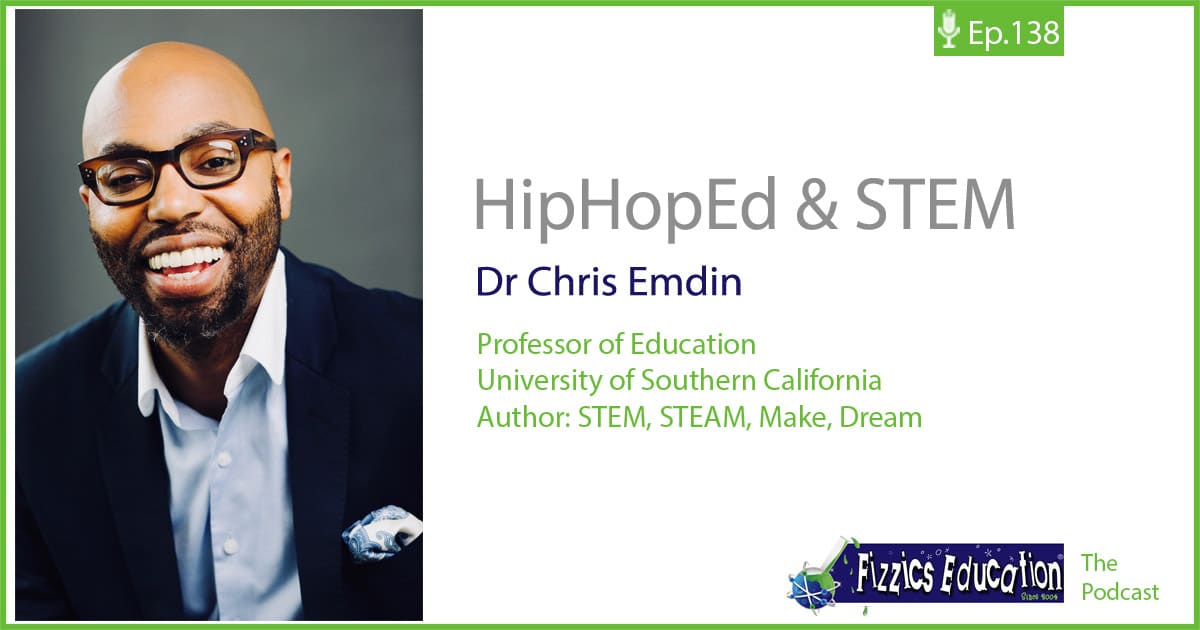
[00:00:15] Ben Newsome: Christopher knows a lot about engagement. This particular session is really interesting because we’re looking at how we can use hip-hop to teach STEM, STEAM—in fact, he’s actually the author of a book called STEM, STEAM, Make, Dream, which is a really interesting book around STEM and STEAM and transforming kids’ lives. So, let’s listen in and think about how can you get hip-hop going in your classroom to grab those kids’ attention in a way that just might matter to them.
[00:00:54] Dr Christopher Emdin: I stumbled into this work. I went to school and undergrad, I trained to be a physical anthropologist. I ended up majoring in biology, chemistry, and physical anthropology and had no intention of going into education at all. But I started realising that there were a lot of young folks who came from the same neighbourhoods I did, had the same background I did, and I just didn’t see them the further I got in science. You get to undergrad, you see a few. You get to grad school, you see less. You go towards your doctorate and you see even less.
[00:01:42] Dr Christopher Emdin: For me, that really hurt my heart. So, I dedicated my life to ensuring that other young people that come from where I come from—but from all backgrounds, whether they’re rich or poor, or urban or suburban, or in Appalachia or New York City—I want all young folks to have the opportunity to be able to see the wonder and beauty and magic of science. That’s what I do.
[00:02:07] Ben Newsome: And clearly doing it well. You’re working with lots of different people. What’s your favourite age group that you work with?
[00:02:13] Dr Christopher Emdin: I’ve taught middle school and high school, undergrads and grad school, a short stint in elementary. I think middle school’s my favourite. There’s something about middle school. You might show up on a Monday and they want a hug and they want to be loved, and then on Wednesday, they want to be treated like adults and be respected. I just love being able to teach a population where you don’t know who you’re going to get, so you always have to be on your toes. You have to be creative and you have to be imaginary, and you have to be flexible. They bring out the best in my teacher self.
[00:02:49] Ben Newsome: Absolutely. I also think with that middle school age group, you really get them really set for the later grades and not setting them up for failure. This is the opportunity to really take them—they’ve got the fine motor skills, they’ve got the understanding, they’ve got the attention span, and this is the chance to really take them further. That’s fantastic. So, how long have you been doing this?
[00:03:13] Dr Christopher Emdin: I have been in science education or STEM education or STEAM education for probably about 25 years now. Again, I’ve taught on multiple levels and I’ve had experience in a bunch of different places—in school, after school, volunteer programmes, graduate school, undergrad. What that perspective of seeing this thing from multiple perspectives allows me to do is to find out where the gaps are.
[00:03:45] Dr Christopher Emdin: I think the gaps are in engagement, creativity, innovation. The gaps are also in teacher preparation and teaching those folks who are going to go teach young folks how to be imaginative. My new discovery and my new interest and new passion is working with parents, having parents be able to be the ones that inspire their children to want to do well in science and tech and engineering and mathematics.
[00:04:31] Ben Newsome: 100%, and especially during the COVID era. They really have to come to the forefront now considering that they’re effectively their teachers by proxy by being at their homes and whatnot, especially with the lockdowns and things. Absolutely, we’ve got to partner with parents. I was having a look at what you’re getting up to, and one thing that grabbed my eye—and it’s not just the capital letters, I just thought I could imagine where this might go—what is a Science Genius Battle or Science Genius Battles?
[00:05:02] Dr Christopher Emdin: It’s my favourite thing to talk about. So, Science Genius Battles: science is science. Genius is actually G-E-N, which is generating, I-U-S, interest in urban science. So, that’s young folks from urban backgrounds, urban neighbourhoods, socio-economically challenged spaces. That’s where the genius comes from. And the BATTLES is an acronym that stands for Bringing Attention to Transforming Teaching, Learning, and Engagement in Science.
[00:05:40] Dr Christopher Emdin: Put it all together, Science Genius Battles is an initiative that began in New York City and has now been expanded to cities across the world. There’s a Science Genius in New York, there’s a Science Genius in Toronto, Canada, there’s a Science Genius in Kingston, Jamaica—Science Genius all over the place. The initiative is about challenging young folks to write raps about science content that they’re learning in school, working with teachers to support young folks as they write those raps so that they’re academically rigorous, and then introducing artists to support the teachers so that they’re creatively effective as well.
[00:06:25] Dr Christopher Emdin: Then battles, in hip-hop culture, is when one person raps, another person does as well, and they go back and forth to see who’s the expert. So, we do the same thing we do in hip-hop, but we do it around hip-hop that’s reflective of science content. Kids battle in their school, in their classroom, we pick a classroom winner. Then we put classrooms against classrooms, and then we pick a school winner. Then we put schools against schools, and then we have a city winner. At the end of the whole enterprise, we have the Science Genius of an established city.
[00:07:00] Dr Christopher Emdin: This person is an expert in science, an expert in performing, and they win an opportunity to be able to shadow scientists, they get to record their song in an actual recording studio, they get to possibly shoot a video, meet their favourite artist, and be known in their community not just as a performer, but also a brilliant scientist. That initiative has been in place now for close to a decade. We’re slowly evolving to include other cities. I recently expanded from New York to Los Angeles, so we’re going to do our national Science Genius rap battle at some point. But it’s just about making science fun. And most importantly, more than fun, right? Because everybody talks about making science fun.
[00:07:35] Dr Christopher Emdin: For me, it’s also about making science cool. For so long, kids think that the science kid and the smart kid can’t be the cool kid. My belief is that we can be both, right? You can be a geek and also really cool.
[00:08:00] Dr Christopher Emdin: You can be smart and you can also be the best rapper in your neighbourhood. It’s about constructing hybridised identities, interdisciplinarity, creativity, and what I call existing at the intersections.
[00:08:25] Ben Newsome: Oh, absolutely. When I think about rappers, I think of people who can do mental acrobatics because they are really incredibly talented. I was actually just imagining someone like Nikola Tesla versus Thomas Edison, perhaps, or Lamarck versus Darwin and rapping against each other with their different theories. That could be a lot of fun.
[00:08:51] Dr Christopher Emdin: I love it. I think that the world of science has always historically had their own battles. Sure, they don’t share through hip-hop, but in their own means. The nature of contemporary science research is that somebody does an exciting study, someone has a counter-study or develops that, and there’s a battle culture. Not in a competitive, tear-you-down way, but it’s like, “I see your idea, I’ll one-up you.” I think that through competition that’s not about destroying but rather about edifying, everybody gets better.
[00:09:12] Ben Newsome: That’s really cool. You said this has been going for 10 years. I suspect this is going to grow and grow and grow.
[00:09:20] Dr Christopher Emdin: Well, that’s the hope so far. We only began in New York City and other cities have been taking notice. I forgot Chattanooga, Tennessee—they had a great Science Genius Battle over there. But the idea is to make this an international endeavour. I’ve partnered up with GZA from the Wu-Tang Clan. The Wu-Tang Clan is one of the most iconic hip-hop groups in the world, and GZA is known as “The Genius” of that group. He’s a science guy. He’s a science geek. He’s written songs about the Big Bang, and he’s working on an album called Dark Matter to talk about the origins of the universe. Folks wouldn’t imagine that somebody who had that hip-hop credibility is that passionate about science. So, to have him come into the classroom and talk to young folks and use his lyrics as examples just really gets the kids excited.
[00:09:50] Ben Newsome: It reminds me actually of—we often do work with sports teams because often sports teams will grab the attention of disadvantaged youth. This is just doing it from another angle and it’s cool. And often the time when you do a sports programme, it’s rather constrained to the physics or the nutrition or whatever it is around the sports thing because that’s the nature of the beast. Whereas a rap around science in general can go, well, anywhere.
[00:10:10] Dr Christopher Emdin: Ben, I’m going to share some of these raps with you. I mean, they incorporate the science concepts and themes with experiences in their lives. They’ve connected it to sports, they’ve connected it to heartbreak, and the way that young folks construct metaphors and analogies. For me, sometimes when we do these sort of creative things where we say, “Let’s bring an athlete in,” or even if I said, “Let’s bring a rapper in,” and a rapper just gets them excited, it’s very different than when we say those folks are going to get you excited and now you’ve got to create your own. And then there’s a rubric, right? It has to be academically rigorous. You have to have at least five scientific principles. It has to be supported by evidence. You have to have mathematical examples. We have very rigorous sort of academic expectations that run concurrently with the fun level. I think you have to bring both together.
[00:10:48] Dr Christopher Emdin: I always find a challenge or find it surprising when folks are like, “Let’s let the kids have fun.” I want them to have fun too, but you want to have fun so that they fall in love with the subject so that they can stay with the subject for a long time and you can increase the rigor. I think that good teaching is equal parts fun and rigorous. I wrote a book about this concept. It’s equal parts ratchet and academic. You have to be ratchedemic.
[00:11:05] Dr Christopher Emdin: In the States, when we talk about somebody being ratchet, we say that they’re loud or they’re obnoxious or they’re abrasive and they have too much personality. We say that the ratchet folks can never be academic. This word “ratchedemic” is about saying you can do both at once. You can be rigorous and you can be cool. You can rap and you can be really knowledgeable. Don’t let anyone convince you that you have to let go of who you authentically are in a pursuit of being a scientist.
[00:11:21] Ben Newsome: This is awesome. When you really think about it, you’re just taking the knowledge to a forum that the kids want to be in. I mean, you kind of think about some of the people who are influencers on TikTok or on Instagram or whatever it is, it’s somewhere where the kids want to hang out. And so it’s more likely that it’s going to connect with them rather than the typical cliched old white guy in a crazy lab space that is not really part of their lives. This makes it real. I like it, it’s awesome.
[00:11:51] Dr Christopher Emdin: So many research studies have been done where you ask young people to draw a scientist. Every single time, they draw the same person. It’s like this guy with crazy hair in a lab coat. When a young person is drawing a vision of a scientist, it doesn’t look like them. It’s an indicator that we have much work to do to help them to be able to see the science in who they are. That’s part of my mission and vision—to meet young folks on what I call their cultural turf, no matter what that is.
[00:12:22] Dr Christopher Emdin: If I’m working with a young person in Appalachia, a place of high poverty in the United States, rural, mostly white, I may not necessarily lead with hip-hop. I may lead with where those young folks are. Eventually, I connect them to hip-hop so they can connect to wide audiences. But the beginning point of any good teaching and learning is wherever the students are.
[00:12:41] Ben Newsome: Totally. Absolutely. Science no longer is a siloed endeavour—never really was, but very much nowadays, it’s the STEM, it’s the STEAM, it’s the various versions of that acronym. It’s really getting kids to understand that they can actually apply this to create something to solve a problem. And that’s just really cool.
[00:12:58] Dr Christopher Emdin: It’s about making school science and home science look more like actual science. Scientists are actually collaborating and they are reflecting and they are applying and they are doing and they’re making mistakes. They’re writing papers that are being cited based on the mistakes that they made. Then you go into the classroom and it’s like “memorise information and spit it back out.” If it’s wrong, it’s wrong. If it’s right, it’s right.
[00:13:28] Dr Christopher Emdin: In a world where every young person has access to the information through their iPhone, why are we still assessing how brilliant they are based on what they can memorise? We should be assessing them based on how creative and imaginative they are. What they know should be applied and should be connected. So we’re trying to make school science look more like actual science. We’re trying to convince scientists to show the collaborative part of their endeavour because oftentimes, all the people in the world see is the image of a scientist that does not reflect what actual science in the world and what actual engineering and what actual architects or creatives are doing.
[00:14:04] Dr Christopher Emdin: That’s why I push for the movement from STEM to STEAM, incorporating the arts, but also making. You can’t be a scientist unless you do science. Memorisation means nothing if you can’t do something based on what you’ve memorised. My work is really about pushing against the status quo and reimagining what even conversations about science look like.
[00:14:28] Ben Newsome: This is really important for kids to understand. I even think about outside of science and STEM, even just the way that business narratives are placed out to young kids. You look at the founder fallacy, the idea that there’s going to be some 20-year-old something creating this billion-dollar crazy thing. But they didn’t do it by themselves. They had a huge network of people to support and make stuff happen. Kids need to really understand that science is, again, a collaborative space. Yeah, it might be argumentative and that’s probably why the battle side of things can be a bit of fun too, obviously if you can lift people up, that’s a good thing. But the whole point is that science doesn’t happen in isolation.
[00:15:08] Dr Christopher Emdin: Never has, never has. I think those old relics—I think we have a culture that really celebrates the hero and the person that pulled themselves up from the bootstraps. I think that narrative is not just in science, it’s in history, it’s in politics. That narrative is so flawed and so broken. Someone’s got to interrupt it. Why not you and I, Ben?
[00:15:34] Ben Newsome: Absolutely. You’ve got a bunch of books out and I know there’s a new one coming out: STEM, STEAM, Make, Dream. Great name, by the way. What can we sort of look forward to in that new book coming up?
[00:15:47] Dr Christopher Emdin: That book is my life’s work, man. Like I mentioned before, I wrote this last one called Ratchedemic, which is my philosophy about melding the ratchet and the academic. STEM, STEAM, Make, Dream is about making it practical. Talking about why we need the arts in STEM. Giving examples of—I had conversations with the most brilliant minds of our time. I had a conversation with Joachim Frank, a Nobel Prize winner in chemistry. I had a conversation with Neil deGrasse Tyson about his thoughts about STEM. Ron Eglash, who’s an ethnomathematician.
[00:16:21] Dr Christopher Emdin: It’s just about showing the world: these are brilliant people who are STEM geniuses who we don’t hear about. How do we tell their stories to young folks and how do you give lessons and examples and make it practical? I tell my story as well. It’s really about bringing all the big ideas home. I’m just so excited about it. I want folks to read it and remember why we got to reimagine these disciplines.
[00:16:47] Ben Newsome: I actually like the idea of story eventually. We often see the person in the limelight or they’ve got a Nobel Prize, whatever it is they’ve done. We’re seeing almost the end result, but they’ve come from somewhere. Getting kids to understand that that’s actually a real thing—at some point, they were 10. They were 11, they were 12, and they were dealing with the same struggles that the kids are today. It means that it brings it down to earth and the kids can kind of see through their lens of perhaps going, “You know what? Maybe that could be me too.”
[00:17:19] Dr Christopher Emdin: Absolutely, man. Joachim Frank, this Nobel Prize winner, I asked him, “What’s your favourite thing to do?” I expected him to say, “Be in the laboratory conducting more research.” He said, “I am a fiction writer. I write stories.” When I was growing up, what I wanted to do is be a writer. To hear that he centred the arts and the creativity and the imagination through his writing and that’s what brought him to science was just amazing. The guy who invented the Super Soaker, which is that water gun…
[00:17:53] Ben Newsome: He was a NASA engineer, wasn’t he?
[00:17:54] Dr Christopher Emdin: He was a NASA engineer, man. An engineer and a creative and that’s how he came up with this amazing toy. I had a conversation with this NASA astronaut, Leland Melvin, who at one point in his life was a professional football player. He was an NFL football player and then ended up working with NASA and then going out in space. Young people don’t know that they can follow that same path. STEM, STEAM, Make, Dream tells those stories and shows them that you can exist at the intersections and still be amazing in STEM.
[00:18:28] Ben Newsome: Absolutely. Your career isn’t your only definition. There are lots of different things you can do.
[00:18:35] Dr Christopher Emdin: Absolutely. I just want everybody to feel like they can be scientifically literate. Your job title does not define who you are. Your identity is continually in flux. I want an adult who reads this book and says, “Oh my gosh, maybe I can start trying to do some experiments I find on YouTube.” I want a teacher to say, “Oh my gosh, I could be a little bit more imaginative with what I do in a classroom.” I want a person who’s a—say, “You know what? I want to be a maker. I want to create things and that can make me a scientist.” I just want us all to reclaim this idea of what science and tech and engineering and mathematics is and realise that those disciplines are not just for the selected few, they’re for everyone.
[00:19:14] Ben Newsome: Absolutely. Actually, anyone listening into this, just Google citizen science in your area. Wherever you are, I’d put money on that there’d be something happening in your area that you can get involved in. If there’s not, there is going to be a state, national, or even a global thing that you can join in. Any device that you’re reading that on is likely to be able to join that on. There is no way that you can’t get involved these days. It’s almost like what was happening several hundred years ago with the citizen scientists. Back in the day, it used to be the aristocrats. Nowadays, it is completely available for everyone. Get into it.
[00:19:49] Dr Christopher Emdin: Yes, I love that you brought up citizen science. I mention it in the book. Here’s what I want everyone to know: it’s right there. If you can use your iPhone to access your favourite podcast, like Ben’s, you can use your iPhone to access the latest scientific research. You can use it to access a video or an experiment or an example that you can try at home with your children or with your students to turn them on to the beauty of science. It’s not left to the teachers anymore. It’s not left to the institutions anymore. Science is for everyone.
[00:20:22] Ben Newsome: It’s amazing what’s so incredibly powerful sitting in your pocket. That phone of yours is really a window into the world’s knowledge and you can add to it. Great. Chris, it’s been really cool to hang out with you. If they’re going to find this book and also what you’ve been up to, where would they need to head off to?
[00:20:48] Dr Christopher Emdin: To find out more about me, follow me on Twitter or Instagram @ChrisEmdin. That’s C-H-R-I-S-E-M-D-I-N. I blog and talk and write about all things education, but also STEM. The book STEM, STEAM, Make, Dream is available wherever books are sold. That’s like your Amazons or Barnes & Nobles. If they don’t have them, request it. I really feel like people are going to get into the book, Ben. It’s stories and it’s examples, it’s quotes and lessons, it’s ideas and visions for the future. It’s a little something in there for everyone.
[00:21:26] Ben Newsome: And you know what? If you do read this book—and I hope you do—why not hit Chris up on Twitter about what you went and did next? That would be interesting. I always love hearing about what are the stories, what are the actual moments that have happened because of some sort of inflection point that happened in a kid’s life. What do the kids do next after looking at a book like STEM, STEAM, Make, Dream?
[00:21:48] Dr Christopher Emdin: That would be exciting for me. Also, I forgot to mention this, I’m rolling out—it’s not out yet, but it’ll be soon—a website called stemsteammakedream.com. On that website, I’m going to share all videos from the folks I interviewed for this book, all these amazing scientists. I’m going to share powerful and inspiring quotes. I’m going to share a couple lesson plans and going to build out this community of folks who believe that they can engage in STEM, incorporate the arts in STEAM, they can make things, and most importantly, dream.
[00:22:16] Ben Newsome: Hey, can I just ask before you head off? If you had a bunch of teachers in front of you who wanted to incorporate rap battles, Science Genius Battles, as you’ve designed, what would be their first steps?
[00:22:29] Dr Christopher Emdin: First step is just to reach out to me. Type in Science Genius in your favourite search engine and you’ll be able to see some examples of the work the kids have done. You’ll see some of the science raps online. If you reach out to me on Twitter or Instagram or however other social media platform, I can get you the Science Genius curriculum. We’ll link up with your principal or administrator and you can start it. If there’s no Science Genius in your city or in your state, reach out to me and we’ll make it happen and you can join the larger global community.
[00:23:03] Ben Newsome: That’s awesome. By the way, too, if your local culture rap may not be your thing, potentially how can you bring science into your cultural song context? Maybe there’s something that could be happening in your area that you can do. It doesn’t have to be necessarily embedded in hip-hop, though it’d be kind of cool because that’s what Chris is getting up to.
[00:23:23] Dr Christopher Emdin: Here’s the thing, Ben—and this is the thing I really think is important to share—the best science raps have come from people who were not into rap at all. The thing about rap is—pun intended—rap gets a bad rap, right? Some of the stuff is not necessarily edifying. I’m the first one to say some of it might be violence and some of it might be misogynistic and some of it might be problematic for a variety of reasons. But that’s not what rap is about.
[00:23:53] Dr Christopher Emdin: Rap is about taking words and constructing them into rhyme over a beat and telling a story that means something to someone else. So I challenge those who may not be into rap to try it. Give it a go. You’d be surprised at how challenging it is to do and how fun it is to see it through until you create something at the other side of it. A lot of folks are like, “Well, I’m not really into rap.” But boy, it was hard to write a rhyme to a beat and boy, it was hard to incorporate some science into it and boy, it was hard to memorise it. If you go through all the steps of writing a rhyme around a science concept, I promise you, you’ll know more about that concept when you’re done.
[00:24:30] Ben Newsome: Absolutely. It’s a bit like you have to learn a concept, nothing like having to teach it because you’ve got to learn it in the first place. But rap about it, you really going to have to know what you’re talking about. That’s good. And it’s fun, let’s be honest. That’s the whole part of it. Chris, it’s been awesome hanging out with you.
[00:24:46] Dr Christopher Emdin: Same here, Ben. I checked out some previous episodes, I love the work you’re doing with Fizzics Ed. Keep at it, dear brother, and if you ever need me, I’m a call away.
[00:24:56] Ben Newsome: Mate, much appreciated. Have a fantastic—what is it, morning or afternoon for you? It’s very early morning for me.
[00:25:01] Dr Christopher Emdin: It’s afternoon right now. It’s 4:30 in the afternoon on the East Coast. I’m currently in New York. Whether you’re where you are or I am, STEM, STEAM, Make, Dream still matters.
[00:25:13] Ben Newsome: Yeah, absolutely. Great, have a fantastic afternoon.
[00:25:15] Dr Christopher Emdin: You too.
[00:25:17] Announcer: We hope you’ve been enjoying the Fizzics Ed Podcast. We love making science make sense. Why don’t you book us for a science show or workshop in your school? If you’re outside of Australia, you can connect with us via a virtual excursion. Check out our website for more.
[00:25:34] Ben Newsome: Well, there we go, just heard from Dr Christopher Emdin, who you can really tell not only loves his hip-hop but loves his community, loves getting kids into science in lots of different ways. And how cool is it that he’s really getting his kids all over the place right into understanding STEM in a way in the language that they love themselves? Really, really cool. Now, I don’t know if I mentioned this before, but he was also named the 2015 Multicultural Educator of the Year by the National Association of Multicultural Educators, and he’s been honoured as a STEM Access Champion of Change by the White House. Yes, the White House.
[00:26:12] Ben Newsome: Very, very cool, and you can tell why he’s such an important person when it comes to getting STEM thriving right across communities. Very, very cool. So, if you want to know a little bit more, head on over to chrisemdin.com. So C-H-R-I-S-E-M-D-I-N.com. You can find all the various books that he has written, including the most recent one which we have mentioned before, STEM, STEAM, Make, Dream. So look, thank you very much for listening in for this podcast.
[00:26:35] Ben Newsome: And I hope you really think about how to engage kids in a way that matters to them using language that they use, and that’s exactly what Christopher does in his work. Hey, thanks very much for hanging out with me. You’ve been listening to me, Ben Newsome at Fizzics Education. This is the Fizzics Ed Podcast. I will catch you another time.
[00:26:50] Announcer: You’ve been listening to another Fizzics Ed Podcast. We’re excited about science. Subscribe to us on iTunes to download the next episode as soon as it’s released. And don’t forget, for hundreds of ideas, free experiments, our new Be Amazing book and more, go to fizzicseducation.com.au. That’s physics spelled F-I-double Z-I-C-S.
[00:27:18] Announcer: This podcast is part of the Australian Educators Online Network. AEON.net.au.
Frequently Asked Questions
What are Science Genius Battles?
Science Genius Battles is an initiative that challenges students to write and perform scientifically rigorous raps. The acronym GENIUS stands for Generating Interest in Urban Science, while BATTLES stands for Bringing Attention to Transforming Teaching, Learning, and Engagement in Science. It uses hip-hop culture to help students from all backgrounds, particularly those in socio-economically challenged areas, engage deeply with STEM content.
How can hip-hop be used to teach academically rigorous science?
In Dr Emdin’s programme, raps are assessed against a strict rubric. Students must incorporate at least five scientific principles, provide evidence-based arguments, and include mathematical examples. By using metaphors and analogies found in hip-hop, students must demonstrate a high level of conceptual understanding to successfully rhyme and flow over a beat.
What does the term ‘Ratchedemic’ mean?
‘Ratchedemic’ is a term coined by Dr Emdin to describe the melding of ‘ratchet’ culture (high personality, loud, or expressive) with academic excellence. It suggests that students do not need to abandon their authentic selves or cultural identities to be successful scientists or scholars; they can be both cool and brilliant simultaneously.
Why is middle school often the focus for STEM engagement?
Middle school is a critical period where students possess the necessary fine motor skills and attention spans for complex science, but their identities are still flexible. Dr Emdin notes that middle schoolers require teachers to be creative and imaginative, making it the perfect time to set them up for success in later grades and prevent them from feeling excluded from the sciences.
How can educators start a Science Genius programme in their own school?
Teachers interested in the initiative can search for ‘Science Genius’ online to view student examples or reach out to Dr Emdin via social media. Dr Emdin provides a Science Genius curriculum and works with school administrators to help establish the programme in new cities and states globally.
Extra thought ideas to consider
Challenging the ‘Draw a Scientist’ Stereotype
Studies consistently show that when children are asked to draw a scientist, they draw an older man in a lab coat with crazy hair. Educators should consider how to shift this narrative so students can see their own reflection in scientific fields. Using cultural ‘turf’ like hip-hop, sports, or fiction writing helps bridge this identity gap.
Citizen Science and Digital Accessibility
With smartphones acting as windows to the world’s knowledge, science is no longer confined to elite institutions. Encouraging students to engage in citizen science projects—using their phones to record data or access the latest research—reclaims science as a collaborative, public endeavour available to everyone, regardless of their background.
Discussion points summarised from the FizzicsEd Podcast, verified and edited by Ben Newsome CF