Transcript
[00:00:00] Voiceover: You’re listening to the FizzicsEd podcast. For hundreds of ideas, free experiments and more, go to fizzicseducation.com.au. And now, here’s your host, Ben Newsome.
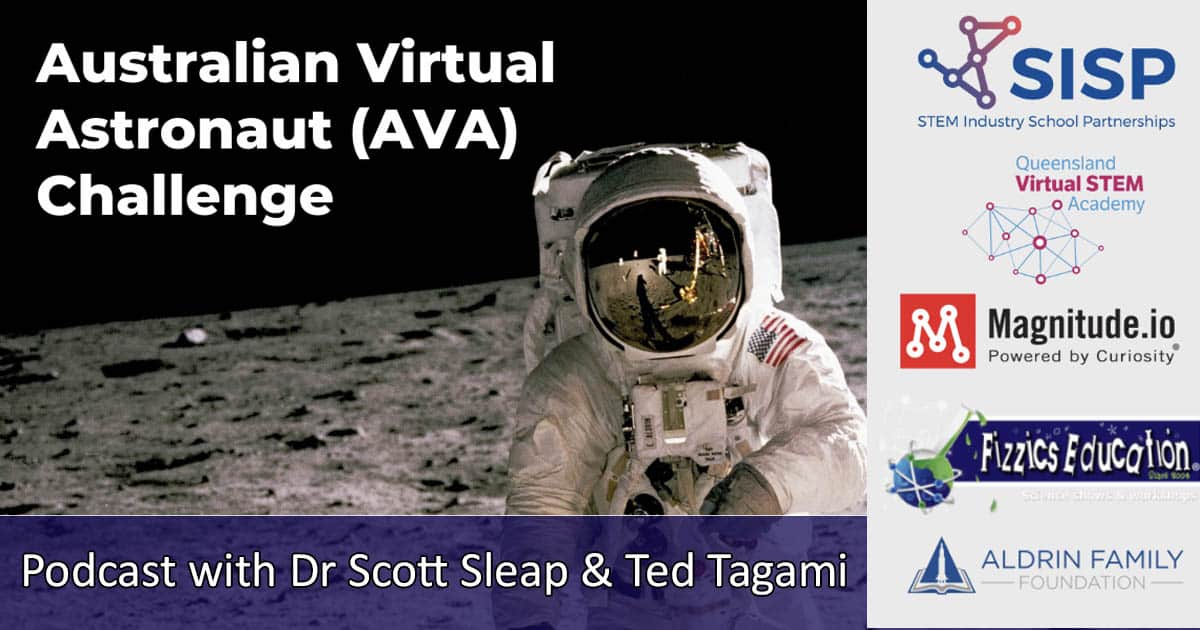
[00:00:19] Ben Newsome: Yes, welcome again for another FizzicsEd podcast. We’re talking STEM education as always and this time, it’s a challenge that your students can get involved in no matter where you are in Australia. We’re talking about the Australian Virtual Astronauts challenge, which is an awesome opportunity for kids who are even isolated due to COVID to get engaged in a real STEM project.
[00:00:45] Ben Newsome: This challenge is very much a collaboration between multiple parties, including the STEM Industry School Partnerships group out of the New South Wales Department of Education, the Queensland Virtual STEM Academy, the New South Wales Virtual STEM Academy, Magnitude.io out of Berkeley, California, Physics Education, and the Aldrin Family Foundation.
[00:01:05] Ben Newsome: Today, it’s all about hearing what this challenge is about and how you can get involved. And to do so, we’re hanging out with Dr. Scott Sleap, who is a STEM Industry School Partnerships project leader, and Ted Tagami, who is not only the co-founder of Magnitude, but he’s also the User Advisory Committee Education Chair at the ISS US National Lab.
[00:01:20] Ben Newsome: So we are really talking about space education and what could this just mean for kids not only in 2021 as we kick off the AVA challenge, but what could this mean into their future and potentially into their career? Let’s head right in.
[00:01:31] Voiceover: This is the FizzicsEd podcast. We’re all about science, EdTech and more. To see 100 fun free experiments you can do with your class, go to fizzicseducation.com.au. That’s physics spelt F-I-double Z-I-C-S, and click 100 free experiments.
[00:01:51] Ben Newsome: Scott, Ted, welcome to this FizzicsEd podcast.
[00:01:55] Prof. Scott Sleap: Great to be here.
[00:01:58] Ted Tagami: Good morning, guys.
[00:01:59] Ben Newsome: Good morning, good afternoon. We are talking global collaboration, aren’t we?
[00:02:04] Ted Tagami: We certainly are.
[00:02:05] Ben Newsome: We certainly are. I’m so stoked that you guys can join. This Australian Virtual Astronaut challenge has really got a bit of a roll on this week and is certainly engaging a lot of teachers and students around the country. I thought we might have a chance to really talk about what on earth is it, where did it come from, what’s the opportunity, and what’s potentially the outcome for students? Considering this is very much sitting in your wheelhouse right now, Scott, let us know a bit more about it if you could, please.
[00:02:35] Prof. Scott Sleap: I love the space puns, “taking off” and things like that. I think that’ll come out quite a bit in this podcast. The AVA challenge, Australian Virtual Astronaut programme, basically came out of conversations that the three of us were having in different forums, really born out of the need for really good quality education programmes whilst we’re in lockdown.
[00:03:05] Prof. Scott Sleap: In Australia at the moment, we’ve got a really big opportunity in space and space education. I don’t think a lot of people are aware of the opportunities that there are for young people now and going into the future in the space industry. I thought it was a good opportunity for those two areas to come together: the idea that we need people to be involved in the space industry, which is going to be a trillion-dollar industry by 2050 and is already a multi-billion dollar industry. It’s also meant to grow faster in Australia than any other part of the economy.
[00:03:45] Prof. Scott Sleap: That’s one side of it. It’s a trajectory that’s going to occur over a very long period of time. We’re going to be in the space industry for 50, 60 years, or basically forever. But the opportunities are now for young people, and those jobs that are going to come are for people who are not even born yet. We don’t even know what they’re going to be.
[00:04:10] Prof. Scott Sleap: What we wanted to do out of this is educate teachers and students about what it’s like to be an astronaut or what it’s like to be involved in space-based programmes so that they get inspired, so that they will be our next generation of young people that are going to come into the industry and innovate.
[00:04:39] Ben Newsome: Absolutely. Speaking of inspiration, Ted, you’ve been heavily involved in inspiration projects, and right now, as we record this particular chat, there’s quite an inspirational project flying overhead every 90 minutes. Do you want to let us know what you get up to?
[00:04:49] Ted Tagami: Thank you, Ben and Scott. This is really exciting for us. We do things with schools around the world, but you guys are going to take it to another level here. The pandemic has hit everyone globally. You guys there in New South Wales, as I’m hearing it, they’re restricting your beer access. Something’s got to change. Being locked in or stuck at home is not a feeling anyone wants for their child or student.
[00:05:19] Ted Tagami: Through these conversations, this idea emerged: how might we create a journey of a virtual astronaut? This stems from some of the work we already do. I have a company called Magnitude, based in Berkeley, California, and we run missions up to the International Space Station. We launch them usually on a SpaceX cargo resupply mission, sometimes on a Northrop Grumman cargo vessel. We have an opportunity to run those experiments in orbit for a period of time, and then they come home again.
[00:06:00] Ted Tagami: When we think about space and aerospace, a lot of people think about rockets, satellites, and astronauts. That’s just a slender piece of the whole thing. As I understand it, the Australian Space Agency was officially founded on July 1st, 2018, and they want to triple the size of that agency by 2030. By the end of this decade, they’re expecting 20,000 jobs in the Australian Space Agency.
[00:06:30] Ted Tagami: My job is to inspire and think about the crazy stuff they’re going to try to do in space. The United States has seven planned crewed missions to go to the surface of the moon; a woman and a person of colour will be there by mid-decade. We have four conjunctions between Earth and Mars between now and the end of the decade. What are going to be on those little sortie missions heading between the planets?
[00:07:05] Ted Tagami: Then these crises that continue to build on each other: weather pattern changes because of climate change, sea-level rise, the fertility of our soil. We’re having a lot of problems that almost feel intractable. Yet, you talk to any young person that hasn’t been ground down too much, and they have hope, ideas, and they’re very curious. I think we can unlock that.
[00:07:35] Ted Tagami: I’m excited about this idea of AVA, Australian Virtual Astronaut. Anyone going to join us, whether you’re an educator, run a science museum or library, or perhaps you’re a student or a citizen scientist. The idea here is how might we imagine this world across all these different activities and maybe not be so bound by the discipline of what we’re supposed to be learning right now?
[00:08:05] Ted Tagami: Let’s give ourselves a little comfort and feel good knowing that although we might be in our capsules, we can actually go somewhere. I’m really excited, Ben, about what you guys have put together. As each person joins in, you’ll add a little bit to the potluck, and hopefully, you will have ideas that you can share.
[00:08:30] Ted Tagami: Probably more than anything, Scott, what you’ve inspired me with is not just solving what’s right in front of us, but imagining what this might look like when these young people are older, or when someone just entering uni today starts their career. Whether it’s workforce development with technical skills or going college-bound, it’s cross-disciplinary. Ben, why don’t we talk a little bit more about the programme as it’s forming and what we can do going into October?
[00:08:50] Ben Newsome: 100 percent. I’m really looking forward to this. This thing is kicking off on October 8. To timestamp it completely, October 8, 2021. It’s really taking advantage of a really difficult situation. Half of Australia is locked down right now, and some of us can’t even leave more than five kilometres around our home. But that doesn’t mean we can’t do a thing.
[00:09:20] Ben Newsome: We see it as very much being analogous to being trapped in a space station, or trapped on the moon in a particular space. It’s not that much different. You think about the resources around us; we can use them to solve challenges. Ted, you were talking about issues coming up with climate. We thought, what’s something that unifies students together apart from their isolation?
[00:09:50] Ben Newsome: We all eat. It’s a thing that needs to happen. That really links very closely with the Artemis missions and eventually going to Mars. Astronauts need to be able to eat nutritious food. What will be designed by the students themselves is how they can use resources around them to grow a thing in a way that works in their environment.
[00:10:10] Ben Newsome: It’s really born out of the scaffolding, the design process that’s done with iSTEM. Scott, I’d love it if you could briefly mention what iSTEM is all about and how that backbones this particular challenge.
[00:10:23] Prof. Scott Sleap: When I was younger, I was actually inspired by members of my family to be an engineer. I’ve always wanted to do engineering, and then I became an engineering teacher. Later on, I went back to university and completed a PhD in engineering, so I’ve always had that passion for engineering and problem-solving. One of the things that we did in the New South Wales Department of Education is develop a curriculum that really supported the engineering design process, innovation, and entrepreneurship.
[00:11:00] Prof. Scott Sleap: As part of that process, it’s very much about enabling teachers to support students going through a complex problem-solving process, which we’re calling the iSTEM engineering design process. Basically, it’s eight different cogs, eight different sections of that process that scaffolds how to get through from having an idea right through the design process to communication.
[00:11:45] Prof. Scott Sleap: One of the big aspects of anything you do when you’re talking about complex problem-solving is this idea of iteration. No one ever gets the thing right the first time.
[00:12:05] Prof. Scott Sleap: We’re all about trying to break this fear of failure. If you don’t get it right the first time, you think about products like WD-40. The name 40 is because it was the 40th iteration of that design.
[00:12:45] Prof. Scott Sleap: This is the type of thought process that we want from Australians. We want them to be able to look at big problems like climate change, the pandemic, or getting into space, and find ways to solve and iterate those problems, constantly improving. While we have a very strong science base with this, we’re also overlaying it with the opportunity for students to work collaboratively in teams.
[00:13:00] Prof. Scott Sleap: They will identify a problem related to space and food and use their creativity and entrepreneurship to come up with a solution, an experiment, or a device that will be just one of those little things getting us a little bit closer to the moon and Mars.
[00:13:19] Ben Newsome: 100 percent. It’s been compressed into a six-week challenge where not only are they solving this challenge of growing food in a device they create, we really want them to showcase what they’ve done. Isn’t that part of the process of science, sharing what you do? We’re inviting schools to consider the students creating their own one-minute video of what they did.
[00:13:45] Ben Newsome: It could be the steps along the way, a collage, the end process, or a shared Zoom screen of how they went about their creation. Putting a hashtag around it: #VirtualAstronautAU. That way we can really find what people create. Scott, you mentioned teams. Ted, you’ve rearranged STEM into TEAMS, and I’d love to jump into that mindset because that really frames what this is about.
[00:14:15] Ted Tagami: Absolutely. I mentioned these almost intractable problems on the planet, and I think we give hope to the next generations. I’m getting close to granddad status, so everything I’m doing is in my own self-interest. I want a really healthy, happy planet for my future offspring. STEAM, how wonderful is that? My background is actually art, and it’s amazing that I can get these projects into orbit.
[00:14:45] Ted Tagami: Our ninth mission is literally on station right now, growing these plants and thinking about how they might work with bacteria to help rejuvenate soil. The fertility of the soil is one thing I mentioned earlier.
[00:15:05] Ted Tagami: A lens that’s really easy for me to think about as we work with schools around the world are the United Nations Sustainable Development Goals. There are 17 of them, anywhere from Zero Hunger to Quality Education, Equity, Life on Land, Life Below Water. You can go look at the United Nations SDGs, and you can look at how, through one of those lenses, we might make the world a little better.
[00:15:53] Ted Tagami: When we think about that, it’s amazing when you have an opportunity to work with brilliant people that really know their subject: physics, chemistry, biology, or engineering. What happens is their domain is so deep that unfortunately, they have to be less deep in other areas. I’m kind of the opposite; I’m pretty shallow across a very broad spectrum. But I’ve got my antennas up.
[00:16:35] Ted Tagami: When you bring very smart people together in different domains, you can start looking at these complex problems in different ways. A biologist might look at it a certain way, the chemist looks at it differently, and the engineer comes at it from somewhere else. Only through collaboration and teams will we actually think about how to affect climate change. Everyone has to come together to figure out these bigger issues. It is one system.
[00:17:29] Ted Tagami: If you look at STEM—science, technology, engineering, and maths—I love my arts, so I put the A in there for STEAM. But that relevance didn’t resonate with me as much as TEAMS does. Take that S, append it to the end, and we’ve got TEAMS: technology, engineering, arts, maths, and science. We can apply everything we think we do really well.
[00:18:00] Ted Tagami: Maybe I do great TikTok videos, or I’m great at writing, researching, or building with robots. When you start bringing a team together like that, it’s like watching a superhero movie; there’s a whole squadron of them. You’ve got to bring a team together if you’re going to solve some of the hairier problems.
[00:18:29] Ted Tagami: You want to build a settlement on the moon? Okay, but what do you know? Who else might you need to come along with you to fulfil that? This is what gets me excited. What’s beautiful here is we think about what everyone’s concerned about right now: learning loss. Numeracy and literacy, these anchors, we can do all of that; we’ll back into it.
[00:19:15] Ted Tagami: We’ll start with feeling comfortable, getting that curiosity going again, and getting that social balance back in our lives. It’s like a musical instrument. If that instrument isn’t in tune, it doesn’t matter how good the fingering is; it’s going to sound bad. That social-emotional balance is what will take this idea of being locked in to something liberating and free.
[00:19:35] Ted Tagami: Ben, Scott, I’m absolutely loving the Australian Virtual Astronaut. Where are we going to take it? Teachers, museum chairs, come talk to us. It’s an emergent conversation, and whatever we do here, we can do in the States, South Africa, Germany, Greece, or wherever we run our projects.
[00:19:48] Ben Newsome: 100 percent. That’s why these six weeks have been set up. Every Friday morning at 9:30 AM Australian Eastern Standard Time from October 8th onwards, a few of us get together on a panel on a Zoom webinar, and we talk about the process, where we are up to in the iSTEM delivery that embeds the challenge.
[00:20:15] Ben Newsome: What’s going to be fun is the opportunity to talk about what happens in the real world. Think about the HI-SEAS project in Hawaii, where people practise being isolated as astronauts, wearing suits in the middle of lava fields. The students have the opportunity to create their own virtual EVA, so to speak.
[00:20:30] Ben Newsome: Whilst it is a webinar and the students consume this through a YouTube livestream, they will be interacting with us using Kahoot. Importantly, we’re not telling them how to design their thing. It’s up to them to create their own solution to this challenge, which is growing food in their own home.
[00:20:58] Ted Tagami: I’d just like to create a couple of anchors. You mentioned some things that are really exciting. Lori Waters works for my company; she’s the Vice President of Learning Experiences. Lori spent time on the volcano in Hawaii in an analogue mission, pretending to live on the moon. They had to put on spacesuits to go outside, collected samples, and thought about habitat and working as a team in a small, closed environment.
[00:21:40] Ted Tagami: She’s going to share some of that, and her university has another analogue mission coming up. We’re hoping to get some live reports from that. Again, this is all dynamic.
[00:22:20] Ted Tagami: Ben, I was chatting with you and Scott, and we realised there could be a crisis if we didnt address it. So we’re coming up with things threaded together thematically to this idea of being an astronaut. Analogue missions go on around the world; they grow plants in the South Pole. They live underwater for weeks or months to acclimate to what that environment might be like.
[00:22:50] Ted Tagami: In space, where does your coffee come from? Today’s coffee is tomorrow’s coffee. They have to recycle 99 percent of the water. We’re lucky because the Space Station is about 400 kilometres up and is resupplied every three months. But when you go to the moon, we won’t have that privilege. Going to Mars, definitely not; it’s a six or eight-month trip. There are really big challenges as we expect by mid-century to have someone on the surface of Mars.
[00:23:30] Ben Newsome: This is the thing. There is a genuine chance that the students here are going to be experiencing what kids did back during the Apollo era. Scott, I’m so excited that you’re able to pull us all together to create this event. For people watching going, ‘Alright, I’m in. How do I get involved?’ Scott, how would they do that?
[00:23:55] Prof. Scott Sleap: If we go on the STEM 2021 website, which was set up for teachers learning about STEM, we’re using that as the vehicle. So www.stem2021.com.au/ava. That will give you information about what we’re doing. Teachers will actually register to be part of a Zoom event and will be in the background with us, working hand-in-hand to develop what you want out of this programme.
[00:24:49] Prof. Scott Sleap: I think this is what’s really important. Ted mentioned the work with Lori, but we’ve also got a quite large group of people working behind the scenes. I’d like to mention Wendy Bode from the Queensland Virtual STEM Academy, and Ian Preston from the New South Wales Virtual STEM Academy, who is going to be assisting with this programme. Both of those teachers are nationally recognised experts. We’re linking in with Lori, and we’ve got a few surprises coming up.
[00:25:28] Prof. Scott Sleap: You register for this programme through the website. The students will consume the information as a webinar. We will record the webinar because this has gone out quite wide and is snowballing. We’ve got schools from Western Australia, Queensland, even New Zealand. The problem is different time zones, so our live recordings won’t work as well. There will be an opportunity to get the students to watch the recording.
[00:26:18] Prof. Scott Sleap: It’s really important, this has been designed as a six-week unit. There are going to be six one-hour video webinars, and students will then go out and do different activities going through the design process. But there are opportunities if you just wanted to be part of the webinars. We’ve had questions regarding what depth the students go into outside of the one-hour webinars, and it’s really up to the teacher.
[00:27:01] Prof. Scott Sleap: You could actually go and build a whole lot of teaching resources around that, and we can help you. It’s also what you want to make of it. We are going to go there about what it’s like to be an astronaut. An astronaut on a trip has to exercise.
[00:27:25] Prof. Scott Sleap: Like Lori’s work, it may be we get the students to try to experience what it’s like being in a dome at home. It should be easy to elaborate with that considering the circumstances we’re in. It’s up to the teacher about the depth they want to go into.
[00:27:49] Ben Newsome: It’s going to be fantastic. As usual, for those listening on a podcast, the link will be in the show notes. If you’re watching this on the AVA website right now or on YouTube, look down the bottom for the link. Thank you so much, Ted and Scott, for joining to chat about the Australian Virtual Astronaut challenge.
[00:28:15] Ben Newsome: Wouldn’t it be interesting in a couple of years if we changed AVA to WVA? World? Who knows? Teachers, we are excited you can join us. Let’s see what happens with #VirtualAstronautAU.
[00:28:39] Ted Tagami: Love it. Thanks, guys.
[00:28:43] Voiceover: Thanks for listening to the FizzicsEd podcast. Sign up now for our fortnightly email newsletter. It’s loaded with details on new experiments you can do, STEM teaching articles, new gadgets, exclusive offers and upcoming events. Go to fizzicseducation.com.au. Scroll to the bottom and add your email.
[00:29:01] Ben Newsome: So, what do you reckon? Do you think this might be a way to engage kids who are stuck at home in STEM? I’ve got a sneaking suspicion it is a potentially useful idea, and it’s something that kids are totally going to want to grab onto. Definitely head on over to the Australian Virtual Astronaut challenge’s website. Go to the website, it’s stem2021.com.au/ava.
[00:29:30] Ben Newsome: There you’ll find all the information not just about the project outline itself, but there’s a bucketload of stimulus material. Trust me, there is heaps of stuff linked towards space science and new websites that you can really sink your teeth into no matter where you are doing your space unit.
[00:29:50] Ben Newsome: Even if you’re not doing space units for your teaching and learning right now, there are so many spinoffs when it comes to space education that link with multiple key learning areas. It’s really worth checking it out and potentially getting your students involved. Head on over to stem2021.com.au/ava. That’s enough of this particular podcast. Thanks very much for hanging out with me, Ted, and Scott. We hope to see you soon.
[00:30:16] Voiceover: Thanks for listening to another FizzicsEd podcast. We’re excited about science. Subscribe to us on iTunes to download the next episode as soon as it’s released. And don’t forget, for hundreds of ideas, free experiments, our new Be Amazing book and more, go to fizzicseducation.com.au. That’s physics spelt F-I-double Z-I-C-S.
[00:30:44] Voiceover: This podcast is part of the Australian Educators Online Network. AEON.net.au. A-E-O-N dot net dot au.
Frequently Asked Questions
What is the Australian Virtual Astronaut (AVA) challenge?
The AVA challenge is a six-week STEM programme designed to engage students in space exploration and industry. It task students with solving the real-world problem of growing food in isolated environments, mimicking the conditions of a lunar base or a space station. The challenge is a collaboration between the NSW Department of Education, Magnitude.io, the Aldrin Family Foundation, and Physics Education.
Who can participate in the challenge?
The challenge is open to all Australian students and schools, regardless of their location. It was specifically designed to be accessible for students during lockdowns, allowing them to participate from home or in a classroom setting. Schools from New Zealand and various Australian states like Western Australia and Queensland are also encouraged to join.
How does the challenge relate to the iSTEM curriculum?
The programme is built upon the iSTEM engineering design process, which uses an eight-stage framework (often referred to as ‘cogs’) to scaffold student learning. This process guides students through assessing resources, identifying problems, brainstorming solutions, prototyping, and iterating on their designs to overcome complex challenges.
When do the webinars take place?
Live webinars are held every Friday morning at 9:30 AM Australian Eastern Standard Time (AEST) starting from 8 October 2021. For students in different time zones, such as Western Australia or New Zealand, the sessions are recorded so they can be consumed at a more convenient time.
What is the final outcome expected from the students?
Students are invited to create a one-minute, student-led video showcasing their design process and the solution they developed for growing food. These videos are shared using the hashtag #VirtualAstronautAU to build a community of young innovators and to simulate the scientific process of sharing findings with a wider audience.
Extra thought ideas to consider
From STEM to TEAMS
Consider the shift from the traditional STEM acronym to ‘TEAMS’ (Technology, Engineering, Arts, Maths, and Science). This mindset emphasises that space exploration requires a diverse range of skills, including creative communication, research, and artistic design, alongside technical engineering and scientific inquiry.
The Global Space Economy
Reflect on the fact that the space industry is projected to be a trillion-dollar industry by 2050. Many of the jobs that will exist in this sector haven’t been invented yet. Engaging in challenges like AVA helps prepare students for a workforce where adaptability and complex problem-solving are paramount.
Analogue Missions at Home
The challenge uses the current reality of lockdowns as a metaphor for space isolation. Students can think about how their own homes act as ‘habitats’ or ‘capsules,’ requiring them to manage resources, maintain social-emotional balance, and solve survival problems just as astronauts do during analogue missions on Earth.
Discussion points summarised from the FizzicsEd Podcast podcast, verified and edited by Ben Newsome CF