Transcript
[00:00:00] Ben Newsome: You’re listening to the Fizzics Ed podcast. For hundreds of ideas, free experiments and more, go to fizzicseducation.com.au. And now, here is your host, Ben Newsome.
[00:00:21] Ben Newsome: Welcome again for another Fizzics Ed podcast. Glad to have you again for another chat around STEM. This week we’re talking about one of the simplest materials you can find in the classroom, paper. Seriously, paper is everywhere and did you know you can make some awesome STEM projects using this stuff? Godwyn Morris really knows a thing or two about how to make this really sing in the classroom. She is the director of two programmes in New York City. One is Dazzling Discoveries, which is a STEAM education centre, and she also runs Skill Mill NYC, which is a maker space and digital fabrication studio for adults and teens. She is also the inventor of Dazzling’s cardboard engineering kits and the co-creator of Engineering with Paper, which is a fantastic resource for teachers because they’re downloadable and very useful. Godwyn has over 20 years of experience working in STEM and it’s a great time to have a chat with her about what paper engineering really looks like and how we can get involved.
[00:01:36] Ben Newsome: This is the Fizzics Ed podcast, all about science, edtech and more. To see 100 fun free experiments you can do with your class, go to fizzicseducation.com.au. That’s Fizzics spelled F-I-double-Z-I-C-S and click 100 free experiments.
[00:01:39] Godwyn Morris: I do so many things. I run a maker space in New York City. I’m based in New York City and you can tell from my New York accent compared to your wonderful Australian accent. I have two physical spaces in New York City. One is a classroom-style space and the other is a more traditional-looking maker space with all the equipment, the laser cutter, 3D printers, sewing machines, vinyl cutter, etc.
[00:02:15] Godwyn Morris: It’s not a membership organisation. It’s what we call fee-for-service. It’s meant for the general public because there’s not a lot of access for the general public for laser cutting or 3D printing. This is just a tiny piece of what we do, but we provide these laser cutting and 3D printing services for people. We tend to get artists, partly because those are the people who know what a laser cutter is and what you can do with it.
[00:02:45] Godwyn Morris: We also run a huge programme for teachers and students in both our maker space and our classroom space. They’re one block apart so we can move between the two of them. Just real estate-wise in New York, I couldn’t get them next to each other, but I was able to get them a block apart.
[00:03:14] Ben Newsome: That’s not bad.
[00:03:15] Godwyn Morris: It wasn’t bad. It’s a funny story how that worked out, but it is what it is. I’ve been running an after-school science programme in New York for 20 years. As that grew, we kept getting more schools, we got bigger, and then I needed my own physical space. I rented one space and then I really wanted a maker space. There was no good business reason for it; I just wanted that equipment a few years ago.
[00:03:52] Ben Newsome: You sound like every educator I love. Honest to God’s truth, that’s exactly what I set my company up to do. I just want to play with cool stuff. I’m just a kid. You sound exactly the same.
[00:04:10] Godwyn Morris: That’s why I love your website and what you do, and that’s why we met, because I found you and I’m connecting with people all over the world who do this kind of thing. I was able to create this space, so we work with a lot of school groups. They come to visit, we do in-person visits. I go to a lot of schools. This past year has shifted everything a little bit, so we’re doing a lot more virtual. Now I’m doing virtual workshops all over the world. It’s been amazing.
[00:05:00] Godwyn Morris: What’s come out of a lot of my work over the years is something we call Engineering with Paper. Most people know paper engineering as a concept, and that’s a very common term. We flipped it a little bit so we could create a trademarked name so you could identify us. It’s called Engineering with Paper. You can see it on Instagram, on Twitter, and our website. It is a methodology that I created with Paula Frisch, our assistant director, for how to make almost anything with just paper, tape, and scissors.
[00:05:41] Ben Newsome: I love this. Paper is fairly ubiquitous. We can get this, we can get scissors, we can get tape. You can fold the paper in ways that it doesn’t need the tape. What you’re doing is so accessible and it’s very connected into the true STEM process. It’s not just a “here’s my template, let’s do the template.” You’re really building the building blocks and empowering kids to use those building blocks in ways that they can do themselves. It’s really cool.
[00:06:21] Godwyn Morris: As we were just talking about being on lockdown, it’s perfect for kids at home to be able to make things without having to have a lot of supplies. It’s also a really great equity issue.
[00:06:37] Ben Newsome: Massively. If people haven’t come across Engineering with Paper, could you paint a picture of what this looks like for the kid? The kid gets told by their teacher or their parent to go check this thing out. What are the initial steps to get involved in this design thinking? What are they making to then make more complex as they go along?
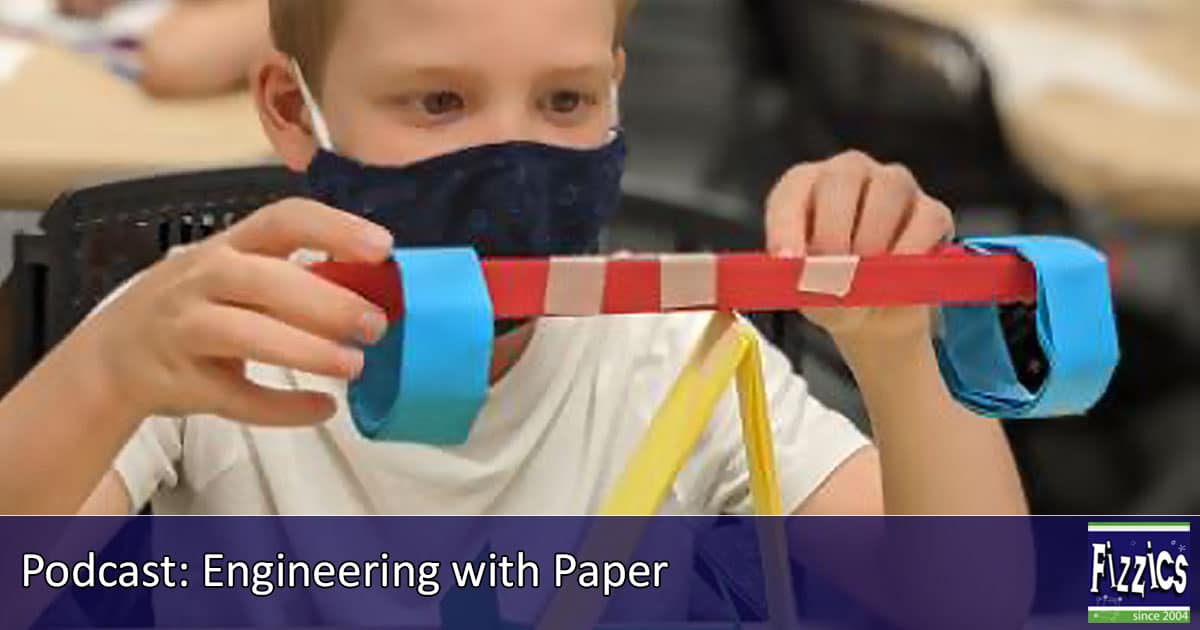
[00:07:07] Godwyn Morris: It’s not origami. It’s three-dimensional shapes. It’s a really simple concept. If I teach teachers, then they can teach the kids how to make basic shapes. This is going to sound really simple, but cylinders. You’d be amazed at how rare it is that people actually remember to use cylinders to build with. You can make wide cylinders and tape them together to make structures. You can roll them really tight into paper straws and connect them into structures.
[00:07:45] Godwyn Morris: That’s just two examples of cylinders. We have 28 or 30 different shapes: a track shape, a tray shape, a cone shape, a cylinder shape, a rectangular prism. The idea is that this methodology teaches you how to make the shapes. If you teach kids how to make shapes and then give them a challenge, it levels the playing field. It means all your students know how to get started, which in my experience is the biggest stumbling block.
[00:08:20] Godwyn Morris: There are some kids who know what to do. You give them a challenge to make a tower that can hold a book, and there’s always a group of kids who already have some past experience. They kind of know what to do. But then there’s that other group that looks at you with that “deer in the headlights” shock of “I don’t know how to get started.” So they say, “I don’t want to do this.”
[00:09:00] Godwyn Morris: My experience is 99% of the time that children say, “I don’t want to do something,” it really means “I don’t know how.” It means I’m scared, I’m clueless, and I don’t want to feel that way. If you teach them some basics—how to make cylinders, rectangular prisms, cone shapes, paper trays—and then say, “Now we’re going to build a tower that can hold a weight,” they have resources in their minds to draw on. They are much more willing and excited to take on the challenges you give them.
[00:09:45] Godwyn Morris: That’s the fundamental concept here. We do have downloadable packets on our website. Some of them are free. Some are inexpensive. The only thing that costs a lot more is if you want to buy the packet that is all the shapes and all the projects. We do give you projects if you want to follow them. Some people just want the shapes. How does that sound to you?
[00:10:13] Ben Newsome: That sounds perfect. We know about lesson progression, like scope and sequence. You start off with the simple stuff and build it up until the kids can do complex things. But this is really open-ended. A good friend of ours, Kylie, does a lot of this work in 2D, and you’re doing this in 3D. Once you understand how shapes work and tessellate, interact, connect, and articulate, it means kids can really make whatever they want.
[00:10:43] Ben Newsome: Even knowing what paper is like in terms of its strength, I know there’s a very simplistic thing called “the crusher”. You just think of four pieces of wooden dowel and a platform that slides over this bit of dowel and crushes down on things. We simply get kids to investigate the strength of said cylinders of paper by making different widths. We actually use spaghetti because it fits in the crusher easily, and they just keep going until the thing crushes.
[00:11:13] Ben Newsome: Once they know the strength of their cylinders, they can apply it to their towers. Godwyn, you mentioned you have over 20 shapes that they learn to build. You must be able to see some amazing structures. What’s the most complex thing you’ve seen someone make out of these basic shapes?
[00:11:42] Godwyn Morris: The answer to that question is twofold. One is that we do have some projects that we’ve come up with. We make a completely rolling car with turning wheels, 100% out of paper. That’s our wheel and axle packet. We have a car, a carousel, a ferris wheel, and we show you how to make those, and then kids go off on their own.
[00:12:13] Godwyn Morris: Kids will often make fans where you make your own blades, windmills, and all of that. The other direction, in terms of what kids have come up with, is our paper roller coaster, which uses incredibly simple shapes. It’s either cylinders or rectangular prisms as the structural support, and then our paper track.
[00:12:41] Godwyn Morris: A track is simply a strip of paper with the edges folded up so it has little walls. You make a bunch of tracks and attach them to these supports. You can make amazing roller coasters with just tracks and bending them, placing them in the right way using a couple of supports.
[00:13:05] Godwyn Morris: We did a workshop last February for a school with about a hundred students on Zoom. They all had just paper, tape, and scissors. We taught them how to make the basic supports, making them double height.
[00:13:32] Godwyn Morris: Then we showed them how to make the tracks and just sat back and watched all the little windows on Zoom as all the kids were building. That’s what we’ve had the whole year: kids building. They’re looking at their hands, they’re looking at their paper, making things. They don’t need to be looking at the screen after we teach them the basic shapes.
[00:13:54] Ben Newsome: I love that. People talk about Zoom fatigue; it’s real. I love any programme that engages the hands to do a thing. The real measure of a programme is if the students are engaged and don’t require the teacher prodding at them. It’s even better when the kids are talking to each other about what they could do better, teaching each other. Now you’ve got a real ecosystem of learning.
[00:14:33] Ben Newsome: This is quite powerful when you think about it as a STEM concept. You build the thing and test it. As a science teacher, I start to think about measuring potential versus kinetic energy on this paper roller coaster. You could almost have someone who loves history look at the history of roller coasters.
[00:15:03] Ben Newsome: Or try to sculpt something. The challenge could be to build an everyday object with complex angles out of paper, and you’ve got one hour. You could do whatever you want.
[00:15:16] Godwyn Morris: Exactly. We say that this doesn’t have to be the end of your process. This is often the beginning. If you’re doing force and motion, this is a great way to start it. Kids can make it at home, and then you can give them a second challenge to go find objects at home to build a second version.
[00:15:52] Godwyn Morris: You can extend the thinking to additional materials, particularly if you have a real maker space. You could make things out of wood or cardboard. We just know that it’s an easy entry point to start with paper. Get them to make paper models so they understand the science, and then they can build a more complex project.
[00:16:21] Godwyn Morris: We have teachers who buy our packets and use them through the year, never needing to build with more complex materials. It’s a starting point: teaching them shapes, teaching them how to connect things, and then taking it in all kinds of directions. I love your concept about history. We are constantly trying to get English teachers and history teachers to participate in these hands-on activities.
[00:16:56] Ben Newsome: Even just taking it to another side, you could have drama teachers create stop-motion animation. We do claymation all the time, why can’t we do that with paper? I like it when you have the intersection between more than one idea, as long as you give the kids a scaffold to build off, so they’re not thrown into the headlights.
[00:17:38] Ben Newsome: I do a lot of outreach, and I try to avoid prescriptive things. It’s almost like making a cake where you only get these exact ingredients and this exact procedure. Procedural thinking is important, but I like it when kids can be organic with their thinking.
[00:18:08] Ben Newsome: It’s like programming. You’ve got top-down programming, which is like the exact cake recipe, or bottom-up programming, where here are the loose rules. Once the kids know the basic rules, they can do whatever they want. Once they know what to do, they use it as a tool to solve a problem. Isn’t that what STEM is in the first place?
[00:18:48] Godwyn Morris: Absolutely. That’s why we created it based on these shapes. Once you teach them the shapes—that they can take a flat piece of paper and roll it, bend it in different ways to get structural shapes—it seems to break through that barrier of fear. Then, when you give them a challenge like building a model boat or a roller coaster, they know how to get started.
[00:19:24] Godwyn Morris: It’s just skill-building. You would never expect somebody to build a real bridge without going to engineering school. You need to learn fundamentals about structures, materials, and shapes, and then you can design your bridge. Give kids the fundamentals so they can build projects based on that.
[00:20:04] Ben Newsome: It’s about being creative too. Shapes interconnect. Right now, medicines are supporting communities, and these medicines are really shapes that connect. We talk about the spike protein on a virus; it’s a shape. It’s a lock and key mechanism. You could use this to look at how medical drugs are designed to target a particular protein.
[00:20:42] Godwyn Morris: It’s a fun tangent! I’m with you!
[00:20:44] Ben Newsome: You could totally look at how the lock and key mechanism works in 3D. Anyway, I know you’ve got a conference coming up.
[00:21:12] Godwyn Morris: Thank you for asking about that.
[00:21:15] Ben Newsome: What’s that all about?
[00:21:18] Godwyn Morris: Are you familiar with Maker Faire and Make Magazine? I am working with the company called Make that produces Maker Faire, and we are running a conference for educators on September 24 and 25, US dates. Kylie is speaking at the conference on Friday evening to your Saturday morning.
[00:22:11] Godwyn Morris: It’s all about how educators can better incorporate making and hands-on activities into their daily curriculum. It’s about maker spaces, but broader than that. I’m doing a Zoom presentation so you can see our projects in motion. We have people talking about art, design, how to set up a maker space, and how to tackle real-world projects with students.
[00:22:59] Godwyn Morris: The website is make.co, and there’s a link for the Make Education Forum right at the top. It’s an international, virtual conference. I have not seen anybody else take on this particular angle where STEM, making, curriculum, hands-on, and design thinking are all in one event.
[00:23:04] Godwyn Morris: Please register, we want you all there. Kylie wants you all there. Do you know Rob Ives?
[00:23:54] Ben Newsome: Yes, absolutely.
[00:23:55] Godwyn Morris: He’s speaking. I’ve become very good friends with him during the pandemic. He’s a brilliant paper engineer, but his work is more “follow these instructions, print out, do it this way.”
[00:24:26] Godwyn Morris: The main thing about our work is that there are no templates; you’re not cutting anything out according to exact instructions. You’re looking at the shapes and putting them together in different ways.
[00:24:55] Godwyn Morris: It’s “look at these shapes, think about how to use them, and combine them to make a variety of projects.”
[00:25:02] Ben Newsome: That’s fantastic. The one thing I do like about this pandemic is it’s been a true catalyst. So many cool conversations have happened faster. It’s good to look on the bright side.
[00:25:21] Ben Newsome: That conference is September 24 and 25, 2021. If you’re listening to this a year or two later, suggest going to make.co, as there will probably be another conference like that.
[00:25:42] Ben Newsome: If a teacher wants to change direction for next year’s programme and incorporate more making and STEM, what are the first steps to take?
[00:26:16] Godwyn Morris: I think you should buy some of my packets because that gets you started at a basic level! But one of the main suggestions you’ll hear is to be brave. You have to let the kids be creative, let them try, let them get frustrated, and experiment. You have to not have an absolute outcome.
[00:26:52] Ben Newsome: And be okay to fail, right?
[00:26:54] Godwyn Morris: They need to play. They need to try. So do the adults. I did a workshop today for a museum, and the educators were willing to play. I showed them basic structures, and they started making their own arches and turning the paper in different ways. That’s what you need to let kids do, but some teachers are not experienced with controlled chaos.
[00:27:34] Ben Newsome: I agree. Because you work in 3D, I wonder if you could build a Möbius strip? You turn the paper once and get this infinite one-sided piece. There’s also this thing called a Klein bottle, where a 3D thing suddenly becomes a 2D thing. I wonder if you could do that with paper?
[00:28:18] Godwyn Morris: Yeah! A Möbius strip is the same concept. I think it all works off the same concept.
[00:28:25] Ben Newsome: That’s the ‘M’ part of STEM, where we’re actually looking at topology, the investigation of shapes.
[00:28:42] Godwyn Morris: We also use our paper tubes, or paper straws, which has been very popular with maths teachers because you can easily make geometric shapes.
[00:29:07] Godwyn Morris: I did a workshop for the Museum of Math in New York City. I couldn’t see who was watching. A week later, I was speaking at a completely separate educator conference, and a woman pinged me.
[00:29:45] Godwyn Morris: She said, “I just have to tell you how wonderful your workshop was last week at the Math Museum conference. I teach maths, and I never thought to just take paper, roll it into tubes, and let them build with that. You have totally opened up my whole year.”
[00:30:08] Godwyn Morris: It was just one of those weird moments where she made the effort to let me know about this simple thing. Whoever is listening, go do it. Just take paper, roll it into tubes, tape them together. You can make so many things with that.
[00:30:28] Ben Newsome: That’s awesome. I love hearing about impact stories. Thank you so much for joining this chat. If people want to reach out to you, Godwyn, how would they do that?
[00:30:50] Godwyn Morris: So many ways! engineeringwithpaper.com. That is housed under my company, Dazzling Discoveries. D-A-Z-Z-L-I-N-G Discoveries. dazzlingdiscoveries.com and engineeringwithpaper.com go to the same place.
[00:31:29] Godwyn Morris: We are on Instagram under Dazzling Discoveries and Engineering with Paper. I highly recommend that because you’ll see lots of photos of projects.
[00:31:55] Godwyn Morris: I’m on Twitter under Engineering with Paper, Dazzling Discoveries, and my own name, Godwyn Morris, G-O-D-W-Y-N M-O-R-R-I-S. You can reach me at [email protected].
[00:32:38] Ben Newsome: That’s awesome. You can also Google it. Thank you so much, Godwyn. I know you’re going to smash it out of the park with Kylie Burrett.
[00:33:01] Ben Newsome: If you want to look up what Kylie gets up to, look up splat3d.com. Kylie and I hung out on this podcast early last year. Thank you so much for joining and have a fantastic evening.
[00:33:28] Godwyn Morris: Thanks! I just want one quick mention that you and I are both participating in a Twitter Spaces series starting in September. Ben will have one show, I will be having a different show on a different date. Make sure to put that in your notes.
[00:33:53] Ben Newsome: Absolutely. That’s #K20Innovates. You’ll see a series of Twitter Spaces held by educators around the globe to share what they know.
[00:34:24] Godwyn Morris: Totally!
[00:34:25] Ben Newsome: Awesome. Thank you so much, Godwyn. Have a fantastic evening.
[00:34:34] Godwyn Morris: Absolutely! Thank you so much for having me.
[00:34:36] Ben Newsome: Thanks for listening to the Fizzics Ed podcast. Sign up now for our fortnightly email newsletter. It’s loaded with details on new experiments you can do, STEM teaching articles, new gadgets, exclusive offers and upcoming events. Go to fizzicseducation.com.au. Scroll to the bottom and add your email.
[00:34:56] Ben Newsome: Well, after that chat, I reckon it’s really worth having a bit of a go at creating some paper engineering challenges for your students. The kids are going to expand their spatial and fine motor skills, they’re going to learn about sustainability, and they’re going to have fun in the process. It’s well worth getting involved with Engineering with Paper.
[00:35:15] Ben Newsome: Go over to the website dazzlingdiscoveries.com and you will find all of that information. I hope you enjoyed that chat with Godwyn. Have a think about how you can incorporate some design thinking and some engineering challenges in your classroom using some simple materials. You’ve been listening to me, Ben Newsome from Fizzics Education. This is the Fizzics Ed podcast, and I hope to catch you another time.
[00:35:46] Ben Newsome: You’ve been listening to another Fizzics Ed podcast. We’re excited about science. Subscribe to us on iTunes to download the next episode as soon as it’s released. And don’t forget, for hundreds of ideas, free experiments, our new “Be Amazing” book and more, go to fizzicseducation.com.au. That’s Fizzics spelled F-I-double-Z-I-C-S and click 100 free experiments.
[00:36:13] Announcer: This podcast is part of the Australian Educators Online Network. AEON.net.au.
Frequently Asked Questions
What is the “Engineering with Paper” methodology?
It is a teaching framework developed by Godwyn Morris and Paula Frisch that focuses on using basic paper shapes—such as cylinders, rectangular prisms, and cones—as building blocks. By learning these fundamental structural elements, students can engineer complex, three-dimensional projects using only paper, tape, and scissors.
How does this approach help students who are hesitant to start a project?
Many students experience a “deer in the headlights” moment when faced with an open-ended challenge. By teaching them a specific “alphabet” of shapes first, you provide them with a toolkit. This levels the playing field, giving every child a starting point and the confidence to begin constructing their own designs.
Is this the same as origami?
No, while origami focuses on specific folding patterns to create figures, Engineering with Paper is about structural engineering. It involves rolling, bending, and taping paper to create load-bearing components and moving parts, such as axles for cars or tracks for roller coasters.
What materials are needed to get started?
The beauty of this programme is its accessibility. You only need standard paper, sticky tape, and scissors. This makes it an incredibly equitable STEM activity, as these materials are usually available in any classroom or home environment.
Can paper engineering be linked to other subjects besides science?
Absolutely. While it naturally fits into physics (forces and motion) and maths (geometry), it can also be used in history to build models of ancient structures or in English to create sets for stop-motion storytelling. It is a versatile tool for any hands-on learning scenario.
Extra thought ideas to consider
The Power of Rapid Prototyping
Consider using paper as a primary prototyping tool before moving to more expensive materials like wood or plastic. It allows students to fail quickly and iterate their designs without the pressure of wasting expensive resources, fostering a more adventurous “maker” mindset.
Moving from 2D to 3D Thinking
Paper engineering is an excellent way to help students develop spatial reasoning. Converting a flat, two-dimensional sheet into a rigid, three-dimensional tube or prism helps children visualise how shapes occupy space and how structural integrity is achieved through simple geometry.
Discussion points summarised from the FizzicsEd Podcast podcast, verified and edited by Ben Newsome CF