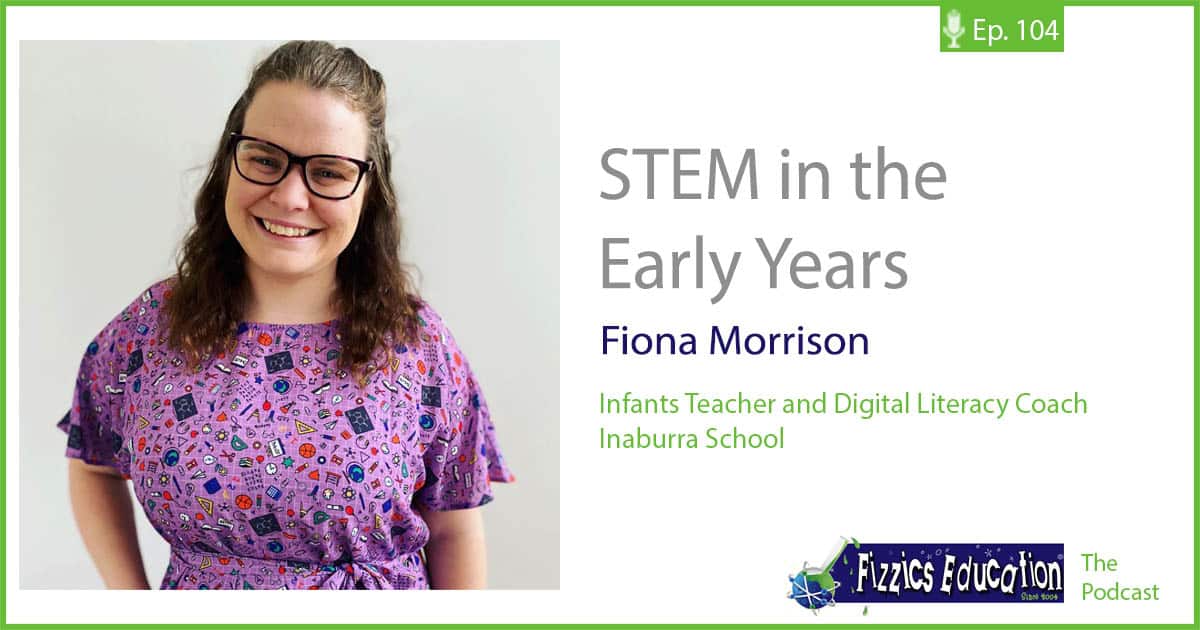
Podcast: STEM in the Early Years with Fiona Morrison
Starting off students in STEM in the early years can make such a difference to their perceptions of STEM in their later schooling years. In this episode, we chat with Fiona Morrison who is a passionate advocate of early years STEM and whom shares with us some great ideas for using Minecraft, Beebots and more as tools for connecting students to big concepts.
Fiona Morrison is a dedicated Infants Teacher and Digital Literacy Coach based at an independent school in South Sydney. With over 13 years of experience working with children across a diverse range of educational settings—including early childhood centres and Out of School Hours Care (OOSH)—Fiona brings a wealth of practical knowledge to her role. After graduating with Honours in 2014, she has continued her commitment to professional excellence and is currently completing her Masters of Educational Leadership to further influence pedagogical innovation.
Fiona is deeply passionate about the integration of STEM within the early years of schooling. She believes that by engaging a child’s natural curiosity and imagination, educators can build a robust foundation for a lifelong enjoyment of learning. As a Digital Literacy Coach, she specialises in making complex technology accessible and purposeful for young learners, ensuring they become confident creators rather than just passive consumers of digital content.
You can follow Fiona’s classroom journey and discover her latest teaching strategies by connecting with her on Twitter @FiMorrison2 or via Instagram at @teachwithmrsm.
Top 3 Learnings
Curiosity is the Foundation: STEM in the early years is less about high-tech equipment and more about fostering a child’s natural sense of wonder and encouraging them to ask ‘why’ and ‘how’.
Tangible Tech Works Best: For infants, coding and computational thinking are best taught through physical, screen-free tools like Blue-Bots that allow children to touch, see, and sequence commands in real-time.
Integration is Key: STEM should not be a standalone lesson; it is most effective when woven into the existing curriculum, such as using storybooks as a launchpad for scientific investigations.
Education Tip
Embrace ‘Loose Parts’ play! Instead of buying specific kits, provide children with open-ended materials like cardboard tubes, old CDs, fabric scraps, and pebbles. These materials encourage divergent thinking and allow children to prototype and engineer their own solutions without the constraints of a ‘correct’ final product.
Explore more: Interested in early years coding? Fiona’s work with Bluebots (as pictured above) demonstrates how tangible tech can introduce computational thinking to even the youngest students in a fun, hands-on way. You can find more resources on Preschool STEM and K to 2 education on the Fizzics Education website.
[00:00:18]Ben Newsome: Yes, welcome again to the Fizzics Ed Podcast. Glad to have you again for another chat around science and STEM and all that sort of thing. Trust me, today is definitely around the STEM side. It’s all about early years. How do you engage the younger kids into STEM learning? I can tell you now, Fiona Morrison definitely knows a thing or two about science and STEM when it comes to young kids. You see, she’s an infants teacher and a digital literacy coach from Inaburra School. That’s an independent school out of South Sydney, and she’s been working with children in a whole bunch of contexts for the last 13 years, including childcare and OOSH. So, she’s got quite a wide varied background when it comes to the younger kids.
[00:00:54]Ben Newsome: Now, she is currently studying her masters in educational leadership, but she is incredibly passionate about STEM when it comes to young kids. Really engaging the kids’ imaginations and their curiosity and really helping them enjoy their learning, and that’s what it’s all about. So, let’s listen to Fiona Morrison. Trust me, she’s got a lot to share when it comes to science and STEM, and let’s get right into it.
[00:01:15]Announcer: This is the Fizzics Ed Podcast. We’re all about science, ed tech and more. To see 100 fun free experiments you can do with your class, go to fizzicseducation.com.au. That’s physics spelled F I Z Z I C S and click 100 free experiments.
[00:01:34]Fiona Morrison: Thanks so much for having me, Ben. I’m excited to be here.
[00:01:36]Ben Newsome: Well look, I’m absolutely stoked to have you here and honestly, it’s… we’ve communicated, but through Twitter. So it’s actually kind of cool to see you face-to-face.
[00:01:45]Fiona Morrison: Yeah, it’s like you know the person really well, but you haven’t actually met them. So, it’s great to actually meet you.
[00:01:51]Ben Newsome: Although I must say on those Twitter chats, and by the way, if anyone’s wondering what we’re talking about, Primary STEM Chat happens every Thursday night at 8:30 Australian Eastern Standard Time. It is awesome, place to hang out with lots of educators. That chat with you, amongst many, many educators, it’s in a flurry. It’s so quick.
[00:02:09]Fiona Morrison: It is absolutely. I had to download TweetDeck to actually keep up with it because I can’t do it on my phone. So, my first tip there is if anyone is keen to do a Twitter chat, get onto TweetDeck because it’ll make your life so much easier.
[00:02:22]Ben Newsome: Oh, totally. And especially if you end up hosting it, it’s just insane.
[00:02:27]Fiona Morrison: Yes.
[00:02:29]Ben Newsome: Absolutely. But here’s the thing. I mean, as much as Twitter is awesome and whatnot, you’ve been involved in education for a while and clearly deal with a lot of the younger kids. Tell us, what do you get up to?
[00:02:37]Fiona Morrison: Yes, so I’ve been with the younger kids for the last five or six years in a school setting. I’ve also got two young boys at home. So, I’m really in the thick of it with the young ones. I’ve also had experience working in childcare and things like that. So, really, I’ve been working with little kids for about 13 years or so. It’s a bit busy, but it’s amazing how excited the kids get, how curious they are, all of those sorts of things. So, yeah, I’m really excited to be chatting about the early years today.
[00:03:10]Ben Newsome: So, when did you start doing that, in terms of working with the kids?
[00:03:13]Fiona Morrison: Yeah, so straight from school I did before and after school care and then I did a bit of childcare, like in a childcare centre with sort of zero to five years. So, I started with the younger kids. I worked in my church for about six years running kids’ programmes and things like that as well. And then I decided I really wanted to be an educator, really get into the thick of it with the kids in the day to day and really have an impact on their whole development. So, I graduated from university back in 2015, I think. So, I’ve been working since then with sort of year one and year two, as well as having my young boys who are two and four.
[00:03:59]Ben Newsome: You can’t get away from the young ones no matter what you do.
[00:04:02]Fiona Morrison: Love it. Absolutely love it. Although there are some days where I say to my husband, “Hmm, will any children listen to me today? Hmm.”
[00:04:11]Ben Newsome: What’s really cool about doing the early years and dealing with your grade one and two, is that you get to see the effect of the programmes that get put into preschool. And they really are quite deep and varied actually, depending on which centre that you work with. But seeing the impact of what the kids come from multiple places, they can really have different skills depending on what they’ve been exposed to.
[00:04:33]Fiona Morrison: Absolutely. I think in the younger years, there really is such a wide variety of skills, and also I think mindsets as well. So, their understanding of things, their patience for things, their resilience for things as well. So, really, when you get a whole lot of the little kids with you in either kindergarten or year one, you really have this whole spectrum that you’re kind of trying to work with and you’re trying to meet all the students where they’re at, which can be very challenging because you want what’s best for all of them, but it’s like how much time of the day do I really have to try to really nut out the nitty-gritty for all of them.
[00:05:13]Ben Newsome: Well, that’s the reality. K to 2 education, especially K, let’s be honest, it is so incredibly wide. It’s kind of like you’re wrangling cats for the first couple of months. Some kids have been accelerated, they’ve been through… I’m amazed how many parents put kids through tutoring even in kindergarten, and others are still learning… they’ve only just learned toilet training. It’s just that wide.
[00:05:40]Fiona Morrison: Yeah, absolutely. And I think coming as a parent as well, there really is this culture of comparison as well. So you know, you’re talking with other parents and they’re like, “Oh, my child has started reading books,” and they’re four years old, or “My child knows their numbers.” And I think that that can be really challenging as well for educators because I’m giving a lot of feedback to parents saying it’s okay that they can’t read by the time they’re starting kindergarten because that’s kind of what they’re learning in kindergarten. So, you’re kind of trying to alleviate the parents’ concerns there and also realise that let’s not rush the kids into reading chapter books and things like that. I think the younger years, it’s all about play and that’s a really vital part of their development and how they’re going to develop skills that are going to carry through to adulthood as well, and those skills can help them with those things like reading and writing and all of that.
[00:06:40]Ben Newsome: And that’s one of the things I really wanted to have a chat with you about. Because play is the deal with the young ones and 100% this thing that’s coming up with this STEM thing, this STEM concept that will not go away in any way. It really is so important for the young kids. How have you been addressing STEM? I mean STEM can be done in so many different ways in the older years, but for the younger ones, direction versus not direction, what do you do with it? How do you handle it? What have you been doing with STEM for the kids?
[00:07:05]Fiona Morrison: Well, it is challenging because I think we have a very crowded curriculum and there is a big focus on literacy and numeracy in those early years. And that’s important, but I think STEM really offers an opportunity to develop those real critical 21st-century skills we keep banging on about and how important they are. Collaboration, creativity, critical thinking, communication, all of those things are really crucial to STEM that carry through into those literacy and numeracy as well. So, we’ve had, due to the current circumstances with remote learning and COVID, we’ve actually had our timetable free up a little bit more. So we’ve been able to have some really explicit STEM time that really has been a challenge to fit in otherwise. I’ve been trying to slot it in when I can or integrate it into the other units because I just think it’s really crucial for the students to be involved in.
[00:08:06]Fiona Morrison: So, for example, we integrated it with our literacy unit this term. We were doing a unit on monsters and we were looking at The Gruffalo. Beautiful book, absolutely love it. So we kind of integrated it with a bit of literacy and we included maps from mathematics and we included the technology with the Blue-Bots and the students were able to make their own little maps of The Gruffalo story and move the Blue-Bots through the map. And my colleague said, “I’ve never seen the kids so engaged before.” And it’s… you’re just covering all of those key learning areas, you’re covering all of those skills and it’s kind of you see that and you think, why wouldn’t you be doing it more often? You know, like I think it’s once you actually get into it and you see what kind of learning the kids are doing, I think that’s a real buy-in for other educators as well.
[00:08:58]Ben Newsome: Yeah, you’ve just created a classic hook, haven’t you? I mean, you might be learning robotics, but no, you’re learning a story, you’re telling a story and the kids just go nuts and suddenly…
[00:09:07]Fiona Morrison: Yeah, they think they’re just playing with robots, but really we know that there’s a lot more depth to it as well.
[00:09:12]Ben Newsome: No, you just did spatial reasoning, didn’t you?
[00:09:14]Fiona Morrison: Yeah, absolutely. Absolutely covered all the bases.
[00:09:17]Ben Newsome: That’s cool. I mean, so those people haven’t seen them before, Blue-Bots are quite neat. I mean, they’re the evolution of the Bee-Bot, clear case, blue lights, kind of cute sort of thing. Do you get the kids to programme off an iPad or do you get them to do it on the buttons?
[00:09:32]Fiona Morrison: We’ve been doing it on the buttons with the actual robots. I think that gives them the opportunity to pick it up and explore it and sort of when they get it wrong and they’re trying to debug what they’ve done, they kind of pick it up and go, “Okay, well I’ve got to move it here and I’ve got to move it there.” And I think again, it goes to that spatial reasoning of because they’re so little and they’re not familiar with coding as much as maybe the older years, it really gives them that ability to kind of move it around and realise, “Oh it goes here and it goes here and I’ve got to move along here.” So the evolution to the iPad and that kind of coding will come, but I think as an introductory, just that hands-on with the actual Blue-Bots has really been helpful for us.
[00:10:14]Ben Newsome: No, I agree. I mean the whole concrete learning thing comes up. I mean, I honestly find it easier to teach just by picking the thing up and moving it around. And watching the kids trying to get their head around cumulative impact of their coding. You know, they think they press a button and that’s the next thing it’s going to do, and they’ve got the other 30 commands they’ve given it…
[00:10:32]Fiona Morrison: Yeah, yeah, and they forget to cancel the previous programme! And so you just see them press the buttons and they go off and they’re wondering why it’s done that. You’re like, “Oh remember you’ve got to cancel the programme first before you…” But they pick it up really quickly, which is amazing.
[00:10:45]Ben Newsome: What’s cool about this is that you could actually bring in the built environment because they could build the forest for The Gruffalo, they could build castles and bridges and whatever else you feel like. It really comes down to the time thing you get.
[00:10:57]Fiona Morrison: Absolutely.
[00:10:58]Ben Newsome: So how would you handle this from a remote learning point of view? Because the kids are in different small houses.
[00:11:03]Fiona Morrison: Yes, so we were trying to incorporate some STEM into our remote learning. So we did things like even things like baking. During Anzac Day, we got the kids to bake their Anzac cookies, and we could do that at school and we could also get them to do it at home. And you’re including your mathematics and, you know, the science of, like, why is the bicarb soda bubbling up and things like that. We were able to incorporate those kinds of things. And it’s really just trying to think of what do the students have access to at their place? STEM‘s fantastic because, you know, you can kind of use almost anything to do building. Like a lot of the students in our area, they have access to LEGO. So if we say, “Can you build X, Y and Z?”, they can do that. We also… just trying to remember off the top of my head, there was something else I was going to say. What did we get them to make? Oh, we… because they’ve got access to devices and technology, we were able to put them onto the Hour of Code website. So the students went through a very basic block coding with that as well.
[00:12:12]Fiona Morrison: But we, yeah, with our science unit last term, we included some design thinking for the year ones and they had to come up with… you know, they had to create something to monitor the noise levels in the classroom. And we started that before remote learning. And so, you know, we’d gone through the empathy stage and the iteration stage and the design stage and they got to that and that’s where they went home. And we actually found that the students had more access to resources at home. They thought, “I want to make this, okay I’m going to use this, I’m going to use that,” rather than relying on only what we had at school. So the things that the students came up with were phenomenal. They came up with lots of different gadgets. We had one student who made a speaker for the phone out of plastic cups and a toilet roll. And it was amazing. I loved it. And I think just them having a bit more space to do that at home because they didn’t have as much of a structured timetable at home. If we say, “Can you turn this design that you’ve made into something at home?”, they just ran with it. And the parents said that they loved it because they got to go and build and create and do those things. And it’s not something that the parents have to monitor as much as, “Okay, go onto the device to do your English and your maths,” because that was a challenge for our kids during remote learning.
[00:13:32]Ben Newsome: That’s totally cool. You literally… it reminds me of the thing I have actually built, so I’m not going to describe it very well, but someone had set up a way of doing a home theatre within cardboard and their iPhone. It projected out which was really, really cool. It’s something you’d create with kids. But I was also just thinking there too about the sound meter within your room. It’s something I kind of did with secondary school kids. We made it, but I didn’t tell them what I was really doing was creating devices which if it actually starts moving is telling you that the class is too loud. So they all made their own quieting devices, it was awesome.
[00:14:08]Fiona Morrison: Oh, well, that’s kind of where we were going with our year ones because we were looking at sound energy and they didn’t understand the concept that we wanted something that could tell the kids when to make noise and when to stop making noise. So they were all thinking, “Okay, it’s something that stops making noise.” So they would ring a bell and go, “Okay, everyone be quiet.” And I’d be like, “Well, how do we… what can we do to make it noisy again if we want people to talk to each other?” and they’re all like, “Hmm.” And they had to really think about it. So it was good to be able to include that questioning to extend their thinking as well.
[00:14:40]Ben Newsome: Oh, totally. Actually reminds me we’ve run a lot of LEGO Mindstorms programmes, and whenever they use the clap to stop, very simple programme. Problem is they don’t allow for the actual genuine noise in the classroom, and the thing won’t move! And I’m going, “Of course it’s already too loud,” and then having to realise they’ve got to change the sampling level. It’s kind of funny watching them actually sort of realise that. And then they realise that the louder they are, the more it moves. They then change it, and then suddenly the class just becomes way louder because they’re all screaming at the robot!
[00:15:11]Fiona Morrison: Oh, that’s fantastic!
[00:15:13]Ben Newsome: It’s good fun. The thing is like I mean STEM is often… depends on which way we cut it anyway, and that’s a lot of the “T”, the technology side of things. But there’s lots of science that kids can do. There’s a lot of measurement and engineering and whatnot, and the kids can have fun. I love the fact you were talking about the Anzac biscuit.
[00:15:29]Ben Newsome: By the way, if you’re listening and you haven’t had an Anzac biscuit, just get some golden syrup and some rolled oats and… rolled rice? Maybe you could try it with rice, that’s the experiment. Oats versus rice! But they were used in World War I and they were fantastically awesome for our soldiers and we’ve had them ever since down this way. Very good. And I suppose do you have any kids try more than one recipe?
[00:15:55]Fiona Morrison: Um, we had some students… so we had a recipe at school to do it with the handful of students who were still at school at the time. But we had students who, you know, their parents had recipes that they’d been using and, yeah, we had a few different bits and pieces. And we also tried to include, again, we included literacy into it. We were doing procedure writing, so we also included a scaffolded procedure writing where the students had to cut and paste and put in the recipe as well. So I think that had a lot of the steps on it. But because the students were at home, they did have that flexibility where they used a recipe that their parents had or they changed the ingredients a little bit and, you know, that’s okay. We’re okay with that! Yeah, it was great.
[00:16:40]Ben Newsome: It is actually a good thing too, because getting kids to understand fair testing from a very, very early age, and procedural thinking is a thing. It turns out you’ve got to do it right through your whole life! Getting kids to actually do that and… be interesting actually to get the kids, I wonder, I’m just sort of making this up, I wonder if you could get them to write a recipe that gets sent to another kid to build. And they could compare the two!
[00:17:05]Fiona Morrison: I’ve done something similar. We’ve done something similar with LEGO building, or no, sorry, with pattern blocks. We got the students to create something with the pattern blocks and they had to write down the steps and then share it with a partner to recreate. And it’s really interesting because with year one, sometimes the steps are not as explicit as they could be. And I don’t know if you’ve seen those videos on YouTube with the dad who tries to make the peanut butter sandwich with his kids? Oh, the sandwiches are a classic. So we actually showed the kids that and we made fairy bread with them. And I was the person who was pretending I was following their exact instructions. So I was wearing bread on my head, and I was sticking a knife in the butter and trying to move it around. And the kids are all laughing going, “What?” and we’re like, “The instructions weren’t specific enough.” So it’s really interesting that real visual example for the students really makes a big difference. So sometimes you’ve got to be really explicit with the younger students so that they kind of… it tweaks that understanding of, “Oh, actually I need to be a bit more elaborate with what I’m explaining and my details have to be really specific.” But yeah, it’s also a lot of fun.
[00:18:23]Ben Newsome: No, it is a lot of fun. And sometimes some schools will link their young ones with the older kids as a leadership thing. Is that something that you do at your school?
[00:18:31]Fiona Morrison: Yeah, we do have a buddy programme. Obviously due to the current restrictions, we haven’t been able to do it because that’s obviously too many students in one space. But yeah, once a fortnight our year ones would have a year six buddy and we would do different bits and pieces. We’ve done some pen pal writing and things. Our plan for when we came back was to do a bit of Minecraft because the year sixes were very jealous that I was doing Minecraft with the year ones! So we had to say, “Okay, when we come back we can do a bit of Minecraft and building within that.” So, yeah, there’s obviously lots of opportunities for STEM there as well and for the older kids to scaffold the younger kids for some of those more challenging activities.
[00:19:16]Ben Newsome: Oh, totally. So, I mean, actually I was thinking of my daughter, she’s in year five, she would be completely jealous knowing that…
[00:19:23]Fiona Morrison: Yeah, don’t tell her!
[00:19:25]Ben Newsome: But the thing is there are a lot of games out there that work incredibly well for teaching. I mean, I’ve actually… I’m aware of chemistry teachers using Minecraft. You can totally go right into it if you really want to.
[00:19:37]Fiona Morrison: Yeah, and I think like I love Minecraft. I’ve been using it for the last five or six years, and I think a lot of teachers sort of shy away because they’re like, “I don’t understand Minecraft,” and I think part of it is just letting go of that and realising the kids will probably know more than you do and that’s okay. If you know the basics of setting up the environment so that it’s, you know, there’s no nasty things coming at you, once you can kind of do that and set those parameters, which is really simple to do, the kids have lots of exploration with that. So we did a geography unit this term about Australian environments and some of the kids chose to make their environment in Minecraft to demonstrate what they’ve learnt about the animals and the plants and how people can care for those environments.
[00:20:29]Fiona Morrison: And I think because the kids are used to using it at home as well, they come with a lot of pre-knowledge and expertise. So a lot of the times I say to some of my students, “Okay, you’re my expert. If someone asks me a question, can you go and help them out?” and that way I’ve got a few people who can help in that area.
[00:20:46]Ben Newsome: Actually I’ve got to ask because maybe some people will be listening who don’t know… I can’t visualise how you’d teach the environment and animals in Minecraft. So what sort of things do the kids create?
[00:20:56]Fiona Morrison: So, the first thing that we do is we set up the world so it’s completely flat. So it’s like just an endless green field. So it’s just completely blank canvas for the kids. We did desert and coral reef environments. They were the two that the students got to choose from. And so because they had this completely blank canvas, which can be overwhelming at times and some students sort of struggled I think with the open-endedness of it, but a lot of the students, you know, they just they choose a sand block and they start building it around to make a bit of a desert space. And we talked about what kind of plants are there in the desert? “Oh, there’s some spinifex.” “Oh, there’s a little grass thing that looks like spinifex, I’ll plant it in here.” And then we talked about how there’s dingoes in the desert, but there aren’t dingoes in Minecraft, so the kids go, “Well, I’ll put a wolf in because a wolf is kind of like a dingo.” Like, “Okay, that’s really good logic there, like good reasoning skills.” So they put those in.
[00:21:52]Fiona Morrison: So, it’s just they’re bringing their understanding of the desert into Minecraft and they’re using those kind of logical skills of “Okay, what can I use? I don’t have a dingo, I don’t have a kangaroo. How can I create something that represents that?” Or with the Education Edition of Minecraft, you can build signs. So the kids were able to actually type in some of the information that was a bit harder to represent in Minecraft.
[00:22:20]Ben Newsome: That makes a lot of sense actually. You could almost create like a tourist trail.
[00:22:23]Fiona Morrison: Yeah, absolutely. Well, I did that at the start of the term. I made our own school rainforest because we started with a rainforest scaffold, so I showed them how the world could look and we went through the process of inquiry through that first before they went on their own. But there’s so many options for it. I just love Minecraft, so I could talk about it all day!
[00:22:43]Ben Newsome: That’s a lot of fun. And actually one of the things that you mentioned there was the open-ended problem. Like you’ve got this big flat green 2D space. In some ways for students that’s kind of like really challenging, even if it wasn’t Minecraft, it was just anything, it’s like “Hey, go for it. I don’t know, give you any scaffold, I’m not going to give you any structure, sort it out.” And quite often with kids they can be almost scaffold to the nth degree.
[00:23:08]Fiona Morrison: Yes, absolutely. I think that was one of the things that, you know, we’re always reflecting as teachers ourselves. I think next time I probably wouldn’t have made it so open-ended for some of the students because some of the students sort of struggled with it. But the other amazing thing about Minecraft is all the kids work together. They sit next to each other and go, “Oh, are you building this? Oh, you could just do this here. Oh, I made a dingo with…” and there’s that collaboration there. So the students who are really struggling with those kind of things were able to turn to their peers and get support. I didn’t have any students who were struggling to come up with something because they were all sitting next to a friend or two or I had huddles of tables of about eight kids who were just working on it and talking about it and doing this and doing that. And it’s just amazing to see such collaboration at such a young age as well, just working together on that problem.
[00:23:56]Ben Newsome: That’s the thing. Often we go, “Oh, they’re only six.”
[00:24:00]Fiona Morrison: Yeah.
[00:24:01]Ben Newsome: But they’ve still got a human intellect in there.
[00:24:03]Fiona Morrison: Absolutely, absolutely. And I’ve been astounded by some of the STEM things we’ve done at school. Like at earlier in the year to try and get to know the kids, we did a STEM challenge of working with partners, choose someone who you wouldn’t normally work with, try and design something for the classroom to make the classroom a better place. And it was great to see what the kids really value in a classroom setting. And two of my students who sort of are a bit lower on the literacy side of things came up with the most phenomenal building of our bag room and they created this water station because we all have water and we need… and just, you know, the students that you don’t think, you’re not sure how they’re going to go are the ones who usually really surprise you when it comes to that hands-on building collaboration kind of exercise. Yeah, I think they’re a lot more capable than we give them credit for, and I think that’s why we really need to be more open to play in the early years because when we allow them to play, we can really see their curiosity and their thinking coming through. Yeah.
[00:25:14]Ben Newsome: Great advice. And next actually I was going to ask you for advice. In fact, let’s frame this actually. So if you had, I don’t know, let’s… it’s hard to say to early educators or primary educators, actually just say educators. There’s an idea. So you had a bunch of educators about to enter the wide world of education. What would be your advice saying, look righto, so you’re going to produce some sort of STEM unit. And I know you’re going to be teaching in grade five and I know some of you are going to be teaching grade one and hey, I’ve got a few people here who are going into grade 10. What’s some generic advice for anyone listening trying to think about how do I sort of kick off my STEM units, make something interesting, fun, irrespective of the age? Because that’s one of the things what you are getting at really does harken through every age.
[00:25:59]Fiona Morrison: Yeah. Well, the first thing I’d have to say upfront is I really think that you need to connect with other like-minded educators because there is nothing more valuable than the advice and the ideas that you can bounce off from other educators. So joining Twitter this year has been by far the best PD I have ever done, and joining this Primary STEM Chat we were talking about earlier has been for me just so eye-opening and every week I get new ideas of things to try in my classroom. I’ve got connections of people I can talk to if I’ve got questions or, you know, I’m like, “Oh, I don’t know what to do here, can anyone help me out?” and I always get a bunch of advice and ideas. So I think by far that’s my first piece of advice.
[00:26:45]Fiona Morrison: I think the second thing is to really look at the curriculum and your programme and your outcomes. And what is it that you’re actually wanting to achieve? Because sometimes, and I’m guilty of this as well because, you know, I love Minecraft and I think, “Oh, I’m just going to do some Minecraft!” But I think we need to take a step back and think about what is it that we’re actually wanting the students to achieve, to be able to do, and then kind of frame the lesson around that. So for example, with the geography unit that we did, we planned out the geography unit first and then we kind of expanded it to, “Okay, so how can the students demonstrate what they’re learning and how can they work on an open-ended problem?” and that’s where the Minecraft came in. So I think if you look at the programmes that you’ve got and the outcomes you’ve got.
[00:27:28]Fiona Morrison: And then there is a lot of understanding the resources and tools that you’ve got. So it’s really hard to just throw Minecraft into it if you don’t really understand it that much. So going away and just learning a bit about those tools I’ve found really helpful. So I spent a lot of time during the week going off and researching some technology tools or going to find some STEM activities or books that can be helpful. Yeah, I think those sorts of things are really good. Yes, I can’t rave highly enough about Minecraft, so that would be a good resource to go to.
[00:28:13]Fiona Morrison: And even just collecting lots of resources for building activities as well. So I’ve got a storeroom full of recycled materials from home that I’ve been collecting over the years just so if you want to put in a building challenge from a picture book you’re reading in literacy, you’ve got those resources ready to go as well.
[00:28:32]Ben Newsome: Yeah, I think we all become bowerbirds, don’t we?
[00:28:36]Fiona Morrison: Absolutely. I’m usually sending messages to friends and family going, “Can you save these bottle lids for me? Can you get this for me?” I’m usually scouring around wherever I can.
[00:28:46]Ben Newsome: It’s crazy. I have a room overflowing with… I just do. Now in our workplace, just outside of this room, it’s just full of stuff.
[00:28:55]Fiona Morrison: Yeah. But it’s so necessary for those things!
[00:28:58]Ben Newsome: It is. And actually, especially when like my poor co-workers are like, “Are you sure we’re keeping this? I can’t tell if it’s trash or treasure anymore, I’ve got no idea.” I’m like, “Okay, it’s all mine!”
[00:29:10]Fiona Morrison: Yeah, I need it. Because you know as soon as you throw it out, that’s when you’ll need it.
[00:29:13]Ben Newsome: Oh, I’m still looking for a particular old camera I was going to use for forensics as a prop. But anyway, that’s a different sort of thing. And when you talk about the PLN thing, totally. I actually reckon that’s probably the number one for me. Because obviously we can teach the biology, chemistry, physics, whatever it is that you teach, but hanging out with people who have done it before or who have at least done it in a different way is useful. And actually, that’s half the problem too, because once you go down into a PLN, it then becomes a rabbit hole of ideas.
[00:29:40]Fiona Morrison: Absolutely. Sometimes you get too many ideas and then you want to do all of them, but you’re like, “Okay, I’ve got to do one at a time.” So yeah, sometimes you get a bit overwhelmed with them, but it’s fantastic.
[00:29:51]Ben Newsome: Absolutely. Hey look, there’ll be some people that’d love to get in touch with you, Fiona, if they may. How would they be able to do that?
[00:29:56]Fiona Morrison: Um, the best way would be through Twitter because I’m on there quite frequently. So my username is FiMorrison2, F-I-M-O-R-R-I-S-O-N-2. So that’s the best way to get in touch with me and I’d be happy to talk about anything with early years STEM, with Minecraft, yeah, I would love to have a chat.
[00:30:16]Ben Newsome: Absolutely. And as usual, we’ll put that in the show notes and you’ll be able to check that out. Look, thank you very much for hanging out, especially on the school holidays. I know you’ve got a little bit of time left, but hopefully you get some still actual holiday time in amongst the lessons.
[00:30:28]Fiona Morrison: Yeah, thank you so much, I’ve really enjoyed it.
[00:30:31]Ben Newsome: Good fun, and we’ll catch you, I no doubt, on… this is like an ad for Primary STEM Chat, but it is, it is, it’s been fantastic. It’s been really helpful for me as an educator from a practice point of view, and just honestly just to hang out with people who are trying to do the same thing.
[00:30:46]Fiona Morrison: Yeah, absolutely, I love it. We’ll see you on Thursday.
[00:30:49]Ben Newsome: Catch you on Thursday. Look, thanks very much, have a great morning.
[00:31:10]Ben Newsome: Well there we go, we just heard from Fiona Morrison who you can really tell loves her STEM stuff, and how good is it for the young kids in that she’s got a background in early education as well as in primary education. What a really handy combo when you’re dealing with young kids. You can really tell she loves this, and certainly if you go hang out on Primary STEM Chat you can totally really find out her background and more information about what she knows. You could get a lot out of, well, what she knows.
[00:31:36]Ben Newsome: So tell you what, go onto Twitter, I really recommend that. Look at @FiMorrison2, so Fi Morrison 2, F-I-M-O-R-R-I-S-O-N-2, or go check her out on Instagram with Teach with Mrs M and you can definitely learn a lot from her. So look, that’s enough of this particular episode of the Fizzics Ed Podcast. As usual, we’ve got more and more things coming up throughout the year and beyond, and I’ve been having a lot of fun chatting with you in the process. So look, thanks again, I will catch you again another time.
[00:32:34]Announcer: This podcast is part of the Australian Educators Online Network. AEON.net.au.
Frequently Asked Questions
How can teachers introduce STEM concepts to students as young as Kindergarten?
STEM in the early years is best introduced by tapping into a child’s natural curiosity. Instead of focusing on complex formulas or high-end technology, teachers can start with simple inquiry-based questions like “I wonder why…” or “What happens if…”. Using familiar objects and everyday scenarios allows children to explore scientific concepts through play and observation.
What are Blue-bots and why are they effective for young learners?
Blue-bots are floor robots designed specifically for young children to learn the basics of coding and sequencing. They are effective because they provide a tangible, screen-free way to understand computational thinking. Children physically press buttons on the robot to program its movement, making the abstract concept of an algorithm visible and interactive.
How can STEM be integrated into other subjects like literacy?
STEM should not be seen as an isolated subject. Many teachers use storybooks as a “hook” or launchpad for scientific investigations. For example, after reading a story about a character building a bridge, students can be challenged to design and build their own bridge using recycled materials, linking reading comprehension with engineering and problem-solving.
What is the “Loose Parts” approach in early childhood STEM?
The “Loose Parts” approach involves providing children with open-ended materials—such as cardboard tubes, pebbles, fabric, or old CDs—that have no specific set of instructions. This encourages divergent thinking and allows children to prototype, experiment, and engineer solutions creatively, fostering a mindset where there is no single “correct” answer.
What is the role of a Digital Literacy Coach in primary education?
A Digital Literacy Coach supports both students and teachers in using technology purposefully. The goal is to move beyond passive screen time and towards active creation. This involves teaching students how to use digital tools to solve problems, document their learning, and create original content, ensuring technology enhances the educational experience rather than just being a distraction.
Discussion points summarised from the STEM in the Early Years with Fiona Morrison with AI assistance, verified and edited by Ben Newsome CF
Extra thought ideas to consider
Reframing Failure as Iteration
In early years STEM, the “oops” moments are often the most valuable. When a Blue-bot does not reach its destination or a cardboard tower falls over, it provides a perfect opportunity to teach resilience and the iterative design process. By celebrating these moments as “debugging” or “testing,” educators can help children develop a growth mindset where failure is seen as a necessary step toward success rather than an end point.
Technology as a Creative Tool, Not a Reward
Often, technology in the classroom is treated as a reward for finishing “real work” or as a way to keep children occupied. However, integrating technology as a core creative tool changes the dynamic entirely. When children use iPads to document a science experiment or robots to act out a story, they learn that technology is a powerful medium for expression and problem-solving, rather than just a source of entertainment.
Recognised by
22 years, award-winning work, 1 purpose
Recognition from business, education and industry bodies across Australia.
Australian Small Business Champion
Multiple years
CILC Pinnacle Award and Hall of Fame inductee
Center for Interactive Learning and Collaboration
Western Sydney Awards for Business Excellence
Winner
Top 100 Coolest Company
Listed
Local Business Awards
Winner
We value your privacy
We use cookies to improve your experience. Essential cookies are always active. You can choose which optional cookies to allow.We use cookies. Optional ones stay off unless you allow them.Privacy policy