Podcast: IVC at the Cleveland Museum of Natural History
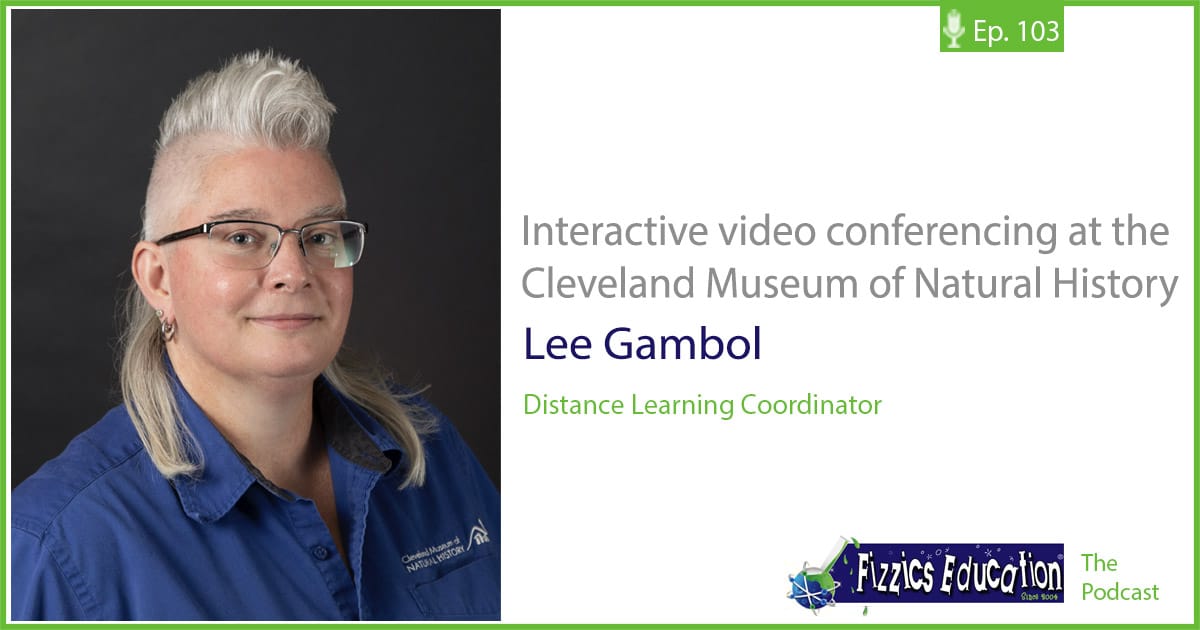
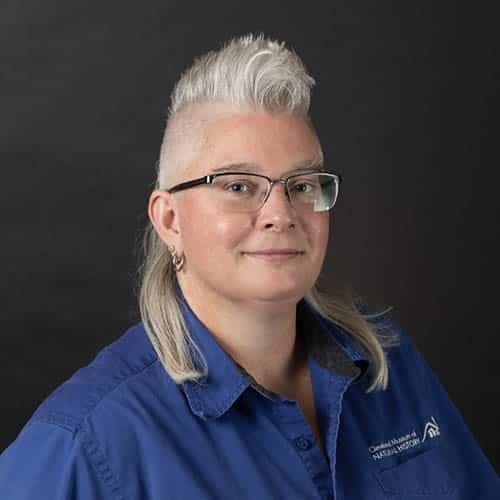
We chat with Lee Gambol, an extraordinary science educator and Distance Learning Coordinator for the Cleveland Museum of Natural History. Their interactive virtual learning programs are fantastic and we get to hear some of Lee’s thoughts on how to make distance learning classes both authentic and engaging.
Lee Gambol graduated with a B.A. from Hiram College, where she pursued a unique dual focus in Theatre Arts and Biology. Since then, she has dedicated her career to roles that blend these two passions, essentially becoming a master of “scientific storytelling.” Her diverse professional history includes stints as a Children’s Theatre Actor, a SeaWorld of Ohio Educator, a “Mr. Wizard” travelling performer, and a Public Programmes teacher at the Great Lakes Science Centre.
Lee’s journey came full circle when she joined the team at the Cleveland Museum of Natural History—a place she first visited as a child. As the museum’s Distance Learning Coordinator, Lee develops and delivers high-energy, interactive video conference science programmes. To date, she has reached students in all 50 U.S. states and over 15 countries, proving that scientific curiosity knows no borders.
Top 3 Learnings
Performance Enhances Pedagogy: Integrating theatre skills into science delivery, or “scientific storytelling,” significantly increases student engagement and helps maintain focus during virtual sessions.
Tactile Integration in Digital Learning: Mailing physical kits (as seen in Cyber Camps) allows students to perform real dissections and experiments at home, bridging the gap between digital content and hands-on practice.
Global Accessibility: Virtual excursions remove geographic barriers, allowing a museum in Cleveland to provide expert-led sessions to schools in Australia, Asia, and beyond, regardless of their physical proximity.
Education Tip
When teaching via video, your energy level needs to be significantly higher than in a face-to-face setting. Use props, varied camera angles, and interactive questioning to keep the “theatre” of the classroom alive and prevent students from becoming passive observers.
About the Cleveland Museum of Natural History
The Cleveland Museum of Natural History makes science relatable by cultivating a deep sense of wonder in every visitor. The museum offers a multifaceted exploration of our world, from the towering giants in the dinosaur hall to the furthest reaches of the cosmos in the Shafran Planetarium.
Beyond the indoor galleries, visitors can experience natural wonders in unique outdoor settings or participate in hands-on learning at the Smead Discovery Centre, where the guiding principle is “please touch!” With a robust digital presence, the museum brings global science stories to life through both physical exploration and immersive virtual learning programmes.
[00:00:19]Ben Newsome: Yes, welcome again to the Fizzics Ed Podcast. I’m glad to have you again for another chat around science and STEM and all that sort of thing. I can tell you what, today is well worth a chat around interactive video conferencing with Lee Gambol. If you haven’t come across Lee, you will definitely recognise her as an amazingly cool person who loves science in so many ways. The work they do at the Cleveland Museum of Natural History is amazingly cool and interactive for all manner of audiences. Everyone from schools, preschools, retirement homes, you name it, they work with all sorts of people and they are very, very good at it. And that’s exactly what we’re talking about in this chat.
[00:00:57]Ben Newsome: Now, by the way, I’ve known Lee since 2014. I got to visit her space where they do their programmes and it is an amazingly vibrant space to check out. Now, Lee actually has a very interesting background. She’s worked in theatre arts and biology and been able to combine both those passions in multiple jobs. She’s worked as a children’s theatre actor. She’s worked at the SeaWorld of Ohio as an educator. She’s also worked at the Great Lakes Science Centre as a public programmes teacher. She’s also worked as a Mr Wizard travelling performer and as an animal hospital vet tech and at HealthSpace Cleveland as a health educator, just to name a few.
[00:02:17]Ben Newsome: Now, she does recount that when she was five years old when she went to the Cleveland Museum of Natural History back then, she did tell her father, “I’m going to work here someday.” And guess what? She does! She’s now the Distance Learning Coordinator there, and she develops and delivers heaps of programmes to a series right across the US and into 15 other countries. Amazingly cool stuff. So, let’s get right into it. Listen to what Lee’s been getting up to, and I really hope you enjoy this chat.
[00:02:48]Announcer: This is the Fizzics Ed Podcast. We’re all about science, ed tech and more. To see 100 fun free experiments you can do with your class, go to fizzicseducation.com.au. That’s physics spelled F I Z Z I C S and click 100 free experiments.
[00:03:14]Lee Gambol: My name’s Lee Gambol. I live in Northeast Ohio and I grew up at a very rural setting. I call myself a country kid, so I grew up outside catching all the local wildlife and putting it inside of little tanks to look at for a couple of days and then setting it free—snakes, toads, whatever I could find. And that’s basically what I do now in a virtual sense, is I teach video conference programmes for the Cleveland Museum of Natural History. My job is to show kids the research that happens at the museum. That means now I get to roam around and pester the curators and see what they have in tanks and their research areas and show the children things like, “Oh, look at this lovely tank full of beetles that are munching the flesh off of that bone! Is that how you clean a bone for display?” Oh my goodness, yes it is. And that’s me in a nutshell: looking at weird things in tanks and sharing the experience with the public.
[00:04:01]Ben Newsome: That’s so cool. Do you reckon you always were going to be heading into the museum sector as a kid? Did you often visit museums and things like that or is it sort of just something that came up over time?
[00:04:13]Lee Gambol: Going to the museum for me as a small child was a very big deal because we lived about an hour—granted I’m here in the US, you’re in Australia, distances may be a little bit different here in our conception of them—but we perceived the big city of Cleveland as being far, far away. It took about an hour to drive there. So, we did not go very often and it was a very special event. As a little kid, when I was five years old, my father—I had just become a dinosaur enthusiast. I loved drawing them, would get colouring books and change the animals into dinosaurs. I just loved dinosaurs. My father told me a story recently. He said, “You know, when we went to that museum and you were standing underneath that big fish, it’s called a Dunkleosteus, and you turned to me as a little precocious five-year-old child and said, ‘Daddy, someday I’m going to work at this museum.’” Hey, guess what? I work at that museum now!
[00:05:01]Ben Newsome: That is so cool. And by the way, I mean, I’ve been lucky enough to visit your museum and Dunkleosteus is… it’s a big thing! It’s much bigger than you actually realise. Quite the big fish. Bony plated crazy thing.
[00:05:23]Lee Gambol: It is indeed. And one of the coolest parts about our museum is that we try to feature mostly things that are unique to our region. That giant fish, that armour-headed monstrosity, used to live here in Ohio when this piece of the Earth was not in the current location it’s in. It was way down closer to the equator and covered with a shallow sea. So, we have some of the most beautiful Devonian era fossils here in Ohio. That’s what I used to find as a kid and I was always so confused. Why am I finding these ocean fossils here in Ohio? And now I work in a place that explains why that is.
[00:06:03]Ben Newsome: So, when you have the public come through, I mean, like every museum, every natural history museum has lots of stuff. It’s really quite eclectic in a lot of ways. I mean, where do people tend to hang out more? Out of all the different galleries and bits and pieces, what tends to grab their attention the most?
[00:06:16]Lee Gambol: Yeah, I would say we have several exhibits that we refer to as our iconic exhibits, and each one of them has their own fan club. The primary, the one that comes to my mind first because it’s my favourite exhibit is Balto, who is… it’s the taxidermied remains of a Siberian Husky that became very famous in 1925 for his role in leading a team of a musher and his team of dogs through a terrible storm. This was up in Nome, Alaska, if your listeners want to take a look, it’s very, very remote. And it was a terrible blizzard and there was a diphtheria outbreak and everybody was in quarantine—gee, sound familiar Ben?
[00:07:02]Lee Gambol: And Balto helped to deliver medicine to that town and save, help save the town. And when he died, he was living here in Cleveland because people in Cleveland had felt so passionately about the story that the city banded together and purchased him from a bad owner who was using him in a sort of a vaudeville circuit circus act kind of situation. And he spent his last six years in a luxurious hero’s paddock over at the zoo and he got to play outdoors and have a good doggy life. And when he died, they taxidermied him and now there are many people all across this planet who are big fans of dog sledding and they make a trek to our museum once or twice a year specifically to go see Balto and just revel in that nifty achievement. So he’s definitely an iconic critter there.
[00:07:47]Lee Gambol: We also have Lucy, and if you don’t know her by her common name, her scientific name is Australopithecus afarensis and she was the amazing little hominin that was discovered back in 1974 by the man who was then the director of our physical anthropology department—that’s the studying of the human creature. And when she was discovered in Ethiopia, she changed the history books because we thought initially—and when I say we, the collective brain of science right across the planet—assumed that humans developed big brains first and then maybe got around to that whole bipedal walking thing. But Lucy turned that upside down because she was a very small creature with a very small brain case, but she had hips exactly like modern humans. And she was 3.7 million years old, right? So when he found this—Donald Johanson was his name—it completely wiped out everything we thought we knew about our own evolution and started a new process. So, she has a lot of fan clubs who come in to see Lucy as well.
[00:08:01]Ben Newsome: I tell you what, I mean, that was one of the things that stood out for me—mind you, there were a lot of things. Guys, I visited this museum, gosh, 2014? I think so, something like that.
[00:08:11]Lee Gambol: Was it that long ago? That’s shocking.
[00:08:14]Ben Newsome: I know, it’s a long time ago on a fellowship to learn about video conferencing and Lee 100% knows a lot about that. We’ll certainly talk about that very soon. But I actually, out of there are two museums in the world where the jaw had to drop for me when I went “Oh my god, that’s the thing I’ve seen and read about”. Lucy was one and also the Rosetta Stone at the British Museum in London. I was “Oh my gosh, that’s the thing”. And Lucy is a thing. So if you’re into biology, seeing Lucy is like “Whoa, it’s the Lucy”.
[00:08:44]Lee Gambol: I’m very fortunate to have a set of her… the original casting. When I say a cast, it means a copy of the actual fossil piece because regulations indicate that once you… if you’re in a foreign country to yourself and you discover a fossil, you are allowed to temporarily bring it back to your home country if that’s where your laboratory is so you can do your research on it. But then it must be returned back to its location where it was found. So Lucy’s real bones are back in Ethiopia now. But we have the original casts. So our casting technicians made these copies using moulding casting techniques, actually putting their hands on the real bones, not a 3D printer like we would have today. And I have those casts up in my studio because I work Lucy into basically every programme I teach because she is such an iconic creature.
[00:09:47]Ben Newsome: Absolutely. So this is the thing that really blows my mind about what’s really cool about museums to be able to go out into the world. And you did mention studio, so I do want to talk about this. I mean, this is something you’ve done for many years, the ability to connect people with iconic things is so amazing. It’s actually quite a privilege when you think about it. And being able to bring that out to the world. Now clearly this year it’s been something you’ve very much been doing. So describe… I mean, you have a vast suite of programmes that are available not just for schools but all over the place. I mean, just describe some of those. I’d love to hear a bit more about them.
[00:10:24]Lee Gambol: I’d love to! We do have a lot and I don’t teach all of them myself but I teach quite a few of them because I’m in charge of our video conferencing content. One of the topics that we… I don’t want to brag but just to point out that this was kind of a big deal when it happened is we won the United States Distance Learning Association‘s award for innovation. Because when I first started at the museum you had to physically come to the museum to see our wildlife. And we have this beautiful wildlife centre named after a person who donated some money so it’s called the Perkins Wildlife Centre and Woods Garden. And in there we have native Ohio animals like bobcats and coyotes, bald eagles, river otters, all these animals you would very seldom see in the wild. But they are animals that were injured in some way or are unable to hunt for themselves, so they must live with human care. And you had to come to the museum to physically see those animals.
[00:11:24]Lee Gambol: And then when we started doing video conferencing, we were doing hilarious things like bringing an opossum up to the studio and having it walk around like all those old talk TV shows like Johnny Carson saying “Gosh, what animal have you put on my desk here?”, you know? And we would do a programme like that, but it was still bringing the animal out of its normal space. So it was uncomfortable for the animals. And then video conferencing extended into live streaming—whoa!—and we got our cameras ready and headed out into Perkins. And that was the next level, was taking your viewing audience directly live streaming out there so you could watch the crew feeding the otters or training the coyotes how to do something. And that was really cool to be a part of that process, the evolution of video conferencing from a very slow and annoying and frustrating process into the smooth process that it can be today.
[00:12:30]Lee Gambol: So that’s one, we feature our live animals. We have programmes about dinosaurs obviously because how would you come to a dinosaur museum and not talk about dinosaurs? And we can go out there and stick the camera right into T-Rex’s teeth—whoa!—so the viewers can appreciate how humungous those chompers really are. We have programmes about astronomy and our astronomy guys are amazing because even though you’re not in a planetarium with that wonderful giant dome over your head, man, they do a great job on the small screen of really getting the audience excited about outer space and how phenomenal some of these giant star clusters and things are they’re talking about. I don’t teach that topic but every time I watch them do it, it blows my mind. Those guys are really good at it.
[00:13:29]Lee Gambol: And some of my favourite programmes are teaching about the human body—nutrition, gross anatomy. And when I say that I mean both ways to define the word gross: boogers and blood and digestion and all those wonderful things, as well as our own organs. And we have a marvellous mix because we are a blend of the Natural History Museum and the old Health Museum of Cleveland where I was working prior to the Natural History Museum. The two museums merged and became one. So we have a really cool combination of health classes and also your basic science classes too.
[00:14:05]Ben Newsome: That’s so cool. And thing is though, I actually remember one of the things that you had is even the beekeeping kit, if I remember.
[00:14:12]Lee Gambol: Yes! Yes! That was a really interesting, yeah, that was a good example of how if you throw us a curveball, we’ll catch it and we’ll see if we can throw it back to you. And we had one school say, “Hey, our students are reading this really neat book called The Secret Life of Bees. Do you have anybody at your museum who knows about bees?” And we happened to have a wonderful lady on staff, Nancy. And Nancy has a beehive at her house and does her own beekeeping and has all the equipment. So I said, “Hey Nancy, want me to buy you a clean beehive and we’ll plonk it down here in the studio and you can talk about beekeeping?” It was really fun. So now, yep, we have a beehive in our studio. No bees in the beehive, just the hive.
[00:14:27]Ben Newsome: Absolutely. So here’s the thing, like obviously, I mean you’ve been doing this for many years through traditional equipment, but these days we’ve got these web conferencing abilities. I mean honestly, this podcast is being recorded on one of them. The way of connecting obviously is much easier and yet it’s also brought its own challenges in that you’re dealing with a vast array of people with different devices and different connectivity ability and different access to materials. I mean, how are you handling just that variety of people?
[00:14:35]Lee Gambol: It is amazing because now you’ve got multiple generations working together too. You’ve got like grandparents sitting with their little grandchildren wanting to watch a programme and you’re trying to develop content that’s going to speak to both of those ages. So it’s not just the equipment. And there’s a fine line between keeping it simple so you know it’s going to work, but making it technologically cool enough that you’re going to retain your audience’s interest. And I would say for anyone who wants to dip their toe or any other part of their anatomy into the virtual pool of teaching, that your best friend is going to be a second camera.
[00:15:08]Lee Gambol: If there’s any way that you can get yourself a USB cable, hook up an iPad to your computer—my favourite hack is using QuickTime to then use that iPad as a document camera—and that way you can switch from just the built-in camera on your main computer just seeing, say, your face or your torso, all of a sudden to a totally different point of view, even if it’s exactly next to you on the table. Your audience can’t tell. All they know is all of a sudden whoa, the camera has shifted and now I’m looking at something from a different perspective. And it brings that television quality to your presentation and that makes it look very, very slick, I’ve got to say.
[00:15:53]Ben Newsome: It’s one of the cool things about having multiple cameras—it makes a huge difference with production. I mean, the TV absolutely what you’re saying makes a lot of sense. Five minutes of presentation in any programme can have gosh, five, six, seven, eight camera angles sometimes. I mean, let’s be honest, we all can’t do that. We can’t all have five cameras or so. But even just having an extra one, it does break up the visual appearance and therefore grabs your attention just a little bit more. And the fact that you’re strapping an iPad to it, I mean, totally you can do that with a lightning to HDMI adapter and suddenly you’re in. It totally works because suddenly you can also share apps and YouTube and all that stuff and it totally works.
[00:16:34]Lee Gambol: Absolutely. One other technique I would say is don’t forget that your audience is human and they know that you are too. And they have been doing lots of online things and expect sometimes that the bandwidth is going to drop or the audio is going to go out or the picture’s going to freeze. And just kind of embrace that as part of the new strange virtual world that we’re experimenting with.
[00:16:58]Lee Gambol: One of my favourite things I did with a class the other day… they were a bunch of seventh graders and as we all know if anyone has taught seventh graders, they are watching carefully for you to mess up because that’s part of the fun. And at one point my picture had frozen because they were all saying, “Your picture is frozen!” And so I said, “Okay, what’s going to happen here is as soon as the picture starts moving again, I’m going to get my face off the screen and just put my hand up so you’ll know when the picture comes back. I want all of you to immediately lock your face into whatever goofy face my face was in when it froze.” And it was so funny because now I’m looking at 25 kids all aping my goofy face and it was a wonderful just goofy moment of, “Well, that was fun. All right, let’s move on.”
[00:17:41]Ben Newsome: That is so… okay, that is so Lee. That is so cool. I’m sorry, that’s how I’m going to describe that. That is such a really great engagement task and what’s cool about that is it’s a complete… I mean you could say it’s just straight up it got flubbed because the internet went, but you turned it into an engagement activity. That’s awesome. Guys, if you’re listening in, seriously do that.
[00:18:03]Lee Gambol: Feel free to steal that move. I welcome you to.
[00:18:07]Ben Newsome: No, that’s a lot of fun. And that’s the thing, there are no real rules with what you have to do. And honestly, the human side of it is real. I mean, I suppose just sort of thinking about over the last couple of months versus the last few years about feedback if something went wrong. A couple of years ago people, because it was seen to be more like a production environment, people expected to be quite slick. And of course we want to make things as slick as possible, but because now other people have to now present their own stuff, they now can see from the other side, the dark side, the presenter side, when things go wrong. The reality is they do. And so how you deal with it is actually what matters totally.
[00:18:50]Ben Newsome: I mean, actually just sort of thinking about this… if you imagine if you had a brand new person who’s going to take over one of your distance learning rooms and you had to sort of think about what sort of advice do you give them to go “Righto, here’s the meeting room and you’re on in a couple of hours.” What would be some sort of things that you’d suggest to them to sort of get their head around?
[00:19:11]Lee Gambol: Do you mean if that person was going to be then conducting a programme solo or I would still be there with them?
[00:19:18]Ben Newsome: Let’s assume that we’ve done the training and we know the programme, but they’re about to be thrown to the wolves—slash, actually they’re running a programme on wolves, why not? They’re about to actually do it for real and they’re just looking for some pointers to make sure it’s engaging and fun and all that sort of thing. What would you say?
[00:19:43]Lee Gambol: I would say, stage one, think back to your favourite improv comedian, if you’ve ever seen anybody do improv. Because that is 100% what virtual teaching is. Sure, you have your basic list of what you think you’re going to get through. Sure, you have all the specific topics and objectives in this lesson plan. However, because technology is what it is, it might throw you a monkey wrench any moment and you’d better be ready to catch that wrench and start adjusting. So, think back to improv and utilise improv skills.
[00:20:17]Lee Gambol: Stage two, I would say don’t forget that your audience, their eyeballs are the camera. And here in the states, David Letterman was one of my favourite—well, I guess I don’t know if his show was in Australia or not, but David Letterman was one of my favourite shows to watch because of the way that he set up his jokes. He would do the whole setup of the joke just looking around at the entire audience. But then when he said the punchline, he would look directly at the camera. And the feeling was that “Ooh, he’s looking right at me. He’s looking into my eyes.” And you don’t have to do that the whole presentation, but I’m so used to doing it now, Ben, we’re not even recording this with visual, but I’m looking at the camera as I speak because it really does make your audience feel like “Oh, the presenter is looking at me.”
[00:21:02]Ben Newsome: And totally so. Absolutely. Looking into the camera to get their perspective, but also looking directly into their room space itself and say, “Hey, see that hat on the shelf?” or “Hey, that’s an odd sweater, you with the blue sweater!” Like that type of thing, it breaks down this 2D space that we’re presenting into. You have to see from their end they’re consuming it from a TV screen or a data projector or their device in some way. It does seem removed, but as soon as you start calling out their actual items in their space, suddenly they go, “Hang on, no, you can totally see me properly. This is really live, properly live.” Especially with a large audience with multiple connections, it can make a big difference because sometimes it can feel like it’s just a pre-recorded session, a streamed session. It can be silly. I mean even when I run a multipoint programme, I might actually rather than calling it “So-and-so school” and “So-and-so school” as the meeting spaces, I’ll actually say “Righto, I’m going to call this ‘funny hat school’ and I’m going to call that ‘red sock school’.” Whatever, it’s silly. But it just means that people are… it has a bit of fun, you know.
[00:21:28]Lee Gambol: Absolutely! And remembering that they will do that to you as well. I can’t even tell you the number of programmes I’ve taught here from my apartment and something happens like one of my cats walks past behind me and then the kids will say, “Whoa, what’s that cat in the background?”
[00:21:43]Ben Newsome: Absolutely. And actually, and this is an audio medium, but Lee does have an amazingly cool cat gym behind her and it’s been used to great effect, which is very, very cool. Look, Lee, thank you very much for taking the time to have a bit of a chat with me this afternoon/this morning. And there’ll be people here who’d love to find out more about your museum and what you get up to, maybe a bit more about virtual classrooms and all that sort of thing. How would they get in touch?
[00:22:11]Lee Gambol: Oh, I would love for everyone to stop by and take a look at the website for our museum, which is www.cmnh.org. And because I’m so used to doing this on the phone with people now, I’m going to do it again with the words, ready? WWW, C as in cool, M as in massive, N as in natural, and H as in whoa boy that’s gonna be great! dot org. And you can take a look at cmnh.org/at-home because that particular page is showing the tons of resources we have tossed up for all the folks out there handling themselves in quarantine.
[00:22:49]Ben Newsome: That’s so cool. And that’s by the way, again another simple engagement thing. You can’t help yourself Lee. Simply just describing your acronym in a fun way, it does matter. It is very, very…
[00:23:01]Lee Gambol: If I’m not having fun, nobody else is. Come on now Ben!
[00:23:04]Ben Newsome: Exactly right! It is always… by the way guys I will as usual put this in the show notes. So if you haven’t got that, totally so. And we will put additional links there and all that sort of thing to be able to help support what you’re doing. And so here’s the deal, you don’t have to just be in Ohio to connect. I believe Lee you’ve been doing stuff right across the country and beyond.
[00:23:22]Lee Gambol: Oh we have. cilc.org is where we advertise all of our programmes as well as on our website. And I know that Ben advertises his fantastic Chat with an Aussie programme with them. I’ve watched him do it, it was a fun programme. And boy that’s a dynamite site for finding content. So yeah, get out there virtually and take a look around. My favourite search move is to think, what is it that I would really like to see from just pie in the sky, no holds barred, what is the coolest thing I’d like to see if someone is doing virtually? And just try searching that on the internet and it’s kind of amazing how many content providers are out there providing really awesome stuff.
[00:24:03]Ben Newsome: No absolutely. CILC, Center for Interactive Learning and Collaboration has over 200 museums, galleries, authors, historians, you name it, they’re there. It’s really cool and right across all over the place. Definitely check that out. Hey Lee, thank you very much for joining me. I mean really, hats off to you and the team. I know you’re moving into virtual summer camp very soon, which is going to be a whole bunch of fun. And look, well done with the programmes that you’ve been doing for years and well done for also just doing that awesome work that you’ve been doing throughout this crazy period and I know you’re doing an awesome job. Well done.
[00:24:39]Lee Gambol: Well I’m going to do a shout out right back to you Ben because folks, right before we started recording this podcast, we got Ben up so early in the morning. What was it, 6:30 your time? So we could pester you about virtual camps because you had just finished running some and we wanted to talk to some of the experts out there and find out what challenges they had dealt with. So thank you for being a team player in this wonderful virtual adventure that we’re all living Ben.
[00:25:02]Ben Newsome: No absolutely. Much appreciated and totally, always there to help and as usual guys, if you need to know anything further just drop me a line and I’ll totally help you out. All the good, all good. So look have a great afternoon and I’ll catch you another time.
[00:25:15]Lee Gambol: Thanks Ben, you too! Have a great morning yourself. Bye bye!
[00:25:41]Ben Newsome: Well, there we go. We just heard from Lee Gambol, who you can really tell loves what she gets up to. And seriously, check out the Cleveland Museum of Natural History. They do some really, really cool stuff. And if you can’t get there, well, we’ve got video conferencing and you can totally connect with Lee no matter where you are. So how are you going to do that? Go to their website, type in Cleveland Museum of Natural History into a search engine, you’ll find their website. Head on over there, it’s cmnh.org/ivc and you’ll find their regular IVC programmes, their interactive video conferencing programmes. And you can check them out, what they’ve been doing. And by the way, they’re running summer camps, their cyber camps. So if you go to cmnh.org/learn/summer-camps or just type in “summer camps Cleveland Museum Natural History”, you’ll find the links and you’ll be able to find out how to connect with them.
[00:26:31]Ben Newsome: So I hope you got a bit out of this chat. I just honestly was reminiscing just heading over to Cleveland. You got to show me around the area, it’s really, really, really cool right around that space. It’s definitely her haunt, her place that she gets to check out all the time and it is well worth visiting if you ever get a chance to head on over to Ohio. But anyway, that is enough of this particular episode. I hope you’re having a fantastic afternoon, evening, morning, whatever it is that you’re doing, and I hope you’re enjoying whatever it is that you’re doing. So anyway, enough from me. You’ve been listening to me, Ben Newsome from Fizzics Education, and I’ll catch you another time.
[00:27:29]Announcer: This podcast is part of the Australian Educators Online Network. AEON.net.au.
Frequently Asked Questions
What types of virtual programmes does the Cleveland Museum of Natural History offer?
The museum provides a diverse range of Interactive Video Conference (IVC) sessions that cover biology, human health, astronomy, and palaeontology. Notable programmes include their forensics and anatomy sessions, often referred to as “The Desk of Death,” as well as sessions on human evolution and live tours of the night sky via their planetarium.
How did the museum adapt its summer camps for a remote audience?
To transition to “Cyber Camps,” the museum developed a model where they ship physical kits to students’ homes. These kits contain all the necessary specimens and tools, such as owl pellets or dissection materials, allowing students to engage in tactile, hands-on science while following along with the educator via a live digital stream.
What is the benefit of having a background in theatre for science communication?
Lee Gambol emphasises that theatre training helps educators master pacing, storytelling, and the ability to hold an audience’s attention through a screen. By using “scientific storytelling,” educators can make data-heavy subjects like human anatomy or evolution more engaging and memorable for students.
How does the museum manage international bookings across different time zones?
The museum utilises platforms like the Center for Interactive Learning and Collaboration (CILC) to manage its schedule. They are highly flexible with their timing, often starting very early in the morning to accommodate schools in Australia or staying late for other global regions, ensuring their collections are accessible worldwide.
What equipment is essential for a high-quality museum virtual excursion?
Key components include high-definition cameras, professional lighting, and high-quality microphones. Lee also highlights the importance of using a second camera or document camera, and using real museum specimens and props to create a visually stimulating environment that competes with the distractions students might face at home or in the classroom.
Discussion points summarised from the IVC at the Cleveland Museum of Natural History with AI assistance, verified and edited by Ben Newsome CF
Extra thought ideas to consider
Scientific Storytelling as a Pedagogical Tool
Lee Gambol’s background in theatre highlights how performance techniques—such as pacing, characterisation, and suspense—can make complex biological concepts more accessible. Educators might consider how incorporating “edu-tainment” elements helps overcome the “digital fatigue” often associated with remote learning and improves student retention of scientific facts.
The Scalability of Museum Outreach
Digital technology allows a single museum educator to reach students in all 50 U.S. states and over 15 countries from a single studio space. This raises interesting questions about the future of museum funding and the potential for world-class institutions to support rural or under-resourced schools that could never afford a physical field trip.
Recognised by
22 years, award-winning work, 1 purpose
Recognition from business, education and industry bodies across Australia.
Australian Small Business Champion
Multiple years
CILC Pinnacle Award and Hall of Fame inductee
Center for Interactive Learning and Collaboration
Western Sydney Awards for Business Excellence
Winner
Top 100 Coolest Company
Listed
Local Business Awards
Winner
We value your privacy
We use cookies to improve your experience. Essential cookies are always active. You can choose which optional cookies to allow.We use cookies. Optional ones stay off unless you allow them.Privacy policy