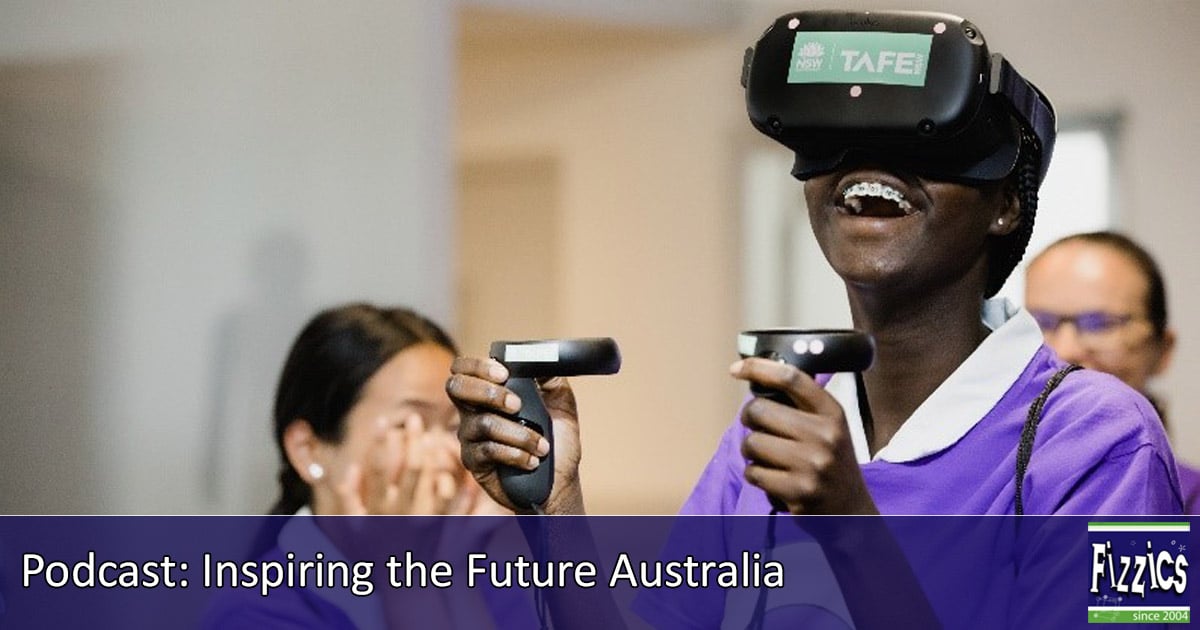
Find out how the Inspiring the Future Australia campaign is helping connect students to people in STEM careers! We chat with Adrian Rhodes who is the Director for the project and discover not only how easy it is for schools to connect, but also the impact it is having in breaking down stereotypes.
Don’t miss out! Join Inspiring the Future and Fizzics Education for our series of FREE Inspiring STEM Online webinars. Tailored specifically for students in Years 5 to 10, these interactive sessions are designed to spark curiosity and showcase real-world scientific applications. Events commence from 16 June 2020.
Adrian Rhodes brings a remarkable 48 years of experience to the education and community development sectors. His career is defined by a steadfast commitment to cross-sector partnership brokering and a passion for helping young people realise their full vocational potential. Adrian’s journey began in the classroom as a Primary School Teacher in Victoria, later venturing to a remote Indigenous community school in Western Australia—an experience that deeply informed his understanding of diverse educational needs.
For the past two decades, Adrian has been a cornerstone of vocational education and government-funded career support programmes across the Greater Sydney region. He has successfully brokered numerous sustainable partnerships between schools, businesses, and community organisations, effectively broadening the career horizons for thousands of students. Adrian is a proud member of the NSW Justices Association and is actively involved in the Asia-Pacific and International Partnership Brokers Associations.
The Inspiring the Future Australia Campaign
Inspiring the Future (ITF) Australia is a national campaign driven by the belief that every student deserves to be motivated by the real-world success of others. The platform connects schools with volunteers from a vast array of occupations and industries. By creating a personal profile on the ITF digital platform, workplace volunteers can nominate regions they are willing to visit to share their unique career journeys.
Teachers can sign up for free to browse and invite these registered professionals into their classrooms. Whether it is a guest talk or a hands-on workshop, ITF actively challenges gender, cultural, and socio-economic stereotypes. By illustrating the direct link between classroom studies and workplace applications, the programme helps students envision a future beyond traditional boundaries.
Research shows that the more connections a student has with the workforce, the better equipped they are to make informed decisions regarding their further studies. ITF provides vital social capital, particularly for students who may lack professional role models or reside in areas experiencing entrenched social disadvantage.
At Schools Industry Partnership (SIP), the philosophy is simple: every young person possesses a unique talent. The SIP team works tirelessly to help youth discover their professional passions and transform those innate skills into tangible employment opportunities.
As a not-for-profit incorporated association based in Western Sydney, SIP is governed by a dedicated volunteer board representing key stakeholders from TAFE, local government, chambers of commerce, and various school systems. Since its inception in 1995, SIP has been a leader in delivering high-impact services, including Work Inspiration, the Bright Futures campaign, and Career Advice Australia.
Currently, SIP facilitates the Work Placement programme, the Transition to Work service, and the Smart, Skilled & Hired Youth Employment Programme. With over 50,000 successful student work placements coordinated to date, SIP continues to be a vital link in the Australian educational landscape, directly helping hundreds of young people secure meaningful careers.
Published: APA 7 Citation: Newsome, B. (Host). (2020, June 3). Inspiring the Future Australia [Audio podcast transcript]. Inspiring the Future Australia. https://www.fizzics
[00:00:18]Ben Newsome: Yes, welcome again to another Fizzics Ed Podcast. Glad to have you again for another chat around science and STEM and all that sort of thing. I can tell you what, today is an interesting chat because it’s not just about science and STEM, it’s about what do you do with it? What do you do with that knowledge that you’ve gained from your classroom or wherever you get it from? How can you apply this in your career? This is what Adrian Rhodes is very much about. He’s the director of the Inspiring the Future Australia campaign and they’re an amazingly cool group that is all about giving students a real chance to be involved and inspired and motivated via volunteers from a whole bunch of occupations and industries from all different levels to really get into careers.
[00:00:56]Ben Newsome: They’re very much involved in STEM too. Adrian actually has 48 years of experience in education and community development, cross-sector partnerships and all that sort of thing, and has a vast experience when it comes to getting kids, high school kids specifically, into really understanding that STEM is important and something they’ve got to get into. Today’s chat is actually hearing about where this all came from and how you might be able to get yourself involved. How can you get your own classes involved? It’s really important.
[00:01:26]Ben Newsome: By the way, you totally can get involved very, very soon. We’re actually working with Inspiring the Future Australia coming June 16, 2020. You can get involved with the free online programmes that we’re running with them in collaboration where you can actually hear about Maths Made Real, Engineering Without Fear, and Where Can STEM Take You? These are free online programmes and you can totally sign up if you jump on the Fizzics website. Just go to fizzicseducation.com.au, type in Inspiring STEM and you will find that programme and you’ll get to sign up.
[00:01:55]Ben Newsome: Whilst that sounds like a bit of an ad, it’s free and it’s 100% supported in collaboration with Inspiring the Future Australia and we’re really proud to be involved with it. But anyway, you’re here to hear about Adrian Rhodes, hear about where he’s come from, where he’s going and more importantly, how you can go along with him with your students. Let’s get right into it.
[00:02:10]Announcer: This is the Fizzics Ed Podcast. We’re all about science, ed tech and more. To see 100 fun free experiments you can do with your class, go to fizzicseducation.com.au. That’s physics spelled F I Z Z I C S and click 100 free experiments.
[00:02:31]Adrian Rhodes: Look, I’m the director of Inspiring the Future Australia. It’s an initiative that our not-for-profit organisation I work for, called Schools Industry Partnership, instigated about three years ago in Australia. It’s modelled on a very successful programme that was launched in the UK about 10 years ago called Inspiring the Future there as well. We saw the amazing things that are happening over there in the UK in this space of connecting young people to people from the world of work to inspire them, to expand their career options. They were a research organisation and they did a lot of research in this space.
[00:03:21]Adrian Rhodes: Among all their research, one of the most profound things they discovered, it’s pretty obvious to most of us but they did prove through their research thousands and thousands of young people, that young people who have four or more connections with people from the workplace while they were at school are five times less likely to be unemployed or not in education in their early 20s. Of course, that shows the correlation but not the causation, but it instigated a programme, a platform they developed to increase those connections, the number of connections that young people have with people from the workforce.
[00:04:03]Adrian Rhodes: It’s one thing to see a video about a workplace or volunteers or someone talking, but when you meet them face-to-face, it’s like they can hear from the horse’s mouth. The young people can hear and ask questions about the career options that these people have followed. It’s not just what they do now. These young people need to hear that career journeys are not linear. A lot of young people can think that you start here and you end up there and that’s what you’re going to be for the rest of your life. When they hear stories from people in the workplace who have walked those journeys to where they are now, it’s amazing to see how they have to be resilient. They have to overcome obstacles, they take opportunities when they arise, things that were not even existing when they start out have to be captured and utilised. So these young people hear these stories and it gives them a tremendous launching pad and confidence to go into the future.
[00:05:13]Ben Newsome: Absolutely. I was just thinking just then about that image that gets shared around a lot with how I got here. I think it’s going to go like this and it’s just a simple nice parabola of an increasing journey onto a way to the future. In reality, they show this actual line going, in reality, and then there’s a person swinging across a creek of sharks and spikes and things being thrown at them. It’s very much the case.
[00:05:43]Adrian Rhodes: Very much so. The need is pretty evident. We know that there are many school students today who are unaware of all the exciting career options and pathways that are possible and available to them. Often that’s due to limited information and also due to a large extent to gender and cultural stereotyping, socio-economic stereotyping, and limited access to mentors who are positive workplace role models. This is especially true for young people growing up in jobless families who just don’t have access to a variety of career role models.
[00:06:30]Adrian Rhodes: For example, in Western Sydney, there are 40,700 young people growing up in jobless families. That’s an amazing figure and in other areas I’m sure that also exists. They just experience so much social disadvantage in that way, not having access to see options that are available to them. There are also thousands of young people, as we all know, struggling in school and failing to see the relevance of their education. For example, teachers are teaching trigonometry, well, sir, what is the use of learning this subject? How’s it going to help me? With Inspiring the Future as the platform, these teachers can access an engineer or even a carpenter and bring them into the school and talk about how those subjects they’re studying are actually applied in the workforce.
[00:07:24]Ben Newsome: Straight up. I mean, I’m just thinking right now, I’ve done some time not quite as a tradesperson, I was the guy off the side just doing what I was told. I can tell you now, anyone listening in, Pythagoras’ Theorem is 100% needed whenever you need to build something. Right up, it’s going to happen.
[00:07:41]Adrian Rhodes: Absolutely. So that’s just an example, but it does bring learning to life when they meet someone and they hear the stories and they interact with them. It does make the lightbulb moment go on. The kids say, “Wow, I never knew about
[00:07:41]Adrian Rhodes: That. Oh, now I understand. Now I’m more motivated to study. Now I want to know what’s the subjects I need to study in when I go to year 11 and 12 or whatever, or university. And we all know that there’s a lot of kids dropping out of school early, and also kids dropping out of uni and dropping out of apprenticeships. And we can’t say this is the only reason, but I’m sure a major reason is that they didn’t really understand what they were getting into when
[00:08:21]Adrian Rhodes: …they made those decisions. And when the young year 10 students have to make decisions about their subject choices for their HSC, they often make it with limited information.
[00:08:33]Adrian Rhodes: And so the more information they can get in those early years, the more informed they’re going to make—the better decision they’re going to make, that’s probably more aligned to their potential and what they really like. They can follow their passion, or discover their passion and then they can follow it. And that creates motivated young people.
[00:08:53]Ben Newsome: Absolutely. So you started this… obviously this was built out of the UK, but so three years ago Inspiring the Future Australia starts up with obviously a serious vision.
[00:09:04]Adrian Rhodes: Yeah, very much so. We saw it happening in the UK and we said it has to happen here. In the UK, they’ve got now I think about 58,000 volunteers registered on our online free platform that I think 14,000 teachers are registered and they’re accessing those volunteers for free. And they invite them into their school to talk about their job, their career or help them with mock interviews or just give demonstrations of what they do in a science class or something like that.
[00:09:44]Adrian Rhodes: So it’s absolutely amazing. And it’s no wonder that people from all over the world have flocked to see it happening in the UK. And we were one of them. My CEO, Ian Palmer, who’s been in this space for many years as I have, he saw this happening there and he went over to the UK and negotiated a licence. We’re a not-for-profit, they’re a not-for-profit, and so we are able to use their branding basically and rebrand it for Australia.
[00:10:14]Adrian Rhodes: We’re the sole provider of this programme in Australia. Different demographics in the UK, much tighter communities, but here we’ve got a very diverse sort of… we’ve got rural, regional, quite remote. Distance is a major issue there. But still, we launched it and we’ve now got over… not nearly like the UK, but they started from the top down from the government and they used all the business connections. We started from the bottom up with only our… we couldn’t get any funding from the Federal Government. We couldn’t get funding from major corporates we approached to try and fund this. They couldn’t quite see that vision of it working, they told us.
[00:10:51]Adrian Rhodes: So we decided to fund it ourselves. Our organisation spent over a quarter of a million dollars of our own funds just launching this programme in faith, believing that it was needed. We’ve been in Schools Industry Partnership as work for 20 years in this space, building connections between schools, business and community with government-funded programmes, but this one we started on our own. And we have now proved it’s working. We have over about 900 volunteers registered nationally. Most of those are Western Sydney focused, but not all. We’ve also got about 700 teachers signed up as well.
[00:11:33]Adrian Rhodes: And what it is, it’s basically a website, Ben. It’s a campaign and it’s a website. So what teachers do, they sign up for online for free on our website, inspiringthefuture.org.au. They sign up for free and they search for the registered volunteers who fit their needs. So they go through a series of filters based on what the volunteers have already provided on their profile, and they can filter it down to a short list. They can ask one, two, they can ask 20 if they want of these volunteers to come to their event or to help them in other ways.
[00:12:19]Adrian Rhodes: And of course with COVID-19 at the moment, with all the social distancing and restrictions on schools, we’re encouraging teachers to use the volunteers on the database as virtual visitors. To be able to invite them that way. They’ve always had that option, but it’s never been taken up until the need at the moment has come to the front. And so, yes, it’s been… but we do have about 500 of those volunteers are actually willing to be virtual visitors. As I said, now they’re starting to be used more.
[00:13:04]Adrian Rhodes: And we’ve also now developed a… on our platform, we have developed a… we’re just about to launch our own webinar feature, which teachers can directly invite the volunteers and it’ll go straight into their… onto the webinar registration. And they can… there’s four classes of people, like the moderator teacher, we’ve got presenter one, presenter two, and students. And so they can use that to run their own webinars, and we’re encouraging them to do that.
[00:13:28]Adrian Rhodes: So that’s how it works. It’s a matching system. It’s all free and it will always be free for teachers. And it’s a resource they can supplement their own database of local connections. I mean, we’re not
[00:13:28]Adrian Rhodes: …the first time teachers have invited people into their school, a lot of schools do that, often using their parent networks, but this is just a supplement. They can look at our database and they can search for the volunteers they want. When they send the invite, they don’t see the contact details of the volunteer, and the volunteers don’t see the contact details of the teacher. It’s secure. They only see the profile. So they send the invitation through our portal, but it looks like it’s going from email to email basically. The volunteer
[00:14:17]Adrian Rhodes: …gets the invitation and they’ve got three options, little boxes at the bottom. They can accept, decline or ask for more information. And then the dialogue goes and if they want to exchange email addresses and telephone numbers, they’re welcome to, but we’ve made that confidentiality commitment to everyone that it is a secure website. And so when the volunteer accepts an invitation, they come to the school or connect virtually or whatever and the event happens. And once the event happens, they both receive, volunteer and teacher, an automated feedback form and we can monitor that
[00:14:58]Adrian Rhodes: …from the back end as well.
[00:15:01]Ben Newsome: So out of the 900 odd volunteers, I mean, I imagine it’s very diverse. Where are these people coming from? How do they find you?
[00:15:09]Adrian Rhodes: Oh look, we sent out an invitation when we began. We purchased a database of 1,000 professional associations, industry associations, thinking that if we sent it to them and invited them to send it to all their members, then that would multiply the numbers of volunteers available across a range of sectors.
[00:15:31]Adrian Rhodes: We didn’t get the big take-up of that, but we did get a fairly good take-up. We’ve got from CEOs through to apprentices. I mean, everyone’s… we’ve got a huge range of people. It’s amazing people, self-employed people, all sorts of professions, occupations, backgrounds. Teachers can just look at the short list and then they can hit a button to say, “Look, see more about this person,” they can read more. And if they want to know more, they could even send them an invite and ask for more information if they want.
[00:16:10]Adrian Rhodes: We’re also now putting up a grading system on the volunteer so they can see how people have rated these volunteers in the past, so that’s trying to maintain the quality there so that teachers have some idea. But basically it’s… we also run demonstration events to show teachers how they can use these volunteers to run simple events in their school. To some people, this is just kindergarten. Some teachers are so used to running careers events, but not all.
[00:16:41]Adrian Rhodes: There are six popular activities that we’ve identified and we’ve provided a step-by-step guide for the teachers and it’s on our website. They can access that for free, like inviting volunteers for formal guest speaking or informal guest speaking, which is like speed career networking, where the volunteers rotate around tables of small groups of young people or students. When a bell goes, they move to the next table. And then the kids ask questions and we give the questions that kids could ask to the teachers as well, so they can share it with the kids and the kids can ask intelligent questions or ask their own.
[00:17:26]Adrian Rhodes: There’s interchange going on, interaction between the volunteer and the young people, more depth. And then they can rotate around. So we’ve got the instructions there how to run that. The most exciting thing that everyone really loves is our primary school activity called What’s My Line? That’s under Primary Futures, which is like a sub-campaign.
[00:17:46]Adrian Rhodes: The What’s My Line? activity is a bit like a celebrity hits competition. The teacher brings in volunteers from six different occupations, for example, they sit on a chair on a stage with a big number, 1, 2, 3, 4, 5 or 6 in front of them. They’re just wearing normal civvie clothes, no one knows what they really do or what they are. And the kids are all… the teacher or the principal could be the facilitator. And the kids are all on the floor in a big hall, you could imagine, on the stage the volunteers are up there. And the kids ask yes-no questions. They’re not allowed to say, “Are you a doctor?” They’ve got to try and guess what the career is. Do you work with people? Do you have a truck? Do you wear a uniform? Etcetera. And they say yes, no, maybe, sometimes, like that.
[00:18:29]Adrian Rhodes: Then they all go offstage and the teacher gets a whiteboard and gets it up there and says, “Okay, now who do you think number one was? Number two and what they did?” And then in the meantime, they’re all offstage getting their uniforms on or putting a prop, coming out with a prop. And they come back on one by one. And the teacher calls out to the… says to the kids, “Look, we all thought you were a this.” And then the teacher says, “1, 2, 3,” and all the kids shout together, “What’s your line?” And it’s a lot of fun.
[00:19:01]Ben Newsome: Absolutely. It reminds me of the Mystery Skypeprogrammes that people do. I know a good friend who’s a great teacher down in Victoria, Ann Murchison, if you’re listening, I know you do this. She gets up at 3 in the morning and kids try to guess firstly where is she from and what’s she do. And this is like taking it to a level in the hall because this is so simple to do and it doesn’t cost anything just getting the volunteers in.
[00:19:25]Adrian Rhodes: And it particularly works well, Ben, when you choose volunteers that will challenge their thinking, the stereotypes. Because it’s been proven beyond a doubt that gender stereotyping and cultural stereotyping, socio-economic stereotyping, all begins in those very early primary years. That’s where they get… and this amazing video on our website called Redraw the Balance, which says that, it’s just with watching it. It’s amazing. It’s had millions and millions of hits on YouTube.
[00:19:59]Adrian Rhodes: Because of it, it really challenges… it really proves that these stereotypes start in those early years. So that’s why Primary Futures is great. We had when we did some demonstration events of these to show it how when we launched it in Australia, in a primary school in South West Sydney, or two of them, we got a female firefighter. And we found a female carpenter. She had pink workboots with her nail gun hanging on her side when she came out. And we also had a man there who was a Black African appearance, he was African. And they all thought he was a rapper or a basketball player. And he comes on, he’s a psychiatric nurse on the Nepean Health. It’s amazing. The kids will never forget. “Oh, you mean I can be a nurse and I’m a male?”
[00:20:51]Ben Newsome: Absolutely. In fact, actually, if you’re listening on in here, obviously you really should do this. This is a really good thing. But I mean one of the activities I always ran when I used to be a high school teacher, you have the year 7s would walk in, I’d go, “Righto, draw me a scientist. Just draw me a thing, I challenge you to draw me a scientist.” And off they go, and I guarantee it’s a crazy old white guy, always a white guy with curly crazy hair. Here’s the thing though, I must say apparently—I haven’t run this one in a few years now—but apparently that stereotype is dropping off purely because of the work of the people who are listening into this podcast in the first place. It is dropping down.
[00:21:28]Ben Newsome: Mind you, when you said “What’s My Line?” I did think about Whose Line Is It Anyway?, the Drew Carey thing, but I think this is a really cool programme to do.
[00:21:36]Adrian Rhodes: So on our website under Primary Futures as a sub-category, there are videos of some events we ran in South West Sydney out at Narellan Public School and also in a remote private primary school out there. And you can see the whole thing step-by-step, there’s some short videos and there’s some step-by-step you can see it all working. So teachers looking at it, go and look at it. So simple to do, easy to do.
[00:22:01]Ben Newsome: So one of the things that you’ve been… I mean, obviously, I mean, this is all sorts of careers, but 100% this STEM thing is not going to go away anytime soon. And some of the events that you’ve put on have been amazingly cool and not over the top, but at the same point to a kid who’s never been to one of those events, I mean, that would have to open their eyes. I’m thinking of the one that you did at Blacktown RSL late last year. It was amazing. Girls’ Tech Day.
[00:22:23]Adrian Rhodes: Yes, Girls’ Tech Day. That was courtesy of AWS, Amazon Web Services, who one of their volunteers there, one of their Sydney managers was actually a volunteer and told… mentioned us to their international community outreach division. And so they were really keen to get the message into the community that STEM is cool for girls, particularly IT.
[00:22:51]Ben Newsome: And the thing is though, right now, there is so much opportunity. You name me a company that doesn’t want to have the equal gender balance, 100%. I mean, it’s straight up a thing, it’s not a passing thing. This is straight up everyone knows that it actually improves everyone’s output, everyone’s ability, it’s such an important thing to do. And it’s not just in the corporate sector, it’s the government sector and the non-profits as well. There are so many opportunities, there’s scholarships, they’ve just got to know it’s there.
[00:23:21]Adrian Rhodes: Absolutely, absolutely. So yes, Girls’ Tech Day is an internationally AWS, Amazon Web Services run these in America, and this was the first time they ran it in Australia and they used Inspiring the Future as their facilitator. So we found a number of providers from educational institutions to come out and run hands-on activities for young girls, primary and secondary. We had about 500, 250 primary, 250 secondary. And Fizzics Education was one of the presenters.
[00:23:58]Ben Newsome: Yeah, we did do a… we were shoved in a corner somewhere, let’s be honest, but it was good fun though. No, look, you looked after us really well. We did some robotics and some electronics. And I know that Quill and Stephanie when they ran it, they came back buzzing. They said that it was a great time.
[00:24:11]Adrian Rhodes: Yeah, so that was a very tight sort of space we had at the Blacktown RSL.
[00:24:16]Ben Newsome: No, it was a perfectly good space, I’m just giving you a ribbing. No, no, it was an awesome spot and the kids didn’t just arrive because they clearly… it wasn’t just, you know when you have some of those excursions where the kids just look like they’ve just been forced to go there because their teachers made them? They were so excited, they were really into it.
[00:24:34]Adrian Rhodes: There’s a video up there on our news. If you look at latest news, you’ll see the Girls’ Tech Day video there also, just snippets of the thing. But Amazon funded that and made it possible. And we also had tremendous feedback from all sectors involved, presenters and students and teachers that came. And we’re planning to do an even bigger one this year in November, before COVID-19 hit us. We were hoping to get up to 2,000 young people coming through with a much bigger space.
[00:25:09]Adrian Rhodes: Amazon like to work in Blacktown and South West Sydney, they seem to prefer those areas, obviously low socio-economic areas. But so we were going to run it at the Blacktown Sports Club, it’s been booked, but it doesn’t look like at this stage it will be a face-to-face activity, which will be a challenge because AWS globally are looking at how we can do that virtually. And still make it possible to some extent for young kids to do hands-on or interact with the presenters. So we’re looking at doing that at the moment, looking at exploring ways to make that happen. But if it does become a hands-on face-to-face if the situation changes, exciting, but in the future definitely we’re going to be doing it again and again.
[00:26:00]Ben Newsome: Absolutely. And in the meantime though, I’ve got a funny feeling though you will in November, you’ll have a virtual event in some way, shape or form because you’ve now got this momentum just building now for this to happen.
[00:26:11]Adrian Rhodes: Yes, and tremendous organisations are keen to be involved already. I’ve been researching and finding people already keen to tap into that
[00:26:11]Adrian Rhodes: …in some way and it’s a challenge for us all how to make it interesting for the kids. Can I just say Ben that I encourage teachers to sign up for free on our website and explore some of the volunteers?
[00:26:30]Adrian Rhodes: Yep. And also volunteers, if you’re whatever sector, whatever job you do, STEM or not STEM, you’ve got a story that you could change a young person’s life. It’s amazing. And perhaps only one hour a year could be even needed. You don’t have to accept every invitation. But please sign up as a volunteer or spread the word, tell others about it. We want to greatly multiply the amount of volunteers available, particularly in Western
Sydney where there is a great need. We need to triple our number of volunteers available there. By the way, when a volunteer signs up, you actually specify which region you’re willing to travel to. So you can do that, you can do wherever you’re working or wherever you live. So please sign up teachers, sign up volunteers and make connections and inspire the future for your students.
[00:27:18]Ben Newsome: Absolutely. And can I just say too
if you’re listening on in and you’re outside of Western Sydney or frankly New South Wales or even the country, there is no reason because we’ve got this global ability to connect via virtual visiting.
[00:27:30]Adrian Rhodes: Totally do this.
[00:27:31]
[00:27:31]Ben Newsome: So if you’re listening to this from Japan or somewhere in a reasonable time zone to Australia, this could be very interesting to a student, especially if you’re an expat from Australia. Or if you’re from a different nationality, please share what you’ve got up to. I know that kids will often wonder how on earth did you get to be working for this place on an overseas thing, and that would be very interesting
[00:27:54]Ben Newsome: …for them, especially if you’re still doing that right now.
[00:27:57]Adrian Rhodes: Absolutely.
[00:27:58]Ben Newsome: Look, thank you very much, Adrian, for popping on this podcast. I know you’ve been, let’s be honest, quite flat out. So, again, the website again, Adrian, say it again so people know exactly where to go.
[00:28:10]Adrian Rhodes: www.inspiringthefuture.org.au. One word. So inspiringthefuture.org.au.
[00:28:21]Ben Newsome: Awesome. And as usual, make sure you put the “.au” in because you’ll go to England if you don’t.
[00:28:26]Adrian Rhodes: Yes, that’s right. And we always want to go to England at some point, but you want to go to a “.au” as well if you’re going to be able to help Adrian and the team out.
[00:28:32]Ben Newsome: Look, well done. And hats off to yourself and Ian for putting this together. It’s a really good programme, and it’s three years young, so it’s going to keep on growing and growing and growing undoubtedly. And teachers, seriously, if you’ve sort of been wondering how on earth… if you’ve always wanted to have someone pop out to your school once we get this COVID thing out of the way, this is a thing that it’s not always the parent base. There are so many different ways you can do this. And because this is a science, this is a STEM podcast, reaching those people, sometimes can be a challenge and this is another way to break down those barriers. And I really like the idea of breaking down the stereotypes, because that is an important thing. It’s really cool. Well done. And look, have a fantastic day. No doubt we’re probably going to chat in the next week or so, but until then, have a fantastic day. Great to have you on the show.
[00:29:20]Adrian Rhodes: You do a great job, Ben, and your team. Absolutely brilliant. And I wish you all the best.
[00:29:26]Ben Newsome: Mate, much appreciated. Thank you.
[00:29:45]Ben Newsome: Well, there we go. We’ve just heard from Adrian Rhodes. You can really tell he loves what he does. He really does. And more importantly, you can get involved too. So here’s a challenge. Why not consider volunteering if you’re not in the school sector? Or, if you’re in the school sector, look about how we can maybe reach out to the Inspiring the Future Australia’s campaign and find out how to link your students to these volunteers and really hear the career pathways. How did these people get involved in what they do now in the way they got there in the first place? It’s so important. And you just might get… especially seeing this is a science podcast, if you’re connecting with scientists, those engineers, those technologists, whatever it is that they do, find out how do they actually do this and maybe find out the way they think. It could be really, really powerful for your students and I really recommend it.
[00:30:30]Ben Newsome: Hey, guess what? It’s the end of yet another episode. But as usual, we’ve got more stuff coming up. You’ve been listening to me, Ben Newsome, and I really do enjoy having these chats with you and we’ll catch you another time.
[00:31:09]Announcer: This podcast is part of the Australian Educators Online Network. AEON.net.au.
Frequently Asked Questions
What is Inspiring the Future Australia?
Inspiring the Future Australia is a free national platform that connects schools with volunteers from a wide range of industries and occupations. The programme allows teachers to browse a database of professionals and invite them into the classroom (either in person or virtually) to share their career journeys and insights with students.
What is the time commitment required from a volunteer?
The campaign asks for a minimum commitment of just one hour per year. This low-barrier entry makes it easy for busy professionals to contribute to their community without a significant ongoing time obligation, though many choose to do more once they see the impact on the students.
Is there a cost for schools to use this platform?
No, the platform is completely free for all state and state-integrated schools and their teachers. It is designed to be a self-service tool that empowers educators to find the specific industry representation they need for their students without any financial burden.
Why is it important to start career conversations in primary school?
Research shows that children often form career aspirations and internalise gender or socio-economic stereotypes by the age of seven. By introducing diverse role models early, the programme helps broaden their horizons before these limiting beliefs become entrenched, ensuring they don’t rule out paths like STEM due to a lack of exposure.
How does the platform help students in regional or disadvantaged areas?
The platform provides vital social capital by connecting students with professionals they might not otherwise meet in their immediate community. It allows volunteers to nominate specific regions they are willing to visit or engage with virtually, ensuring that geographic location does not limit a student’s access to inspiring career stories.
Discussion points summarised from the Inspiring the Future Australia with AI assistance, verified and edited by Ben Newsome CF
Extra thought ideas to consider
The Impact of ‘You Can’t Be What You Can’t See’
Consider the powerful role that visible representation plays in a student’s self-belief. When a student meets a professional who shares their background, gender, or cultural heritage, it breaks down the psychological barriers that often prevent them from pursuing high-level careers in fields like engineering, medicine, or technology.
How might schools more effectively integrate these ‘lived experience’ stories into the daily curriculum rather than treating them as a once-a-year event?
Leveraging Virtual Connectivity for Equity
While in-person visits are impactful, the rise of virtual excursions allows a school in a remote part of Australia to ‘visit’ a laboratory in a major city or a corporate headquarters overseas. This technology can level the playing field for regional students.
Recognised by
22 years, award-winning work, 1 purpose
Recognition from business, education and industry bodies across Australia.
Australian Small Business Champion
Multiple years
CILC Pinnacle Award and Hall of Fame inductee
Center for Interactive Learning and Collaboration
Western Sydney Awards for Business Excellence
Winner
Top 100 Coolest Company
Listed
Local Business Awards
Winner
We value your privacy
We use cookies to improve your experience. Essential cookies are always active. You can choose which optional cookies to allow.We use cookies. Optional ones stay off unless you allow them.Privacy policy