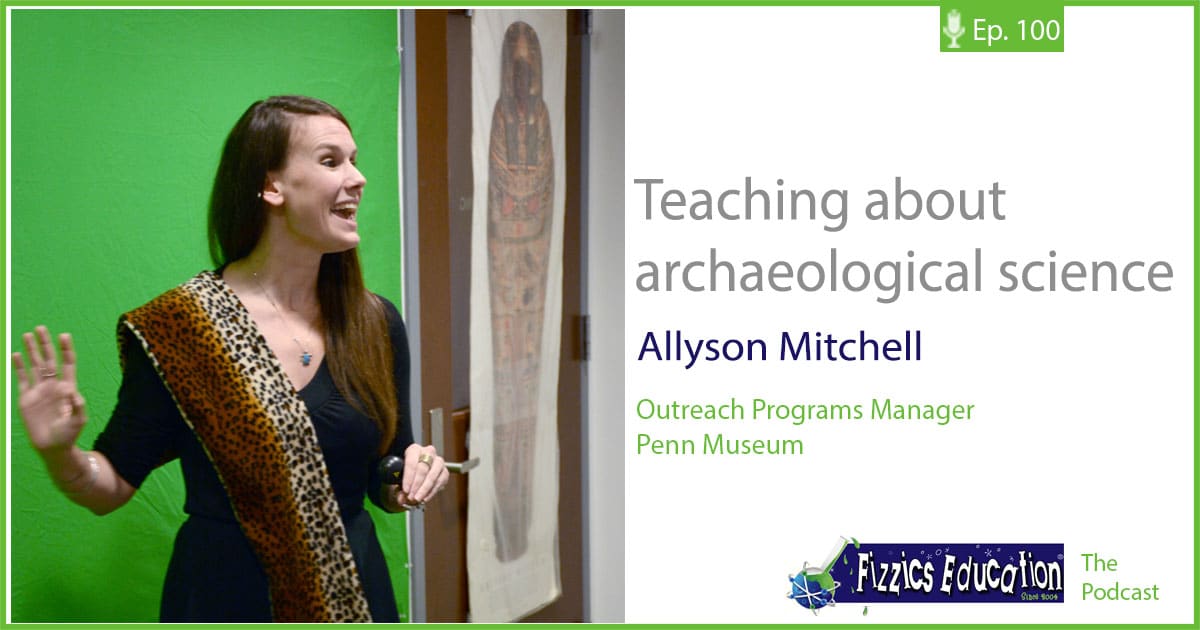
Podcast: Teaching archaeological science at the Penn Museum
Bringing science, history & culture together can be so rewarding for learners! In this episode, we chat with Allyson Mitchell who is the Outreach Programs Manager for Penn Museum, also known as the University of Pennsylvania Museum of Archaeology and Anthropology. From interactive virtual learning to science & cultural engagement programs onsite and beyond, there’s a lot happening near the heart of Philadelphia.
Throughout her distinguished professional and scholastic career, Allyson Mitchell has focused on the transformative power of technology as a bridge between formal and informal educational landscapes. Her work centres on creating seamless connections between museum collections and the classroom, ensuring that geographic boundaries do not limit a student’s access to world-class cultural heritage.
Prior to her impactful tenure at the Penn Museum, Allyson served as the Curator of Education at the Delaware History Museum. There, she was instrumental in spearheading the development of a state-of-the-art Distance Learning studio and its accompanying suite of programmes. Her leadership in the sector was further evidenced by her two-year term as the State Coordinator for the National History Day programme. Additionally, Allyson has held various specialist roles within the Education Department at the Philadelphia Museum of Art, where she focused on empowering K-12 educators to integrate digital museum archives and cutting-edge technology directly into their daily curricula.
Allyson graduated with high honours from the Tyler School of Art at Temple University with a Bachelor’s degree in Art History (and a minor in Italian). She furthered her expertise with a Master’s degree in Museum Education from the University of the Arts and recently earned her certification in Global Education Leadership. A respected voice in the industry, she has presented at the Mid-Atlantic Association of Museum Conference and the American Association of Museum Expo to discuss the evolving implications of virtual engagement. In 2019, Allyson shared her insights as the Guest Editor for the Journal of Museum Education, contributing a seminal article on the “beaming in” of live museum experiences.
CAAM – The Centre for the Analysis of Archaeological Materials.
Top 3 Learnings
Archaeology as a Science-Driven Field: Archaeological research at institutions like the Penn Museum integrates advanced chemistry and physics through CAAM (the Centre for the Analysis of Archaeological Materials) to analyse ancient ceramics, metals, and biological remains.
The Value of ‘Live’ Conservation: The Artifact Lab provides a unique public window into the scientific preservation of Egyptian mummies and other artefacts, making the technical work of conservators accessible and engaging for visitors.
Breaking Geographic Barriers with Virtual Learning: High-quality digital programmes allow museums to ‘beam’ their collections into classrooms worldwide, providing students everywhere with access to primary source materials and expert knowledge.
[00:00:18]Ben Newsome: You’ve spoken in for another Fizzics Ed Podcast. I’m so glad to have you again for another chat around science and STEM and all that sort of thing. This week’s a bit of an interesting chat. We’re hanging out with Allyson Mitchell, who is the outreach programme manager for the Penn Museum. If you haven’t come across the Penn Museum, it seriously is a cool site. Think archaeology and anthropology from across the planet. That’s pretty much what it is. Name your country, they’ve got possibly a collection about that, and they link the sciences in amongst us. That’s exactly what we’re talking about. Allyson is a big proponent, a massive advocate, for linking science and culture together. That’s exactly what we’re doing. The thing is, she does this via virtual learning and has done this for many years, and she has some real insights around how to engage learners no matter where they are in archaeological science. So, let’s dive right in. Let’s dig right in. Why not? Let’s put that pun in there too, because it really is worth our time. Allyson has a lot to share, so let’s get right into it.
[00:01:14]Announcer: This is the Fizzics Ed Podcast. We’re all about science, ed tech and more. To see 100 fun free experiments you can do with your class, go to fizzicseducation.com.au. That’s physics spelled F I Z Z I C S and click 100 free experiments.
[00:01:32]Allyson Mitchell: I work at the University of Pennsylvania Museum of Archaeology and Anthropology, which is a huge museum name, so we actually go by the Penn Museum for short. If you didn’t catch it, we study archaeology and anthropology. That’s why it’s that big title. I’m the outreach programmes manager there, so I hold this really cool position where I have the opportunity to create ways of interacting with our collections and our research through three different lenses. One being right out in the community, doing tabling experiences in science festivals. I’m excited to talk about that and art festivals. We also are able to create these kits that had touchable objects that were really developed over this long period of time at the Penn Museum in this teachable collection where children could touch and interact with these objects, the same as the public that would come in. They would have these programmes that I built around archaeology, helping kids put critical thinking they practice in school into some fun engagement with museums. Then I also do a whole bunch of virtual learning, which was always my niche, and that’s how we connected way back when at an ISTE conference when it was in Philadelphia one time. So, I wear a couple of hats, I think just like everybody as you said.
[00:03:00]Ben Newsome: Yeah, I feel like we’re like a hydra with lots of heads. Absolutely, lots of hats to wear. Look, you’ve got a lot going on. One of the things, apart from you just doing awesome stuff in the virtual world, which obviously we can definitely talk about, archaeology itself is something I’ve really wanted to talk about for a while now because I love weaving that history, art, and culture into a science context, because honestly, it all comes together all in one go here. This is very much something that you’re right into.
[00:03:30]Allyson Mitchell: Yeah, absolutely. I really feel so lucky to be able to work in the context of the Penn Museum because you not only have the opportunity to have this vast collection that’s global. The objects are things that individuals owned, used, or created. Some that were living 10,000, 5,000, just 1,000 years ago. You’re able to connect really beautifully within the exhibits and with everything that’s digitised as well. But you have these amazing multiple layers with the Penn Museum and with this view into archaeology, especially when you look at the programming and how we really work to make the programmes interactive and give you access to experts. When I say experts, I mean content knowledge experts.
[00:04:14]Allyson Mitchell: So people, like you said, that are coming from different fields and different perspectives but are all looking to understand humans, and doing that by looking at the material culture, those objects that are left behind, and having these discussions and also being able to work to understand the world cultures available today that you can compare these objects to. Especially with so many different minds at the table, you get introduced to these different perspectives or these different objects or these different stories that maybe you would never have the opportunity to have learned before without those many minds on the table. And on top of it, it’s just really interesting. It helps remind you that world history is living, that you constantly have the opportunity to learn more about the people that came before. And in all reality, we’re not that different from people from ancient times. I mean we have obviously new technologies, but we still have similar and necessary needs and desires, so it’s really a cool subject to jump into.
[00:05:30]Allyson Mitchell: And also for my expertise is being an educator, so being able to help interpret that, especially working with these content knowledge experts like graduate students who are a great resource and these amazing curators that have this another amazing role to be a faculty member of the University of Pennsylvania and bring in these lived experiences and connections from all over the world. So it’s really a fun perspective, so I’m excited to talk about it.
[00:05:58]Ben Newsome: Lovely. Considering, if you’ve never been to the Penn Museum guys, seriously, if you ever get a chance, go around because you are going to spend a lot of time there. There’s a lot of artefacts. And this is the thing, often people, the misconception can be with students that it’s just a dusty old relic sitting in a corner somewhere or something like that. There really is a scientific method involved with trying to work out, not just from a conservation point of view, where did this thing come from, etc. So how do you go about teaching kids honestly how science weaves into this?
[00:06:28]Allyson Mitchell: Well, that’s a great question. One thing I do always like to say is conservation is one of my favourite parts of museum work, and we have a really interesting view in, and we can talk about that as well because I think that you’ll like some of the cool things that we can check out in the Artifact Lab. We have this amazing team of conservators who again, so many different minds and disciplines coming to the table. The science that I also like to dive into is the idea that it’s a social science, and when you say scientific method, at least how I interpret it and help individuals that are walking in and, like you said, may have one idea about what this institution, what the objects might be, how we try to bring it to life is really having them use the most important tool. And what I think is always the most important part of the scientific method, which is the tool being your eyes, and helping you observe and look closely to really take time to ask yourself questions, some that might be answerable easily, like basic features, and in other cases asking yourself questions that require you to pull out background knowledge, be able to start your research and form a research question to then experiment in different ways.
[00:07:46]Allyson Mitchell: So what experiment I guess I always love to talk about is one that was shared with me from an Egyptologist and talking about ancient mummification. We have lots of different topics to explore when that relates to history, when it relates to art, and obviously a great understanding of their daily practice was connected to their belief system. In mummification, when you really break that apart, that’s truly a wildly scientific experience done so early. And to understand how archaeologists do science experiments to maybe recreate ancient materials like natural absorbents called natron, or to understand the science behind the practice that was really done for a belief system. It helps remind you that science is connected to a movement and a connection to the culture. So understanding science, language, art, it’s a really fun way to help kids connect something they may have heard in their history class and their science class together. Using archaeology as a practical use of science and the method is also really fun to talk about with kids and adults as well. Reminding everybody they have that skill.
[00:09:06]Ben Newsome: Absolutely. One of the things that often comes up is how old is the thing, and dating techniques are straight up science. And often sometimes debatable, is this within 50, 100, 1000 year correct and all the rest. I imagine that comes up a bit.
[00:09:28]Allyson Mitchell: Oh yeah, I think always. I think no matter what, when you’re going to be working with objects and collections and all different types and shapes and living and history and science, it’s all such people come in with such different understandings. I would say, I’m sorry Ben, say that one more time because I just got excited.
[00:09:52]Allyson Mitchell: Early morning for me, then it’s like ok, now.
[00:09:55]Ben Newsome: Oh totally. Like you know how you got carbon dating, you got argon dating, a lot of different…
[00:10:00]Allyson Mitchell: Yes, I was going to say I just my mind got so excited because what I really enjoy is the specific science where carbon dating, yes, and these different of course the arguments. What I got lost in thought in is the question I guess I’m always asking myself is how do we know what we know, and which ways are we going to answer that. So the carbon dating, that is a really interesting topic and I really like how carbon dating can also be balanced in to dendrochronology. Dendrochronology is actually something that has a specific tie, this idea of tree ring dating, and not only tree ring dating but an understanding of the environment, the idea that if tree rings are closer together, it’s going to be that there’s not a lot of water that season and farther apart vice versa. The idea is that we actually have a person that helped found that specific type of dating method. So I dove into that story and the idea of ancient trees.
[00:11:00]Allyson Mitchell: Then my colleague, he was actually developing a programme all about carbon dating. So we’re talking about these two very interesting scientific methods and these conversations, these chances in the environment you’re working with to connect with experts that actually study this and have dedicated big parts of their life to this amazing science to understand dating better. And then all of a sudden as we’re talking and bantering and trading ideas to help our programmes grow, we realise that carbon dating and dendrochronology are each other’s balance. A way for people to prove a point in some cases about a specific date. I also like the idea of dating being something that in some cases you can look around society, you can look to different resources like artworks or statues and you can at least get an estimate, a hypothesis, a good guess of when a person could have been living based on what they were wearing, how their hair might be, or maybe even a material or an artistic method that was being used that might be an advancement from something that was seen before. So that’s another fun way to at least give yourself a starting ground, a foundation point.
[00:12:16]Ben Newsome: Absolutely. I’m thinking about definitely the tree rings for sure, there’s some ancient trees around, and also the ice cores themselves. I actually wonder, considering what’s gone on in 2020, there’s going to be a record of this because of what’s happened with the atmosphere, for sure. It’s something that can totally be brought in. I suspect people working in the Penn Museum 400 years from now will be able to find that record.
[00:12:38]Allyson Mitchell: Yes, well I will say that of course in archaeology, records are one of the most important things. I always say another important tool is the pen and the paper and everything that you can draw, right, anything you can do with it. But dendrochronology is a really, really cool story. At least the connection that I have with it is there is a gentleman who actually was moving more towards a retirement and even into his retirement, he was still a researcher and connecting with different forms of researching. One specifically being the dendrochronology story, and he had gone and collected different parts of trees in California, bristlecone pine, and it’s just so beautiful because the bristlecone pine grows really, really, really, really close together tree rings, so they grow wider as opposed to taller. So it was such an interesting story, and the scientists who work in this really amazing set of labs that are at the bottom of the Penn Museum, called the CAM Labs, they actually have this one individual who’s a researcher, she’s so wonderful, and she showed me these amazing samples of these bristlecone pines.
[00:14:04]Allyson Mitchell: I now point them out everywhere, and we made this really cool thing, we took out actually into a community programme, a really fun programme where we actually took these different patterns that were based off of tree rings and we had students slide across a little material, like just a little sample of a straight up and down design and they had to match it with a similar example on a little mat on a table. It was something that helped them figure out a dating technique. So we had them put it on a timeline, so they had to match the pattern on the two individual pieces of paper, or I guess they were laminated. But it was really, really fun, the kids got into it. And we actually had another experience where it wasn’t just this ancient tree. There was actually a connection to an excavation that’s occurring in Gordion, it’s actually still something that we have a heavy hand in, a specific archaeologist, and it has a connection to King Midas and the family of that tale.
[00:15:07]Allyson Mitchell: Actually a specific mound where there was a specific tomb-like structure, it’s actually one of the oldest wooden structures. We played around with this idea of how wood is used in that, and we had kids apply this same idea of this tree ring dating and pattern matching. And it was really cool to have them understand that it wasn’t just you could just count the tree rings and that was it, and they knew how old the tree was. They actually had a lot more information in it. So it would be cool to think about a core sample of a 400-year-old tree, 400 years from now and see how the patterns would change.
[00:15:50]Ben Newsome: Absolutely. I kind of wonder out of all the students, do you mainly have middle school students come through or is it high school or younger ones? Who tends to turn up?
[00:15:58]Allyson Mitchell: Yeah, so I would say at least from our museum perspective, it’s a middle school population. We definitely serve high school audiences and younger audiences as well, but we see a big, big, big connection to middle school. That’s mainly because the content of social studies kind of wraps in social studies or history and world history, it kind of all wraps in in a beautiful way with our global collection and especially with it being an ancient world context. And then outside of that, we also are connected to the university, so we have a lot of colleges and different university students both connected through Penn and obviously different universities from around the area also come and visit, which is wonderful. So it’s great to see a nice mix.
[00:16:49]Ben Newsome: One of those things that you do, you’re not just getting people rocking up to you, you’re going out to the world via virtual video conferencing as well as doing festivals. I might just look down the virtual world for a start. I know you’re presenting right now not in the museum because you’re kind of locked out.
[00:17:05]Allyson Mitchell: Unfortunately I miss it so much.
[00:17:08]Ben Newsome: No, it’s strange. It’s like you know home, I feel the same, I often interchange my work with home all the time, get in trouble from my wife. But the site itself, you’ve been presenting for many years going out to many places via video conferencing. Tell us a bit about those programmes.
[00:17:26]Allyson Mitchell: Yeah, so the distance learning, right, and what was now what I call interactive virtual learning, is something that’s so close to my heart. That’s pretty much been connected to my career since the very beginning. So I’ve been working in museums and really working with this connection to a distant audience since 2009, which is wonderful. And I’ve had the opportunity to work in an art museum context, a history museum context, and now to find myself in the archaeological collection and content is just wonderful. And really, really exciting because again, like we talked about before, it’s just bringing all of these wonderful viewpoints together.
[00:18:09]Allyson Mitchell: So the virtual aspect has been a great way to see not just middle school students that are in our area, but also be able to help activate and extend this understanding of this very interdisciplinary topic to students just around the nation. And it’s really an opportunity for kids to get hands-on, for them to kind of look in a different way or have an opportunity to kind of explore the way they might already kind of look at a subject or want to understand a subject and just have never had that vehicle before. And it’s as fun as doing field trips on site. We get to meet these classes and we get to have these really fun personalised moments. So we’re talking about Minecraft or Roblox in some moments, and then we’re talking about what happened in Herculaneum the next, and the wind shift and how that affected the ash in Pompeii in the other.
[00:19:04]Allyson Mitchell: So it’s a really fun day, but I think the most special opportunity when it comes to the virtual learning aspect is that you get to have a constant connection, or a second connection. Sometimes when you’re on site and you’re able to have these moments with these classes, it’s wonderful, but you only have them for a little bit, and I know you know how that feels. Even in the community, you’re just like oh my gosh stay longer, we can talk about more. And not that I don’t want to do that on virtual as well, but when you know that you have an opportunity to have the content and the different types of connection points and different viewpoints that the Penn Museum collection really offers, you know that you’re going to be able to establish this wonderful relationship with the teachers and the students and the tech directors and all the IT people involved as well. You know that the work’s all worth it because you see the class again and they remember the Penn Museum.
[00:20:01]Allyson Mitchell: That was just how I felt of course prior to COVID. And on top of that, also making these connections and giving this enrichment to communities that just aren’t able to have field trip opportunities. Those are some opportunities that I know I think you and I both have many times talked about. That’s what this is all about. That’s what education is about, being able to provide that enhancement that just might not be available due to budget, due to physical limitation, due to how remote you may be. So it’s the passion that drives it. But what’s been really cool, or a silver lining I guess in reflection and things that you have to kind of hold onto in the particular time of human history that we find ourselves, is this idea that they’re still connected, that you’re hearing from these teachers, they’re asking for anything that you have available and we can suggest these cool Facebook opportunities that are happening or our programmes that are still running and never would have been able to reach an audience of that size beforehand unless they were on virtual with us anyway.
[00:21:02]Allyson Mitchell: So they can feel connected to an institution they can’t physically get to anywhere and will never hopefully go anywhere. Also on top of that, these pre-recorded pieces of content and different pieces of the website that have already been digitised and can be used in this different way. One thing that I also feel really lucky about is that there is an opportunity for such collaboration within the Penn Museum, and they really open this door where departments are sharing these different techniques and these different ways of working and different, like we talked about before, different viewpoints. And that makes the programmes better. And everybody’s job there is just to study human history. And so right now in this moment, it’s been so wonderful in this digital pivot that’s kind of necessary to help people feel somewhat connected in this unconnected world, what can feel right now like an unconnected world. It’s been really, really, really great to see everybody just kind of give what they can in whatever digital with whatever technology is available to them. They give it and they use it as a tool to help provide content for people that really need it. And it’s lucky for us too, because the stuff that’s pre-recorded, we can help teachers use now, families use now, and then hopefully lots in the future as well.
[00:22:20]Ben Newsome: Absolutely, and that is the thing, it is a unifier too. Admittedly there are some kids from an equity point of view that have not been able to connect because they don’t have the internet, and that’s a thing that people have to surmount over time. But as a whole, we’ve been able to connect much more broadly to places. A lot of places might only have ever connected to their local site because they would drive out to the site and that’s how they did their excursions. Now there is this whole massive world out there of just people you can connect with, and it’s only time zone that’s the barrier a lot of ways.
[00:22:50]Allyson Mitchell: Yeah, I would agree. That’s why I’m always one for content that’s going to be available. And also, I’m a traditionalist, I have so much of a traditionalist in me as well, so even when I prior to the circumstances that’s affecting everyone globally, I was still someone that was telling students we’re going to do a worksheet with a pencil, and I don’t want you looking at other monitors, look up at one, let’s all be together. I definitely think that’s where these opportunities are for the website, right, to be with the engagement that your website can give you or the materials that you can provide digitally that could be printed out or something that could be taken with them. Or in some ways, even if they’re so remote, hopefully you can get to them or make a connection where it can get to them. Because I work with a lot of groups in a lot of remote situations, and there’s one group specifically that’s in a very remote part of Canada and I just, the connection I have with them and I feel for them and that we’ve been able to maintain past through all of this progression into whatever this new normal is, has been a light for me. Outside of of course my family and those that I love and the blessings that you of course hope, you thank the world for every day. The idea of being able to have that connection is another really great silver lining and an understanding of, people do want to learn about really cool stuff and it’s fun that science works into that and like we said, history and art and lots of cultural understanding too.
[00:24:38]Ben Newsome: That’s cool. And one of the things you’ve been heavily involved in, it’s not just been with the Penn Museum, but with multiple sites, and actually on the research basis about from an impact point of view, how people actually perceive what an IVL programme, Interactive Virtual Learning programme is, and that is a whole rabbit warren to get into. You did something recently about this.
[00:24:58]Allyson Mitchell: Yeah, yes I will say that I was lucky enough just to get the right internship and have the connection with this wonderful, wonderful mentor Linda O’Leary. She is just the most, I will credit so much to her because she really opened up this door as a learning opportunity. I will say the one consistency I did see from the time like I shared before in 2009 was this idea of how the digital identity for each institution, each cultural centre, each science centre, art, zoo, the botanical gardens, under that great umbrella, there was this small pocket of individuals that were providing these amazing programmes that were live broadcasts. They were educational, and they had standards, and they were fun, and they were exactly what’s happening on site and bringing to life all of these cool topics. But nobody knew how to define us. We called ourselves content providers, and then all of our institutions may have called us something different.
[00:26:04]Allyson Mitchell: But what the research was really focused on at that time was the idea of digitising collections and how to use a website, and from an educator’s point of view, MOOCs and how that really fits into what you can do for engagement in digital engagement and resources. So I found that in our monthly meetings, we would there was this gap, this lack of nomenclature, this lack of defined vocabulary. They really helped us carve out and explain our work. So working with so many different people, I decided I wanted to try to do something about it.
[00:26:46]Allyson Mitchell: And I had the opportunity in getting my master’s degree to really understand this connection to scholarship. So I’ve always kind of had this, I’ve always been like a secret writer and I did an undergraduate thesis in art history and I wrote this master’s thesis on how video games is a bridge between informal and formal learning and had to fight for a blog post to be considered a credible source. And then I found myself in the world of distance learning and found that we gotta speak up, what are we doing? But this idea of scholarship, we could make a small change, we could do something that someone could use as a resource or offer to a department lead or a museum or a cultural institution leader and say, hey here are some best practices, some ways that we can really talk about our content and our collection and our research in a digital format that’s what we do in our tours or your educational or public programming.
[00:27:48]Allyson Mitchell: So I went and I decided to spend two years of my life on this journey of peer review where scholarly journal, I proposed a theme to just talk about what distance learning was in the context of it being interactive virtual learning programmes, and worked with these four author teams, this great group of women that wrote about the historical context, the different audiences, K through 12, lifelong learners, and this other idea of a global and community outreach that these digital platforms can provide. And we did it all just kind of to add to the scholarship that was already this asynchronous or this web-based user-directed digital resource, and we said like hey, here’s this other example of this interactive synchronous version of technology that can be used as a tool as well. And our whole goal was to really make it be something that people could use.
[00:28:53]Allyson Mitchell: So we wrote it kind of like a skim. I don’t know if you’re familiar with that media, that it’s like a newspaper thing I read, an app, and it’s also a podcast now, so I’m sorry I didn’t know how exactly to define it there. But we basically just had big headlines, and we would write quick modules with best practices as conclusions as a constant flow through these four articles that really talked about different practices that make technology a tool, available technology a tool, and also that it doesn’t have to be trendy. It can fit your budget, it can be sustainable, and we had some really cool data that was collected from content providers that have been doing this for over 20 years. We started some data with a whole group of lifelong learners, this whole adult community that was using the distance learning or the interactive virtual learning programmes as enrichment. And then we also were able to kind of give some case studies on some practices, some that worked, some that needed, that were just happenstance and it was really cool to see some collaboration, and others that were trials and quick experiences to explain how you can use it, just some really cool use cases.
[00:30:16]Allyson Mitchell: So that was a real big mission to help everybody really think about, you know, in this world that felt like digital resources are just flickering all around, you had some opportunity to really create a robust digital identity. Not just one that fit one direction, that really could be something that hits both ends. But this was also published in July 2019. So it was bizarrely close to what we’re doing now. Like what’s now become a big interest to a lot of museums. So I’m really excited to talk about the research because it seems so relevant now, more relevant than my personal mission it started as, you know, now three years ago.
[00:31:26]Ben Newsome: Totally with you. I was lucky enough to visit a lot of museums and zoos and aquariums across North America on a Churchill Fellowship back in 2014 and produced that research and got it out there into the world. However, it was sort of used by distance learning teams once it was shared out and then it was sort of left there for a while, and now all of a sudden, it’s really popular! So I mean I only just yesterday completed another training round through Inspiring Australia where we had over 200 organisations listening to myself and a few others from Sydney Science Education, Refraction Media, and guest people just explaining what it is that we do and how we do it without the hyperbole, without the over-polished, over-produced blah, just simply just here’s how we do stuff. And just Q and A back and forth and it worked a treat. And what’s what we’re still doing it, it’s currently May 2020 and we’ve got a couple more rounds to go. And it’s been a lot of fun. And just hearing just how many people really want to come to grips with this tech, because it’s not just because they’ve got to, because they want to. And so it’s a lot of fun, and yeah, we sit in a weird intersection right now, I must admit.
[00:32:42]Allyson Mitchell: I know, and isn’t it so fun? I used to start certain conversations either saying like no, I’m not a YouTube video, it’s not pre-recorded, or showing a clip of The Jetsons where she puts her morning face on, or trying to show something that could have been a quick clip I saw in a different way. And I find it so funny that that’s no longer needed, right? I will say the cool thing that I saw was how nicely the Penn Museum did actually respond to really thinking about this digital identity, and we really have been, at least within my department and the person that I work with, my leader, she really works hard and let me tech out and go crazy when all of this happened and sent her as many resources and pings that I possibly could to just help put as much information in her hands.
[00:33:36]Allyson Mitchell: But in this idea of really thinking about that identity of what we do, Ben, you and I, where it is really this very unique and now growing, what was unique I should say and now growing and wonderfully accessible form of teaching and learning and engagement and connection. That it has a different role than something else that we might do that has a very important educational role or engagement role, and then also something else we might do in a collection-based or a research-based role. So it’s been really interesting and really exciting for me, especially doing the research and stuff, to see them put into practice. Like my webpage has the interactive virtual learning programmes on the top of it, and it makes my heart so happy. I sent screen grabs to Linda and Casey, the authors, with all the heart emojis I could to express how much I wish I could reach through the phone. And also that they took the time to explain the purpose of the digital resources, like we were talking about before. Those resources that can be available even if it is maybe when you have to take that ride or you get the opportunity to have that ride to an area, a centre, a family’s home where you can access that type of enrichment. So that’s been really cool. And it’s exciting for me, and what I hope is you as well, to not only enhance this type of technology, but also the collections that obviously we’re really passionate about as well.
[00:35:05]Ben Newsome: Absolutely. And by the way, anyone listening in who is a distance educator, who is a tech coordinator, seriously hats off. We know how hard you have worked for your organisation, for your schools, your districts, whatever it is that you do. Oh my goodness. We know you got slammed. We totally do it because we got slammed. That’s the thing. And you really have done an amazing job and I know that the impact extends well beyond COVID things because honestly the number of people that now 100% get what it is that you’ve been doing for years and will use it over and over and over again. And I think that it’s like the whole rubber band, once stretched, will not come back to the same form. Education will be like that for sure. And the thing is though, yeah, you do the digital role, 100%, but then again you’re also involved in not just the people visiting the museum, you’re involved in the local festival as well. What’s that all about?
[00:35:57]Allyson Mitchell: Oh yes. So we have this amazing, amazing opportunity as the Penn Museum, as being part of the University of Pennsylvania. Every year, I’m sure, you said you were involved in some festivals. Are they annual? Is there an annual one? A lot of ours tend to be sat around National Science Week which sits around middle of August. And by the way, National Science Week to people like us is National Science Month and a half, because you can never actually get everything fit into that one week.
[00:36:34]Ben Newsome: Right. Is it a bit like that for your festival?
[00:36:36]Allyson Mitchell: Yes, exactly. It’s a ten-day wonderful celebration of science that happens all over the city of Philadelphia. It’s hosted by a local institution, the Franklin Institute, which is obviously a wonderful and amazing draw in Philadelphia. So another great place we’re really lucky in Philadelphia, Pennsylvania where the Penn Museum is located, that there are so many great cultural experiences. So this science festival, everybody from all different types of fields get together and just celebrate the science of their organisation, their centre, their school. And we have a whole great deal of opportunities to kind of get involved with. So you can do family programming, you have opportunities to go to the national parks, there are food programmes, there are things that happen after school, and they’re dotted everywhere, so wherever your neighbourhood is, you can find something having to do with science.
[00:37:30]Allyson Mitchell: They have these cool stickers. I found that when I first got on the team, that was something I kind of had to take control over, that was part of my new role and I was excited to learn the collection or the research really in that way. So I got to find these really cool perspectives in to the collection through science. So I got to explore conservation, one of the most amazing teams. When we were open to the public, and once we will be open again right in the future whenever that may be, they actually open the window two times a day where they were actually interacting with the public and answering questions and they could ask any question about what they saw, whether that be about the tools, like the microscopes, and in some cases the different ways that objects are mended and put back together. Really what they were working on and the content and the reason, making sure that we’re preserving history through their work of science. And history as we found it, right, not adding anything to it of course.
[00:38:30]Allyson Mitchell: So they had this really cool way of looking under the wrappings of mummies because obviously nobody’s unwrapping anything like that, animal or human, they use X-ray technology. So I thought that was a cool way to celebrate science at this big carnival that’s kind of the end where it’s a big party. I made this matching game about that, and kids just come up with their families and they have to look really close and they have to put together these matching cards to the X-rays of these five sets of different animal mummies that we have in our collection. And what’s also really cool about that is that we got to see not only families and visitors that didn’t really know about us kind of interact in that way, but we also got to talk about conservation and the different roles scientists have on site in archaeology. The different types of conservators and their specialties to specific parts of our collection. And that opened up this door of me being able to connect again to those labs down at the bottom of the Penn Museum that explore metal working.
[00:40:35]Allyson Mitchell: So I created this experience about ancient metal working, and we have this whole series of gold tattoos, and we would talk to families that would come up and they would get these tattoos during the festival. Hypoallergenic body paint comes off in a shower, no worries. But we talked all about that. We had lots of conversations about the science of henna at one carnival which was really fun, the chemical process of that and understanding that part of the world and their science. And then we also had this amazing conversation about how archaeology is truly a science, so bringing something that families can’t touch, but we asked them what’s different from this and this, and explain gridding and different experiences again bringing in that scientific method with this aha moment. So that, it’s just so, so, so fun to be able to think of these quick moments. And honestly, some of those have even turned into some new virtual programmes that we’re offering now as well.
[00:41:31]Ben Newsome: But yeah, the Philadelphia Science Festival is near and dear to my heart. I think people at my institution would know me to be carrying around stickers at one point of the year. At this point, it would have been probably only two weeks ago actually Ben, I would have been telling everyone they had to wear their I Heart Science stickers. I would have been wearing it everywhere, asking for volunteers. And I’m upset because I had to do this one programme about how we moved the Sphinx.
[00:42:01]Ben Newsome: For the carnival this year, we had… did you know this? That we actually moved the Sphinx?
[00:42:06]Ben Newsome: I saw this time-lapse video! Everyone, imagine this, this is not a small Sphinx, this is like a truck!
[00:42:15]Allyson Mitchell: No, it’s the largest one, literally the largest one in the Western Hemisphere. It’s the largest one. So yes, this amazing team of great minds, people that work with objects, of course the conservators, exhibitors, and of course the team of individuals that engineered and constructed this amazing man-made bridge that moved this 14.5 ton Sphinx 300 feet from the space it was rested over close to 100 years ago, 300 feet through our mosaic courtyard into a doorway that could not have been fit better for this colossal amazing object of material culture. But what was really cool was that they moved it on air tracks. And so on my exploration for Science Festival this year, which probably starts in about November, I go and talk to people that did really cool science or experiments to see how could we make that something that kids and families can engage with.
[00:43:28]Allyson Mitchell: And I thought about this idea of what about a race, like who can move the Sphinx fast enough? And one of the individuals that was a leader of the team, Bob Thurlow, he actually talked to me about it and we were talking about the idea of an air hockey table. It would be the same idea of the Sphinx kind of floating with the air track technology, if you put a little Sphinx on top of a doughnut or of some sort and kind of just smooth along like it did with these cool air tracks. I didn’t get enough chance to break it down, because all of this happened, so I had to shift my focus, but I’m going back to it.
[00:44:08]Ben Newsome: You can totally do it. Actually, if you jump on the Fizzics website, there’s three ways to use a leaf blower. So you can actually use marine ply, some industrial plastic, a plastic lid, a bolt, I really do right up because I’ve made a couple of them. You punch a few holes into the plastic, tape the plastic to the board, bore a hole exactly the size of your leaf blower. Tell your IT, tell your safety people so they know you’re not going crazy. But essentially, turn a leaf blower on and it just totally lifts the person. It can hoverboard right across a very flat, clean surface. Make sure that your leaf blower connects well and doesn’t entangle people’s hair, make sure it’s all safe. And you totally can lift a person. You can actually have races and move people across the stage or space. It is a lot of fun. And I’ve also seen balloon hovercrafts done with an upside down picnic plate, poke a hole at the bottom and you throw a balloon in there, blow it up, it doesn’t last that long, like five seconds.
[00:44:55]Allyson Mitchell: But still, I was like, but you know those are the fun things that I feel like, like you said, our days are always so busy and you love working with so many groups, but it’s always you’re moving, you’re just constantly moving which is great. But being such a researcher at heart and somebody that’s also a kid that’s got way too much energy so I always want to play, I would carve out these days to be able to just to break it down. Like you said, I love the balloons. I also was thinking when you said a leaf blower, I’m like, could I do it with a hair dryer? Ben, let’s do a collab, we gotta do something! This would be so fun.
[00:45:32]Allyson Mitchell: But yeah, these are the things that are really I think also the special moments you get to be as someone that wears a lot of hats, and also that gets to work with this really cool, this really amazing content. And I think even to bring it back to the research, that was another word outside of interactive virtual learning and all of these specific terms that help you understand the audiences and connection points. We also worked to help define content or collections or help people understand what is a museum, how do we get an umbrella, so calling it cultural centres and cultural organisations. And also what is an idea of a collection? How do we make that as universal as possible to help people know that they can do it. You know, we got this. And that’s the cool… so we would say things like content. And it helps me with such an interdisciplinary collection like the Penn Museum offers, it’s just such an exciting, such an exciting way to apply the research in a realistic application. It’s really happening so we can use it.
[00:46:35]Ben Newsome: Absolutely. Now I’m just thinking, imagine you had a whole bunch of people in front of you who are starting their museum education career. They’re walking into it and they’re about to start, they’re about to be let out into the world. What would be some sort of advice you’d give to them in terms of stepping out irrespective of which museum they end up entering in the first place?
[00:46:55]Allyson Mitchell: Oh my goodness Ben, that is such a great question. I actually really appreciate that question because the one thing that I’ve always been extremely tied to is the people that I learned from. I really was lucky in high school to meet a mentor, this touchstone that really helped me understand what teachers and educators and what turned into professionals really can mean to an individual. And for me, I have been really, really lucky to trust in a lot of mentors to help me find my path. And I am a little bit zany, so it’s cool to have had people believe in me and see or at least stick with me to help understand how I could really apply myself.
[00:47:53]Allyson Mitchell: So the idea of education and continued education is really important to me, and I’ve always worked extremely hard and close with interns. High school interns as well as undergraduate and graduate interns. And all of them kind of come along with me as a learning experience with the Science Festival. A way of kind of introducing them to what family programming is, what are really quick ways of getting people interested in such a place they might have never heard of. Once I find out more about them, being able to understand like we talked about before, what’s your lens? Like do you want to research, do you want to interact with the public, do you want to do something that’s more web-based? Because technology has always been in my professional and scholastic life. Usually all the interns would be like, distance learning is cool but I wouldn’t exactly hit them right on what they would want to be doing.
[00:48:53]Allyson Mitchell: So being able to act as mentor and teacher was really cool for those students. So I would say that if you’re going into museum education, match your scholastic pursuits, what you’re going to be asked to study and write and do as class work, match that with your professional experience. Make sure that you intern and you do assistantships and you have or whatever is those opportunities. Like for me, I volunteered. I would just keep going places until they would be like, Allyson, don’t you want to take a Sunday off? I just think that you don’t have to be like that, but you should really find a balance between matching the theory with the practice so that you not only have connections and ways of finding part-time work maybe or full-time work or whatever opportunity or path you might go down after your studies, but you also have this opportunity to see different parts of the field and different ways and reasons people have to look at the field or the practice a little bit different.
[00:49:58]Allyson Mitchell: So I would say that would be a really big part, and the other thing I would say is I think scholarship is important. So I was really lucky my programme I picked specifically because we could write a thesis that was then published, you know you had a copyright to the idea. But also it helped me understand the reason I was learning what I was. I got to write an instrument, I understood the importance of data, I understood how to talk about that data not just to prove your point, but I honestly think what makes you a true researcher is an understanding the importance of the data that doesn’t necessarily prove your point, because it’s helping you see what you need more research in and applying again that scientific method in whatever that came about. So I would say writing, and if you’re not a writer, then definitely make sure you get that experience along with all the cool stuff you’ll be introduced to.
[00:50:50]Ben Newsome: That’s absolutely right. And it doesn’t matter which stage of your career either too, because you can get involved in research quite early on, or you can do it 30 years down the track, it’s up to you. But getting out to that point of at least getting connected with what everyone else is doing, and then pulling the data and going actually critically analysing, does this thing work?
[00:51:08]Allyson Mitchell: Right. Yeah, exactly. And that’s what I always, even when we were writing about the journal, there was some pushback about certain data points and it was just because in some cases you get into these conversations of like, is this exactly what we want to say, this is… but I would have to, especially in the role of editor and also the ultimate goal was to help to add to the scholarship. You know, this is because we’re all cultural workers, anyone that’s going to be reading it or is going to have an interest, they’re going to want to hopefully help improve and just bring knowledge into themselves. And so to me, what I always said was it doesn’t necessarily have to be our good data, it doesn’t have to prove our point, but it means we have to look at it harder. So that’s a hard thing to do as well, because you’re just like ugh, this meeting is almost over, why do we have to talk about what we have to do, we have to write again?
[00:52:00]Ben Newsome: Look Allyson, you’ve done an amazing job since 2009 doing this sort of work and it’s really, really cool. Not only the work that you’re doing for the Penn Museum, but frankly for the industry as a whole. This thing that is this teaching mechanism that is not just virtual learning, but all over the place, museum education is fantastic. Look, how would people be able to get in touch with you?
[00:52:23]Allyson Mitchell: Yeah, so thank you so much Ben, and it’s always so great because I always learn, I literally was taking notes with my pen and my paper here while we were talking. So I always learn from you and it’s always fun. That’s really the goal, right, is to share and not just about our specific little small point that’s now really kind of big part of that type of education, that style using technology as a tool, but also the field of museum education. So I really appreciate that. If anybody wants to get in touch with me, I’m on LinkedIn so you can do that. And then also you can connect with me on my email address for like speaking, or if you ever just kind of want to, I do lots of consulting. I work with lots of local small institutions as well to just help them think of really good ideas for content. I guess should I give that to you now or should I say it online or should I give it to you?
[00:53:05]Ben Newsome: Totally up to you. We can put it in the show notes of course.
[00:53:07]Allyson Mitchell: Okay, cool. So it’s just [email protected]. So you can go ahead and just email me that, and we’ll put it in the notes because my name is spelled with two L’s and a Y, and that’s not always the typical way. My mom wanted to make sure I never got a key chain in the summer, so…
[00:53:24]Ben Newsome: Oh, I get that. I get that. And hello to everyone out there with unique names. I have family members in a similar situation.
[00:53:36]Ben Newsome: That’s cool. Allyson, thank you very much for joining me. I know it’s been a busy time for you and to take this time out just for a little while to reflect on what you’ve been doing has been fantastic. And seriously, if you’re listening in wondering how will you start teaching archaeology, how will you start talking about conservation, maybe just reach out to Allyson, she 100% will be able to help you out in amongst everything else she’s trying to help out with.
[00:53:55]Allyson Mitchell: Yeah, absolutely. And I’ll also give you links to the Penn Museum and the amazing Artifact Lab blog as well, so I will give you all the links if you’d like so you can put them in the notes. Really exciting stuff.
[00:54:06]Ben Newsome: Have a great one. Thank you so much.
[00:54:09]Allyson Mitchell: Bye.
[00:54:11]Announcer: Thanks for listening to the Fizzics Ed Podcast. Sign up now for our fortnightly email newsletter. It’s loaded with details on new experiments you can do, STEM teaching articles, new gadgets, exclusive offers and upcoming events. Go to fizzicseducation.com.au. Scroll to the bottom and add your email.
[00:54:30]Ben Newsome: Well there we go. We just heard from Allyson Mitchell, who you can really tell loves her virtual learning, and more importantly, loves connecting to people all over the globe to teach about archaeology and science and culture and history all in one go, and the learners have a blast. So this is the thing, you can reach out to Allyson. You totally can. Jump on their website. Jump on penn.museum, check out their collections that they’ve got on site, but also reach out to Allyson through the education programmes and find out how you can connect your learners to there. By the way, this was episode 100. So, if you haven’t checked out all the other episodes, go check it out. There are organisations right around the planet who are doing really cool science and STEM stuff, and a lot of them are doing virtual learning programmes too, especially given what’s happened during 2020. But some have been doing it for years, and Allyson definitely is one of those people who has been helping a lot of organisations right around North America and beyond to really engage audiences in remote learning. So definitely awesome job, thumbs up, excellent, love your work. Hey, that’s the end of this episode. I hope you have a fantastic afternoon, evening, morning, wherever whatever you are doing, and I will catch you another time.
[00:56:21]Announcer: This podcast is part of the Australian Educators Online Network. AEON.net.au.
Frequently Asked Questions
What is the Penn Museum’s focus in terms of archaeological science?
The Penn Museum is home to the Centre for the Analysis of Archaeological Materials (CAAM), a joint endeavour between the museum and the University of Pennsylvania. It focuses on the scientific study of the past, using specialised labs for human skeletal analysis, archaeobotany, and ceramic petrography to understand ancient technologies and cultures.
What is the ‘Artifact Lab’ mentioned in the podcast?
The Artifact Lab: Conservation in Action is a glass-enclosed conservation lab where visitors can watch conservators treat Egyptian mummies and other ancient artefacts in real-time. It allows the public to ask questions and see the technical scientific work required to preserve historical items.
How does the Penn Museum engage students through virtual excursions?
The museum offers interactive virtual learning programmes where students can explore collections like Ancient Egypt or Rome via live video links. These sessions use high-resolution digital tools to show close-up details of artefacts, allowing students to engage in evidence-based inquiry from their own classrooms.
What is the ‘Daily Dig’ programme?
The Daily Dig is a series of short, one-minute videos where museum experts—including curators, keepers, and researchers—highlight a single object from the collection. These provide quick, accessible insights into the vast archaeological and anthropological stories housed within the museum.
How can schools teach archaeological science without high-end lab equipment?
Allyson suggests focusing on ‘low-tech’ archaeology, such as ‘garbology’ (analysing modern rubbish) or observing how different materials decay over time. These activities teach the scientific method, data collection, and evidence-based reasoning using accessible everyday materials.
Discussion points summarised from the Teaching archaeological science at the Penn Museum with AI assistance, verified and edited by Ben Newsome CF
Extra thought ideas to consider
Archaeology as a Multidisciplinary STEM Field
Consider how archaeology acts as a bridge between the humanities and STEM. By using techniques from chemistry to analyse pottery glazes and biology to study ancient DNA, how can we reframe archaeology in the classroom to attract students who are interested in ‘hard’ sciences?
The ‘Glass Wall’ of Scientific Conservation
The Artifact Lab at the Penn Museum allows the public to see conservators at work. Discuss the impact of making ‘behind-the-scenes’ scientific work visible. How does transparency in scientific processes build public trust and interest in heritage preservation and forensic science?
Primary Sources in the Digital Age
With museums ‘beaming’ high-resolution images and live video into classrooms, the definition of a primary source is evolving. How does interacting with a digital representation of a 3,000-year-old artefact compare to physical interaction, and what are the pedagogical advantages of digital access for global equity in education?”,
Recognised by
22 years, award-winning work, 1 purpose
Recognition from business, education and industry bodies across Australia.
Australian Small Business Champion
Multiple years
CILC Pinnacle Award and Hall of Fame inductee
Center for Interactive Learning and Collaboration
Western Sydney Awards for Business Excellence
Winner
Top 100 Coolest Company
Listed
Local Business Awards
Winner
We value your privacy
We use cookies to improve your experience. Essential cookies are always active. You can choose which optional cookies to allow.We use cookies. Optional ones stay off unless you allow them.Privacy policy