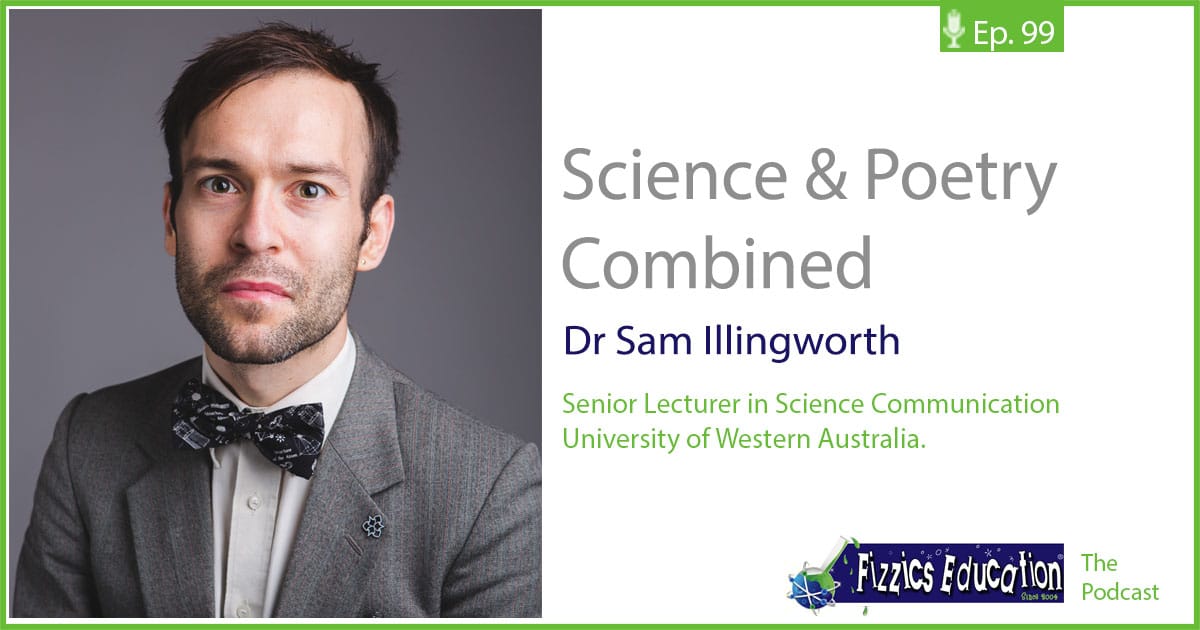
Here’s a challenge to take up – why not try combining poetry with your science programs? We chat about the positive impact this has on learning and about how this can be done with Dr Sam Illingworth, a Senior Lecturer in science communication at the University of Western Australia.
Dr Sam Illingworth is an Associate Professor at Edinburgh Napier University and a leading figure in the field of science communication. His research focuses on the innovative use of poetry and games to bridge the gap between complex scientific concepts and the public. By leveraging these creative mediums, Sam facilitates a meaningful, two-way dialogue between scientists and non-scientists, ensuring that research is not only shared but truly understood and felt.
His work explores how the emotive power of the spoken word and the interactive nature of tabletop and digital gaming can break down traditional barriers to scientific engagement. Through his academic contributions and creative projects, he continues to advocate for a more inclusive and imaginative approach to STEM outreach. You can explore the full breadth of his research and creative portfolio by visiting his official website or connecting with him directly on Twitter.
Top 3 Learnings
Poetry as a Tool for Dialogue: Poetry provides a non-hierarchical space where the audience’s expertise in their own lives meets the scientist’s expertise in their field, moving beyond simple information delivery to genuine engagement.
Humanising Data: Creative arts like Art and poetry can translate cold scientific statistics into emotional narratives, making complex issues like climate change more accessible and actionable for the general public.
[00:00:18]Ben Newsome: Yes, welcome again to another Fizzics Ed Podcast. Glad to have you here again for another chat around STEM and science and all that sort of thing. This week, we are talking with Dr Sam Illingworth, who is a senior lecturer in science communication at the University of Western Australia.
[00:00:37]Ben Newsome: His research focuses on poetry and science put together, which is a really cool way to develop a dialogue between scientists and non-scientists. Guess what? We could totally take a leaf out of his book when it comes to education.
[00:00:52]Ben Newsome: Have a think about it. How could you link poetry into how you’re teaching science? Really cool. Sam has a lot to chat about—his background in this, why he does this, and some pointers about how we might be able to do this in our own classrooms. Definitely worth listening in as we talk with Sam. Let’s head on into the chat.
[00:01:05]Announcer: This is the Fizzics Ed Podcast. We’re all about science, ed tech and more. To see 100 fun free experiments you can do with your class, go to fizzicseducation.com.au. That’s physics spelled F I Z Z I C S and click 100 free experiments.
[00:01:23]Dr Sam Illingworth: My name is Sam Illingworth. I’m a senior lecturer in science communication at the University of Western Australia in Perth, where I lead the science communication unit with my colleague, Dr Heather Bray. My background is in environmental science and atmospheric physics.
[00:01:42]Dr Sam Illingworth: These days my research and my work are more concerned with developing dialogue between different audiences and especially connecting scientists and non-scientists, and giving voice to audiences that are maybe traditionally underheard and underserved by both science and science communication.
[00:02:03]Ben Newsome: One of the things that I always wonder about is how people fall into a thing. In this case, you’re working as an environmental scientist and then you end up in this. What made that change?
[00:02:13]Dr Sam Illingworth: My PhD was at the University of Leicester in atmospheric physics, and I was using a satellite called the infrared atmospheric sounding interferometer to make measurements of greenhouse gases at the Earth’s surface, which I enjoyed doing greatly. At the same time, I was also the president of the theatre society at Leicester. I was really interested in how we could maybe use theatre as a way to communicate science to non-traditional audiences.
[00:02:43]Dr Sam Illingworth: Off the back of that, I was really fortunate to get a scholarship to live and work in Japan for a couple of years with the Daiwa Anglo-Japanese Foundation to further investigate the relationship between science and theatre, working with the Japanese director Yukio Ninagawa. During that time, I got the opportunity to also develop a lecturing course at the Tokyo Institute of Technology in which we used theatre to explore effective communication techniques for scientists.
[00:03:16]Dr Sam Illingworth: During this time, I realised that I was quite a good scientist, but probably a much better communicator and facilitator and developer of dialogue. Following that, I was then really interested in developing science communication as an academic discipline and started publishing in that area. I was really fortunate to then get a lectureship at Manchester Metropolitan University.
[00:03:42]Dr Sam Illingworth: I then decided that theatre wasn’t maybe the area that I was most interested in, and instead what I started looking at was how we could use poetry and also games as a way to develop dialogue between scientists and non-scientists. That’s now where my research areas lie. That’s how I ended up at the University of Western Australia.
[00:04:08]Ben Newsome: Wow, that’s quite a shift. Obviously you’ve moved partly out of the theatre, but you obviously have a keen interest in that still, bringing in poetry as well. A lot of people talk about games in science and STEM, but often you don’t hear people say poetry, or theatre. That’s really cool.
[00:04:30]Ben Newsome: I’m trying to picture how that would have played out, especially in Japan as well. The theatre itself can take many forms and many audiences. What sort of productions were you involved in? Just out of pure curiosity, I’d love to know.
[00:04:43]Dr Sam Illingworth: It definitely wasn’t science theatre that I was involved with. I spent a lot of my time in Japan basically understanding 20% of what was going on. I loved my time in Japan and it had a huge impact on my personal and professional life.
[00:05:04]Dr Sam Illingworth: The kind of productions I was working on were traditional Japanese productions, looking at Japanese street theatre as well, something called Shogekijo. Not really traditional Japanese theatre in terms of Kabuki and Noh, but looking at modern interpretations of Shakespeare through a Japanese lens.
[00:05:25]Dr Sam Illingworth: But really, it was the work at the Tokyo Institute of Technology and later Tsinghua University in Beijing that gave me the confidence and the opportunity to start thinking about how the arts can be used as a facilitatory tool to develop this. Going onto poetry, because that’s really where my expertise lies now.
[00:05:43]Dr Sam Illingworth: I am a poet and a spoken word artist. I’ve been fortunate enough to perform my work all over the world. It very much started off as this idea of I’m going to perform poetry as a way to communicate science to other people. I’ve got a weekly blog called The Poetry of Science where I read a new piece of scientific research and write it as a poem to hopefully bring it to new audiences.
[00:06:17]Dr Sam Illingworth: What I realised was that this is effective, but it’s very much a one-way dialogue. It’s me telling people, standing on a stage, saying, this is poetry. It’s a good performance and it’s definitely effective. However, for me, what I’m really interested in is science communication that can engender dialogue. So that’s a natural conversation.
[00:06:40]Dr Sam Illingworth: How can we work with audiences so that we’re not just telling them about science, but rather they’re telling us about their needs and their experiences and how that can be used to inform research governance and research direction.
[00:06:54]Ben Newsome: Interesting. So how do you go about doing that?
[00:06:57]Dr Sam Illingworth: That’s where poetry comes in. When we bring together scientists and non-scientists, let’s take for example an Australian example of the bushfires. Obviously this is something that affects all peoples, all different communities. And it’s not just scientists that are going to be able to come up with the answers. Actually, lots of non-scientists are still experts.
[00:07:20]Dr Sam Illingworth: They live in the area, they know what does and what does not work in terms of tackling these bushfires, in terms of mitigating these bushfires. So it’s really important that the scientists work with these non-scientists in order to develop effective mitigation strategies.
[00:07:37]Dr Sam Illingworth: However, sometimes when we bring together scientists and non-scientists, as you will know, we develop what I call a hierarchy of intellect. All these people who are non-scientists but are still experts in many other capacities might feel a bit intimidated because somebody’s there with 20 letters after their name or whatever.
[00:07:55]Dr Sam Illingworth: So what we try to do is use poetry as a way to level those hierarchies. Because what poetry does is it creates a sense of shared vulnerability. When I say poetry, what I mean is we sit down together, with the scientists and the non-scientists, and we write poems together about that particular topic.
[00:08:15]Dr Sam Illingworth: What that does is it gives voice to people. It gives permission to the scientists to display an element of pathos that they’re maybe not normally allowed to do, and it gives permission to the non-scientists that actually what they have to say is valuable. In terms of this shared sense of vulnerability, once you see a professor stand up and read a very poorly constructed haiku, you realise that they’re fallible as well. So it’s a great way of engendering dialogue between disparate groups of people.
[00:08:46]Ben Newsome: I can definitely attest to not being able to do haiku that well, that’s for sure. It goes both ways. If you go into a community—I do a lot of outreach all over the place—and going into a community where you’re not known, people do know this is their place, this is their home, this is their spot. They’re the experts, 100%.
[00:09:07]Ben Newsome: Irrespective of any letters after any name, I always walk in extremely humble because I honestly think that maybe I’m not the person to be in that space; they’re the ones who know the spot far more intimately. It 100% needs to be an even dialogue, and using poetry as a medium is very useful. How often have you done that? I haven’t come across this as much.
[00:09:30]Dr Sam Illingworth: Quite a lot. A lot of my research is around this. I can send you heaps of papers that I’ve written about this topic if it’s of interest to you. But I guess one of the most effective things we did was a project where we worked with a group of audiences that we would consider to be vulnerable in the UK. We worked with them and we talked to them about environmental change.
[00:09:50]Dr Sam Illingworth: Obviously, environmental change is something that’s going to affect everybody, but it’s probably going to affect the most vulnerable in society the most. So we worked with people living with mental health needs, refugees, asylum seekers, people living with disabilities. We talked to them about their needs and their experiences.
[00:10:14]Dr Sam Illingworth: As a result of that, we were able to find out what their needs were, what their experiences were, and then what the disconnect between that and current strategies for mitigating against environmental change were. It’s a really effective technique and it’s something that I continue to do, and it really frames all of my research at the moment.
[00:10:38]Dr Sam Illingworth: If any of your listeners are interested in being involved in such a project, I’m really happy to work with them in that way. How it normally takes place is we work with different community groups to establish a dialogue and then we go into those settings, as you say humble, realising that we’re the intruders really in that space.
[00:11:04]Dr Sam Illingworth: And then put together a series of, I think quite fun and innovative sessions where we write poetry together and ultimately come up with a set of outcomes that can hopefully be used in a way that can benefit that community whilst granting them agency in an area that they find to be important to them.
[00:11:21]Ben Newsome: That’s the thing. I’m certainly no wordsmith, but I do understand that when you choose certain words to put into a sentence or some form of structure of a poem, those words that you choose do matter. Which means if you’re working with different groups, all with different experiences, backgrounds, understandings, etc., if you’re forming it together, that means you actually have to create the dialogue around the words, which means you then create the dialogue that you needed in the first place. So it’s really a vehicle and a tool, isn’t it?
[00:11:47]Dr Sam Illingworth: Absolutely. What I find as well to be really powerful is if we’re working with people with their native language as well, if English isn’t their first language. It’s a great way to be able to again grant permission and talk to them about the culture of poetry from their backgrounds as well.
[00:12:15]Dr Sam Illingworth: That can be a really humbling experience. It certainly showed me to never go into a situation with any preconceptions because oftentimes, thinking about when we were working with a group of people who were asylum seekers in Bristol in the UK, a lot of them had very limited levels of English having just arrived in the country.
[00:12:33]Dr Sam Illingworth: Maybe certain assumptions were made by myself and by some of the scientists as to their level of understanding of environmental science and climate change. But once we got past that barrier of English, it actually transpired that some of them were experts in this field. That was really interesting, that poetry actually enabled us to transcend language, which was an unexpected pleasure.
[00:13:00]Ben Newsome: I bet. Obviously working with disparate audiences in different backgrounds for sure. At the same point, this is not just for adults, this is for kids. How young have you done this with, so to speak, as I stumble over my words on a Friday afternoon?
[00:13:15]Dr Sam Illingworth: No worries. We’ve done this with a lot of different groups and I guess it depends on the audience and to what the outcome will be as well. I’ve certainly done a lot of science and poetry writing workshops with children from the age of five upwards.
[00:13:33]Dr Sam Illingworth: With them it’s slightly different. When I do those kinds of workshops with schoolchildren, it’s more getting them to think about the concept that science and poetry aren’t actually mutually exclusive entities, but rather they’re complementary brethren that can help us to better understand the world and the way in which we live.
[00:14:00]Dr Sam Illingworth: I think one of the problems with formal education is that people are pigeonholed very early on into being a creative or a scientist, whereas actually it’s possible to do both. One of the exercises I like to do is the kind of physics experiments which I’m sure you’ve done a billion times, Ben.
[00:14:21]Dr Sam Illingworth: The ones where you make elephant’s toothpaste and you make slime, which obviously the kids love. But what we try and do is instead of writing it up as a science experiment, we write it up as a poem. It gets them really thinking about how we can maybe use poetic language to explore and explain our environments and how poetry and science aren’t necessarily antagonistic but rather complementary in nature.
[00:14:43]Ben Newsome: It could be quite interesting. I was thinking, listening to this, in this current remote learning environment—because this is a thing as educators—and by the way, that is a very cool way of teaching, I’m definitely going to have to try this. From a remote point of view, it’d be interesting to create some form of situation whereby the kids collaboratively create a poem, but they don’t necessarily all have to be together at the same time. It could be done asynchronously or it could be done together in breakout rooms or whatever. It would be interesting to see what would come out in these shared spaces.
[00:15:20]Dr Sam Illingworth: Well, it’s a very good idea and it’s something we’ve actually already done. The other week I ran a session. I’m still very much involved in environmental sciences and the geosciences and I’m a long-standing member of the European Geosciences Union. We had our conference a couple of weeks ago that’s normally held in Vienna every year for 16,000 people, but was moved into a virtual space.
[00:15:45]Dr Sam Illingworth: In that conference I normally run a short course called Rhyme Your Research with my colleagues Tim van Emmerik, Ariana Soldati and Caitlin Hall in which we teach people how to write poetry about their research. It’s always a really fun session.
[00:16:01]Dr Sam Illingworth: We did that on Zoom this time and we actually put people into breakout rooms of four. We had 150 participants and we got them to write collaborative haiku together about their research. It was a really innovative way of getting them to think about how to discuss their research, how to work collaboratively together.
[00:16:22]Dr Sam Illingworth: What was really cool was that some of the poems that came in were not in English as well, which is really great. I think there’s definitely a space for utilising poetry in a virtual environment to enable learners of all ages to better understand the experiences of their colleagues.
[00:16:46]Ben Newsome: Absolutely. There’s lots of platforms too. You could go down a whole rabbit hole of different platforms. One of the ones that has been very hot in education lately has been Flipgrid. Flipgrid allows you to record a two-minute video of yourself saying whatever it is, and then people get to respond to that over and over again.
[00:17:03]Ben Newsome: One of the things that goes around a lot is a good friend of mine, Sean Forde out of South Korea, does this thing called world read alouds where people from all over the world will read one page of a Dr. Seuss book or something like that. It’s fun for the kids to digest and watch these people with different accents read out their book to them as they turn the page. It could be fun doing that with poetry. You could do the same thing over and over again. There’s lots of ways of doing this.
[00:17:28]Dr Sam Illingworth: That sounds like a really cool way of doing it. Going back to this idea of listening to people with different accents and listening to people of different languages as well, I was greatly informed in my work and ethos by the Austrian philosopher Ludwig Wittgenstein, who said that the limits of my language are the limits of my world.
[00:17:51]Dr Sam Illingworth: I just think that is so true. Not just in terms of different languages outside of English, and for anybody who speaks more than one language they’ll be able to attest to how much you can better identify with that culture once you understand the language. But also the language of different disciplines.
[00:18:14]Dr Sam Illingworth: If you’re just speaking science, if you’re just speaking poetry, if you’re just speaking theatre, you’re missing out on all these different approaches and systems to understanding the natural environment and the human environment.
[00:18:33]Dr Sam Illingworth: I think that anything that enables people, especially children at a younger age, to get into their heads that science and English are not the only languages is a really vital tool for all of us to be working towards.
[00:18:48]Ben Newsome: Oh, absolutely. I was spending a couple of weeks touring Shenzhen in China a couple of weeks ago. We were doing these presentations to preschool groups. Running it, I’m an English speaker, I just honestly couldn’t speak the local language.
[00:19:08]Ben Newsome: Having fun grappling with my translator back and forth to describe these concepts to kids who were barely five, it was a lot of fun. You could see the kids could follow it based on speaking to the teachers afterwards. But it forced us to think very carefully about what we were trying to explain.
[00:19:28]Ben Newsome: If what we’ve always done is bring out the usual lines about how to describe the thing, if it doesn’t work, it straight up doesn’t work. You could tell straight away with the translator that they’d say, this sentence, actually the words you’re using, there really isn’t a great direct translation whatsoever. We’ve got to work on this.
[00:19:42]Ben Newsome: Which means on the very first session, we had to co-write the script as we talked. It was a lot of fun, and nothing like doing that in front of a bunch of kids. It did work. We were able to refine and morph and change this particular production because we had no choice. It was just the nature of the beast, and I actually think it was better for it.
[00:20:04]Ben Newsome: It’s a lot of fun. I was thinking, there are lots of people who listen in to this from all different backgrounds—schools through to universities, museums, zoos, aquariums and all the rest. Inevitably they’ve got to teach in some way. Perhaps teaching in poetry—and I can tell you right now from my end, I’ve never tried it before, so it’s time I should try—what would be the first steps to start considering how to go about doing this?
[00:20:26]Dr Sam Illingworth: That’s a great question, Ben. I really invite all of your colleagues and all of the listeners to get in contact with me, either via my email address or contact me on Twitter. I’m just @samillingworth. I’ve got heaps of resources that I’m really happy to share with people.
[00:20:44]Dr Sam Illingworth: One of the things I like to do in a classroom environment is to begin by collecting a group of poems written either by scientists or about science, sharing those with the students, getting them to read them, and getting them to analyse them.
[00:21:02]Dr Sam Illingworth: I think sometimes when we’re taught to analyse poetry, it feels like it’s tedious, whereas actually analysing poetry is so much fun and it’s really beautiful. For me, and I’m not an English professor so I’m sure many of my colleagues will correct me, but for me, there’s no correct reading of a poem.
[00:21:20]Dr Sam Illingworth: You take from the poem what you take from the poem. Your taking or your understanding of a poem is no less or more correct than anybody else’s.
[00:21:32]Dr Sam Illingworth: There’s a wide range of excellent poetry that I could happily recommend to your colleagues. I’ve got some I can read out if you’d like as examples for the classroom setting.
[00:21:47]Dr Sam Illingworth: I think what these poems really do is act as the starting point of a conversation. This is a poem, a really fun one, by Robert Kelly. Robert Kelly was the children’s poet laureate in America, and it’s written in 2006. It’s quite short. It’s just called ‘Science’.
[00:22:06]Dr Sam Illingworth: Science explains nothing,
but holds all together
as many things as it can count.
Science is a basket,
not a religion he said.
A cat as big as a cat,
the moon the size of the moon.
Science is the same as poetry,
only it uses the wrong words.
[00:22:32]Dr Sam Illingworth: For me, that’s such an awesome poem. I think it really pokes fun at science in a playful nature that I know a lot of us as science educators and science communicators think is a really important part of science. It shouldn’t be taken too seriously.
[00:22:47]Dr Sam Illingworth: I just love the idea that he’s playing with a cat as an SI unit of measurement. A cat as big as a cat. I think that’s really cool. How big’s that room? It’s about seven cats. It’s just a really nice, playful poem.
[00:23:04]Ben Newsome: Absolutely. I was even thinking about the basket itself. It’s meant to hold things, but what’s the basket made out of and if it’s got holes in it? You can really dive into each part of it, couldn’t you?
[00:23:16]Dr Sam Illingworth: Absolutely. I wrote a book last year, 2019, called A Sonnet to Science, published by Manchester University Press. In this, I investigate the lives of several famous scientists and the poetry that they wrote and actually how that poetry impacted their lives and their research.
[00:23:36]Dr Sam Illingworth: People like Ada Lovelace, Sir Humphry Davy, Ronald Ross, who’s the person who discovered the links between malaria and mosquitoes, and James Clerk Maxwell, who obviously as physicists is one of our heroes with the Maxwell equations.
[00:23:53]Dr Sam Illingworth: In writing that book, what I really discovered was that so many scientists have used poetry as a way to interrogate their research and to get them thinking about things in a slightly different way.
[00:24:07]Ben Newsome: Ah, that’s fantastic. If you’re listening in, guess what homework we’ve got! Give it a go. That’s what I love about having these chats because every now and then you just go, it’s about time I gave that a shot. It sounds like that’s exactly what I’m going to take on because it’s certainly something to try out.
[00:24:26]Ben Newsome: If you’re listening in, hit Sam up. Let him know what you’ve done. Let us know what you’ve done here at Fizzics, because it’s always nice to know what people are doing and achieving, and frankly failing! It’s nice to know how it went, and more importantly what you did about it.
[00:24:43]Ben Newsome: Sam, thank you for your time to pop on in. I know it’s quite a busy time, quite an unusual year so to speak, but certainly making the most of it. The fact that you’re doing this virtually already, that’s a lot of people to contend with—multiple haikus coming at you with multiple languages! Interesting times.
[00:25:07]Dr Sam Illingworth: Absolutely. Thanks, Ben. Just to touch on that final point you said there, I think failure is such a great word and such a great concept for why we should think about an arts-based and a science-based approach. Failure is something that all of us as artists, as scientists, as human beings should embrace. It’s only through understanding and working with our failures that we’re ultimately able to have our successes as well. Thank you very much for having me on the podcast. It’s been an absolute pleasure speaking to you, Ben.
[00:25:37]Announcer: Thanks for listening to the Fizzics Ed podcast. Sign up now for our fortnightly email newsletter. It’s loaded with details on new experiments you can do, STEM teaching articles, new gadgets, exclusive offers, and upcoming events. Go to fizzicseducation.com.au. Scroll to the bottom and add your email.
[00:25:55]Ben Newsome: So, what do you reckon? Are you going to try it? Are you going to try putting science and poetry together? I reckon it’s worth a shot. You just might find it has a genuine impact with your learners. If you’re in science communication, maybe it’s a great way to really do those reach out programmes with the public, and make some connections that you haven’t made before.
[00:26:15]Ben Newsome: Sam has a number of links that you can definitely check out. It’s well worth your time. Head over to thepoetryofscience.scienceblog.com. He also has a podcast called Sci Poetry, which you’ll be able to find on a lot of podcast catchers. He’s definitely on Podbean for sure. He has a website samillingworth.com. We’ll put all those notes in the show notes as usual, and you can check those out.
[00:26:35]Ben Newsome: I hope you’re having a fantastic time wherever you are. I hope you’re making your learning environment awesomely cool, and maybe weaving a little bit of art into your programmes just like Sam has been doing. You’ve been listening to me, Ben Newsome from Fizzics Education. We totally love doing this sort of stuff. We will certainly have more science and STEM coming up through this year and beyond. Have a fantastic time. I will see you another time.
[00:27:26]Announcer: This podcast is part of the Australian Educators Online Network. AEON.net.au.
Frequently Asked Questions
Why is poetry an effective tool for communicating complex science?
Poetry provides a non-hierarchical space where the expertise of the scientist and the lived experience of the audience are both valued equally. It facilitates a genuine two-way dialogue, moving away from the traditional model where facts are simply transmitted to an audience. By using metaphor and emotive language, poetry makes abstract concepts more relatable and humanises the research process.
How can writing poetry help scientists in their professional work?
Writing poetry encourages scientists to step away from technical jargon and find their human voice. It allows them to think about the broader societal impact of their research and can help them process the emotional aspects of their work, such as the anxiety often associated with studying climate change. This reflection can lead to more effective and empathetic communication with the public.
How can teachers integrate poetry into a standard science lesson?
Teachers can use poetry as a tool for reflection. For example, after a lesson on a specific scientific concept, students can be asked to write a short poem or create ‘found poetry’ using words from a scientific text. This encourages students to synthesise what they have learned and express it in a way that is personally meaningful, reinforcing their understanding of the material.
Can creative arts like poetry really influence public policy or action on climate change?
Yes, because data alone is rarely enough to change behaviour. While scientific statistics provide the evidence, poetry and art provide the narrative and emotional connection required to move people to action. By humanising the data and making the consequences of climate change feel personal, poetry can bridge the gap between understanding a problem and wanting to solve it.
Discussion points summarised from the Poetry & Science Combined with AI assistance, verified and edited by Ben Newsome CF
Extra thought ideas to consider
The Power of Non-Hierarchical Communication
Poetry levels the playing field between the ‘expert’ and the ‘layperson’. How might we apply this non-hierarchical approach to other areas of science communication to foster more inclusive and collaborative problem-solving within our communities?
Humanising Data through Narrative
In an era of information overload, statistics can often feel cold and disconnected. How can we train the next generation of scientists to not only be masters of data but also effective storytellers who can use creative mediums to make their findings resonate with a diverse public?
Recognised by
22 years, award-winning work, 1 purpose
Recognition from business, education and industry bodies across Australia.
Australian Small Business Champion
Multiple years
CILC Pinnacle Award and Hall of Fame inductee
Center for Interactive Learning and Collaboration
Western Sydney Awards for Business Excellence
Winner
Top 100 Coolest Company
Listed
Local Business Awards
Winner
We value your privacy
We use cookies to improve your experience. Essential cookies are always active. You can choose which optional cookies to allow.We use cookies. Optional ones stay off unless you allow them.Privacy policy