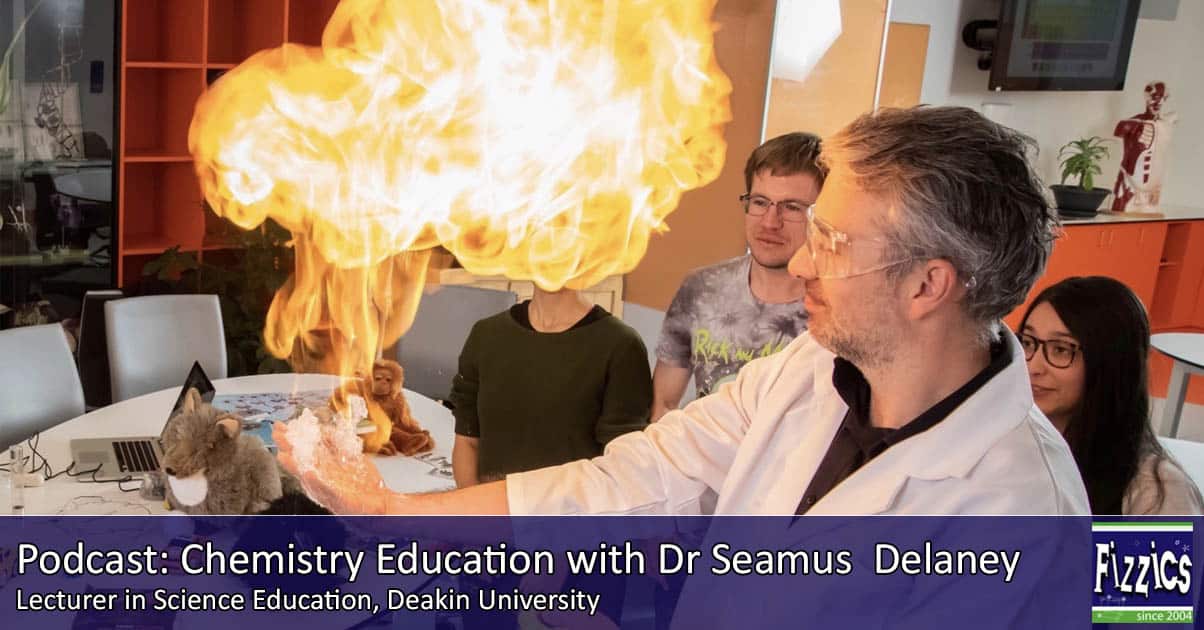
Podcast: Chemistry education with Dr Seamus Delaney
Meet Dr Seamus Delaney, a science education lecturer and researcher from Deakin University. He has a real passion for chemistry education and for the past 15 years has been heavily involved with making chemistry accessible for students of all ages. together with the team from Deakin University, Dr Delaney is making a fantastic impact!
Is Chemistry the key to a sustainable future? In this episode, we speak with Dr Seamus Delaney about re-positioning chemistry as “the sustainability science.” We explore his 15-year journey from classrooms in Australia and Switzerland to leading-edge research at Deakin University, focusing on how Augmented Reality (AR) and Virtual Reality (VR) are transforming how we teach the building blocks of our world.
About Dr Seamus Delaney
Dr Seamus Delaney is a Science Education Lecturer and Researcher at Deakin University, Australia. Over the last 15 years, Seamus has held diverse roles including classroom teacher, Head of Science, Head of eLearning, and researcher across both Australia and Switzerland. He is a dedicated committee member of the Chemistry Education Association (CEA) and co-founded the Early Careers Chemistry Network (ECCN) to support the next generation of chemistry educators.
Seamus co-established the Elements of Sustainable Chemistry group with fellow Deakin researchers. This international, interdisciplinary project aims to shift the narrative of chemistry toward its vital role in global sustainability.
Research & Innovation Areas:
Repositioning Chemistry: Moving the focus toward green chemistry and sustainable practices that address global environmental challenges.
Immersive Technology: Investigating the incorporation of Augmented Reality (AR) and Virtual Reality (VR) into teaching and learning to make abstract molecular concepts visible and interactive.
Informal Learning: Researching science education in out-of-school and informal contexts to bridge the gap between the lab and the community.
ECCN Support: Providing a robust network for early-career teachers to share resources and pedagogical strategies.
Top Episode Learnings: Chemistry for a Greener World
Chemistry as Sustainability Science:
Seamus explains how chemistry provides the solutions for renewable energy, waste reduction, and carbon capture. It is the fundamental science required to meet the UN Sustainable Development Goals.
Digital Pedagogies:
We discuss how AR and VR can help students “step inside” a chemical reaction. By visualising atoms and bonds in 3D, students develop a deeper spatial understanding of Chemical Equations and molecular geometry.
Supporting New Teachers:
Through the Early Careers Chemistry Network, Seamus emphasises the importance of mentorship and resource-sharing to prevent teacher burnout and ensure high-quality science instruction.
Education Tip: The “Green Chemistry” Substitution.
Follow Seamus’s lead by reviewing your standard chemistry experiments through the lens of Sustainability. Can you substitute a hazardous reagent with a safer, bio-based alternative? Challenge your students to evaluate an experiment not just by its result, but by its “E-factor” (environmental factor). As Seamus demonstrates, when students see Chemistry as a tool for environmental protection, their sense of purpose and engagement skyrockets.
[00:00:18] Ben Newsome: Welcome again to another Fizzics Ed Podcast. Glad to have you here again for another chat around science education. This week we’re heading down to Deakin University where Dr Seamus Delaney has been working as a lecturer and researcher in this space. You see, for the past 15 years, he’s worked as a classroom teacher, a head of science, a head of e-learning, he’s a teacher educator and researcher in both Australia and Switzerland, and he’s a committee member for the Chemistry Education Association.
[00:00:44] Ben Newsome: Plus, he co-founded the Early Careers Chemistry Network, which helps chemistry teachers early in their careers. One of the things Seamus loves is incorporating augmented and virtual reality into chemistry education, and he’s currently working with a number of educators right around the world to reposition chemistry as a sustainability science, which is an amazing research area and something he’s very passionate about. So let’s listen into this chat. He’s got a lot to share.
[00:00:59] Announcer: This is the Fizzics Ed Podcast. We’re all about science, ed tech and more. To see 100 fun free experiments you can do with your class, go to fizzicseducation.com.au. That’s physics spelled F I Z Z I C S and click 100 free experiments.
[00:01:29] Ben Newsome: Thank you very much for joining me. It is the first holidays of this COVID-19 thing, and how’s it been with you in what you’ve been doing?
[00:01:41] Dr Seamus Delaney: Well, it hasn’t been holidays for us. The universities have still been open, so we’ve been frantically getting all of our on-campus programmes exclusively now online. At Deakin, we’re somewhat fortunate. Much of our science education programme always had an online component, so you could be an online student or an on-campus student. So it wasn’t too much work to change a lot of it.
[00:02:06] Dr Seamus Delaney: But a big part of our teaching was always doing the practical activities and helping the pre-service teachers really actually try them out and fail and tinker with practicals. So we’ve missed that, and we’ve really missed that sort of feeling in the lab. That’s what we’re missing. We don’t really capture that one-to-one in an online space. But it’s been a busy time and, with a kid at home, trying to work out how you entertain a kid during the holidays when none of the holiday things are running. That’s a difficult thing.
[00:02:32] Ben Newsome: With my kids, it’s been a mixture of some of the stuff that I get up to, but also, I’m going to be honest, Minecraft and YouTube. I’m one
of those parents. And yes, we get them outside for walking the dogs, but yes, it’s been a challenge for everyone. And I mean, just thinking about working through Deakin University, I mean, trying to… okay, you’re not pivoting an entire programme, but there’s still a lot of effort in doing that. I mean, just for now, I mean, what is it exactly that you do exactly within Deakin? Like, you know, title and all that sort of thing, what is it that you totally get up to?
[00:03:01]
Dr Seamus Delaney: Sure, so I’ve been at Deakin for a few years now and I largely look after the secondary science pre-service teacher education programme. In the sense that we have, I would say, about a suite of, let’s say, seven or eight subjects that are secondary, and then probably the same number that are primary. And most of my time is in the secondary space. We’re a great team, there’s about four or five of us across biology, physics, psychology, environmental science.
[00:03:36] Dr Seamus Delaney: So we really work well together and we get a lot of our units together and just try and design a cohesive programme for either bachelor’s or master’s students who are coming through as a pre-service teacher. It’s quite challenging to make sure that they… for secondary, we benefit from the sense that they already feel like they’re a science teacher and they’ve got a science background. But to be honest, I really love working with the primaries.
[00:04:09] Dr Seamus Delaney: One of my other hats is coordinating for the Burwood campus… Deakin’s a multi-campus university… some visits in schools with our primary pre-service teachers to go out and do some short science lessons in schools
.
[00:04:22] Dr Seamus Delaney: And that is a lot of fun because they often don’t feel like they have ownership of the science or they don’t refer to themselves as a scientist, as you would know. So that’s a lot of fun working with those students and they’re often the ones that are most keen to really jump in and try things out. And yeah, that can be a lot of fun and a lot of failure, but that’s part half the fun.
[00:04:44] Ben Newsome: I must say, I’ve been lucky enough to work the whole gamut from preschool to year 12 because of doing outreach as well. And you know, high school trained, etc. But vast majority of my work has been around primary and there’s something about… it’s like the kids haven’t had the science beaten out of them yet. I don’t know how to say this in a politically correct way, but they are still so incredibly curious and not so worried about failure and what other people think. They just want to have a good shot at it.
[00:05:13] Ben Newsome: And it’s amazing watching the kids do it and also watching the teachers just come up with some really cool stuff. And like you said, they’re going “oh, we’re not scientists”, but in reality they really think like it and really dive right in and it’s really cool to watch.
[00:05:28] Dr Seamus Delaney: I think we do our best to… yeah, I always remember that first lesson we always have where we talk about… they do walk in and they feel a bit anxious about it. And then we say from day one, you know, this is about developing curiosity and wonder in your students in the primary school. And it’s not about, you know, feeling like you have fact-based knowledge of it all.
[00:05:53] Dr Seamus Delaney: And so it’s really just about making sure that that curiosity and wonder is able to develop and nurture inside these students. And I think there’s just that collective sigh of relief around the room. It’s like, oh that’s good, there’s not going to be a chemistry test at the end of this. It’s more… it’s just like, okay, well, I can do that, you know? That’s why I got into, you know, why I’m doing an education degree at university and I want to develop and motivate students and engage them. So I think that… once you get over that hurdle, that for me certainly helps.
[00:06:23] Dr Seamus Delaney: From the secondary side of things, they do come in a bit value-heavy where they’re thinking, “Well, you know, I’m a chemistry educator” or “I’m a physics educator”. And so we do spend a lot of time working with those students to go, “Well, actually, you know, when you go out in schools, you’re going to be teaching year seven to ten science. You’re going to be teaching subjects outside of your sort of comfort area.”
[00:06:49] Dr Seamus Delaney: So a lot of time is convincing them to actually realise again that it is that curiosity and wonder, even in that seven to ten stage. Students, we want them to be completely open to… do they want to study science in senior secondary? Or if they don’t, what level of science, what level of science inquiry do we want them walking out the door at the end of year ten, you know? If they’re not thinking of doing science in year 11 and 12, how do I want them thinking about science at the
sort of year 10? So that’s sort of something we truly do focus on here at Deakin.
[00:07:13] Ben Newsome: Absolutely and I was just sort of thinking there, just thinking of some of the best things I’ve seen around with almost inter-school things, where you might have a grade three student and they’re paired up with a grade 10 student from the high school down the road. I mean, usually involves a
lot of cross-talk between the schools and whatnot. But gee, there are some awesome opportunities for young kids to teach older kids and vice versa because often you always think the older student knows more, and usually invariably they do, but sometimes it can be flipped completely and it can be rather cool. So for anyone listening in who teaches primary, your students can do cool stuff. They totally can, and give them a chance. And I guess just thinking about what happens at Deakin, I mean, you have a lot of people from an undergraduate level through masters and whatever doing education. I’ve got to ask yourself, I mean, how did you fall into teaching pre-service teachers to teach science? Like, how did that come about?
Dr Seamus Delaney: Oh gosh, it’s a very long story. I’m… what’s that movie with the Benjamin Button? I think I’m doing it that way. I was a PhD student, I did my PhD in chemistry here in Australia at Monash University. And as most PhD students do, they do some lab demonstrations or tutoring, anything to just make a bit of money.
[00:08:37] Dr Seamus Delaney: And I was very lucky to become involved with a first-year Faculty
of Science subject. It was a science subject for students who didn’t have a science background, so hadn’t done the prerequisites at year 12, or they were mature age students and they had to do this fundamental science subject first before they could enrol in later subjects. The subject was called The Design of Science and it was so much fun. It was in a computer lab room, but what we had was we had them standing on chairs and making whirlybird paper planes and dropping them, doing different wing lengths and all those things.
[00:09:22] Dr Seamus Delaney:
And then putting it in Excel and doing all the stats. But it was just that, we had them looking at statistics about the Titanic and working out who died in first, second, third class and thinking about disparities. And the students just had so much fun. They were just like, “I didn’t realise I’d be doing this.” And so that stuck with me. And so I was getting towards the end of my PhD.
[00:09:43] Dr Seamus Delaney: And my very understanding PhD supervisor knew that I loved doing this,
getting quite involved with this first-year subject. But I thought, “Well, why did they not do science in secondary? And why are they now a mature age student coming into a tertiary degree but not having done as much science before?”.
[00:10:06] Dr Seamus Delaney: So I thought, “Well, I’ll go do a Master of Teaching. I’ll go be a science teacher.” And my supervisor was very understanding. I did my Master of Teaching as I was writing up my PhD. I gave him my first draft of my PhD just before I started
the course. I gave him my second draft just after I finished the course. I was very lucky, I landed in a very good school, a secondary school. And at the end of my first year teaching, I finally graduated my PhD. So I was doing all that while becoming a teacher. And as I said, it was a very good school. I quickly became the head of science and head of e-learning at that school. And I helped set up a group for chemistry teachers. We were quite conscious of the fact that graduating teachers do need a bit more.
[00:10:51]
Dr Seamus Delaney: support, and so we thought, well, what better way to do that than ourselves? So we set up a group called the Early Careers Chemistry Network. It was supported by the Chemistry Education Association here in Victoria, and we basically ran professional learning for chemistry graduating teachers. So around either online stuff or remote learning, ICT, or even just, you know, designing your own assessments and practicals.
[00:11:28] Dr Seamus Delaney: And so, doing that for a few years and being head of science at a big school here in Victoria sort of got me the attention… the attention of my old lecturers. And so when my chemistry education lecturer retired, he said, “Well, why don’t you be me?” you know, and I was like, “Are you kidding?” and he said, “Yeah, of course.” So I made the switch… so I made the switch to university, doing secondary education there. And that was all going fine until my family moved to Switzerland.
[00:12:03] Dr Seamus Delaney: My wife’s also in the university sector, she’s an associate professor and she was offered a job in Switzerland, the city of pharmacy, in Basel. So our son was quite young, so we packed up and we went there. And after a few months, I got a job there as a researcher working with the Centre for Science Education… the Science and Teacher Education there. And there, I became a pre-service teacher educator for early childhood and primary.
[00:12:31] Dr Seamus Delaney: That was really different. And that was in German, by the way. I learned German very quickly and I was teaching…
[00:12:37] Ben Newsome: Could you still teach in German?
[00:12:39] Dr Seamus Delaney: I could still teach in German, not… not well. But we did… so in Basel and the Fachhochschule Nordwestschweiz, we had the early childhoods… so it’s a little bit different there. They have the early childhood, you’re trained to do two years of kindergarten or the first two years of primary. And then primary you could be three to… three to six. So that… we worked with the early childhood, and that was, gosh, that was… I mean, in German, but it was still so much fun.
[00:13:10] Dr Seamus Delaney: They had a book called Experimentieren mit Ameisen and it was this ant… this ant that had all these inquiry experiments and amazing pictures of the ant, you know, carrying a candle and showing… just all the experiments that they would do. And I just found that they were doing so much inquiry at such an early age, it was just amazing.
[00:13:29] Dr Seamus Delaney: So anyway, this really got me involved. I’d never really done any early childhood or primary before this stage, so hence the Benjamin Button reference, I was going backwards. But when I… when we knew we were coming back to Australia, you know, Deakin were looking for someone who was both primary and secondary, so I was very well placed for that. And now back at Deakin and now back thankfully, you know, back with my core love, which has always been chemistry.
[00:13:58] Dr Seamus Delaney: Chemistry education’s my… my real passion for education. I’m back involved with the Chemistry Education Association where at the moment trying to come up with ways that we can support chemistry teachers in this remote learning space. And then I was very lucky to meet my partner in crime, Madeleine Schultz, who was also new to Deakin at the time. And she’s in the School of Life and Environmental Sciences.
[00:14:24] Dr Seamus Delaney: She’s definitely a chemist, but her passion as well is chemistry education. So between the two of us, we set up an interdisciplinary group called Elements of Sustainable Chemistry. Our website’s eschemistry.org. And what we’re really trying to do with that interdisciplinary group is work with researchers and work with schools and educators to really change what people think about chemistry in terms of sustainable development. And so that’s really something we’ve been pushing very hard these last probably year and a half.
[00:14:59] Ben Newsome: It feels like quite a path. I’ve got to say, it’s quite funny when you ask someone that because it’s often we talk about our practice, what we’re doing today. But a lot of what you’ve been doing in the background really brings out what people really love. And I was just sort of noting clearly experimental design is a thing that just kept on popping up through that, as well as your love of chemistry and the trip off to Germany… an unexpected twist, but it certainly gave a lot of skills.
[00:15:27] Ben Newsome: Before I go into the experimental design stuff, because that’s something I personally love… well done. I mean, one of the things that I’ve been asked quite a few times in conferences is how did you start Fizzics, etc. And all it ever was was just take the next step. What’s the next step? What’s the next step? And honestly, I don’t think I’ve taken many steps right now. So it’s kind of like you just don’t know where you’re going to go. So no, well done, that’s really cool.
[00:15:50] Dr Seamus Delaney: I mean, I think I should say that I’ve been very fortunate to be able to work with just some truly amazing people along the way. And I think so many of those experiences that I just described were only possible because of the chance encounters and the collaborators who are keen to explore things. I mean, even the situation in Switzerland, you can imagine someone turning up in
your office who’s written you a random email, who speaks no German at the time, and taking a chance and you go, well, you know, I’ve got this small project, do you want to get involved? And we started with that. We were writing essentially NAPLAN-style questions for Switzerland. They were putting their own national assessment programme together. And so you can imagine this is not something someone who has an inquiry and experimental design background would be really interested in, but we wrote all the chemistry, the physics, the general science questions.
[00:16:55] Dr Seamus Delaney: But what Professor Peter Labud, who was the person who got me involved, really pushed hard with the government was, no, we don’t want them just doing questions. We want them to do a practical activity first. So what we did was we designed some activities that each school could do. We wrote the instructions, we wrote the teacher resources, we wrote what the students have to do and we wrote it very inquiry-focused. So it wasn’t just question-answer, it was, you know, what do you think it’
[00:17:10] Dr Seamus Delaney: …had to do the experiments first, and then there was the NAPLAN-type questions. And so the emphasis was really much on getting the schools to really understand that it was through experimentation that you can really develop your knowledge around these areas. And so we were really thankful that the schools really took that on board and it’s still part of their programme today.
[00:17:51] Ben Newsome: My apologies with the Switzerland, I should have been listening properly. But the thing about that experimental design, I mean, that is a… not a beast, it’s just fun. When you get into it and start peeling back the layers and you teach kids about how to really look deeply at their design and “what are you messing up this time?”, they really get it, they really do. And so I’m actually going to throw you… no preparation whatsoever, so I’m putting you on the spot.
[00:18:36] Ben Newsome: I mean, if you had, let’s just go middle of the range, say a year seven kid… so you know, overseas, middle school type grade… and you’ve got some kids in front of you, they’re clearly interested, they’re about past their first three months of how to not burn yourself and burn down the lab and they’re starting to do some cool stuff. And you want to bring in some experimental design, I mean, there’d have to be a couple of go-to experiments that off the top of your head you go, “You know what, if I just do this, no matter who they are, no matter what their background, they’re going to love it and they’re going to get right into it and it’s going to be really hard to peel it off them.” So I’d just love to know, I want to dive into your brain a little bit. What sort of experimental design things could people set up, even without too fancy equipment, just things hanging around that could get kids involved in the experimental design, the real scientific method really well and grab their attention?
[00:19:08] Dr Seamus Delaney: Yeah, it’s a big one, isn’t it? I think there’s so many things to take into consideration, like is it something that you want to go for one lesson or one week? So those things in mind, but you know, I would probably just answer with some examples that… I won’t use one of mine, but a colleague of mine, Kieran Lim and Peter White and some other great names here at Deakin, they were part of a programme called ASELL for Schools. You can still find all the resources online for that.
[00:19:44] Dr Seamus Delaney: And Kieran would always demonstrate this inquiry activity. And again, it was designed for sort of years five to eight, so it works well. And it was bungee cord design. Maybe you’ve heard this one before? So it was around, you know, we’re going to drop Barbie or we’re going to drop a figure off the bench and we don’t want it to go splat on the floor. So he would just have these boxes of different cords, you know, elastic, not elastic, all sorts of things.
[00:20:19] Dr Seamus Delaney: And you go, well, what sort of things do we need to take into consideration in the design of this bungee cord? Like we want this person who is stupid enough… and I’ve never done it… but stupid enough to sort of jump off a platform and fall down to the ground but not, you know, kill themselves on the ground. But also we don’t want to rip their neck open when the cord gets to the end of its length. So all these sort of things. And so that was a tough one for students.
[00:20:43] Dr Seamus Delaney: Students really have to figure that out. That could be one that could be 15 minutes, it could go quite long. One that we used to do, back at my school, and I guess it is so old… one of my educators when I was in my pre-service teacher, he did this and he told me that he’d been doing it for 30 years. So this is a really old one, but I still love it and nowadays it’s got a nice ICT feel to it: egg parachutes.
[00:21:19] Dr Seamus Delaney: I can’t go past it. I mean, I love it. Nowadays we get them to film it, we get them to work out all their energies, work out their velocity using stop-motion cameras and it’s… it’s the communication of it. Having to really not just design the experiment and think about the inquiry and tinker with it, just communicating. I think that is as well… communicating your results to both a lay audience, your peers, to a scientific audience, all the challenges that are different there.
[00:21:46] Dr Seamus Delaney: Communication for me is really one of those key focuses around inquiry as well. So having whatever the experiment is, how you communicate that to those three different audiences… a lay, your peers, and a scientific audience… poses its own challenges that students have to overcome.
[00:22:12] Ben Newsome: I love it because both of those involve a context. I mean, the kids can totally picture themselves in the bungee jumping. Like, if they’re never going to do it, at least they know what it’s about. And that’s really cool. And I was just sitting there thinking, because I’m just one of those people, going, how would I make that even weirder? Like, if I put chalk on the Barbie’s hand, can they high-five something without crunching on the ground? Or, you know what I mean? Like, something that sort of says they touched it but they didn’t die.
[00:22:57] Ben Newsome: And the egg drop challenge, and that’s a classic one. I mean, I used to mess around with this, I was probably maybe a bit brutal now looking back at the back in the day. But we’d do the initial drop and that’d be fun. And then I’d go, righto, we’re going to try and work out a ranking
system and one of the students said, “well, what if we weigh it?”. “Okay, righto, we’ll do some weighing.” And we decided to create this matrix, this rubric so to speak of, well, it’s not just about the egg as the payload and, you know, sometimes with egg vapour allergies you’ve got to use water balloons, but it would be, right, so you survived the three-storey fall, but you weighed way more, so your payload was too much and you overspent your dollars’ worth. And you could really get quite nasty with it. And the thing is, you’re not the one doing it, the students are doing it to themselves. And it’s funny.
[00:23:32] Ben Newsome: But that means they’re right into the actual context of the whole point of it. Because a lot of the time you see these experiments and it’s kind of like, okay, I’ve got to get this out of the textbook and somehow give it relevance and the kids just looking at you half blankly because there’s no relevance to them. And so I love that both of those things, I mean, the egg drop challenge, I mean, has direct comparison not just to car crashes and things, but you know, the usual Mars lander or whatever it is. It’s cool, kids get it. I mean, kids like destruction. I did. And it’s interesting and I love that.
[00:23:55] Dr Seamus Delaney: You make a good point about the context as well. I mean, speaking of failures, one thing we sort of got wrong when we tried to have an open inquiry is we had this idea that we just put lots of stuff on a trolley and we’d say, “right”. It’s the classic open inquiry failure where the teacher sort of goes, “if I let the students do anything, then they will come up with something that they want to do”. But it just never works. And so we would put these trolleys out of stuff and say, “you can literally use anything off the trolley to come up with an experiment”. And they would go, “No, no, what do you want me to do?”.
[00:24:32] Dr Seamus Delaney: So I think that context as well is really an important one. And I think we shouldn’t be too fearful about… you can still have open inquiry, but if the context is there, if you help the students devise a problem that’s worth investigating, I think that’s half the challenge.
[00:24:45] Ben Newsome: You know what, I’m going to throw in a weird sort of version of this. I’m sitting here in my kitchen because I’ve got no choice. I’m normally in my recording studio at work, but I’m at my kitchen and that’s why you hear the dogs bark… maybe it is, I’m not too sure if it’s coming through the microphone. But all through Facebook and social media,
obviously this thing with this COVID-19, people are stuck at home and needing to come up with things to do. And all of a sudden people are actually looking in their pantry going, “What can I make with this stuff?”. And I don’t know about your friends, maybe it’s just my friends, apart from the weird stuff that friends do, they’ve been posting all these… you know, they’ve got their cafe effectively going. They’re showing pictures of their stuff, like the Instagrams of food, but they’re saying, “This is what I made out of random stuff.” And I thought, “You guys would never have done that before.” No one would have. And now they’re actually teaching themselves to genuinely cook because there’s something to do.
[00:25:32] Ben Newsome: I mean, obviously they’re actually quite busy, but I know it doesn’t sound like a science thing, but the reality is that cooking is still procedural and it still requires you to experiment and stuff around. And they are, they’re effectively self-teaching themselves through trial and error to become pretty good cooks. At least it looks on picture anyway, maybe they’ve got too much salt in it or something. But it’s a thing, a context does matter and a reason to do the thing matters. Because if there’s no reason, they won’t touch the trolley of the stuff that you just suggested. If there’s no context, why would you care? Once you’ve got the story and a game that matters, all of a sudden your class listens, and I reckon that’s good fun.
[00:26:49] Dr Seamus Delaney: Yeah, you make a good point about the context as well. We’ve… I mean, speaking of failures, one thing we sort of got wrong when we tried to have an open inquiry is we had this idea that we just put lots of stuff on a trolley… no, sorry, you made the point about the context as well. We were very fortunate to get a bit of money from the Australian National Commission for UNESCO, so essentially UNESCO in Australia, to celebrate the International Year of the Periodic Table, which was last year.
[00:27:26] Dr Seamus Delaney: And so it kicked off with essentially, we wanted to have a programme that highlighted not just the elements obviously, hence the focus of the international year, but help students perhaps connect the story of sustainable development with chemistry. Now again, as someone with a chemistry background, I’m aware that that’s not often the connection that students make. You ask a student, well, what’s chemistry for? and they say explosions and things like that.
[00:27:57] Dr Seamus Delaney: But they don’t inevitably hear, “Oh, well, it’s about saving the environment.” You know, a student’s much more likely to connect that with, say, environmental science or biology. So we thought, well, no, many of the great ways that sustainable development is being addressed is through chemical processes. And we would always have the line, you know, it was “yesterday’s solutions are today’s problems”. It’s that idea that many of the advances that we had in the 19th and 20th century were chemical ones, but they’ve led to today’s problems.
[00:28:32] Dr Seamus Delaney: And so we said, well, let’s have that, let’s make it about the elements. We’re going to have outreach, we’re going to have engagement, we’re going to have fun, you know, short, brief five, ten, fifteen-minute activities that students can do, but there’ll be the context. There’ll be, as they’re doing it, we’ll have some really amazing, engaging undergraduate student volunteers come with us and they’ll use this an opportunity to sort of tell the story behind the scenes. So I’ll give one example: aluminium.
[00:28:58] Dr Seamus Delaney: You know, aluminium is one that has a very big Australian context where aluminium is certainly not an endangered element… and so maybe I’ll talk about endangered elements later… but it’s an element that we use massive amounts of throughout many of our industry and society. And it’s a very energy-intensive one. And again, you can… if you’re doing this with senior students you can talk about the reasons why it’s energy-intensive. But it’s enough to say that you have to put a lot of electricity in to aluminium ore to get pure aluminium out, hence the Hall-Héroult reaction.
[00:29:40] Dr Seamus Delaney: And so, you know, we’re talking about… in Victoria, it’s about 10%. 10% of all of the electrical energy that’s generated in Victoria is used in just one place: the aluminium smelter in Portland on the coast of Western Victoria. About globally, it’s about 5%. So 5% of all energy made in the world… you know, all those coal, nuclear, solar, whatever it is… 5% of all that is used to make aluminium.
[00:30:11] Dr Seamus Delaney: So, you know, is that a right thing to do? Is that… should we be using that much energy for this one thing? And should we be recycling aluminium? Recycling would use 1/20th of the electrical energy to recuperate that aluminium. So we devised experiments to sort of show them what you could do. So we had two. We made a metal-air battery. So we had a battery that you could make, again, at home, you could make a battery with a piece of aluminium foil, a piece of paper soaked in some salt solution, and a few wires. Maybe a bit of charcoal if you have, but Madeleine assures me you can do it without the charcoal. A few wires and that’s it, and a light bulb, and there you go, you could make electrical energy just from those things.
[00:31:02] Dr Seamus Delaney: So that was a great way of going… student could go “huh, you know, I’ve got a few little things here just out of my cabinet that are generating electricity”. And no batteries, well, you talk about where the energy’s coming from. And then of course the other way, we always ended with an explosion, we would do the thermite reaction. Now, I know you’ve probably done the thermite reaction many times, and students love seeing the thermite reaction. It’s a big explosion, and a lot of schools don’t do it anymore, so they’re very happy that we came out and did it for them.
[00:31:34] Dr Seamus Delaney: But, you know, we gave the context. We talked about where’s all that energy coming from? You can release all that energy from aluminium by reacting it with iron oxide. So we always tried to contextualise what we were doing. And so we called the programme… we still go around and, obviously not right now, but we still go around and do the outreach programme… it’s called the Periodic Table of Sustainable Elements.
[00:32:02] Dr Seamus Delaney: So we talk about… we would talk about 10-15 elements across the different activities. Many of them we’d talk about the fact that many of these elements are really running out. So we would talk about zinc. So when they’re playing with zinc and they’re, you know, we would coat coins… so we would take… I bought on eBay 1,000 one-cent coins. And I absolutely assure you it did not cost me $10, it cost me considerably more than $10.
[00:32:33] Dr Seamus Delaney: But we would take one-cent coins… they had to be one-cent because they’re… they’re copper coins. I’m sure you remember them, Ben. Why they’re hard to get, and so we would coat them in a solution of sodium zincate to turn the coin silver. And so we would put a really fine layer of zinc on the coins and students would be amazed by that. But then we’d stick the coin in a blowtorch and it would turn gold. So we would have a bronze, a silver, and a gold coin. Students would just like, “What are these people doing?”.
[00:33:07] Dr Seamus Delaney: But we could talk about, you know, just simple formation of an alloy and coating zinc on a coin and all that’s galvanised steel and that’s the roof that, you know, is currently above our heads. So we could have those conversations about zinc is just through so many parts of our lives we don’t realise, but that’s also a problem. We could really, realistically run out of zinc in the next 30-40 years, and what do we do then?
[00:33:33] Dr Seamus Delaney: So we would have those… we would always try and have lots of experiments. We would go out, we’d run probably, you know, in a 90-minute programme, we’d run… have the kids going around different tables doing about 50-60 minutes’ worth of different activities, but at the same time we’d always try and have a bit of an intro, an outro, and some demonstrations that maybe got that story about sustainable development across a bit better and how it relates to chemistry.
[00:34:00] Ben Newsome: It makes so much sense to actually give that context. And I was just sitting there thinking about the experiments you can do with coins. In fact there’s a… I can never remember the name of the author, it’ll probably pop in my brain real fast… the guy who writes Mad Science. And these are generally… I think part of the title is “experiments you can do at home but still shouldn’t probably do”, like it’s honestly you actually shouldn’t touch it but it’s a great read.
[00:34:26] Ben Newsome: But there are so many things you can do from a metallurgy point of view that often get missed because a lot of the experiments are “here’s your kitchen chemistry” or “here’s your liquidy-based stuff”. And metallurgy has some interesting stuff going on. I mean I was just thinking then like even with the coins, I’ve seen one of the experiments in one of those books… the author’s name will come to me soon, my brain’s just not working… but where you could have multiple coins and we’re talking like you said you had 1,000, we’re doing a lot of coins, and two different types, so you got two different metals, and apple cores.
[00:35:03] Ben Newsome: You’re coring an apple and chopping it up in little little disks, so to speak, and you line them up, line them up, line them up in these cells and you can charge an iPhone. I think it was an iPhone 4 at the time or something like that. But that’s a lot of juice, and that’s quite impressive to do and probably something you’ve got to be careful of considering what it might take. But the point is that you can do cool stuff with seemingly simple objects like a coin. That’s awesome.
[00:35:26] Ben Newsome: Hey look, thank you very much for popping on in. I know we could probably chat for hours about this sort of stuff, but you have been cooped up in a house for a long time doing crazy like all of us. But undoubtedly there’s some people who’d love to get in touch with you or find out what you’ve been getting up to or getting up to soon. How could they get in touch?
[00:35:54] Dr Seamus Delaney: Well, probably the easiest way is we have all our contact details… our website for the group is eschemistry.org. I think if you just search for Elements of Sustainable Chemistry, I think we’re slowly getting higher up on the list of Google, thank you Google, I think we’re near the top now. So yeah, you can find all our details, we put all the resources that we did for all of our outreach activities, we put them all online. We want the teachers to do them.
[00:36:26] Dr Seamus Delaney: We can’t get out to each school, so we put all the activities up and you can find them all there. And of course we’re more than keen to… we’re coming up with new ones for this year and this is a space that we’re going to keep working on. So yeah, come have a look and see what we’ve got up there.
[00:36:43] Ben Newsome: Absolutely and like always, I’ll put that information into the show notes so whatever podcast catcher you’re listening to this on, just have a little look on that. Alternatively jump on the Fizzics website and you’ll find this episode and click on the links and go for it because this content’s great and worth your time. So look, thanks very much again and all the best to all the Deakin crew. You do a fantastic job and getting out there and amongst the students and in this case virtually, but we’ll be out there again. All of us will.
[00:37:19] Dr Seamus Delaney: Yeah, exactly. Well, thank you for your time as well, Ben.
[00:37:23]
Ben Newsome: Thanks very much, it was great to have a chat.
[00:37:48] Ben Newsome: Well there we go, we’ve just heard from Dr Seamus Delaney who you can really tell loves his science education. He really gets into it and he’s making a massive impact. Now you can follow him on Twitter. Check out @delaneysw. So @ D E L A N E Y S W. Plus you can visit the Elements of Sustainable Chemistry website at eschemistry.org. So E S chemistry dot org. And as usual we’ll put all the links in the show notes so you can check those out later. Okay, that’s enough from this particular episode, but we have far more episodes coming up through the year, so I hope you have a fantastic time no matter what you’re getting up to, and I’ll certainly catch you another time.
[00:38:55] Announcer: This podcast is part of the Australian Educators Online Network. AEON.net.au.
Frequently Asked Questions
What is sustainable chemistry and why is it important in schools? Sustainable chemistry, also known as green chemistry, focuses on designing processes that minimise hazardous waste and energy consumption. Seamus emphasises that teaching this in schools helps students see chemistry as a vital solution to global environmental challenges rather than just a source of pollution.
How do Augmented Reality (AR) and Virtual Reality (VR) enhance the learning of chemistry? These technologies allow students to interact with 3D representations of atoms and molecules. This helps bridge the gap between what students see in a test tube and the invisible molecular interactions occurring, making abstract concepts like chemical bonding much easier to grasp.
What is the Early Careers Chemistry Network (ECCN)? The ECCN is a support network co-founded by Seamus to assist new chemistry teachers. It provides a platform for sharing resources, pedagogical advice, and mentorship, which is crucial for building confidence and retaining talent in the teaching profession.
How can teachers incorporate the UN Sustainable Development Goals into the chemistry curriculum? Teachers can link specific chemistry topics to the SDGs, such as discussing water purification (Goal 6) or battery technology for renewable energy (Goal 7). This provides a real-world purpose for learning and demonstrates the social relevance of scientific research.
What is an ‘E-factor’ and how is it used in education? The E-factor is the ratio of the mass of waste produced to the mass of the desired product. By calculating this in classroom experiments, students learn to evaluate the efficiency and environmental footprint of chemical reactions, encouraging more sustainable thinking.
Extra thought ideas to consider
Redefining the Image of the Chemist Consider how moving away from the ‘mad scientist’ or ‘polluter’ stereotype toward the ‘sustainability innovator’ might encourage a more diverse range of students to pursue chemistry careers. Immersive Tech vs. Hands-on Labs While AR and VR provide incredible visualisation, how can educators best balance these digital tools with traditional ‘wet’ lab experiences to ensure students develop both conceptual understanding and practical laboratory skills?
Discussion points summarised from the Chemistry education with Dr Seamus Delaney with AI assistance, verified and edited by Ben Newsome CF
Recognised by
22 years, award-winning work, 1 purpose
Recognition from business, education and industry bodies across Australia.
Australian Small Business Champion
Multiple years
CILC Pinnacle Award and Hall of Fame inductee
Center for Interactive Learning and Collaboration
Western Sydney Awards for Business Excellence
Winner
Top 100 Coolest Company
Listed
Local Business Awards
Winner
We value your privacy
We use cookies to improve your experience. Essential cookies are always active. You can choose which optional cookies to allow.We use cookies. Optional ones stay off unless you allow them.Privacy policy