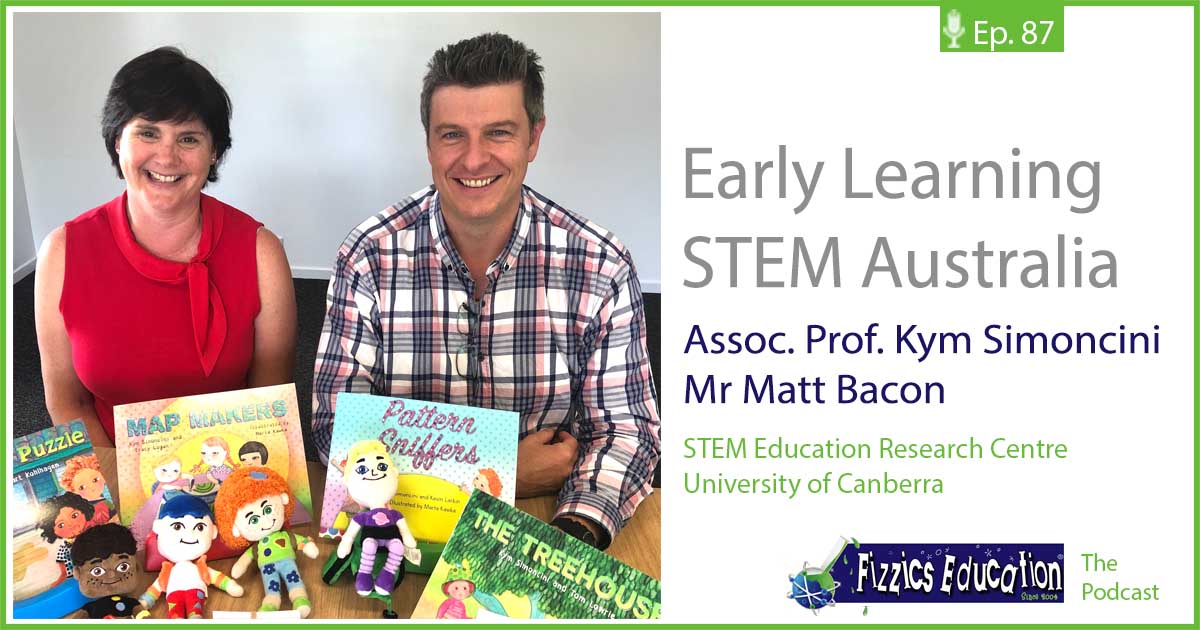
Bringing STEM into the early childhood setting is so important for kid’s development! We speak with Kym Simoncini and Matt Bacon as they describe the work being done by Early Learning STEM Australia (ELSA) project to assist 100 centres from across Australia use apps and picture books for helping preschoolers understand patterns, map making, encoding and decoding, and investigations.
Is it ever too early to start thinking like a scientist or an engineer? In this episode, we dive into the world of Early Learning STEM Australia (ELSA) with Kym Simoncini and Matt Bacon. We explore how digital tools, play-based frameworks, and family engagement are being used to build a sophisticated STEM foundation for our youngest learners long before they reach primary school.
About Kym Simoncini
Kym Simoncini is an Associate Professor of Early Childhood and Primary Education at the University of Canberra. As a key member of the ELSA team, she oversees the Families’ app and professional learning. Kym has authored four companion picture books focusing on patterns, map-making, encoding/decoding, and investigations. Her extensive research also spans family learning and play-based education in Papua New Guinea.
About Matt Bacon
Matt Bacon is the research project manager for ELSA within the STEM Education Research Centre (SERC). With over 17 years of experience in higher education, Matt specialises in technology-enhanced learning, educational design, and user experience (UX). His background includes innovative research into augmented reality (AR), virtual reality (VR), and the design of modern learning spaces.
The ELSA Program & STEM Education Research Centre (SERC)
The Early Learning STEM Australia (ELSA) pilot is a digital play-based program for preschool children. It isn’t just about apps; it’s a comprehensive ecosystem designed to foster STEM Practices through the ERA Heuristic.
The ERA Framework (Experience, Represent, Apply):
Experience: Children engage in hands-on, real-world activities that spark curiosity about a STEM concept.
Represent: Children use the ELSA apps to represent their physical experiences in a digital environment, reinforcing their mental models.
Apply: Children take what they have learned back into their physical play, applying STEM concepts to new problems and scenarios.
Beyond the Screen:
Matt and Kym discuss why “digital play” must be tethered to physical play. The ELSA apps are designed to be a bridge, not a destination, encouraging children to look back out at the world with fresh eyes.
Spatial Reasoning and Patterns:
We explore why Pattern Recognition and Map Making are critical precursors to later success in mathematics and coding. Kym’s picture books provide a narrative “hook” to make these abstract concepts concrete.
Empowering Educators and Families:
The team highlights that STEM confidence starts with adults. By providing professional learning and a dedicated families’ app, ELSA ensures that STEM conversations happen at the dinner table as well as in the classroom.
Education Tip: The “STEM Literacy” Connection.
Follow Kym’s lead by using Picture Books as a launchpad for scientific inquiry. Before starting a hands-on activity, read a story that involves a character solving a problem through trial and error. As the ELSA project demonstrates, when we combine Literacy with STEM, we help children develop the vocabulary they need to describe their discoveries. Use the ERA Heuristic: let them experience the garden, represent it with a drawing or app, and apply their knowledge by building a bug hotel!
[00:00:18] Ben Newsome: Yes, welcome again to another Fizzics Ed Podcast. Glad to have you. We are here again to talk science and STEM and all that sort of thing. And this week, we are speaking with the ELSA project team, the Early Learning STEM Australia project, where a hundred centres around Australia have been trialling out four children’s apps that are linked with four picture books to help kids understand about patterns, map making, encoding and decoding, and investigations.
[00:00:50] Ben Newsome: Today we get to speak with Matt Bacon, who is a research project manager for ELSA, and as well as Kym Simoncini, who’s an associate professor of early childhood and primary education at the University of Canberra. Matt’s also from the University of Canberra, and together they’ve got this fantastic wealth of knowledge and experience when it comes to education. This particular project is something that’s very close to their heart. So rather than me introducing it, I’d rather Matt and Kym tell you a bit more about it and perhaps how you might be able to get involved too. Let’s get right on into it.
[00:01:13] Announcer: This is the Fizzics Ed Podcast. We’re all about science, ed tech and more. To see 100 fun free experiments you can do with your class, go to fizzicseducation.com.au. That’s physics spelled F I Z Z I C S and click 100 free experiments.
[00:01:31] Kym Simoncini: Hi.
[00:01:32] Matt Bacon: G’day Ben, thanks for having us.
[00:01:33] Ben Newsome: No, seriously, thank you for having me along. You guys have been very, very busy with what you’ve been doing. At the same point, some people might be wondering what you’ve been doing. So Kym or Matt, what is it that you do at Early Learning STEM Australia?
[00:01:50] Matt Bacon: Yeah Ben, happy to give some context. ELSA, as we’re called, or Early Learning STEM Australia, is a play-based digital programme that is a pilot programme at the moment. It’s run out of the STEM Education Research Centre (SERC) at the University of Canberra. We’ve been running a pilot programme looking at STEM engagement in the early years through digital apps and play-based learning.
[00:02:16] Ben Newsome: What drove this to get all set up?
[00:02:20] Matt Bacon: Initially, it was actually a proposal from the Commonwealth Department of Education. They funded a pilot programme. They wanted to look at STEM engagement in the early years and approached the SERC team to get involved and to develop that programme. So our programme is app-based, but that’s only one-third of the programme. We have four apps for children, one app for educators, and one app for families.
[00:02:54] Ben Newsome: Which means there’s a lot of scope there.
[00:02:55] Kym Simoncini: So the pilot’s been running for 2018 and 2019, and we’re just about to go into a third year, which is moving… there’s a slight shift. It’s still engagement, but we’re also going to be looking at learning. So next year there’s a research component, which I think is really exciting.
[00:03:17] Ben Newsome: Yeah, I bet. It’s one thing to put these apps out there, but does it have any impact? It’s probably not a bad thing to check. Absolutely. And I imagine, especially Kym, your work as an associate professor in early childhood education means that you come across a lot of early childhood educators. Have they been using primarily early education type apps for their kids, or have they been repurposing primary or even secondary apps for younger kids?
[00:03:44] Kym Simoncini: Well, it’s funny you ask that because we’ve just done a series of visits to centres to see what it looks like in action. A lot of the places were saying, “Look, this is our first foray into using apps.” We might have had an iPad for a little while, but really, staff or children have used it maybe to take photos or do some stories, but we haven’t used any apps. And so we thought ELSA would be a good place to start because of the support that we’d be given. So I think app usage is still very new to before-school settings. Certainly there are centres that have embraced it and have been using apps for years, but on the whole, most are late adopters.
[00:04:40] Ben Newsome: Well, especially when the kids are still learning to manipulate their fine motor skills and understand the 3D environment in the real world, let alone on an app, is challenging enough. I can see that. But at the same point, these things can be quite valuable as a way of adding to this. Matt, could you describe… you mentioned those different app versions. Jumped onto the website, downloaded the thing, it’s all in front of me. What sort of thing would be in front of me that I could use with my learners if I was in an early childhood setting? What do the apps actually do?
[00:05:14] Matt Bacon: So our four apps are basically split across two foundational pieces of thinking. One is spatial reasoning and one is logical reasoning. That’s an important foundational piece to understand because some of the other research work that our colleagues in SERC have been doing has shown that spatial reasoning is the biggest predictor of children going into STEM professions later on. And so it’s very important to look at the spatial reasoning.
[00:06:00] Matt Bacon: We have one app which is around patterns and sorting, and then we have a second app around locations and arrangement. Our third app is around representation, so that’s encoding and decoding primarily. And then our fourth app is around investigation, so that’s tinkering, discovering, evaluating evidence and so on. And I think probably importantly about the apps is that they’re all based around the idea of STEM practices.
[00:06:40] Matt Bacon: For those interested in STEM, the ELSA programme is really looking at the ideas, methods, and values that underpin STEM practices. So we’re not so much focused on discrete discipline knowledge of science, technology, engineering, and mathematics, but we are very interested in the early years looking at the thinking and the framing of STEM practices so that no matter where these bright learners end up, they can use the skills of STEM and STEM thinking to be productive where they are, to be investigators, be curious, solve problems, and generate ideas.
[00:07:08] Kym Simoncini: And if I can just add, the other really important thing about ELSA is that we use an ERA framework, which is Experience, Represent, and Apply. Just before you were saying Ben about early childhood people thinking apps are a new thing because children are still learning from the world. I would definitely agree and I remember at the beginning of the programme confessing, “Look, I actually think kids should be outside playing more than they should be playing on an app.” So there is definitely a reluctance by a lot of early childhood people because play is so important and children should be playing with real materials outside.
[00:08:00] Kym Simoncini: But using this ERA framework and guidelines for time. So one thing is the time, we’re saying 10 minutes maximum, 40 minutes across the week. So you can already see, we’re not just saying three hours on the iPad.
[00:08:16] Ben Newsome: I think you’d get a bit of backlash there.
[00:08:19] Kym Simoncini: Exactly. Most people go, “Oh 10 minutes, no one really has a problem with 10 minutes.” But the ERA framework means that the app, as Matt said, is only a third of the programme, because we suggest that educators do some type of Experience activity, which is off-app, then they use the apps for their 10 minutes, and then they do other Apply activities afterwards. And those E and A activities, Experience and Apply, they could take half an hour. There’s no limit to those things, especially if the children are really interested.
[00:09:02] Kym Simoncini: Patterns, for example, there is an app where they make patterns, but of course we know from the educators that children are spending lots and lots of time making patterns off the app with different manipulatives. One centre we visited, they even did it with morning tea. They’d cut up all fruit, and so they were making fruit kebabs or skewers and making patterns with the fruit.
[00:09:34] Ben Newsome: That’s useful. I was just thinking then, my child, he is in Year 1, and I’ve got another one in Year 4. Year 1 is just getting into the number sequences big time. And being able to do… like looking at sequences and the patterns of how the numbers emerge. I mean, that goes right through primary school and beyond. Funnily enough, I was just running a programme just before this particular podcast on the Richter scale for Year 6 students, and getting them to understand how a logarithmic scale works.
[00:10:14] Ben Newsome: You think back all the way to early education, understanding that this number comes before this number, seeing the patterns of how they actually work on a number line makes sense. And if you’re doing that with concrete materials, as if you’re making fruit kebabs, if the strawberry comes after the pineapple every time and being able to predict what comes next, that’s really laying the groundwork for that reasoning.
[00:10:27] Kym Simoncini: Yes. And I think that’s really won over educators who may have been a little bit worried about how much screen time. Actually, most of the programme is off-app. Patterns is a funny example because actually you can easily make patterns off-app, but most of the other apps do things that you can’t do so easily off-app.
[00:11:00] Kym Simoncini: So in the location and arrangement app, which is app two, the children design a playground, and then later on the characters come out and take a photo and you have to guess who took the photo. And it moves from the bird’s eye view to… what do you call it when it’s front-on?
[00:11:26] Kym Simoncini: Yeah, face view. And actually you can’t do that in real life, or it’s very difficult to do.
[00:11:32] Ben Newsome: No, it’s challenging. I actually saw something like this before as a puzzle for a middle school type age group, whereby you do exactly that. You do a bird’s eye view of an arrangement of blocks, and they could be a cylinder, a cone, a block, a rectangular prism type shape, arranged in different ways, and then they’d show the side view and you had to predict where their locations were and what was the thing you’re looking at. It’s far more challenging than it sounds. And doing that in an app environment, I can totally see how that would really work.
[00:12:04] Kym Simoncini: Yes, because you actually get to see it from that top-down view moving slowly to the side view. And it’s really great. I can’t think of an example other than getting up in a cherry picker to see something top-down and then slowly moving to be able to see it.
[00:12:29] Ben Newsome: Yeah. But at the same point I could imagine if you had some of these daycare centres, long daycare centres, proper preschools, some of them will have a variety of different blocks in different ways. And even if it was just the red, the yellow, the blue, and green, make it really obvious that that’s their arrangement on the mat, when the kids can see above, then you get them down on the floor and look sideways. I wonder if that could help conceptualise what’s happening in the app as well? They start putting LEGO figures out or whatever. Mind you, LEGO figures probably aren’t so good because they’re a little bit of a choke hazard, but something different.
[00:13:03] Ben Newsome: It’s an interesting thing because with spatial reasoning, we come across this a lot when we do visits to young centres where we’re doing Bee-Bots, which is a very popular programme. A lot of people listening in will be aware of the Bee-Bot. It looks like a bee, and the latest version is Blue-Bot, where you programme this bee to do a certain sequence of moves. It does 90-degree turns and 15-centimetre movements incrementally. Getting kids to actually understand the relationship of the buttons they press to where the bee actually goes can take some time, especially for a four-year-old. This will help.
[00:13:36] Kym Simoncini: Yes.
[00:13:37] Kym Simoncini: Actually, that was another thing we saw in our visits, which I thought was very cool. As well as the apps, we have developed a book that goes with each app and we’ve also got an off-app game. And the game that’s with app two on location and arrangement, is like a zoo board game. So think about the idea of snakes and ladders that you’ve got to get from the entrance of the zoo to the exit. And of course there’s all the animals spread out and it’s the one-to-one correspondence because children find that really hard with board games. How many is three? Does three start here?
[00:14:22] Ben Newsome: We still have arguments with my kids about that, by the way.
[00:14:26] Kym Simoncini: It’s so common! And so that’s why I think board games are so great, because you can get the importance of one-to-one correspondence with a physical… here’s a space and you are moving three. Anyway, I’ve seen at some centres, they use the Bee-Bots on the big zoo game, because it’s a big metre by metre floor game. And they put the Bee-Bots on it and they quite like it because they’ll start somewhere and go, “Okay, I want to go to the lions” or “I want to go to the kangaroos”. They’re really interested and motivated because of the animals. And I just thought that was a great way to use Bee-Bots on something that has context for them on a big map.
[00:15:13] Ben Newsome: And it really works! I’ve seen that done to the nth degree where we visit a centre at the start of the year, we give them an idea how to use it, we turn up later in the year to do something completely different, it might be a biology workshop or something, and they’ve gone and got themselves that particular platform. And what’s really cool is if they’ve been doing that once a week with their kids. What I’ve seen some people do is they get a completely clear mat without anything marked on it apart from a grid of 15-centimetre squares. The kids can actually put things underneath the clear mat, whether it’s a flower in one spot and the hive in another spot, or if they feel like doing some rudimentary mapping, they could move around a town, make the bee go from one spot to another. What’s really cool about that is the kids don’t realise but they truly are learning about coordinates, which turns up way later in school, but the kids can kind of get an idea of where they’re meant to go.
[00:16:08] Matt Bacon: Takes some effort though.
[00:16:09] Kym Simoncini: Yes, and one of the things I’ve seen because I really like books, is where people have cut out pictures from books and so they’ve done the sequence. Sequencing is a really important skill, not just for STEM but in literacy as well. Think of The Very Hungry Caterpillar, and they’ll have all the fruits and things that it ate, the salami and ice cream, and the kids have to go in order of what it ate until the end. So I thought that was a pretty cool idea.
[00:16:48] Ben Newsome: Yeah, actually can I ask Matt, you mentioned when you were saying there’s four different apps with this, and one sort of dives a little bit into coding. I can imagine some people go, “Oh yeah, I know exactly how to do that with some young ones,” and other people might be going, “Well, how does that look?” What do you mean by that on the coding side?
[00:17:04] Matt Bacon: So our app three, Representations, is really diving into encoding and decoding. Broadly breaking that down into interpreting instructions and making instructions for others to interpret. And we do that through a thematic lens of music and celebration. Inside the app we have “Make an Instrument”, and there’s the classic make a drum with a cardboard tube, piece of material, and rubber band, and the children initially have to follow the steps to make that. We end up throwing some red herrings so they have to then also make some decisions about what is correct and incorrect.
[00:17:41] Matt Bacon: After they make that, they then get to actually play that instrument on the app and then add modifiers to speed the sound up, to make it louder, to make it faster and slower and so on. So that can then become, again that ties back into app one, because that can become a pattern, which then they can save out and then use to create another pattern so they can build up on the patterns. In that sense they do a lot of looking at conditionals as well and also some debugging where they make their own instruments and then they can pass that around amongst their mates to try and work out how to make those things.
[00:18:31] Ben Newsome: I like how these things are all meshed together. It’s not just discrete lessons, which by the way have their own purpose too, but the idea that one lesson then becomes the next lesson. What you’re talking about sequences, funnily enough a sequence. It seems to make sense to walk the way through it. So you’ve got the centres that are dealing with spatial reasoning and whatnot, how are they going on that side? This idea of “here is my representation of what I’m trying to think and here’s how I’m trying to communicate it to the next child”. How’s the feedback from the other centres in regards to how the kids are dealing with communicating a set of instructions to another child?
[00:19:10] Kym Simoncini: I’m not sure if we’ve had very specific feedback like that. What we have had feedback from educators is that the apps and the entire programme is actually showing how capable children are, because often we underestimate what children are capable of. And so in particular with encoding in terms of drawing maps, children have done these amazing maps of how they get to their centre, or around their centre, if they go for walks around their community.
[00:19:35] Kym Simoncini: I know our head of SERC, Professor Tom Lowrie, who’s also a professor of mathematics, was like, “Wow, these are incredible, this is what we would normally expect of a Year 2 student, but we’re seeing done by four-year-olds because we’re going, ‘Oh actually they can do this’ and look what they are capable of.”
[00:20:14] Ben Newsome: No, I totally agree. While you were saying that, just on a bit of a tangent but this will make sense, when you’re talking about the faster and slower speeds of your instrument, therefore higher and lower pitch, you can actually put in a graphical representation of that. There are free oscilloscopes… you’d have to type it into your favourite app catcher to find the oscilloscopes. You can then find the wave forms of what happens. These are free and you can actually show the kids… and I’ve done it with kindergarten, haven’t tried it with the early years yet, but there’s no reason why we couldn’t show them a high frequency sound, a high pitch sound, and the kids can see the really wiggly line.
[00:20:59] Ben Newsome: And when they hear a low sound, they could see the thing hit, and it’s a low sound and they see this very long wave, they can see it showing up on their screen as well. The kids really do pick it up. I know at the kindergarten level we often show it with a Slinky and you can then show it with the graphical version of the same thing. These kids, I agree, they totally can pick this stuff up much faster than we give them credit for. We’ve just got to give them the access to it.
[00:21:24] Matt Bacon: Yeah, I think that’s very true Ben. And something that why we draw out that sort of knowledge in ELSA is something I’m quite excited about is the UGC, which is the user-generated content in ELSA. So we allow children to create their own content and also explain some of their thinking.
[00:21:48] Ben Newsome: What sort of things are being created?
[00:21:51] Matt Bacon: So in our app one, we have an activity called lunchboxes, where children sort lunchboxes. That can be done as a collaborative activity, three kids to one tablet. They each sort different food as it’s presented into their lunchbox. Now the app has a certain level of AI that will recognise a sort, but after the child has finished sorting, or as they feel they’ve finished sorting, the app will give them a screen with a nice little microphone and one of the other little characters that we’ve developed will say… they have an opportunity then to record their reason for the sort.
[00:22:30] Matt Bacon: This goes back to the educator app, which the educator can check and verify. There’s a lovely example that we’ve come across where the app can’t verify every single type of sort there is, but there was a child in one of our centres and they sorted. The educator didn’t think it was a sort, and the app didn’t say it was a sort. But when they asked the child, “Why did you sort?”, there was corn, apple, and something else. They weren’t necessarily representative, but the child said, “Oh, I sorted by core. They all have a core.”
[00:23:06] Matt Bacon: There’s no way we would’ve necessarily thought about that as a contingency to put into the AI to recognise that kind of sort. But by giving the child the opportunity to actually think through and verbalise what their own methodology was, that’s very powerful. They become their own creators.
[00:23:25] Ben Newsome: No, that’s really good and actually it’s really good training for the educators too, because there’s one thing about closed versus open questions that comes up a lot. The child was trying to answer your question, and did, by definition, was correct, but their definition was different to your definition.
[00:23:41] Kym Simoncini: Yeah. And we see examples like, “Oh well, all of these foods, they’re my grandma’s favourites.”
[00:23:49] Kym Simoncini: Well, how are we to say that they’re not?
[00:23:53] Ben Newsome: There you go. So if you’re listening and you’re from an older age group and you’re doing healthy choices or something for Stage 2 or 3, if the child says it’s Grandma’s favourite food, you have to then challenge it. How do you do it? But hey, I was just thinking though, this means that effectively, by getting this user response, you effectively are creating data for the centre to help with the kids’ growth. This is what centres do. Is that data then, obviously with privacy concerns all in place, is that data then useful for the STEM Education Research Centre? Because I could imagine this data would be really helpful because on mass it helps you sort of think where are kids kind of placing.
[00:24:34] Matt Bacon: Yeah, true, thanks Ben. Because we’re a government pilot at the moment we have some pretty strict privacy issues on that for sure. Restraints on us, which is fair enough, of course. But what we are doing through the apps is we process the data that comes through and some of the analytics, and some of that gets sent back through to our educator app for the educators to use.
[00:25:01] Matt Bacon: And their app actually acts as a little bit of a dashboard for the children in their classes. It gives them a measure of how much time each child in their class has spent on a device. And also it flows through information in the form of “I can” statements.
[00:25:21] Matt Bacon: So in these early years, we don’t want to obviously test kids, but we want to see what they can do and not what they can’t do. So we have “I can” statements. The educator app will then have some check marks against a child who says “I can sort ABB pattern” or “I can fix a pattern”, “I can sort with friends” or things like that. These are some of our “I can” statements. And that’s very useful for the educator then to be able to have another piece of information to use to see where the kids under their care are and how to move them forward or support them or extend them as they see fit.
[00:26:09] Kym Simoncini: Yeah, actually one of the educators that we visited was talking about that. About how having these apps… because sometimes they’re not the “pass back” type of app of Mum in the car, “Quick, just have the phone and be quiet while I need to concentrate on driving or something.” So all the time the educators will actually have to show the children how to use the app. And so this educator was saying it’s been amazing because I’ve had to spend time sitting with small groups of children, and I’ve really got to see what they can do. And again, I wouldn’t have known unless we had these types of apps because I just probably would never have done this type of activity. So again, it’s that “Wow, kids are really capable and with this app I’m actually seeing it.”
[00:27:06] Ben Newsome: And with this sort of thing being a pilot project, I’d undoubtedly expect that as this thing grows and grows, you’re going to hear more and more educators go, “You know what I did with this app? I did this thing!” And you go, “Wow, you did that?” And I imagine over time you could build up a body of knowledge from the educators using it themselves as whether they’re doing articles on their particular website or they’re giving you ideas, even anecdotally. That’s going to mean that you get some real cross-linking going on between the centres themselves about here’s how we’re doing this, and you could really form a community of best practice, which is great.
[00:27:36] Kym Simoncini: In fact, that’s what we have done. So as part of the pilot, we did have to have a community of practice. And look, everyone is time-poor, but people have put up ideas and photos of things that they’ve done with the different apps, which has been great because often you can just see a picture and go, “Oh, I could do that!” Or, “I’ve got something similar,” or, “I could just change it a little bit for my context.”
[00:28:02] Kym Simoncini: But the other great thing is because we’ve done professional development with the hundred centres, we’ve seen them a couple of times and they’ve really built relationships and networks with other educators. And what’s been great is from the different sectors, because like you said, we have long daycare centres, we have standalone preschool or kindies, depending what state you’re in, and we also have preschools or kindies attached to schools. So they’ve got to meet people around Australia from different settings, and whenever we’ve had the workshops, it’s been really important that they come and share things that have worked really well. And yeah, they’ve got some great ideas. I know when I visit the centres, they talk about, “Oh, I got this great idea from so-and-so about how we could manage the apps or how we could do this patterning activity or a map activity.”
[00:28:47] Ben Newsome: That’s great! And so I’d imagine, you’ve got your hundred centres as part of the pilot. Just say more money got dropped on in and you’re going to make this bigger and brighter and more beautiful and all that sort of thing. What sort of things would you, just thinking off the cuff, what sort of things would you add to this if you had more time, more budget, more things to make it prettier and better? What would you want to add to this if you had a bit more scope?
[00:29:26] Matt Bacon: Gee, that’s a good question.
[00:29:29] Ben Newsome: Sorry, I’ll give you some thinking time. The reason why I ask this is that we do a lot of professional development to early educators as well as primary school and high school, and one of the things that is a blockage is this idea of resource. Because let’s be honest, we are time-poor, we are short of cash. But sometimes what can help is this 10x thinking, this idea of, you know what, in a perfect world, in the perfect scenario with all the perfect amount of time in the world, what would a perfect example of a lesson sequence and series look like? And it produces what-if statements. And so I guess I was just wondering, what would you be able to do if you had lots more time and lots more support?
[00:30:08] Matt Bacon: So I think one thing that we’re very interested in is that our current ELSA programme is built around the EYLF.
[00:30:18] Ben Newsome: Early Years Learning Framework for those people overseas.
[00:30:21] Matt Bacon: Yes, thank you. And so these apps can we believe push into from the early years into the foundation or kindy or Year 1 and 2 as well. And so part of our vision would be to extend ELSA to cross over that threshold. And probably even extend some of the apps to be more complex for those years into the Years 1 and 2.
[00:31:00] Matt Bacon: And also I suppose build up some better analytics and some data-driven pieces here for the educators and for schools if we went into those areas, to be able to make good decisions based on some of the data they can see, to really create a good learning environment for their children.
[00:31:17] Kym Simoncini: I would still do, like you said, professional development. Not so much… I think in the early years, or I know in the early years, they don’t get the same professional development opportunities as teachers at schools. One, they might be working in a centre where they are the only teacher, whereas at a school at least you’ve got all the other teachers at your school and you can make a community of practice within your school, maybe its year levels or if you’re in high school, like the science department.
[00:31:51] Kym Simoncini: So I would always push for more face-to-face professional development sessions where people can share and make those connections because once you hear other people when they give those ideas, like I said, often you can look at it and go, “I could do that!” And sometimes they’re so easy it’s like, “Wow, why didn’t I think of that?” But until someone says it or shows it to you, you don’t think about it. So I think that whole sharing ideas of what works and let’s not reinvent the wheel would be really helpful. You could never have enough talking to people and getting ideas.
[00:32:31] Ben Newsome: No, I agree, absolutely. I 100% agree with that. I mean that’s the thing I always learn a lot on even just doing these things. It’s amazing what you find out just getting 20 minutes just to chat with people about what are you doing. This is really, really cool.
[00:32:43] Ben Newsome: Actually just as a query because I mean that’s the nature of this particular podcast is that we’ve got people listening to it all over the world. So if they were in, I don’t know, Quebec or wherever, Uruguay, wherever they are, do they have access to this or is it currently a bit of an Australian thing for now?
[00:33:00] Matt Bacon: Right now it’s just an Australian thing because it’s still in a pilot phase.
[00:33:05] Matt Bacon: And so it’s restricted to the centres that we’re working with across Australia. But our website elsa.edu.au does have some resources and information about ELSA generally. Also the SERC website has some information of the more conceptual thinking behind the STEM practices, the ERA model as well that’s been developed. Yeah, so there’s some reading resources there if people are interested. But hopefully at some point we’d definitely like to have it as a fully-fledged programme that runs out everywhere and anywhere.
[00:33:44] Ben Newsome: Absolutely. And no I’ve got to actually also second what you said with it being useful for the early years in primary school, so elementary school for overseas, because these concepts don’t go away. They just don’t. And they turn up for kids who are six years, seven years, eight years, nine years old and even further. I could also imagine this being useful in a support learning environment as well. So for some of those kids who need more help, even if they’re older, this would totally help them out. I could totally see that happening.
[00:34:14] Ben Newsome: Look, hey one thing I just always like to ask everyone who jumps on this is simply if, okay in your case, if say you had some brand new pre-service about to hit the world educators in the early learning sector, they’re in front of you, there’s a hundred people all ready to go, they’ve pen and paper in hand ready to write down whatever you’ve got to say. If you had to give some advice about applying whether it’s logical reasoning or using these apps or even just helping kids with STEM in general for the younger years, what sort of advice would you give them?
[00:34:44] Kym Simoncini: I always think start small, start with success. So one of the things that Matt was saying about we’ve got resources, so you can go onto the ELSA web page and there are resources, or the SERC web page. So one of the things that is available to everyone is an early childhood STEM book list. And so for me, that was the way in, because I like books and I really like literacy, and I actually didn’t do any science beyond Year 10. So I feel like I’ve got lots of gaps in my science or STEM knowledge, but I could look at books and go actually there’s a lot in books if we use a STEM lens.
[00:35:28] Kym Simoncini: We’re quite good at picking up books to teach different content, about sharing or teamwork or whatever it is that we find a book on. Actually, we can do that for STEM as well. So I sort of think that’s why you should start with something that you’re already comfortable with. Don’t start with something enormous and something that you’re a bit unsure of. Start with something that you really like and you’re familiar with and you feel confident about and then just gradually add a bit more.
[00:36:09] Kym Simoncini: It might just be asking… one of the things I’ve talked a lot about with ELSA and with the educators is questioning. Because like I said I don’t have a huge amount of STEM knowledge, don’t start with the why do the magnets stick together or what makes the bubbles stick together because if I don’t know then how is a four-year-old going to know?
[00:36:30] Kym Simoncini: But we can talk about what’s happening, what we’re seeing in front of us, and then move on, because I feel like sometimes we shut conversations down by going straight to those high-level questions that a lot of early childhood educators don’t have the content knowledge for. But they can certainly inspire that engagement and curiosity about, “Oh, what’s happening here? Oh, look at the bubbles. What are they doing?” Some are sticking together, some are floating off. “Oh, look, when they touch the ground, they burst.” Those types of things, I think all early childhood teachers are capable of doing. So it’s about thinking about, “Well, could I look at my questioning to inspire more STEM learning?”
[00:37:14] Ben Newsome: Yeah, absolutely. And actually I’m going to just bounce off what you just said there too. A classic example of this in early education and in the early years for primary is there’s a book by Pamela Allen called Who Sank the Boat? And Who Sank the Boat? has three animals I believe off the top of my head, and it’s literally who sank the boat. And people use this a lot as a precursor into why things actually float, and they produce foil boats, and they add things into it until they sink and all the rest. And it totally works.
[00:37:40] Ben Newsome: And in the older years, we actually were lucky enough to speak with Jillian King-Cargile who from the US does an amazing job with a programme called STEM Read. So stemread.com, you can check it on the previous episode on our website somewhere, it’s one of the back episodes. But they with the older kids, we’re talking high school, are using fiction to tease out where is the STEM found, and can we talk a bit more about this? And there’s no reason why you can’t do that with the early years too. And totally agree with that. And yeah, that’s where the fun is.
[00:38:12] Kym Simoncini: Yeah.
[00:38:13] Ben Newsome: No, fantastic. Look, hey, thanks very much for joining me on this and well done with the ELSA programme. I mean, yeah, you’re in your pilot phase, but I got this sneaking suspicion it’s going to go a little bit further. And well done with it and much appreciated and have a great afternoon.
[00:38:31] Matt Bacon: Thank you Ben. Thank you for your time.
[00:38:33] Announcer: Thanks for listening to the Fizzics Ed Podcast. Sign up now for our fortnightly email newsletter. It’s loaded with details on new experiments you can do, STEM teaching articles, new gadgets, exclusive offers and upcoming events. Go to fizzicseducation.com.au, scroll to the bottom and add your email.
[00:38:51] Ben Newsome: Well there you go. What do you think? Should you get involved with ELSA? Yes, it’s definitely worth your time. So go check out the Early Learning STEM Australia website to find out more. It totally is worth your while and just keep an ear out and an eye out for when that is open to even more centres right across Australia. Well, that’s enough from me this week. We have plenty more coming on up, but definitely jump into our website. There’s a heap of actually support information to help you with early childhood and STEM education. And I’d recommend jumping on the Early Learning STEM Australia website as well. There’s a whole bunch of info that can help you out. So anyway, have a fantastic afternoon, morning or whatever you might be, and I will catch you another time.
[00:39:58] Announcer: This podcast is part of the Australian Educators Online Network. aeon.net.au
Recognised by
22 years, award-winning work, 1 purpose
Recognition from business, education and industry bodies across Australia.
Australian Small Business Champion
Multiple years
CILC Pinnacle Award and Hall of Fame inductee
Center for Interactive Learning and Collaboration
Western Sydney Awards for Business Excellence
Winner
Top 100 Coolest Company
Listed
Local Business Awards
Winner
We value your privacy
We use cookies to improve your experience. Essential cookies are always active. You can choose which optional cookies to allow.We use cookies. Optional ones stay off unless you allow them.Privacy policy