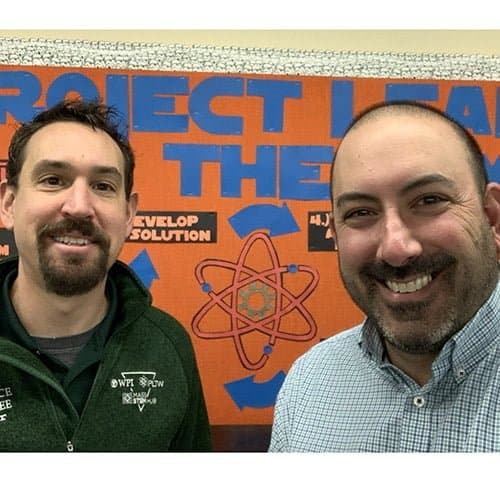
We chat with two amazing STEM teachers from Leicester Public Schools who are working hard to help their learners understand STEM form the early years and onward. Listen in to Dr Matthew X. Joseph and Mr James DePace as they describe some of the lessons & activities they’ve used to help STEM shine in their district.
How do we transform a standard classroom into a hub of modern innovation? In this episode, we speak with Dr Matthew X. Joseph and James DePace about the power of collaborative leadership and authentic instruction. We explore how 25 years of district leadership combined with a background in the aviation industry can create a middle school STEM program that truly prepares students for the future.
About Dr Matthew X. Joseph
Dr Matthew X. Joseph is the Director of Curriculum, Instruction, and Assessment for Leicester Public Schools. Over a 25-year career, he has served as a Director of Digital Learning and Innovation, elementary principal, and classroom teacher. A prolific writer and speaker, Matt is the author of Power of Us: Creating Collaborative Schools and co-author of Modern Mentoring. He is a leading voice on how to best support teaching and learning through collaborative frameworks.
James DePace is a middle school STEM educator with a unique professional history. Before spending the last five years teaching grades 6–8, James spent 15 years in the aviation industry. This experience allows him to bring an unmatched level of authenticity to his “Flight and Space” classes. James also teaches Automation and Robotics, Design and Modelling, and Computer Programming, and serves as a key contributor to state-wide STEM curriculum development.
Leading Through Innovation: Leicester Public Schools
The synergy between district leadership and classroom instruction is what makes a STEM program successful. Matt and James discuss how they work together to ensure curriculum is not just “compliant,” but inspiring and relevant.
Key STEM Pillars:
Authentic Instruction: Leveraging James’s aviation background to teach the physics of flight through real-world experience rather than just theory.
[Image of the four forces of flight: Lift, Weight, Thrust, and Drag]
Modern Mentoring: Using Matt’s research to reimagining how teachers support one another, ensuring that innovation isn’t isolated to just one classroom.
Agile Curriculum: Staying current by collaborating with organisations like Worcester Polytechnic Institute (WPI) and Project Lead The Way (PLTW) to bring industry-standard practices into middle school.
Project-Based Learning: Engaging students in hands-on challenges across Automation, Robotics, and Computer Programming to build critical thinking skills.
Top Episode Learnings: Building a Collaborative Culture
The “Power of Us”:
Matt explains why collaboration is the secret sauce of school improvement. When teachers and leaders move out of silos, they create a “force multiplier” for student engagement and innovation.
Translating Industry to Education:
James shares how his 15 years in aviation provide a “meaningful context” for students. When a teacher can say “this is how we did it on the airfield,” abstract concepts like aerodynamics or systems engineering become concrete.
Designing for Engagement:
We discuss the importance of “Design and Modelling.” By giving students the tools to prototype and fail safely, we prepare them for the iterative nature of high-level STEM careers.
Education Tip: The “Industry Expert” Audit.
Follow James’s lead by looking at your own professional history or the history of those in your community. How can you bring Authentic Context to your next science unit? If you’re teaching forces, can you bring in an enthusiast to talk about drones? If you’re teaching biology, can a local vet share real-life cases? As Matt and James demonstrate, STEM shines brightest when students can see the direct line between the classroom and a career.
[00:00:18]Ben Newsome: Yes, welcome again to another Fizzics Ed Podcast. Glad to have you yet again for another chat around STEM. And this week, we’re talking with Dr Matthew X. Joseph and James DePace out of Leicester Public Schools in Massachusetts, USA.
[00:00:30]Ben Newsome: Now, Matthew is currently the Director of Curriculum Instruction and Assessment in Leicester Public Schools. For the last 25 years, he has been heavily involved in public education in so many different ways. We’re talking being the Director of Digital Learning and Innovation, being an elementary school principal, a classroom teacher, and a district professional development specialist. He is also the author of The Power of Us: Creating Collaborative Schools and the co-author of an upcoming book called Modern Mentoring: Reimagining Teacher Mentorship, which is due out in November 2019. And by the way, if you’re listening to this past November, you can go get it now.
[00:01:03]Ben Newsome: By the way, James DePace also joins us. He is a middle school STEM educator out of Leicester Public Schools, and for the past five years, he’s been teaching STEM in grades six to eight. So middle school. He also teaches other things too, which include automation and robotics, design and modelling, and computer programming. What’s interesting about James is that he actually spent 15 years in aviation before becoming a teacher, which is awesome, so those students would love his work with those practical skills that he can totally help out with those kids. As a side thing, James has been the co-chair of the 2019 PLTW State Conference at the Worcester Polytechnic Institute.
[00:01:42]Ben Newsome: Now, big long spiel to start, but that’s because these guys have been doing a lot of things. The point is, they’ve been doing a lot in STEM, especially in the middle years and elementary years, and what they’ve been doing can certainly help you out in your school. So enough from me, let’s just listen on in to Matthew and James.
[00:01:58]Announcer: This is the Fizzics Ed Podcast. We’re all about science, ed tech and more. To see 100 fun free experiments you can do with your class, go to fizzicseducation.com.au. That’s physics spelled F I Z Z I C S and click 100 free experiments.
[00:02:15]Dr Matthew X. Joseph: My name is Matthew Joseph. I’m coming to you from the Greater Boston area over here in Boston, Massachusetts, USA. So, it’s pretty exciting. Currently, my role is the Director of Curriculum Instruction in Leicester, Massachusetts, just about 40 minutes west of Boston. Previous to that, I was a Director of Digital Learning and a school principal for 11 years before sitting in this current position where I’m at right now.
[00:02:41]Ben Newsome: A few different hats there. There you go, a few different hats there. And Jamie, what do you get up to?
[00:02:46]James DePace: Sure, well, my name is Jamie DePace. I’ve been a STEM teacher now for five years, but before that, I worked for about 15 years in aviation all over the country. I actually spent a year in Australia out at the uni. But since then, I came into STEM and I’m excited to share everything that I’ve learnt because it’s been a life-changing experience for me.
[00:03:09]Ben Newsome: And actually, I might actually go with that. I mean, a lot of the time, there is a life-changing experience for kids, but often we don’t have a chance to reflect on the fact that we tend to have these as well. How did you jump from aviation into teaching? What made you want to move into that role?
[00:03:24]James DePace: Well, getting into management and the whole glorification of being around aeroplanes, that always stayed there, but that really wasn’t the job. So, when I came into teaching and I realised I was making an impact on students’ lives and in society, I said this is awesome and it really made me much happier as a person.
[00:03:45]Ben Newsome: Yeah, I can totally agree with that. And Matthew, how about you? What made you get into this sort of thing?
[00:03:50]Dr Matthew X. Joseph: So me, I think I came at it from a different lens where as a school leader, one of the things that I was pushing was design thinking in both lesson planning and then student activities and projects. When I moved into the district role about four years ago, I was charged with creating this dynamic learning environment. One of the ways that really struck me was the STEM thinking. I know we have connected on the primary STEM chat, and that’s one thing that I talk a lot about on that Twitter chat, is not just STEM as something, it’s STEM as a design thinking process, the prototyping, the practising, and then the trial and error so students can be very creative.
[00:04:35]Dr Matthew X. Joseph: So I kind of stumbled onto STEM as something that interested me from a building perspective and a learning perspective, and then seeing what the STEM dynamic in classrooms looked like. It’s something that I gravitated to because I like the inquiry learning, I like the design thinking, and I like when there’s not one set answer to a global problem. All of that led me to some of this type of work, and then I know we’ll probably touch upon how I got into doing some more communication with all of you and some of my interests, but initially that was my entrance into this kind of lane of education, the design thinking process and the projects that align with that.
[00:05:14]Ben Newsome: So with the design thinking thing, I mean, in practice, there’s a couple of different ways you can sort of go down that path. As a whole, do you find design thinking easier to work with kids? Do they naturally take it on board, or is it something that you sort of have to go, “Okay, now we do this, now we do this, now we do this”? How do they tend to take it on board when you first introduce it?
[00:05:36]Dr Matthew X. Joseph: So one of the things that I have found is it’s usually trial by error. So, yes, we often think that students intuitively can just create and design and go through this process, similar to when we say to adults, “Go collaborate.” We think we know what’s going to happen, but often what we need is a teacher to, one, give the big picture of “this is where we’re going to go”, and then give step-by-step instructions. Not where we’re holding their hand, but really more in small chunks. Here’s what it looks like, here’s how you can try it, here’s where you can take a step back. I think within that design thinking, the biggest piece is asking questions. What could it be? What could it look like? And Jamie, what have you found in your class for some of those strategies that have worked?
[00:06:23]James DePace: Well, I think that students are using the design process all the time without even knowing it. So to be able to break it down step-by-step and actually let them focus on each step really puts a different perspective on it for them, and they can start to think about each step better as each project comes along and hopefully impacts the rest of their lives.
[00:06:50]Ben Newsome: Yeah, so what sort of things have you seen the kids build, Jamie, in your classroom or try and solve as a problem? Because there’s a lot of things you could go down. What are some of the things that have clearly worked?
[00:07:02]James DePace: So I think if you connect the projects to real-world problems and things that impact their lives, they seem to take more care into their thought process through it. For example, in one of our sixth-grade units, we discuss cerebral palsy, and most schools have a few students who have this disorder. So they learn a little bit about it and they actually first start off by creating a foot orthosis to help students with cerebral palsy or children with cerebral palsy fix their muscles, to stretch them out and get them back into functioning order, I guess.
[00:07:47]James DePace: And in the end, they end up making a toy that will help children with cerebral palsy that has certain criteria that they have to meet in order to achieve the project. So just the whole cerebral palsy unit is very impactful, I believe.
[00:08:12]Ben Newsome: Absolutely. I mean, actually, I’ve come across a couple of schools that have used 3D printing to build some sort of orthopaedic device to help people out with that. Is that sort of what you went with, the 3D printing side, or did you use some other device to be able to make… how did they make it, I guess is what I’m asking.
[00:08:28]James DePace: Yeah, so we had just basically recyclables, cardboard, tape, just classroom supplies, and obviously they had to design it on paper. We didn’t go as far as using the 3D printers for this project, but when they design a toy to help the children with cerebral palsy, we try to incorporate the CAD programmes into it and let them print up different elements to the project.
[00:08:56]Ben Newsome: That’s really cool because often my brain went straight to 3D printing, just thinking of the hard device that could last years, but going into this initial pilot phase of creating something out of cardboard, tape and whatever you need to do so you can see whether it works or not is just as powerful. And isn’t that really going back to what Matthew was saying, the design process is iterative? You’re constantly, “Here’s an idea, what worked, what didn’t? Here’s a better idea, what worked, what didn’t?” So sorry, Matthew.
[00:09:24]Dr Matthew X. Joseph: So what I was going to say, to stay on the design thinking process to bring the school leadership side into this and kind of where we’re looking to go. So, at our last professional development day, one of the things that I was trying to bring in was the STEM thought process and design process for our classroom regular education and special education teachers, is that we created one of our professional development sessions was for all teachers on STEM education. It wasn’t “what is STEM?”, it was the reverse of “how can you bring STEM education and design thinking into your lesson planning, into your ELA class, into your maths class?” Actually Jamie was one of the leaders of that and facilitated that to really flip the thinking about STEM is not where students go, but it’s about the students that come to you. So Jamie designed and led a session about that as well.
[00:10:16]Ben Newsome: Yeah, and how did that go? So there’d be people listening on in who have that same challenge. They’re leaders in their schools, or also maybe a group of schools, and they want to get STEM going in their classrooms and they don’t know where to start. I guess the question Jamie for now is, how did you introduce this idea to help people out in your school and beyond?
[00:10:44]James DePace: Well it’s tough because I don’t want to tell people that they need to make their classroom a STEM classroom, but I want them to try and look at some of the problems that they have in their classrooms and try to think of a project, so more of a project-based lesson that you can as a teacher sit back and kind of facilitate and let them work their own project. You kind of just give them some guiding tools to work them through solving their problem. And it can be history, ELA, English…
[00:11:22]Ben Newsome: No, I agree. I mean, just thinking now, I remember I was running a session once and someone, it was one of those sessions where you have multiple schools in the same room. The question came up, “What projects could the kids do?” and I remember a teacher just putting their hand up going, “Well, our window latches don’t work.” Perfect! There’s a perfect one to start on.
[00:11:43]James DePace: Perfect.
[00:11:44]Dr Matthew X. Joseph: Yeah, well I think that is another piece that really drew me in and also why I promote it in the schools is that we try to increase the relevance in learning. We try to create real-life situations and with our STEM thinking and STEM projects, it is real life. It is creating orthotics for students, it’s fixing windows, it’s building a bridge, it’s doing things that are very practical and students can see the results and how it helps within the community or globally.
[00:12:12]Ben Newsome: And sounds like you guys are doing pretty well because a little birdie told me this year, Jamie, you did very well in a statewide competition regarding this type of thing.
[00:12:24]James DePace: This is true. In Massachusetts out here we have, the Governor actually put out a STEM week and established the whole week dedicated to STEM, and they created some problems that are actually real problems and they wanted the students all the way through K to 12, they each had their own problems to focus on. But as a middle school teacher, we had our students look at plastic in water and how it is really a problem. Actually it was pretty eye-opening to me after I did some research, I didn’t realise how much plastic there really is in the water. I mean, every time we wash our clothes, which is mostly plastic anyway, all those little fibres wash off into their washing machines and run off into the water. So our kids were tasked with creating a prototype of how to remove the plastics from the water.
[00:13:25]James DePace: Yep. So one of the groups, we had a little local competition here and I chose two of the best groups to go to the capital and go to the Boston Garden where the Celtics play, and they were able to showcase alongside 60 or 70 other schools who were tackling the same problem. Out of all of them, one of my groups of students came in second place and was able to win Boston Celtics tickets.
[00:14:00]Ben Newsome: Oh, awesome! That is so cool. And I mean, highly practical too. I mean this idea of plastics into the water is a big deal. Like, really is. Actually, I only recently had a chance to have a chat with a couple of students, we haven’t released the interview yet, but they’re elementary/middle school sort of borderline students. They entered the Australian Museum Eureka Prizes, which is a big thing that happens in Australia, and they were looking at microplastics and things that were turning up in fish. So they spent several months every weekend catching fish and looking through their entrails.
[00:14:43]Dr Matthew X. Joseph: Wow.
[00:14:44]Ben Newsome: Which is, yeah, particularly potent smelling! But they actually found that this is a genuine issue and some fish will stay locally in a particular area of a creek or a river and others are migratory. They found it was an actual problem and something that could actually contribute real data to the real world. I suspect with your project, that could actually be useful if it was passed on to some scientists or engineers to take it further.
[00:15:15]James DePace: Well, I think that was the whole idea, getting a different perspective on a solution to a problem. I mean, when you have how many hundreds of schools in the state coming together to focus on a problem, the odds of one or a couple of groups coming up with a different solution that maybe a scientist didn’t come up with, the odds are good. So I can’t tell you exactly what they took out of it, but I can tell you that there were engineers and they were scientists as judges going around looking at all the projects.
[00:15:51]Ben Newsome: Yeah, and I mean I like the idea of students working together as a collective genius. Like there’s a lot of brains out there, you’ve just got to apply them, and when you give them actual problems to solve, off they go! It’s a great thing. So, what else have you seen? So there’s the statewide competition type things, and then there’s just the day-to-day type project, PBL type stuff that kids can be doing. What kind of cool projects have you seen in the younger years through the older years that you go, you know what, people in other states, other countries could totally emulate if they wanted to at least dip their toe on the water into the STEM game?
[00:16:28]Dr Matthew X. Joseph: Yeah, so I’m going to talk a little bit because oftentimes when you think of STEM, you think of the middle school where Jamie’s at, which is fabulous, or even up into the high school when you talk about possibly a career in some form of design thinking. But I’m going to share a project from our Kindergarten and first grade as well. We have Miss Donovan is our STEM teacher at the elementary school, and she did this thing because it’s Thanksgiving and she brought in little pumpkins and Popsicle sticks and napkins. So the project was to build a stand to hold the pumpkin. The pumpkin was maybe like one or two pounds, wasn’t extremely heavy, but how high, first of all, could you make a stand that would support the pumpkin?
[00:17:13]Dr Matthew X. Joseph: It was a group of five, and once you had that, how high could you make it? So yes, it might seem like a very basic project, but when you put four to five first graders, second graders together and you walk around and you see them talking about, “Alright, well the angle on this Popsicle stick,” or “the weight of the tissue, we might need four of them, how about we put a Popsicle stick across the top?” and to see their verbal brainstorming is what was really impressive for me because too often we hear, “Oh, they can’t do that in the elementary school.” When we give the students an opportunity and a challenge, students are very eager to solve it.
[00:18:00]Dr Matthew X. Joseph: One of the things that I liked is when it didn’t work. Not that I wanted students to fail, but if the pumpkin fell or it was off balance, students were like, “Well, we’ve got four more sticks, why aren’t we using these?” and they started to work together. I’m going to compare it to our adults for a minute because I did a project similar with spaghetti strands and a marshmallow, how to support a marshmallow. When our first graders failed, they asked friends, they asked neighbours, they went and looked at what other people were doing. It was incredibly impressive. But when our leaders were doing it, they never asked people around us, they never borrowed supplies. So it just goes to show when we give our younger learners an opportunity to collaborate, design, build, the sense of accomplishment because the project was to get the pumpkin off the ground. Not one of them looked the same, but they all reached their goal. I think that was something that really stuck with me.
[00:18:49]Ben Newsome: Absolutely. And the thing is, I mean, this is more down the pure science line, not so much STEM, but I was at our statewide science awards for students. There was a young student again, I can’t remember if it was Kindergarten or year one, but she was pretty young. She came up with this project which actually took out the prize, it was her “Big Blueberry Project”. Her big blueberry project was she went to the effort because her concern was you get your packet of blueberries, you get the big ones, you get the little ones and the in-between ones and everything else. Firstly, are we getting the number of blueberries that we expect? And also if they’re big versus small, are they sour or sweet based on their sizes? And does it matter in which week they’ve been picked or whatever?
[00:19:34]Ben Newsome: So she went to the effort of measuring, literally learning how to do volume of these blueberries. This little kid measured individual blueberries, counted the whole things out, weighed them, the whole lot. Did taste tests, the rest, and presented all this data set that was quite actually quite complicated. Would have had a bit of work with a teacher there, but she 100% was able to articulate what she was concerned about, was that she just wanted a decent blueberry punnet in her lunchbox! But it was kind of cool. And again it’s relevant and it was important to that student.
[00:20:13]James DePace: Yeah, and she went with it and she learnt a lot out of it. And it was clearly authentic because no one else came up with the blueberry project.
[00:20:20]Dr Matthew X. Joseph: Right, exactly. Which is the point.
[00:20:23]Ben Newsome: That’s cool. And I imagine that pumpkin thing would be an easy one that other people could emulate or you could just twist it slightly. And that’s actually the thing, as educators, often can feel like we’re in these four walls, but the reality is those walls really aren’t there and there’s a lot of information where people can find other ideas from other educators. So I might just throw to you both: where do you find your ideas for STEM applications in the classroom? Or do you get it from the kids?
[00:20:51]Dr Matthew X. Joseph: Jamie, kick us off.
[00:20:53]James DePace: Okay, so I am constantly on the prowl for problems, basically. And I try to think of unique ways for students to solve them. We do have a set curriculum that we try to go through, but I like to spice it up with my own ideas from time to time. We’re working on a flight and space right now, so I kind of took some of our old office equipment and reconfigured it to be a space lander so they could actually feel like they were in a spaceship. So I think without getting too much into details on it, I can just say that the more fun and exciting you make them for the students, the more engaged they will be in trying to solve the problem.
[00:21:48]Ben Newsome: Yeah, I agree. I mean, I still got memories, it’s not so much STEM, it’s got definitely a lot of “A” in it, there’s a lot of STEAM. I remember we were reading Charlie and the Chocolate Factory and I distinctly remember I was in grade three, our teacher got us all to make this wild, over-the-top classroom. It was like, you know, when you’ve got just everything everywhere, it looked like a crazy chocolate factory. And then we got to melt chocolate, we got to measure chocolate, we did chocolate maths, we did chocolate everything for the month. I guess looking back now as an educator, I mean she was 100% integrating everything. We did the history of chocolate, we did the art of chocolate, we did everything we could do with chocolate. Let’s be honest, grade three pretty much cares about chocolate!
[00:22:31]James DePace: True. Exactly.
[00:22:34]Dr Matthew X. Joseph: Sounds like she was promoting a dentist too, though.
[00:22:37]Ben Newsome: Oh yeah, absolutely! Yeah, little cards at the end saying, “Now you see this person.” That’s true. I mean nowadays, though, you could do a chocolate thing like that and describe what sugar levels would you need and what the health impacts, etc., what’s good and what’s in between. Yeah, it’s good.
[00:22:50]James DePace: There’s so many different levels you can take it. As far as trying to incorporate all the subjects into just your STEM lesson. Working with an English teacher or social studies teacher or civics to try and incorporate different levels. That was one other thing that I wanted to mention earlier too is trying to work with different classroom teachers to work them together, and have them both work on a similar lesson can really take a project to a different level also.
[00:23:20]Ben Newsome: Absolutely. And if I can actually add to that, if you do have paired classrooms, what can be challenging for the kids is not only just to present to each other about what they’ve done, it can be interesting to see if they can present to other schools, whether it’s face-to-face or via this web conferencing or video conferencing thing is that kids can connect via this because once you leave school, collaborative technologies is a thing and it’s permeating nearly every industry nowadays. That ability to communicate in so many different forms can be helpful. Whether they’re Kindergarten kids all the way through the middle grade or higher, it’s a good thing to sort of learn as soon as they can. Sorry Matthew, I think I cut in on you just as you were about to say something.
[00:23:59]Dr Matthew X. Joseph: No, I was going to say this actual what you were just saying is how I started to look for and get into the STEM process and interest as well where I was looking for projects and inspiration and I went to down to a school by Tori Cameron. She does Steam Up the Classroom, and she’s from Massachusetts as well. I was looking at how you incorporate STEM with the classroom teacher, as you were just talking about, and she was doing a fabulous project with the science class on the digestive system and other anatomy projects. She invited me down, and I got to see her running two classrooms and students got to create projects and teachers came in and looked at it. So I saw how it was seamless of her working with classrooms and that was my first kind of thoughts and sights of like, wow, this is what it looks like in practice.
[00:24:44]Dr Matthew X. Joseph: Actually she was the one that says, “Hey, you should check out primary STEM chat on Twitter.” This was about 18 months ago, and I was like, “Oh, that’s great.” Logged in and then been chatting. Rachel Lair, I think is how you pronounce her last name, has been awesome to keep me involved. Now that you’re 16 hours ahead, getting up at 4:30 AM is a little tricky so I’m trying to catch the questions and read back through. But then I did a lot because I don’t teach it, so I do visit Jamie’s class as much as I can, but I go and read and see what other people are doing on chats just like primary STEM chat. Actually through that connection, we’re here together chatting. Rachel’s actually quoted in my next book to come out. So it’s just really exciting to see what other people are doing outside of our zip code and outside of our country because if we’re looking at STEM and creating these authentic experiences, it’s everywhere.
[00:25:45]Ben Newsome: Absolutely. And big shout out to Tori Cameron. She was on this podcast oh gosh, six months or a year ago and she was just setting up at the time that STEM space. Actually she put her a tweet out this week, was kind of funny, she was so incredibly excited about this stack of cardboard she had!
[00:26:04]Dr Matthew X. Joseph: It’s the little things, right? It’s the little things.
[00:26:06]Ben Newsome: It is totally so! And that just goes to say that your PLN can be quite broad. Absolutely. And so you’ve got another book coming up?
[00:26:15]Dr Matthew X. Joseph: I do. The next book’s actually coming out in about, just got a word from the publisher, by Thanksgiving time, so in the next two and a half weeks, called The Modern Mentor. And that’s through Times 10 Publication, it’s part of the Lead Forward series, so if you want to check that out, you can go to @leadforward2, or you can check me out on Twitter, I’ve been kind of talking about a little bit because we’re really excited about it, @matthewxjoseph, and really talks about mentoring, reimagining mentoring in education and not just new teachers. Yes, new teachers is part of the process of mentoring, but for me, going to see Tori’s classroom, going to primary STEM chat, you all are mentoring me as a district leader on how to be better in my role to support the Jamies of our school district.
[00:27:00]Dr Matthew X. Joseph: That’s mentoring also. So the new book talks about how peer-to-peer mentoring is allowing us all to grow, and then mentoring leaders, sitting leaders, where I’m hoping I can take what I learned from Jamie, from you, from all the STEM educators out there and bring it to our leaders to say this is not just a standalone classroom. So the new book is about mentoring and not just new teachers, it’s mentoring us as a profession so we can continue to grow and be better for our students.
[00:27:30]Ben Newsome: Absolutely. And just throwing to you Jamie, I mean if you had to mentor people in front of you, what would you suggest if they were going to start their STEM journey or frankly, if they’re halfway through their STEM journey and they want to step it up a notch, what would you say would be the first steps?
[00:27:46]James DePace: Well, for me coming in with STEM, STEM was kind of a new subject. I mean, it’s the buzzword, everybody’s talking about STEM, but what is STEM? is the question for everybody. So for me, trying to get new teachers involved is to try different stuff because there’s nothing else really out there that shows like this is how you need to be a STEM teacher. So to bring enthusiasm and come up with different ideas and just try them.
[00:28:31]James DePace: I proposed to our school administrators that we have a STEM Fair. So we’re going to actually have a STEM Fair and we’re going to bring in actually industry judges, so we’ve reached out to a bunch of local industry, some all kinds of engineers, and they’re going to be coming in and going to be judging the students and talking with them about their jobs and the importance of what they’re doing so we can tie the outside real world a lot better to what they’re actually doing in the classroom. So making that connection to the industry is important and just being enthusiastic and try to bring in cool new ideas to get everybody excited about it.
[00:29:00]Ben Newsome: No, I agree. And what can be a fun layer with that is some form of pitch fest, like a Shark Tank or Dragons’ Den, depends on the age groups of course, it can be a bit daunting for some, but it can be also kind of fun going look imagine if we were pitching to get funding for this thing to go large, can be interesting.
[00:29:18]James DePace: Oh that’s a great idea. Adding a story to it at the beginning of it can really change the whole element of the project just making it more fun for everybody.
[00:29:30]Ben Newsome: Yeah, absolutely. So guys, thank you very much for spending a little bit of time to have a chat on this. I mean there’ll be people here would love to reach out to you, so how would they get in contact? So Matthew, we can find you on Twitter, but we find you Jamie on Twitter as well, right?
[00:29:44]James DePace: Yes I am. Mr DePace. I haven’t looked at my tagline in a long time. Matt what is it?
[00:29:53]Ben Newsome: Well, if I go over here and we find you over here, where are you Mr DePace? It is actually mr.depace somewhere. It’s funny, we’ve got a chat here in the background because we organised this through Twitter, guys, and it’s just a matter of just finding you. Oh no! I gotta find you.
[00:30:13]Dr Matthew X. Joseph: So to get in touch with us, you can get in touch with me @matthewxjoseph on Twitter. You can find me on LinkedIn as well, I’ll be there. You can email me if you have any specific questions at [email protected]. Jamie on Twitter, he’s only got 82 followers peeps, let’s get him up there, get him out there. He is Mr DePace and that’s @mrdepace because now that he has talked about his STEM Fair, he’s going to tweet it out and really talk about some of the things that he’s doing because I’m sharing with you now that this is how I have gained ideas and learnt and I hope he can jump in and see what’s going on, put in the hashtag, #primarySTEMchat and learn for here in the states every Thursday morning.
[00:30:58]Dr Matthew X. Joseph: Some of the great things that are happening obviously there, I think it’s Thursday night, is that correct, primary STEM chat?
[00:31:11]Ben Newsome: Yeah, it’s Thursday night at 8:30, but that is Eastern Standard Time in Sydney, so yeah, I’m a big fan of a time and date converter these days.
[00:31:21]Dr Matthew X. Joseph: I need it now because I’m so off, it was 15 hours, then it was 14 hours because I do the hashtag #TLAPdownunder and of course my friend Brett Salakas who does the AussieEd chat as well. So a lot of friends down there I try to stay connected so I got to know the time change.
[00:31:39]Ben Newsome: Yeah, Brett and Zeina do a fantastic job with AussieEd and that’s half the problem is because we keep on changing with daylight saving, it’s so frustrating!
[00:31:47]Dr Matthew X. Joseph: Don’t worry about it!
[00:31:48]Ben Newsome: No, it does my head in, we’re in it. But anyway look. Well, thank you very much guys for jumping on board, and have a fantastic time as you start to wind up this year. Timestamping this podcast, you know it’s November 2019, you guys will be getting cold. You’re in Massachusetts, you’ll be getting snow now.
[00:32:06]Dr Matthew X. Joseph: It’s pretty cold, it’s pretty cold for sure.
[00:32:09]James DePace: We actually just got some snow last night.
[00:32:11]Ben Newsome: There you go, very much very cold. We’ve had the opposite here, sadly we’ve actually had some very over-the-top bushfires in our state in New South Wales. And hopefully people listening in on this, because we’ve got people listening all over the place across Australia here, hope that everything was okay in your community, because I know that we did have sadly a few houses lost and that sort of thing which is a bit sad. But anyway.
[00:32:36]James DePace: Yeah.
[00:32:37]Ben Newsome: And actually, there’s a learning thing for kids, there are different time zones and seasons in different places in the world and right now we are hot. We are very hot and very windy. But anyway. But look, thanks very much guys, and I’ll catch you.
[00:32:49]Dr Matthew X. Joseph: Oh thank you very much.
[00:32:51]James DePace: Thank you very much, thank you. Have a good afternoon.
[00:32:56]Announcer: This is the Fizzics Ed Podcast. We’re excited about science. Grab a copy of our new book, Be Amazing: How to Teach Science the Way Primary Kids Love from our website. Just search Be Amazing book. It’s available in hard copy and ebook. Go to fizzicseducation.com.au. That’s physics spelled F I Z Z I C S.
[00:33:16]Ben Newsome: Well there we go, we just heard from Dr Matthew Joseph and James DePace out of Leicester Public Schools in Massachusetts, USA. Now, hope you got a lot out of that chat, and you can totally connect with them. So definitely hit them up on Twitter. So if you’re looking for Matthew, look at @matthew, that’s with a double T, @matthewxjoseph. All one word, matthewxjoseph, or check out his blog at techinnovation.live. Or if you want to just get in touch with James DePace, and you should get in touch with both of them, reach out to James on Twitter as well with @mrdepace. That’s M R D E P A C E. Anyway, I hope you will get in touch with them and I hope you’re making your STEM journeys for kids as enriching and engaging as possible. You’ve been hanging out with me, Ben Newsome for Fizzics Education, and we’ve got more things coming up through the year and coming into 2020. So have a fantastic afternoon or morning or evening or whatever you listen to this podcast, and I’ll catch you another time.
[00:34:41]Announcer: This podcast is part of the Australian Educators Online Network.
[00:34:48]Announcer: AEON.net.au
Frequently Asked Questions
What is the core philosophy of STEM according to Dr Matthew X. Joseph? Matthew views STEM not just as a standalone subject or a collection of activities, but as a design thinking process. This involves inquiry-led learning, prototyping, and iterative trial and error to solve global problems where there isn’t just one set answer.
How can teachers introduce STEM to very young students in elementary years? STEM can be introduced through simple, hands-on challenges that encourage verbal brainstorming and collaboration. An example shared was the Pumpkin Stand Challenge, where Kindergarten and Year 1 students had to build a stand using Popsicle sticks and napkins to support a pumpkin, teaching them the basics of angles, weight, and structural support.
How does James DePace’s aviation background influence his teaching style? James brings 15 years of industry experience into the classroom, which provides students with authentic instruction. For his “Flight and Space” units, he repurposes old equipment to create immersive environments like space landers, helping students see the direct connection between their classroom work and real-world careers.
What are some examples of real-world problems used in these STEM programmes? Projects discussed included designing devices and toys for children with cerebral palsy, as well as developing prototypes to remove microplastics from water—a project that saw James’s students win second place in a state-wide competition.
How can educators find inspiration for new STEM projects? The guests recommend looking at immediate classroom problems (like broken window latches) or joining Professional Learning Networks (PLNs). They specifically highlighted the #primarySTEMchat on Twitter as a global resource for connecting with other educators and sharing innovative ideas.
Discussion points summarised from the STEM in the Middle & Elementary Years with AI assistance, verified and edited by Ben Newsome CF
Extra thought ideas to consider
The Importance of Productive Failure
Matthew observed that younger students are often more eager to collaborate and look at their neighbours for ideas when a prototype fails, whereas adult leaders may struggle with the same iterative process. Educators should foster a classroom culture where failure is seen as a necessary data point in the design process rather than a final result. Leveraging Collective Genius
James highlighted the idea of students as a “collective genius.” By posing real-world challenges like plastic pollution to hundreds of schools simultaneously, the odds of discovering a unique solution increase. Schools should consider hosting STEM Fairs with industry judges to validate student ideas and provide professional feedback. Integrating STEM Across the Curriculum
Rather than keeping STEM in a siloed block, it should be integrated into ELA, history, and maths. Using a central theme—like the history, science, and measurement of chocolate—can allow for a deep, month-long immersion that covers multiple syllabus outcomes while keeping engagement high.
Recognised by
22 years, award-winning work, 1 purpose
Recognition from business, education and industry bodies across Australia.
Australian Small Business Champion
Multiple years
CILC Pinnacle Award and Hall of Fame inductee
Center for Interactive Learning and Collaboration
Western Sydney Awards for Business Excellence
Winner
Top 100 Coolest Company
Listed
Local Business Awards
Winner
We value your privacy
We use cookies to improve your experience. Essential cookies are always active. You can choose which optional cookies to allow.We use cookies. Optional ones stay off unless you allow them.Privacy policy