Podcast: Introducing students to Artificial Intelligence
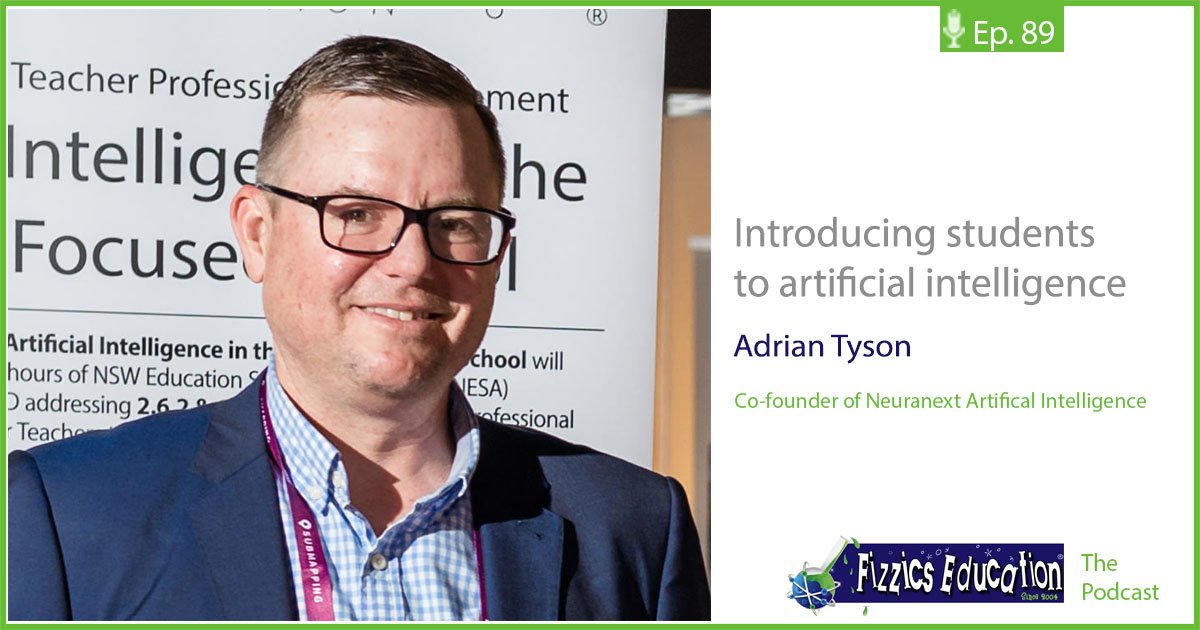
Just what is A.I? What isn’t A.I? Does artificial intelligence affect me? These are questions that students have now and will continue to have as A.I. becomes more and more integrated in our everyday lives. We speak with Adrian Tyson, a NSW teacher and co-founder of Neuranext Artificial Intelligence, an organisation that it is passionate about helping both teachers and students learn more about artificial intelligence through experiential learning.
How do we prepare students for the most transformative technology of our generation? In this episode, we explore the world of Artificial Intelligence (AI) with Adrian Tyson. We discuss how his organisation, NeuraNXT, is moving beyond the “black box” of AI to show students how to actually build, train, and deploy intelligent systems—from data science fundamentals to autonomous robotic cars.
About Adrian Tyson
Adrian Tyson, along with co-founder Dr Andrew Kingdon, is the driving force behind NeuraNXT Artificial Intelligence. Together, they have developed NESA-approved professional development for teachers in AI. Adrian is passionate about creating experiential learning environments where students don’t just talk about AI, but actively create data and apply machine learning models to it. His work spans from primary schools in Australia to teaching doctoral students at Beijing Normal University.
Expertise: Artificial Intelligence, Computer Vision, Machine Learning, and Data Science.
NeuraNXT Artificial Intelligence
NeuraNXT is dedicated to demystifying AI for the next generation. By focusing on experiential activities, they allow students to see the direct relationship between raw data and “intelligent” machine behaviour.
Key Educational Components:
Data Creation: Students learn the importance of high-quality data by creating their own datasets (numerals and photos) and seeing how an AI interprets them.
Computer Vision & NLP: The programme explores how machines “see” images as numerical values and how Natural Language Processing powers digital assistants.
Autonomous Robotics: Using AI to power robotic cars on a 5×4 metre track allows students to see real-time problem-solving and the societal implications of automation.
NESA-Approved PD: NeuraNXT provides teachers with the accredited training needed to confidently introduce AI and Digital Technologies into the Australian curriculum.
AI is Distinct from Coding:
Adrian emphasises that while Python is a tool for implementation, AI literacy is about understanding models and data patterns. It is a unique field that should not be confused with general robotics or coding.
The Importance of Experiential Learning:
By having students “break” an AI (e.g., entering a letter into a numeral classifier), they learn the limits of Narrow AI and how machines arrive at statistical labels.
The Future of Infrastructure:
The discussion shifts from “smart cars” to “smart roads.” Understanding the Internet of Things (IoT) and how street furniture must communicate with autonomous systems is key to future urban planning.
Education Tip: The “Human Machine Learning” Game.
Follow Adrian’s lead by teaching Pattern Recognition and classification. Have students define the specific rules or features they use to identify an object. As Adrian demonstrates at NeuraNXT, once students understand the Logic of Classification and how data is reduced to numerical values, the transition to understanding a digital neural network becomes a logical next step.
[00:00:17]Ben Newsome: Yes, welcome again to another Fizzics Ed Podcast. Glad to have you yet again. If it’s your first time, welcome. If it’s your 50th time, glad to have you back. We are talking STEM as usual, and this week we’re talking with Adrian Tyson, who is the co-founder of NeuraNXT Artificial Intelligence, which is an interesting space to jump into education. You see, Adrian along with his co-founder, Dr Andrew Kingdon, have been working in China and in Australia to get teachers and students to sort of get their head around what AI means for them now and what it could mean in the future. And importantly, what is AI and what isn’t it?
[00:00:54]Ben Newsome: You see, this is a really burgeoning topic. It’s something that’s going to keep growing and growing. Getting kids to really understand how this works in the real world through experiential activities is something that is right at the heart of how Adrian and his team are working. And so, let’s jump on in with a chat, because this is really interesting that you could potentially think about how could you position your students to understand how AI might be impacting them and maybe get in touch with NeuraNXT to find out how they might be able to help you.
[00:01:21]Announcer: This is the Fizzics Ed Podcast. We’re all about science, ed tech and more. To see 100 fun free experiments you can do with your class, go to fizzicseducation.com.au. That’s physics spelled F I Z Z I C S and click 100 free experiments.
[00:01:40]Adrian Tyson: So, my name is Adrian Tyson and I’m from a company called NeuraNXT Artificial Intelligence. And we, among other things, we teach artificial intelligence to students in schools, both primary and high school. And we also have teacher courses for Australian school teachers to learn about artificial intelligence as well.
[00:01:58]Ben Newsome: How long have you been doing this?
[00:02:00]Adrian Tyson: This has really kicked off just this year, actually. We’ve been working on it for two years, but it’s been accredited by NESA in New South Wales for teachers just in March this year. And that’s when we kicked off our in-school programmes and we’ve had just over a thousand students and teachers do the course since.
[00:02:18]Ben Newsome: Fantastic. I mean, interesting you said two years because often people say, so when did you come up with this? And often when people are designing things, it doesn’t just always come up overnight. I ran into someone at a TeachMeet last night, they were developing, I think it was called Kookaberry. It was a sensor-based application that they had built themselves, and they said similar things; it took a couple of years to get going. And it doesn’t surprise me it was the same for you because obviously getting into AI and all the rest, it’s not like you can start off instantly straight away.
[00:02:49]Adrian Tyson: Straight away, no. Well, my co-founder on that is actually a PhD in psychometric statistics, Dr Andrew Kingdon. And with him, we’ve been teaching actually doctoral students at Beijing Normal University in Beijing, which is the big teaching university up there. And for a couple of years now we’ve been teaching computer vision and natural language processing AI to doctoral students up there.
[00:03:13]Adrian Tyson: So, that’s a very deep dive into calculus, linear algebra and the statistics that is the underpinnings of artificial intelligence. And that’s sort of where the genesis of it was, is up there teaching, and we also present, we’ve presented a couple of years papers at the AI and Big Data Global Conference for Education, which is attached to Cambridge University as well. That’s sort of how we got involved, Andrew’s done a bit of work with Cambridge.
[00:03:41]Adrian Tyson: And we thought, well, we’ve got teaching backgrounds and stuff in New South Wales and Australia and we thought we should really be not just teaching Chinese students, we should be providing this opportunity to Australian students as well because it is a critical technology going forward and we want Australian students to be participants of this technology as much as anyone in the world. And so, that’s where the idea sort of originated from, was our work in Beijing.
[00:04:07]Ben Newsome: Fair enough. And just out of that, because you do have a teaching background, were you kind of teaching coding and AI and whatever you could to kids prior to setting up NeuraNXT?
[00:04:17]Adrian Tyson: No, actually, I was just doing regular teaching in a primary setting. And I actually had another interest in film-making and with that I was teaching that to students as well, teaching filmmaking. So, we saw the opportunity to, when I got into the AI thing with Andrew, who I’d known for 25 years, we saw an opportunity there to bring AI education. So it wasn’t something that I’d started in before doing coding.
[00:04:46]Adrian Tyson: And one thing I like to really underline is that AI is not coding and it is not robotics. A lot of people do confuse that and that’s one thing we like to upfront really delineate and say it’s not really any coding. However, we do use Python code to bring in AI libraries and to implement them for tasks. So while there is a usage of coding, it’s not about coding, which is interesting I think.
[00:05:11]Ben Newsome: Absolutely. And I was kind of just thinking about the students who rock up to your courses because, I mean, yeah, you’ve just started this year, but at the same point, you’ve still reached a thousand students, which by the way is well done to get going. And they’re going to bring a lot of different backgrounds and thoughts and theories around that as they come into your room. What do they think AI is?
[00:05:30]Adrian Tyson: Well, we have a range and I’m actually surprised as to how many students will say, “I have never heard of it.” And then there’s the range of students who, and that’s mainly the younger students.
[00:05:40]Ben Newsome: Do they say like, “Hey Siri, what’s AI?” Sorry.
[00:05:44]Adrian Tyson: Exactly. And that’s part of it. We say, what AI are you already using? And they go, “Oh, our phone.” In what way? And they can’t answer that. And then that’s when we start saying, well, Siri is a natural language processing AI and we go into that and there’s other ones like, they’re all familiar with Amazon Alexa or Google Home and those kind of other NLP or natural language processing AIs that are out there.
[00:06:08]Adrian Tyson: But then you’ve got the students who’ve heard of it, but they don’t really know what it is, but they want to know. They understand that it’s effectively a massive, almost society-changing technology. But they don’t understand it because really there’s not a lot of solid info out there and unfortunately, there’s a lot of misinformation out there, particularly in terms of the media. You have these movies like, if you go way back to Terminator 2 or you’ve got I, Robot, and you’ve got lots of these kind of movies that are just giving total false information and very worrying information to students about what the technology is. So that’s part of very early on in a session we really bust those myths, that’s not AI, this is what it actually is and this is how it works.
[00:06:55]Ben Newsome: So when the kids walk in, let’s ignore their ages for a moment, just kids who are competent to handle what your course is going to be about. I mean, so how do you walk them through, I guess, not just what AI is, but actually getting them to conceptualise what could they do with it and how could they get engaged to actually create it themselves? I mean, there’s a lot of baby steps to take I’d imagine initially, or is it actually easier than that?
[00:07:20]Adrian Tyson: Absolutely. Yeah. So this course that we’re delivering, our aim and our goal of this course is to spark student interest in the technology. When it comes to the actual implementation of that, we start that at the doctoral level. So students aren’t going to leave our course and implement AI. It is far too complex for that. But so we’re very upfront about that. What we want them to do is we want them to go, “Wow, now I understand how this works. Oh, look at all of the applications of this,” because less than 10% of applications have even been thought of so far.
[00:07:50]Adrian Tyson: How could I make a difference with this technology? And as they go throughout their schooling, we’re going to bring new courses all the time, but as they go throughout their schooling, I say to them, “I want you to go down this path. If you’re interested in this, go in that direction and learn these things because that’s where the jobs are going to be.” Jobs are going to change probably as significantly as an industrial revolution. And we want them to be on the right side of that. And I think that’s our aim is to just spark that interest. They understand the mechanics of what it’s doing, how it’s representing data in ways that computers could never do before and make associations which computers could never do before. And so that’s the goal of us is to spark them, get them thinking, “Wow, this is where I want to go.”
[00:08:42]Ben Newsome: I must say, my brain always goes, “It’s a brave new world” with this sort of thing. But what’s cool about it is these kids can 100% be part of that world and part of that journey. And so they get the introduction; AI is here already. It’s not like it’s coming in the future, it’s here now. And of course, at the doctoral level to actually get this thing pulled together it takes a little bit of effort, I believe. But at the same point, getting kids to truly understand, I imagine it’s not just “Here’s a presentation done on PowerPoint.” I mean, they’ve got to actually conceptualise it much deeper. So how do you go about that?
[00:09:19]Adrian Tyson: That’s right. So what we do is we’re strong believers in experiential learning. So students, we don’t just want to present to them on the screen. We want them to actually create their own data. Let’s play with some artificial intelligence to do classification on the data that they’ve created. So the good thing about that is the student could never, you can’t say, “Oh, well, the computer’s seen that data before.” Because it hasn’t. They’ve just created it new now. It’s their own individual data.
[00:09:47]Adrian Tyson: And one of the examples that we do is to demonstrate that AI is a narrow technology. It will do its task, but something outside of its task, it can’t deal with. So in one example, we have a numeral classification AI which is actually originally trained to recognise postcodes on the front of envelopes. So it will only do one numeral at a time. And you get a student to come out, create some numerals, and it will do a beautiful job, in fact, better than human performance job at classifying those numerals.
[00:10:14]Ben Newsome: So it says like odd or even or something like that?
[00:10:17]Adrian Tyson: Well, it’s just it will say it’s a five or it’s a six or whatever it may be. And then I say, “Now let’s go outside the bounds of what this thing can do. And why doesn’t someone come out here and enter a letter, or enter two numbers?” And the AI fails completely. And as I say to them, that this AI only has the only labels it can associate with the data is zero to nine. It doesn’t know anything else. Fantastic at that performance, but it’s not trained to deal with letters or anything like that.
[00:10:48]Adrian Tyson: And so we actually get them to deliberately break it, as it were, and then have a look at what’s going on. And when I enter a capital A or the student does a capital A, why does it classify that as a four? What’s going on with the data? And so we get those kind of discussions happening as well so they can understand how it’s arriving at its label and why that label is statistically the most likely, even though it’s wrong, but we’re looking at what’s going on with the data. So yeah, you get to actually do that.
[00:11:15]Adrian Tyson: And the other thing that they do is we get them to take some photographs around the room of particular objects and we try and classify those photographs with AI. And also we get them, and probably the most engaging one, is once we’ve talked about computer vision and neural networks, we actually get them to show them how to train and build an autonomous robotic car—when I say build, build the model, not the vehicle—to do a self-driving task.
[00:11:42]Adrian Tyson: So we have a, like we get out this giant track, it’s like five by four metres, and we actually deploy this car that will automatically drive. And as we say to them, since the invention of the motor vehicle, you required a human consciousness to do that task, and now I’ve automated it. That’s a quantum leap in the technology. But and that’s fantastic, and they love that and we have fun with that.
[00:12:08]Adrian Tyson: And then I ask them, you know, how many people are employed to drive something? What’s the implications of this? What’s this going to do to the structure of society? And get those kind of discussions happening as well. So it’s not just the technology, it’s also, what does this technology mean? And is it going to mean reduced road toll as an example, because it has less errors happening on the roads? So there’s lots of things like that that we get them talking about.
[00:12:34]Ben Newsome: It’s a really interesting headspace because only last weekend I was lucky enough to be a judge on the One World Robotics competition and they had an AI component in it. And part of that was the kids had to present to us as judges as a panel what they think would be happening in future cities. And one of them was autonomous cars as part of it. But also that they say what is their solution for dealing with what’s going to be like in the future cities. The kids came up with some really interesting ideas. There was one group of kids that are from Marist Sisters, actually, they said, “Actually, one of the things we’d like to talk about is, well, artificial intelligence, it is an intelligence, and by definition intelligence is you’ve got to deal with the real world and occasionally they’re going to make mistakes. And so perhaps there might need to be some sort of unit at a crimes level that actually works out, well, if something went wrong, who do we deal with? Do we look at the data set? Do we look at the people who created it? Or do we look at the AI itself?” It brings up actual challenges that are far beyond just “here’s some data”, because these things are in the world.
[00:13:40]Adrian Tyson: Absolutely. And I mean, self-driving cars, one of when we do the long day programme, we actually have time to go into a bit of the ethical considerations of artificial intelligence. And you know, we present students with things like the trolley problem, which is you know, there’s a tram coming down the track and it can either run over one person or you can switch the track and it can run over two. And it’s an ethical dilemma. It’s like what, you know, well, what if this person is a young person or that person’s an old person, and all of these different ethical dilemmas come into it. And AI is going to have to deal with those. And we’ve seen like Tesla self-driving cars or an Uber self-driving car in the United States run over and kill a pedestrian. And the reality of that situation is that a human driver would most likely have done the same thing in that particular instance. It was a really tough problem.
[00:14:35]Adrian Tyson: But when they dived right into the technology and what is going on, the AI recognised the person 5.6 seconds, or recognised there was an object, prior to the accident and then was unsure. It wasn’t trained, didn’t have enough data to deal with a jaywalking style setup. They understood if people were near pedestrian crossings or intersections they were well-trained, but when it was a jaywalker or a random person on a road where they didn’t expect it, it was unable to do the classification.
[00:15:07]Adrian Tyson: And then by the time it was strong enough that it was, “Oh, I need to stop this car,” they had an inbuilt one-second delay because they had a problem with their AI meshing with a system from Volvo that was driving the car. So that one-second delay then made the accident inevitable. And so that was an example of, you know, whose fault here? You know, what’s going on? And I think that the technology to drive the vehicle is there, but the regulatory environments, you know, the legal world, is nowhere near caught up. And I think that’s a big problem.
[00:15:39]Ben Newsome: Which is fantastic because that opens up the discussions that go right down, okay, we’re talking as a New South Wales type educator, so we often talk around our curriculum, but we know there’s many around the world. But the Human Society and its Environment has a number of different things that you can discuss amongst this, and it’s not just the built environment, it’s how we interact with said environment and it’s a big deal.
[00:16:00]Adrian Tyson: Absolutely. Absolutely. And there’s just huge amounts of ethical considerations. And I know one thing that’s coming is that street furniture, so this is Internet of Things, street furniture is going to need to be part of the data set that cars are using. So a car at the moment, like a self-driving car, Tesla approaches a light and it’s making a computer vision decision as to whether the light is green or red or amber.
[00:16:29]Adrian Tyson: Whereas I know in railway settings at the moment, I know John Holland Rail in New South Wales that runs the regional freight lines, the train, the computer on the train knows what the signal is going to be before it gets there. And they are actually using computer vision to do a double check on that. So they’ve got the other way around. So they’ve got a very what’s called smart track and dumb train is their paradigm, whereas in vehicles with Teslas, it’s very smart car and dumb road as it were. And that’s what they’re trying to, part of that building the world of the future is that the street furniture or the street lights and all of that kind of thing are going to need to communicate with cars in advance.
[00:17:14]Adrian Tyson: And the other side to that as I say to students is that who’s ever been in a car, you approach a street light, it goes red, you stop, and there’s no other traffic that needs to flow through the intersection. You’re just waiting there because they’re just on a timer. But if they were communicating between the lights and the cars, they would know that there’s no other demand for that intersection, so this car could just keep going. And the efficiencies and the lack of wastage of fossil fuels and/or electricity would be in the billions of dollars just from that little efficiency alone through, and that’s not so much AI, that’s just Internet of Things and information being advanced instead of just reactive information. So there’s lots of discussions about all that kind of stuff that you can get from it.
[00:18:03]Ben Newsome: I guess then when I think about it, I mean if I was a student in this day and age growing up and kind of hearing these discussions, I mean there’s always ethical discussions that come across, but of course we need as growing up kids have a set of tools that can help us navigate this world. It seems like the understanding how data and how data moves is becoming more and more fundamental to kids as they grow up irrespective of what area they’re actually interested, whether it’s art, maths, cooking, whatever it is.
[00:18:30]Adrian Tyson: That’s right. Yeah. Absolutely. And it’s funny you should mention art. We actually show them, there’s quite a few instances out there now where AI is being applied to create art. And so that’s like data that is being turned into what looks like creative output that a human has previously done is now being able to be imitated by data. And it is pretty amazing what’s out there.
[00:18:59]Adrian Tyson: But 100% right, a student now would, and that’s what, that’s our goal is to try and say look, this is where we want, you know, this is really cool apart from that, this is where the jobs are going to be. We want you to be understanding how the data is dealt with, particularly in computer vision because as I say to the students, okay, we know that a computer can hold a photo, or record a photo, we know that our camera can record a photo. But the camera has no idea, or the printed image doesn’t have any idea what’s in the image. It’s just holding colour, it doesn’t know what’s in the image. Whereas now computers can understand what’s in the image. And that’s what’s changed.
[00:19:37]Adrian Tyson: Is that in a digital image, a pixel now, and every student seems to understand the concept of a pixel, particularly in terms of video games and things like that, is that every pixel is reduced to a numerical value. And we show them how those numerical values are arrived at. So what is a picture is reduced to pure numbers and then dealt with with a neural network. And so that’s to that point about how does data flow and all that is that’s part of what we do with particularly teaching computer vision.
[00:20:08]Ben Newsome: Which really means that our job as educators is to be able to help those kids who really don’t care about data, who really don’t care about maths, they really can’t stand it, and to make those connections going, “You know what, this is part of your future and here’s why it might matter.”
[00:20:23]Adrian Tyson: Absolutely. And you know, those students you just mentioned, you put a self-driving car in front of them and that is a real thing that they can really grab hold of and it really grabs their attention. And as I say to them, I mean this is more for the high school students, but we say don’t ever say to your mathematics teacher, “When will I ever use calculus in real life?” because there it is, AI. AI is mainly a lot of calculus. And so we actually had one of, Andrew met with Eddie Woo and he said that to him and he agreed wholeheartedly. That’s definitely using calculus is whenever there’s AI there.
[00:20:58]Adrian Tyson: But yeah, that’s and that’s what we try and use really engaging examples of AI and not just things that may only interest students who are heavily interested in mathematics. We try and make it very broad so that every student, no matter what their interests are, can get engaged by this and and as I say to them, look, you don’t need to be a fantastic mathematician anymore than I need to be a mechanic to drive my car. Okay, sure, we go to China and we teach the deep mathematics, but you’re not going to need to have that to implement and to work with AI. So it’s not something that they have to be a really A-grade mathematics student to be involved in this. And I think that’s a key point that we make.
[00:21:42]Ben Newsome: So I guess this brings up the question. So say you’ve got just in front of you a whole bunch of soon-to-be freshly graduate students who are going to be teaching other students, whether in the primary or the high school setting, and some absolutely love this world and others are going, “You know what, the curriculum is being shoved down my throat, I’m going to have to teach it anyway.” What advice would you suggest to at least help them teach their first set of students how the world’s starting to go, starting to move?
[00:22:16]Adrian Tyson: I think that that’s a very good point. And I think that one of the, I mean obviously we have courses for teachers, but forgetting that, there is also a report that was just put out, I think by Dr Erica Southgate was one of the main authors. There were quite a few authors but I think she was the main author, which the Federal Department of Education put out. And one key thing in there is it says that teachers are going to have to start their AI journey now and they’re going to have to keep updating it every year because this is moving so rapidly and it’s just a constantly changing world. And we need to be able to position our students to be successful in that world and not be left behind by it.
[00:23:03]Adrian Tyson: So I think that even if someone’s not that interested in this world, I think it’s critical. It’d be like for myself as a primary teacher, you know, if there’s something I was say less interested in and let’s call that art as an example, you know, it’s still my job to expose students to art and to teach them about art and to be enthusiastic about that even if that’s not my forte. And I think that that’s a core responsibility of teachers.
[00:23:32]Adrian Tyson: And I think that if we’re trying to make it so that it’s not, we’re trying to demystify it and make it so that it is explainable to students. It is something that is engaging for students and I think that that’s the role of teachers particularly going forward. And you know, our work in China, we see that those students up there are getting exposed to it and if Australian students aren’t because their teachers aren’t doing anything with it, you know, it’s going to leave them floundering. And that’s, you know, as educators, that’s the worst thing that can happen, I would imagine.
[00:24:08]Ben Newsome: Ah, thank you and I totally agree. I mean it’s all about the enthusiasm that truly makes a difference. Always is the case and more than enough research backs that up for sure. I guess like there’s a part B to this question. I mean the, okay so we got to get enthusiastic but of course it’s nice to be enthusiastic when you’ve got some resources to work off. So I guess to that same cohort of people in front of you, where would you point them to say, “You know what, here’s a great place to find some stuff to get going”?
[00:24:38]Adrian Tyson: Yeah, um, so we, there’s a, it is a deeply mathematical and you need Python skills and calculus and all that kind of stuff to actually build new AI. And that’s not where I’d be going. But I send out to anyone who’s done the NESA course, they get a whole bunch of resources sent out to them. And I just this morning sent out a pack to a school that had done my course and they can actually implement, you know the one I was talking about the numeral classifier, and have those discussions with students about it works now when I’m giving it the data that’s trained on. And so that’s something that teachers can get hold of and they’re going to implement that in their school and they’ll be able to use that as a resource for teaching that sort of introductory computer vision and neural networks in the classroom with new data that the students are creating. So that’s the kind of resources that we’re sort of sending out to the people that have been and seen with the course.
[00:25:44]Ben Newsome: Now, fantastic. Now I know there’ll be some people who want to get a hold of you, I suspect, to be able to help out a little bit. So how would they be able to get in touch?
[00:25:53]Adrian Tyson: The best thing to do is to visit our website which is www.neuronxt.ai. So it’s N E U R O N X T. ai or email myself which is [email protected].
[00:26:08]Ben Newsome: Easy. And as usual we’ll always put these in the show notes so you’ll be able to check it out. And look, thank you very much, Adrian, for popping on to have a bit of a chat. It is Friday afternoon, but then again, we’re always busy no matter what day it is.
[00:26:21]Adrian Tyson: That’s right. My pleasure.
[00:26:22]Ben Newsome: Absolutely. And look, well done getting this off the ground. I mean, you’re in your first year, but like you said, this is two years in the making and it sounds like you’re doing an awesome job, not just in Australia but in China and potentially elsewhere I suspect as you go on.
[00:26:36]Adrian Tyson: Yeah, we’ve been very lucky to, we’re part of the Amazon AWS EdStartprogramme for edtech startups and also the NVIDIA Inceptionprogramme for AI startups. So those two things are helping us in small ways, but they’re certainly helping and giving us some exposure around the place and yeah, it’s going quite well. We just want to expose as many students to this technology as possible and as I say to them, you know, it’s the creative thinkers who apply these STEM skills that change the world and that’s my suppose my message to leave them with.
[00:27:10]Ben Newsome: Mate, great message to leave them with. Awesome. Have a fantastic afternoon.
[00:27:14]Adrian Tyson: Thank you, you too.
[00:27:15]Announcer: Not all TPL for teachers is as awesome as it could be. I feel like there’s a lot of PowerPoint presentations, a lot of sitting and listening to someone talking. Well, if you want a break from that, Fizzics TPL sessions are fully hands-on, fully integrated with the curriculum and full of amazing science ideas that you can put in your classroom right now.
[00:27:37]Ben Newsome: Well there we go, we just spoke with Adrian Tyson, who you can really tell is a very passionate person when it comes to AI. And not just AI, technology in general; he is really, really clued in on this. I mean, this is something that’s 100% going to affect us. It’s not just about autonomous robotic cars, it’s all sorts of things, and it’s impacting us right now.
[00:27:58]Ben Newsome: So why not get in touch with Adrian at NeuraNXT Artificial Intelligence and find out how they can help you out. And as usual, on our website, we have a bunch of different resource links about this that Adrian kindly gave to us so that you can sort of start that journey along too. So just jump on the Fizzics Ed website, type in artificial intelligence, you’ll find the blog article about this and all the different links that Adrian’s given us. Hey, that’s enough for this particular chat. As usual, we’ve got more things coming up and I hope you have a fantastic evening or morning or whatever you’re doing, and I’ll catch you another time.
[00:28:57]Announcer: This podcast is part of the Australian Educators Online Network. aeon.net.au
Recognised by
22 years, award-winning work, 1 purpose
Recognition from business, education and industry bodies across Australia.
Australian Small Business Champion
Multiple years
CILC Pinnacle Award and Hall of Fame inductee
Center for Interactive Learning and Collaboration
Western Sydney Awards for Business Excellence
Winner
Top 100 Coolest Company
Listed
Local Business Awards
Winner
We value your privacy
We use cookies to improve your experience. Essential cookies are always active. You can choose which optional cookies to allow.We use cookies. Optional ones stay off unless you allow them.Privacy policy