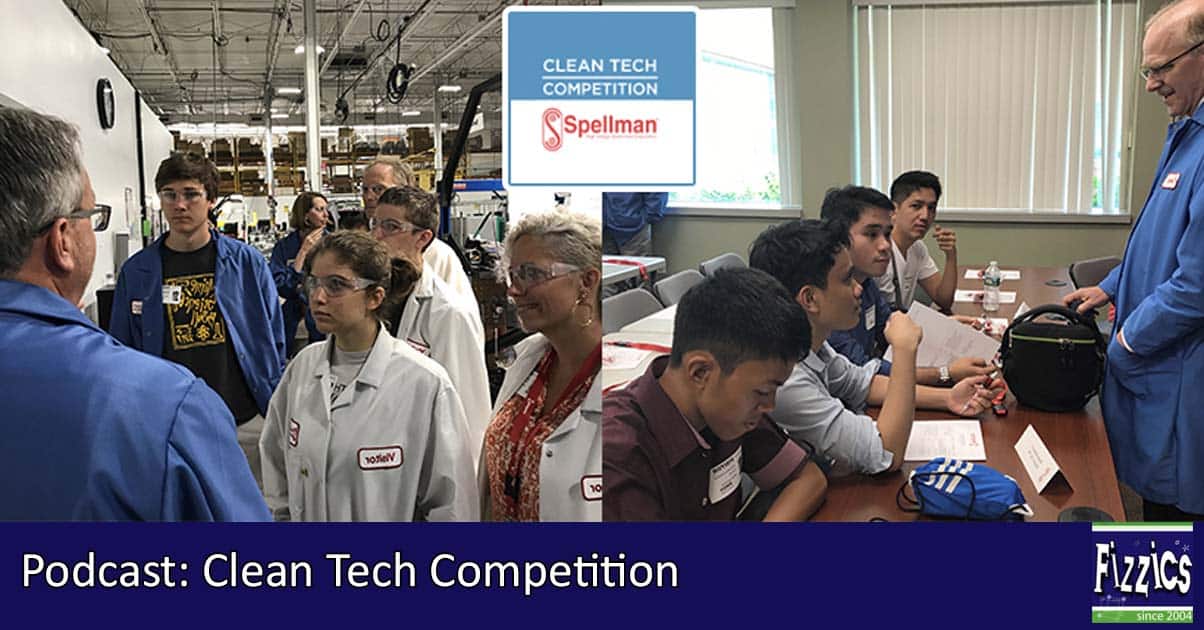
How can the next generation of engineers solve the world’s most pressing environmental crises? In this episode, we dive into the Spellman Clean Tech Competition. We explore how this global research and design challenge is empowering 15–18-year-olds to tackle real-world issues through sustainable innovation, scientific understanding, and the integration of environmentally responsible engineering solutions.
About the Clean Tech Competition
KSKevin Sanders
The Spellman Clean Tech Competition is a prestigious worldwide challenge for pre-college youth, administered by the Centre for Science Teaching and Learning (CSTL). It encourages students to integrate core technological competencies with environmental responsibility. Each year, the competition focuses on a specific engineering theme—such as “Reducing Individual Impacts”—challenging teams to develop solutions for both resource-abundant and resource-limited environments. Finalists have the opportunity to present their prototypes to an international panel of industry professionals and university instructors for a chance to win significant grand prizes, including a $10,000 top award.
The Road to Sustainable Innovation
This competition is more than just a science fair; it is a rigorous engineering challenge that prepares students for careers in Green Technology and Environmental Science.
Competition Structure:
Team Collaboration: Students work in teams of 1–3 to identify a specific environmental problem and research a viable, technical solution.
Professional Judging: Submissions are evaluated by an international team of experts, including engineers from Spellman High Voltage, ensuring students receive high-level feedback.
Prototyping & Presentation: Finalist teams receive a $200 stipend to construct physical prototypes, which they present at a global finals event, previously held at locations like Washington DC.
Global Impact: By addressing diverse resource categories, the competition forces students to consider how localised engineering can solve global challenges, such as the electronic aquaponics system developed by a finalist from Zimbabwe.
Economical Innovation:
Innovation doesn’t require massive budgets. The competition’s $200 prototype limit proves that effective solutions can be built from common materials like PVC piping, making sustainability accessible to everyone.
Contextual Engineering:
Students must differentiate between ‘Abundant’ and ‘Limited’ resources. They learn that a technical solution must be tailored to the specific environment where it will be used, requiring deep research and adaptability.
Professional Integration:
By interacting with the public and industry judges, students develop Science Communication skills and gain insight into how their ideas might translate into real-world business or research opportunities.
Education Tip: The “Clean Tech” Audit.
Follow the competition’s lead by having your students conduct a “Sustainability Audit” of their own home or school. Challenge them to identify one specific waste stream and sketch a technical solution to reduce its impact using limited materials. As Kevin Sanders explains, when you give students an open-ended problem, they stop being students and start being Environmental Engineers.
[00:00:17] Ben Newsome: Yes, welcome again to another Fizzics Ed Podcast. Glad to have you wherever you are. This week, we’re very excited because we get to hear about the Clean Tech Competition, which is an interesting competition that has been going for quite a while. It’s all about helping out high school students to really understand what it’s all about regarding sustainability and, more importantly, about international research and creating something through a design competition.
[00:00:41] Ben Newsome: We get to speak with Kevin Sanders, who is the Clean Tech Competition administrator at the Centre for Science Teaching and Learning, which is out of the East Coast of the US. They do a fantastic job reaching not just kids in the US, but right across the world. They’re a really cool sort of competition that you guys can get involved in, no matter where you are. So, enough about the preamble. You want to hear about this comp, so let’s dive right in.
[00:01:04] Announcer: This is the Fizzics Ed Podcast. We’re all about science, ed tech and more. To see 100 fun free experiments you can do with your class, go to fizzicseducation.com.au. That’s physics spelled F I Z Z I C S and click 100 free experiments.
[00:01:22] Kevin Sanders: So, I administer the Spellman High Voltage Clean Tech Competition. It’s the only global innovation competition for high school students. It’s a really cool programme that allows 15 to 18-year-olds to research on a sustainability topic that we change every year, work on a paper and then produce a prototype that they are able to travel with and bring to our finals competition if they’re invited, and show it off and look to win our $10,000 grand prize. So it’s a really cool concept.
[00:01:53] Ben Newsome: That’s fantastic. So where did this all come from?
[00:01:56] Kevin Sanders: So, it started about nine years ago. It originated as a competition for just students in California and Singapore. And then from there it kind of expanded and continued to grow. Now it reaches, last year we had over 40 different nations and over 1,100 students from across the globe, all in the interest of finding a sustainable solution for our future.
[00:02:21] Ben Newsome: That’s fantastic. That’s pretty good considering nine years and suddenly you’re in 40 nations. Well done.
[00:02:27] Kevin Sanders: I know. It’s pretty amazing the growth that happened. And now obviously I’m on board with it and I’m really excited. It’s a really cool opportunity for everyone.
[00:02:36] Ben Newsome: Considering how many schools are involved, but then again, there are so many thousands of schools that are around the place.
[00:02:44] Kevin Sanders: There really are.
[00:02:45] Ben Newsome: So there’d be people who haven’t really come across this Clean Tech Competition. Maybe I just generally wanted to know, how does this sort of work?
[00:02:53] Kevin Sanders: So, it starts out by the competition committee, we pick a theme for each year. This year it’s reducing individual impacts, and we really tried to go with something that we thought would be able to put the action into the hands of the people and not just have it kind of be this out-there project that doesn’t really seem like they can do much with. So then we introduce that, we send out emails, we spam it on social media and all that fun stuff so that everyone who’s interested gets a hand on it.
[00:03:21] Kevin Sanders: And then the students, they perform their research. Whenever they feel that they’re ready, they go ahead and they submit a 5 to 15-page paper. And then we have an international team of professionals in engineering industries, innovators, university professors, all the like of that. They grade them and then from there we choose the top 20 in each category.
[00:03:44] Kevin Sanders: So this year we’ve had two separate categories. This year they are abundant resources and limited resources, so it really gets both ends of that spectrum. So once they’ve found the top 20 projects, those are our semi-finalists and then from there we take the top 10 and those finalists are then invited to come to our finals event, which this year is in Washington DC. We try to change it up every year to really kind of expand it, because climate change and the issues that we’re trying to address, they’re not just one area. They’re not localised; they’re all over the place.
[00:04:21] Kevin Sanders: So then those students, they come to the finals, they are given a $200 stipend to work on and build a prototype. And then they come and present that prototype in front of another team of judges that look at it and from there they pick the top teams and they get their awards. And it’s a really cool programme. It’s not like they just show up and they’re judged. They come, we have members of the public, we invite school groups, STEM organisations and professionals to come and look at it as well and they’re able to talk to them as they’re cycled through to give their presentations to the judges. So it’s a really all-encompassing experience that gives them a lot of experience for themselves as they grow and change as a person.
[00:05:00] Ben Newsome: One of the things I really love about this is the fact that you said prototype. I love the idea how the kids can generally make a thing, or at least an idea of a thing, to present to people who have actual genuine backgrounds around this. So this is 15 to 18-year-olds, right?
[00:05:14] Kevin Sanders: Yes, correct. For 15 to 18-year-old pre-university students. As long as they have not started to take college classes or university classes yet, then they are more than eligible in that age range.
[00:05:27] Ben Newsome: So you’ve been going for nine years with this. You would have seen some really cool prototypes over the years. What’s something that comes to mind that you can remember in the past that students have created that you totally didn’t expect?
[00:05:40] Kevin Sanders: One of the ones that really stood out for me last year was a really cool project from a young man from Zimbabwe. He came and he had developed an electronic aquaponics system. Aquaculture is growing plants and stuff. Aquaponics is using the water to grow plants in it so they’re constantly submerged in water. You don’t have to constantly cycle out water and water them, so it’s a much more efficient source.
[00:06:08] Kevin Sanders: And aquaponics uses fish to fertilise it. So the waste products that come out of fish, they use that to fertilise so you’re not putting any toxic chemicals in the water, in the plants, or in the food. The young man combined all this together and then he made it controllable via the internet. So you can monitor all the levels of just everything involved with it.
[00:06:28] Kevin Sanders: So it’s a very low energy-use system, it uses a low amount of resources, and it takes a lot less of your time to manage it and really utilise it to help grow food potentially on a large scale someday. So that one really sticks out to me as something that was super cool that I really enjoyed.
[00:06:53] Ben Newsome: Yeah, and when you kind of think about it, that is not just a research project. This person could 100% actually build a real thing out of this after they left school.
[00:07:04] Kevin Sanders: Exactly. And when he came, that’s why we give them a $200 stipend and all the teams are limited to that. So it really makes it so that they have to make something that’s very economical. It’s not going to be, you don’t need $100,000 to be able to build these things. They’re very simple, straightforward and he built this thing, half of it was out of PVC pipe, a very commonly available material. So it’s really incredible that they’re able to come up with these concepts and actually build them and they’re not just on paper.
[00:07:31] Ben Newsome: I bet, absolutely. So I mean, I haven’t come across, this is just my pure ignorance, I haven’t come across Spellman High Voltage before. So what does Spellman actually get up to?
[00:07:44] Kevin Sanders: Odds are, even if you haven’t heard of them, odds are that you have been in a medical system that uses their equipment. So they make a lot of things for MRIs and X-ray machines, like the power sources for that. So they’re a great company. They’re all over the globe, they have offices in Europe, Asia, America, so they’re all over the place.
[00:08:05] Kevin Sanders: And the great thing about them honestly is that they’re a very hands-on sponsor. They don’t just write us a cheque and say this is yours to do what you will with it. They’re very involved, they help us come up with the concepts, they help us think of new ideas, they help us with judging. So they’re very integrated into the overall system and it shows that they truly care and they’re not just doing this for the notoriety or anything like that, which means a lot to us.
[00:08:28] Ben Newsome: It really does. I mean, I’m from a private business and the reality is that we’re people too. We want to be able to help as much as we can. This public-private partnership is a real big deal down in Australia, and it can often give a real momentum behind some of these projects. So you’re out of the Centre for Science Teaching and Learning. Whereabouts is that?
[00:08:52] Kevin Sanders: So we’re located in Rockville Centre, which is on Long Island just outside of New York City. So we’re a small science education and advocacy centre. We do so many things here. Our most exciting thing is that we just opened up a dinosaur exhibit, so we got full-size skeletal models, animatronic dinosaurs, and incorporated in that is our animal adventure and it’s all tied into one to really teach kids and adults honestly about adaptations and how we’re able to determine all these things just by looking at bones. Obviously dinosaurs aren’t around.
[00:09:28] Kevin Sanders: So that’s our big thing, but we also do plenty of science camps, we have an outdoor-based nursery programme, we do birthday parties, we do outreach. It’s really all about making science affordable and exciting for kids. So hopefully they get into it one day and try to do something with that.
[00:09:45] Ben Newsome: There are so many awesome science centres and people who have been listening in to this podcast know that I run into a lot of friends right across the museum and science centre sector right across the place. And so many cool things. Let’s be honest, kids love a dinosaur. That’s very straightforward.
[00:10:00] Kevin Sanders: Very exciting things, everyone loves dinosaurs.
[00:10:02] Ben Newsome: They do! And places like your Centre for Science Teaching and Learning really make a huge difference. So you’re out at Long Island. Do you get many people coming across where you are? Or do they act mainly virtually? It sounds like mainly people visit you whenever they can during the school term. How does that all sort of go?
[00:10:20] Kevin Sanders: Yeah, so we’re open to the public. We’re on a 17-acre nature preserve which, if you know much about the suburbs of Long Island right outside of New York City, that’s a pretty good amount of open land. So it’s a really cool thing to bring these kids that are used to just seeing a few trees on their street and stuff.
[00:10:40] Kevin Sanders: They’re able to come, that’s always open to the public. We do plenty of programmes on the weekends and stuff to really allow other kids to come in. But then we also have school groups come here and do things to learn through our field trips, the dinosaur programme, and whatever else that we can really do to help them again learn and become excited about science.
[00:11:00] Ben Newsome: That’s it. And one of the things I like to sort of find out, especially with people that come on this who’ve got a bucket load of experience in their own worlds and you certainly do around science education. If you had some teachers in front of you who are trying to get their head around how can I teach renewable energy or green technologies, all that sort of thing. How do I do this if I haven’t got much of a budget? What would be the sort of things that you could suggest to them to start them on the path to get them involved in teaching?
[00:11:30] Kevin Sanders: That’s one of the great things here is that we try to do things where you don’t need a lot of resources. We do a lot of things where we incorporate honestly almost common art supplies and add an extra level to it and really challenge the kids to get thinking and try to start working and really just kind of grow upon that.
[00:11:52] Kevin Sanders: And that’s what’s great about these challenges that we give for the competition is that they’re very open-ended. They’re not trying to give them a very linear way to go about these things. It’s all about starting with just an idea and seeing how you can build off of that and expand it and make it grow. You’re not going to come out with a finished solution right away.
[00:12:12] Kevin Sanders: So it’s really just about challenging the kids to think and try to do things in a way that they might not have done before, or that they’ve never seen before, or if they have seen it to really do it in their own different way and put a spin on it, just to make them excited and see that science isn’t just somebody sitting in a lab with a microscope or something like that, which is exciting in its own way, but might not have the same draw for a younger child as it does as you grow older.
[00:12:42] Ben Newsome: Yeah absolutely. And obviously these competitions are 100% a good gateway to or even just a reason to commence if you haven’t quite put your toe in the water yet. So I mean this is kind of time stamping this particular podcast being late 2019. Next year is your next competition and so there’ll be people listening in who would love to know righto, I’m in. So what are the dates? What do I do? So Kevin, what are the…
[00:13:06] Kevin Sanders: Very important things to know. So registration is open and it’s free to register. That’s one of the things that we like about it is that we try to make it as accessible as possible to everyone. So there’s no fee, you just go onto our website, it’s cstl.org/cleantech, and on there you’ll find a wealth of information including the rules and everything like that as well as the registration page. You go ahead and sign up there.
[00:13:31] Kevin Sanders: Registration will end in mid-March, March 13th. And then after that, there’s about three weeks, hopefully they’ve started working on their papers before then, and then their papers are due on April 3rd. And then we’ll announce the finalists at the end of April. And then our finals are actually July 2nd in Washington DC.
[00:13:53] Kevin Sanders: July 2nd is right before July 4th, America’s founding date. So it’s definitely a weekend that’s going to be filled with a great celebration. The Smithsonian, which is a big museum down here, their folklife festival is going on as well, as well as the Solar Decathlon, which is a big collegiate competition where the students essentially create sustainable housing. That’s going on at the same time as well and they’re very excited that all this is going to be happening in conjunction with our event at the same time.
[00:14:18] Ben Newsome: Sounds like you’re just having a bit of fun now.
[00:14:22] Kevin Sanders: I am, I really am. I get very excited talking about this because I think it’s such a cool thing and an opportunity to really provide for so many different kids that may not have this opportunity where they’re from. We really try to inspire as many people as we can.
[00:14:38] Ben Newsome: Yeah absolutely. This thing will obviously keep on rolling over and get grow and grow and grow. You’ve already hit 40 nations. I’d imagine you’ll just keep on going. I’m guessing a lot of those are still in the northern hemisphere, yeah?
[00:14:52] Kevin Sanders: So a good amount of them, I would say we have a very solid base in the United States. But beyond that, Singapore is our next biggest one. We always have a good amount of teams from Africa. Like I said, Zimbabwe, they had a finalist last year. We always have teams enter in South Africa. We always seem to get teams from Pakistan, Malaysia. Australia always sends a few teams. They had a finalist a couple years ago.
[00:15:19] Kevin Sanders: Malaysia, China always sends some. Peru was another finalist from a few years ago. We always get teams from Brazil in that area. So it’s really, that’s the great thing is that it’s not just a very northern viewpoint or maybe even just a western style competition. It’s really open to everyone as long as they’re able to do the research and be able to present that speaking English.
[00:15:43] Ben Newsome: One of these things that I love about this is that you’ve got kids in upper high school and they’re so focused on getting their task across the line to get it judged and do really well. And often when they leave these competitions, they realise, you know what, I got to just meet some really cool people and they were doing amazing things and they get to learn a lot more off the other kids’ projects. Do they get much of a chance to sort of circle around and just learn off each other?
[00:16:05] Kevin Sanders: Yeah, no, they definitely do. The way the competition is structured is in the morning, it’s essentially open to the public, which also means that there’s plenty of time for the kids, because they come in teams of one to three. So we try to give them time to go and talk to each other. We try to set up other events so they’re able to meet each other and talk and get to make friends and stuff.
[00:16:32] Kevin Sanders: Because that’s one of the things that they always come back to us and say is that, I really loved being able to hang out with all these other people that are like-minded, but from the other side of the world and get their perspective and learn about their project and see things that I never would have thought of because my circumstances are different.
[00:16:49] Kevin Sanders: So it’s a really cool experience for these kids to be able to come. A lot of them, if they’re international, they haven’t visited the states at all in general. And even if they have been, oftentimes they haven’t come to these areas because they come from so far away that they’re able to see something new and get a new unique experience, which is just really something that we enjoy being able to offer.
[00:17:08] Ben Newsome: No, that’s fantastic. Well yeah definitely all the best with the 2020 competition. And if you’re listening on in by the way, and it’s not 2020 and it’s 2021 or whatever, jump on cstl.org and I imagine if it’s not slash clean tech at the time, it’ll be something like that if it doesn’t change. You’ll be able to find out about whatever the following competition is. Do you actually plan much further ahead or do you sort of just work on these things on a year-to-year basis?
[00:17:33] Kevin Sanders: So yeah, it’s a year-to-year basis. We’re not planning out so far in the future. We’re confident that it’s going to happen because we really think this is an area that a lot of people are interested in and want to see growth in. But we like to focus on the present and take our time here and really make sure that this experience and this competition is the best that we have to offer and not get too distracted by what’s coming up in the future.
[00:18:00] Kevin Sanders: It’s in the back of our minds, but it’s not at the forefront of our thought because again, we want to make sure that this is the best possible experience for everyone involved and make them enjoy it. Because our finalist teams this year, some of them do enter again, others may not. And that goes for anyone, whether they’re invited to the finals or not, we really want to make sure that this opportunity is as smooth and as great for them as it is for us every year to be able to do it.
[00:18:24] Ben Newsome: Yeah, and let’s be honest, it’s always about what matters to me now that tends to motivate most people. And now this is fantastic, I love the idea and well done, I mean nine years and now you’re in 40 nations. You are going to go further, and importantly it’s really about what the kids are getting to do. And well done to Spellman High Voltage for really doing this and backing it. I know there’s a lot of sponsors and donors that also back these competitions in lots of different ways too. So awesome. Kevin, thank you so much for dialing in.
[00:18:52] Kevin Sanders: Thank you very much, Ben. It was great talking with you. I’m glad I was able to come join you today.
[00:18:56] Ben Newsome: No worries. Now if there’s someone who wants to reach out to you yourself in some way, how might they be able to get in touch with you?
[00:19:03] Kevin Sanders: So if you go onto our website, there is a contact form on there that you can go ahead and fill out and it’ll allow you to reach me. But also you can directly email me, it’s just [email protected]. And that’s I’m monitoring and sending emails on that very often every day. It’s an all-day process responding to everything that’s going on and stuff. So that’s a great way to reach out to me.
[00:19:29] Kevin Sanders: If you want to pick up the phone and call, I’m also always more than happy to talk to you about that. The phone number is 1-516-764-0045. And that is also available on our website, so if you quite missed it there, then it’s always available online to go access.
[00:19:46] Ben Newsome: Absolutely. And as always, we’ll put those links in the podcast show notes. So check those out and definitely just follow along. If you’re not getting involved next year, put in your diaries for 2021. Or consider how you might be able to get involved in some way shape or form, it’s awesome. So look, Kevin have a fantastic afternoon for you, morning for me. And we might catch you another time.
[00:20:08] Kevin Sanders: That would be great. I would love to come back and join you again.
[00:20:12] Announcer: You’re listening to the Fizzics Ed Podcast. Why don’t you book us for a science show or workshop in your school? We love seeing students get excited about science, and you will too. Go to fizzicseducation.com.au and click on schools for more info.
[00:20:29] Ben Newsome: Well there we go, we just heard from Kevin Sanders, who is from the Centre for Science Teaching and Learning. And you can really tell, this could be a great competition for your students. So, why not? Why not get in touch? If they’re not in your nation, if you haven’t heard of other schools doing it in your region, why not be the first? Just get in touch with them.
[00:20:51] Ben Newsome: Just reach out to cstl.org and just look up the Clean Tech Comp and you’ll be able to find all about it, about how to get involved. And look, if you can’t do it for next year, it seems to me like this is going to keep growing anyway, so maybe plan for the year after if possible. So well worth your time and definitely get in touch.
[00:21:08] Ben Newsome: Hey, that is the end of the 2019 series of podcasts that we’re doing on the Fizzics Ed Podcast. But, we definitely have more coming up in 2020. And if you’re listening in 2020 or further on, yeah you’ve got plenty more to check out on the site for sure. But look, we’ve got a heap coming up. I hope you have a fantastic end of year break and I’ll catch you in the new year.
[00:21:52] Announcer: This podcast is part of the Australian Educators Online Network. aeon.net.au
Frequently Asked Questions
Who is eligible to enter the Clean Tech Competition? The competition is open to high school students aged 15 to 18. Participants must be pre-university students, meaning they cannot have officially started college or university classes at the time of entry.
How many students can be in a team, and is there an entry fee? Students can enter as individuals or in teams of one to three people. There is no cost to enter the competition; registration and participation are completely free to ensure the programme is as accessible as possible.
What is the difference between the ‘Abundant Resources’ and ‘Limited Resources’ categories? These categories challenge students to consider different environmental and economic contexts. One category focuses on solutions for areas where resources are readily available, while the other requires engineering designs tailored for resource-poor environments, emphasising adaptability and economical design.
What kind of support do finalists receive for their prototypes? Finalist teams that are selected to advance to the global finals receive a $200 stipend to construct their physical prototype. This budget limit encourages students to find innovative, low-cost solutions using common materials like PVC piping.
Who judges the student submissions? The projects are evaluated by an international panel of professionals, including experts from engineering industries, university professors, and innovators. Finalists also present their work to the general public and STEM organisations during the finals event.
Discussion points summarised from the Clean Tech Competition with AI assistance, verified and edited by Ben Newsome CF
Extra thought ideas to consider
Engineering for Empathy The competition’s focus on ‘Limited Resources’ requires students to look beyond their own immediate environment. How can we encourage more young designers to consider the geographical and economic constraints of their end-users to create truly global sustainability solutions?The Value of Physical Prototyping In a digital age, the requirement to build a physical prototype on a strict $200 budget forces students to move from theory to practical application. Does this constraint actually spark more creativity than a project with an unlimited budget?Integrated Corporate Responsibility Spellman High Voltage is described as a ‘hands-on sponsor’ involved in judging and concept development. How do these types of active public-private partnerships compare to traditional sponsorships in terms of student engagement and industry relevance?
Recognised by
22 years, award-winning work, 1 purpose
Recognition from business, education and industry bodies across Australia.
Australian Small Business Champion
Multiple years
CILC Pinnacle Award and Hall of Fame inductee
Center for Interactive Learning and Collaboration
Western Sydney Awards for Business Excellence
Winner
Top 100 Coolest Company
Listed
Local Business Awards
Winner
We value your privacy
We use cookies to improve your experience. Essential cookies are always active. You can choose which optional cookies to allow.We use cookies. Optional ones stay off unless you allow them.Privacy policy