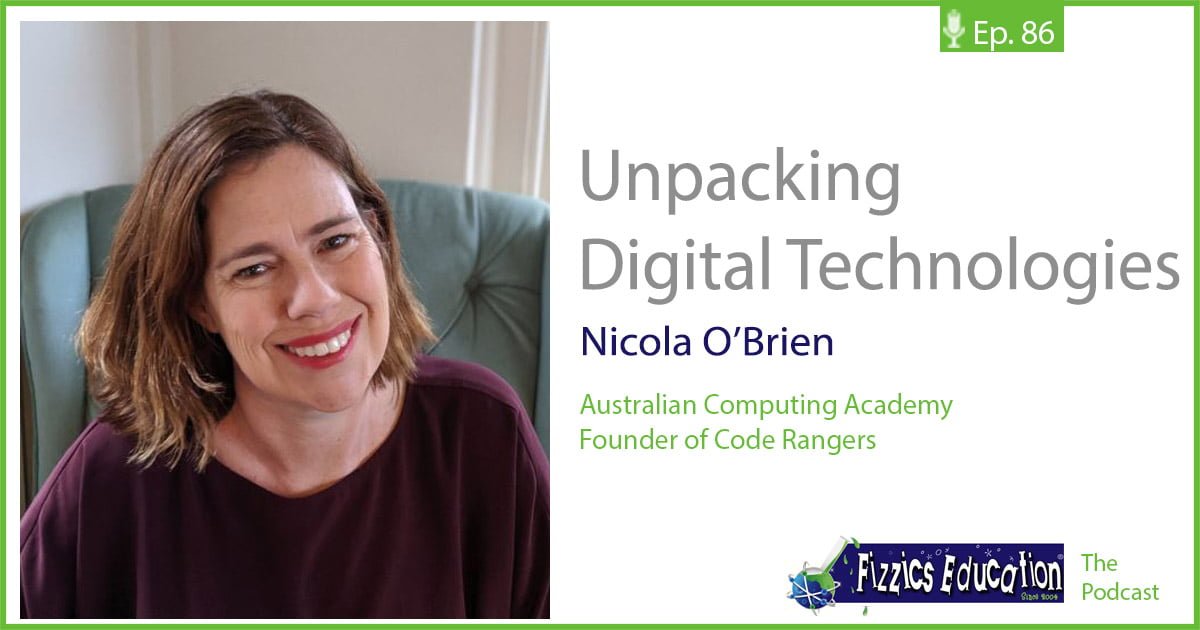
Podcast: The Australian Computing Academy with Nicola O’Brien
Meet Nicola O’Brien, a computing education specialist who works with the Australian Computing Academy that is helping teachers implement the Digital Technologies Curriculum in classrooms around the country. We chat with Nicola to find out just what ACA has been doing and the impact that they’re making!
How do we move students from being passive consumers of technology to being creative coders? In this episode, we chat with Nicola O’Brien about the essential shift in digital literacy. We explore how her work with the Australian Computing Academy and her own start-up is giving teachers the confidence to bring coding into the classroom and helping kids unleash their digital superpowers.
About Nicola O’Brien
Nicola O’Brien is a computing education specialist and the founder of Code Rangers, a start-up dedicated to teaching children to code and supporting teachers in implementing digital technologies. Currently, Nicola works at the Australian Computing Academy (ACA) at the University of Sydney, where she creates and delivers curriculum-aligned content. She is also the author of “Ready, Set, Code!”, published by CSIRO, which provides a hands-on guide for kids to master the basics of programming.
Expertise: Digital Technologies, Curriculum Design, Python and Block-based Coding, and Teacher Professional Development.
The ACA is at the forefront of the Digital Technologies curriculum in Australia. Nicola’s work involves building the resources and challenges that allow schools to meet national standards while keeping students engaged and excited.
Key Educational Resources:
Curriculum-Aligned Content: Nicola helps develop the DT Challenges used by thousands of Australian students to learn everything from basic algorithms to data representation.
Code Rangers: Her start-up focuses on the “creative” side of coding, encouraging students to bring their own unique ideas to life through software.
Ready, Set, Code!: Her CSIRO book serves as a practical entry point for young coders, focusing on problem-solving and logical thinking.
Teacher Support: A major focus of Nicola’s career is “upskilling” teachers, providing them with the pedagogy and tools needed to lead digital innovation in their own schools.
Top Episode Learnings: Unleashing Coding Superpowers
Coding as a Creative Outlet:
Nicola explains that coding is about much more than syntax; it’s a medium for expression and invention. When students realise they can build a tool or a game from scratch, their creative confidence soars.
Computational Thinking:
We dive into the core pillars of computing: Decomposition, Pattern Recognition, Abstraction, and Algorithms. These skills aren’t just for computers—they are vital for solving complex real-world problems.
Low Floor, High Ceiling:
Nicola shares her philosophy of making coding accessible. By starting with block-based languages and moving to Python, students can start simply but quickly progress to professional-grade programming.
Education Tip: The “Human Robot” Algorithm.
Follow Nicola’s lead by teaching the basics of Algorithms without a computer. Have one student act as a “robot” while another provides a set of precise instructions (the code) to make them perform a simple task like making a jam sandwich. If the code is vague, the robot “glitches”! As Nicola demonstrates, this unplugged activity helps students understand the importance of logical sequence and precision before they ever type a line of code.
[00:00:40]Ben Newsome: And with curiosity, risk-taking, and engagement in mind, the Australian Computing Academy has done a fantastic job reaching nearly a quarter of a million kids in just a few years. Listen on in as Nicola O’Brien takes us through how they’ve done it.
[00:01:10]Ben Newsome: Yes, welcome again to another Fizzics Ed Podcast. Glad to have you here and this week we are speaking with Nicola O’Brien, who’s representing, and has been doing this for quite a while, the Australian Computing Academy, which is a fantastic group which hails out of the University of Sydney and is all about getting, well, computing sciences right across Australia. Seriously, they’re doing an amazing job to this. You see, Nicola is a computing education specialist, and she’s really tasked with creating and delivering engaging, curriculum-aligned content. Why not? We probably should do that. We’re educators. And she really wants to help students bring their ideas to life and unleash their coding superpowers. And that is one thing she’s totally doing. You may just recognise her from her start-up with Code Rangers, where she was the founder that helped kids learn to code in a variety of different applications. And I’ve got to say, they’re doing a fantastic job. So, enough from me. You want to hear from Nicola. So let’s get right on into it.
[00:02:04]Announcer: This is the Fizzics Ed Podcast. We’re all about science, ed tech and more. To see 100 fun free experiments you can do with your class, go to fizzicseducation.com.au. That’s physics spelled F I Z Z I C S and click 100 free experiments.
[00:02:22]Nicola O’Brien: Well, my name’s Nicola O’Brien, and I’m part of the team at the Australian Computing Academy, which runs out of Sydney Uni. I also have a couple of other hats on, so I love getting involved in any initiatives to support girls in STEM. I also have a book that I’d love to chat about soon and do some consulting work directly into schools.
[00:02:41]Ben Newsome: And before we get into that, I must say the number of people I speak with who say they’ve got a lot of hats, I feel like we’re like a hydra with lots of heads.
[00:02:47]Nicola O’Brien: We are. Yeah, chop them off and we keep coming back.
[00:02:50]Ben Newsome: That’s right. You’re always wearing more than one thing, I swear. All right, so Nicola, you’ve been doing this stuff for a while.
[00:02:55]Nicola O’Brien: Yep.
[00:02:56]Ben Newsome: Why’d you get into this type of work?
[00:02:58]Nicola O’Brien: Oh, I think I probably fell down a big rabbit hole without thinking too much about it. But as my children started heading into the mainstream education system, I was really interested in what they were learning about computers and technology, and started to investigate before digital technologies came into the syllabus here in Australia, and was a little bit disheartened that there wasn’t too much going on. And decided to investigate and start looking at educational resources around DigiTech. Got really interested, started convincing my friends and my neighbours to drop their kids off at my place to do some coding, and out of that mushroomed a whole lot of different things.
[00:03:38]Ben Newsome: Of which one of the things, of one of the heads that you wear, the hats that you wear, either way, something about that analogy, was Code Rangers.
[00:03:45]Nicola O’Brien: It was, yes. So I think it was 2015 I started, so it’s a few years ago now, but I started up running extracurricular workshops and getting kids really interested in block-based coding, a bit of Python, a little bit of robotics, and just trying to expose them and give them a little bit of inspiration to give things a go.
[00:04:05]Ben Newsome: So when you were meeting with kids, especially block-based coding and all that sort of drag-and-drop type stuff, what sort of age groups were you dealing with there?
[00:04:12]Nicola O’Brien: About age eight and up. So I like them, I love working with kids that are super curious, haven’t yet had any kind of preconceived ideas or feedback from people that it’s not for them, and want to give things a go, but have that cognitive ability to be able to think a little bit abstractly and understand what’s actually happening rather than just copying something.
[00:04:34]Ben Newsome: So what platform were you using to do that?
[00:04:36]Nicola O’Brien: I mostly use Scratch. And then I used Scratch a lot, and I’ve come back around and I love it. But I had a period where I just needed a break from Scratch. So I’ve explored lots of things. So I’ve done MakeCode, I’ve used Australian Computing Academy resources, Sphero robots, a whole bunch of things.
[00:04:59]Ben Newsome: Eventually, it’s just how to make the ones and zeros talk nicely.
[00:05:03]Nicola O’Brien: It is, it is. And I think it’s not a bad thing for kids to pick up some higher-level skills and apply them in lots of different frameworks.
[00:05:09]Ben Newsome: Well, funnily enough, and just to preface this, Nicola and I are here at a conference up at Abbotsleigh school in Sydney, and Inspiring Greatness, I believe it’s called. That’s the name, but more importantly, we were playing around with this device with the Micro:bit and a bottle of water and had to hold it in front of us. That was a bit of fun trying to get that thing to work.
[00:05:31]Nicola O’Brien: That was fun and that was a really nice activity to do together. Thank you for your help. Yeah, I really like the way things come together. So Micro:bits and Scratch talk to each other these days, which opens up a whole way of exploring the world around you, gathering some data and representing it on screen beautifully.
[00:05:48]Ben Newsome: Actually, I want to go down that rabbit hole. One of the things I do find is a lot of software is great, but doesn’t talk nice with anything else. And gee, that makes it difficult when you’re… especially as educators, we only have so much budget to spend on certain bits of software. And let’s just be honest, you just want things to talk. I mean, sometimes I feel like if any developers are listening in, please make your API talk nicely to others.
[00:06:12]Nicola O’Brien: Yes. That’s one of the problems. But I’ve spent lots and lots of time researching mostly free things that mostly work in the browser. That is where I’ve come to land. And pretty much anything I want to teach now I’ve found something that will help me with those kind of resources.
[00:06:29]Ben Newsome: Now, right, so we’re playing with Scratch and you’re doing a lot of stuff with the Australian Computing Academy these days.
[00:06:35]Nicola O’Brien: I am. Yes, I’m in there most days.
[00:06:37]Ben Newsome: And I must ask, what is their main role?
[00:06:39]Nicola O’Brien: So the Australian Computing Academy got set up a few years ago, funded by the Federal Government to help with the rollout of digital technologies teaching in schools. So we kind of have a two-step process. We have online courses for kids, which are perfect for primary school and secondary teachers that have been told to teach coding. Full stop. Without much support. So our courses let you teach coding easily by popping your kids into an online course. It’s curriculum aligned, it’s self-marking, it gives the students feedback on the spot. And the teacher, depending on how involved they want to be, can just monitor from a dashboard and see which problem each student in the class is up to, where they’re stuck, where they might need support.
[00:07:23]Nicola O’Brien: So, you know, our main issue talking to teachers is confidence. And I’m talking probably more primary focused here, general teachers who have been told to teach computing with not much support. So the courses really help get up and running. And then we offer face-to-face PD for the teachers. So over time, we would hope probably that they rely less on our online courses and start to develop their own teaching resources.
[00:07:47]Ben Newsome: So it’s not buy-in in any way from any of the schools. It’s more literally just how to get the thing started up.
[00:07:53]Nicola O’Brien: Yeah, that’s right, exactly. So we just were funded to get something running that every school in Australia could access and meet.
[00:08:00]Ben Newsome: Wow. How many schools is this—are you working with so far?
[00:08:03]Nicola O’Brien: We work on how many students we’ve got enrolled, and we are, I believe, around 240,000 students enrolled in courses across the country.
[00:08:13]Ben Newsome: That’s awesome. When did that start up, by the way? Because that’s a lot of kids.
[00:08:16]Nicola O’Brien: That’s been since the beginning of 2018. We’ve signed up that many kids.
[00:08:21]Ben Newsome: Mm. And you’ve got a few more thousand, hundred thousand to go.
[00:08:24]Nicola O’Brien: We’ve got many more to go, which is great. We never run out of teachers to talk to this stuff about.
[00:08:30]Ben Newsome: Now, stop me if I’m asking one of those questions that isn’t really fair, but I kind of wonder. You’ve got such a good program rolling out there. Is it just for Australian students, or if someone from Indonesia or someone from Canada went, “Oh, I really want to get involved.” Is it something that they could sign themselves up to?
[00:08:45]Nicola O’Brien: It’s a bit of a technical question. So the way our funding works, when you sign up students, you say what year group they’re in and what sort of school they’re at. And so it will open the door to them if they meet the criteria of being Australian students, Years 3 to 8. But overseas kids can sign up through our sister entity, Grok Learning, and get a subscription.
[00:09:12]Ben Newsome: Ah, I’m one of the people that spells it wrong.
[00:09:15]Nicola O’Brien: groklearning.com. And then they can buy a product. I think it’s for primary school $5 per student per year for a licence.
[00:09:24]Ben Newsome: And it’s got effectively the same backbone to be able to learn from anyway.
[00:09:27]Nicola O’Brien: Exactly, same courses. It’s just behind a paywall if you’re overseas.
[00:09:30]Ben Newsome: Oh, that’s cool. I mean, that’s still very equitable.
[00:09:34]Nicola O’Brien: It is, it is. And high school, is it more, it’s $30.
[00:09:37]Ben Newsome: Yeah, the reason why I ask that is that we know that people are listening all over the world, which is wild to see that this happens by the way. It’s the coolest thing to find out we’ve got people in Africa and Southeast Asia and everywhere. It’s nuts, which is cool. Hi everyone in Africa and Southeast Asia and everywhere else. Yeah, so anyway, so we’ll get back on track with this. So the, you’re doing lots of stuff, you’ve got 240,000 kids involved, and they’re predominantly you said what, Year 3 to 8?
[00:09:59]Nicola O’Brien: Years 3 to 8 are the ones that we track. Yes.
[00:10:01]Ben Newsome: Would it be mainly primary sort of middle school type age group type thing?
[00:10:05]Nicola O’Brien: There’s a really big chunk around Years 7 and 8.
[00:10:09]Nicola O’Brien: Yeah, a lot of 7, 8 students. And then quite a few 5, 6, and we’d love to have more 3, 4s in there.
[00:10:15]Ben Newsome: Oh yeah. I mean, obviously start early, they’re going to have more of a chance later on.
[00:10:19]Nicola O’Brien: Exactly, exactly.
[00:10:21]Ben Newsome: And I imagine something like this would really help with the ICT component… oh, no?
[00:10:29]Nicola O’Brien: So one of the resources we have is a poster to separate, is it DT or is it ICT? And so these courses teach DT, digital technologies. So they’re teaching coding. In terms of ICT general capability, which sits across all subjects, we see that as something every subject and every teacher should be embedding and doing as part of their teaching. So the English teacher is teaching word processing skills as they teach English.
[00:10:56]Ben Newsome: Actually, that’s interesting. I was having a chat with a teacher at one of the breaks of this conference. She was a high school English teacher and said, “Oh, no, no, this is science. I can’t do that.” I went, “No, no, it’s cool. Like you could be writing about their science experiments or they could be doing—creating a podcast, funnily enough like this, doing an oral communication around the thing that you know.” And suddenly they went, “Oh, yeah, I totally could be doing that.” I went, “Yeah, you can.” And I suppose that’s exactly the whole point with the ICT, right?
[00:11:19]Nicola O’Brien: It is, it is. And particularly in primary schools, there’s some really nice integration starting to happen with ICT and digital technologies. So teachers looking at ways that they can incorporate all sorts of other capabilities inside a DT project.
[00:11:32]Ben Newsome: And actually, that’s what I’ve got a question with around DT projects. I mean, undoubtedly you’ve come across so many teachers, especially in these PD sessions that you’re running. What are some of the cooler projects that you’ve seen come out of these conversations? Because I’m sure there’d be some schools just doing some wild stuff, like not just the basics, they’re doing some interesting things.
[00:11:49]Nicola O’Brien: That’s a great question. So some of the things we’re seeing, one of the things we really enjoy using are the Micro:bits. We like them because they’re programmable, they’re small, they’re cheap, and they can gather data.
[00:12:02]Ben Newsome: I was just thinking about this. I was listening to a podcast recently on Freakonomics, and they said that what a lot of universities would really like kids to actually understand is how to handle and manipulate data, and lots of it. Because, I mean, yeah, we can do algorithms till the cows come home, but the reality is that your day-to-day life in any industry is eventually data in some way, shape, or form. And being able to handle those datasets and being able to move them around is a real core capability which is useful for students.
[00:12:35]Nicola O’Brien: It is, and it’s not being taught particularly well at the moment. It’s in the curriculum. We have one course that gets students to explore datasets using Python and start to delve into that. That will be going live soon. But it’s a massive opportunity and that’s one of the areas of digital technologies that’s spreading out across every industry and every part of the workforce. So it’s a nice way to engage kids.
[00:12:56]Ben Newsome: Yeah, I was speaking with Dr Linda McIver recently on this podcast a while ago, who is one of the superstars of STEM, and she is big on data, massively. And she just says, look, it should be everywhere. If you speak English, you learn to read and write it. Well, funnily enough, when you deal with numbers, you should be able to move them around.
[00:13:20]Nicola O’Brien: Absolutely. Couldn’t agree more.
[00:13:22]Ben Newsome: No, it makes sense. And it fits. When you look at what you’re doing with Micro:bits and whatnot, that’s exactly what you’re doing is applying the use of numbers.
[00:13:27]Nicola O’Brien: It is, and it’s just starting to get students to unpack the world around them and look at it in a different way and start to think computationally about what they see every day. Which is a nice way to introduce it because there are things they are already doing that just a little bit of a tweak and a dust-up and suddenly they’re thinking computationally.
[00:13:43]Ben Newsome: So, say we had a group of brand new pre-service teachers and they wanted to know just simply, how do I teach computational thinking? Like here’s a broad question for you. How do I teach it? What are the first steps that you suggest for kids to… like what would they do with their classroom?
[00:14:02]Nicola O’Brien: Okay. I’d turn off all the devices in the room. I’d get them to think about an activity that would be familiar to everybody. So one example that works quite nicely is planning a school excursion, and pull it apart from a computational point of view. So you would look at breaking it into chunks and solving the problem by solving each component of the problem. You’d look at applying patterns. So if you’re looking to book 50 kids on a bus, “Oh, we’ve taken 50 kids on a train before, what are the similarities? What skills do we know we can apply to putting them on a bus?” You can look at abstraction. So when we write the list for the day’s activities, how much detail do we put in there? Do we need every minute step? Do we need to describe how the children move from the school to the bus, or can we say, “Teachers get the students to the bus stop?” Things like that. And all the strands of computational thinking, you can apply them to a familiar problem and see how those skills then, as you build up, you will have a planned school excursion or, for younger kids, baking a cake, whatever you choose. You can see how those skills go into problem-solving in a completely analogue way, and that will get the ideas going.
[00:15:11]Ben Newsome: I remember watching someone—sorry, I just realised I interrupted you, but I just realised I remember someone showing computational thinking on making a jam sandwich.
[00:15:20]Nicola O’Brien: Yeah, I’ve seen that.
[00:15:22]Ben Newsome: And it’s so well done because, I mean, you think the steps, there aren’t many steps, but it turns out there are. And especially if you mess up the order very, very quickly and very easily, to great amusement.
[00:15:31]Nicola O’Brien: Absolutely. That’s another great one, and there are so many videos online showing that. I saw a great one the other day actually. Any activity like that, you can break it into pieces, you can talk about abstraction, you can talk about how much detail you need. You can even talk about why programming languages look the way they look, because you need specificity, you need no ambiguity, you need the same person and then another person to follow them in exactly the same way. And English is not a programming language because we have too much vagary in the way that we speak. And then you can even talk about… a hilarious thing to do is to get people to write instructions to build a Lego figure with words instead of diagrams.
[00:16:07]Ben Newsome: Oh, that would be harder than it sounds.
[00:16:09]Nicola O’Brien: Oh, it’s awful. And so then you can talk about finding the right programming language for the job, because a diagram would be so much easier. So you talk about fit. So there are lots of really great things pre-service teachers can do and try, which will get them thinking.
[00:16:24]Ben Newsome: Now one of these things, I’m going to segue this not so disjointedly, is that to help them, you’ve written a book with Heather Catchpole.
[00:16:32]Nicola O’Brien: I have written a book with Heather. Hi Heather.
[00:16:34]Ben Newsome: Hi Heather. Now, Heather, by the way, is a good friend of mine from Refraction Media. Hi Heather if you’re listening. And Heather and Nicola have been doing a bit of stuff on this and it’s just about to come out. Tell us about it.
[00:16:42]Nicola O’Brien: Excellent. So we both have a love of tech and we both love the world around us and we’re both very curious. So we had this idea that she has background as a science writer, so she would write a chapter that kids would understand about data or about artificial intelligence, chatbots, things like this, and how they’re impacting kids’ lives. And I’d create a coding activity off the back of it. So that the children can learn about a relevant concept and then have a go at making something that would mimic it. So we have 10 chapters, 10 beautiful activities using Scratch, Micro:bits, and another piece of software to make apps. And the kids will just have a chance to really start to see their world a little bit differently and get hands-on and make stuff as well.
[00:17:25]Ben Newsome: Fantastic. So when’s that coming out?
[00:17:28]Nicola O’Brien: I think it’s coming out in February 2020.
[00:17:31]Ben Newsome: February 2020. Yes. Got it. So if it’s already out, if you’re listening to this after the fact, what title have they got to look for?
[00:17:36]Nicola O’Brien: It is called Ready, Set, Code!
[00:17:38]Ben Newsome: Ha. Good name. Who came up with that?
[00:17:41]Nicola O’Brien: Oh, we had a lot of brainstorming on that one.
[00:17:43]Ben Newsome: I was speaking with Michael Kasumovic, who’s the founder of Arludo, and they said that the best team chats are the names of their programs. His current favourite was Blue Steel, which was something around evolution and things, which is just fun. Anyway, yeah, that’s cool. So Ready, Set, Code! coming out, published by CSIRO. So they have pre-orders on their website right now, and there will be a website readysetcodebook.com, where we will maybe extend some of the projects, have some extra resources.
[00:18:15]Ben Newsome: Fantastic. And in the meantime, if there’ll be people listening in who would love to get in touch and find out what Australian Computing Academy is doing and what you’re doing and all the rest, how they—how would they get in touch? How would they do that?
[00:18:27]Nicola O’Brien: Okay. So if you’re interested in the Australian Computing Academy, drop me an email, [email protected]. Come and chat to me on Twitter. I’m @NicolaO_B. O_B_R_I_E_N… on Twitter. Those are the two best places to find me.
[00:18:48]Ben Newsome: Easy. You can find me on LinkedIn if you like.
[00:18:50]Nicola O’Brien: Absolutely.
[00:18:51]Ben Newsome: And as normal, we’ll put that in the show notes. And please, click and find out more about it. Hey, thanks very much for jumping on the chat.
[00:18:57]Nicola O’Brien: It’s my pleasure, thank you. It’s a great chance to catch up.
[00:19:00]Ben Newsome: No worries. We’re going to head down to the conference, go get myself some cake.
[00:19:02]Nicola O’Brien: Yes. Brownies.
[00:19:03]Ben Newsome: Or maybe some fruit because we should be sugar conscious.
[00:19:05]Nicola O’Brien: No, cake.
[00:19:06]Ben Newsome: Cake. All right, at that we’ll leave you be. Have a great day.
[00:19:26]Ben Newsome: Well, there we go. We just heard from Nicola O’Brien, who you can truly tell is a passionate educator and having a bit of fun with it at the same time. So are you interested? Do you want to hear about more of what the Australian Computing Academy has been doing? So jump on their website to find out. If you didn’t get it before, it’s aca.edu.au. Again, aca.edu.au, and they will help you out. And if you’re overseas, why don’t you find out some of the short courses that you can get involved in? It may cost a little bit of cash, but it’s not exorbitant and it will help you out. And if you’re in Australia, hey, jump right on in. Anyway, so I hope you enjoyed this. We’ve got more episodes coming on up. And I hope you’re having a fantastic afternoon, morning, week, wherever you might be, and I’ll catch you another time.
[00:20:41]Announcer: This podcast is part of the Australian Educators Online Network. AEON.net.au.
Frequently Asked Questions
What is the main role of the Australian Computing Academy (ACA)? The ACA was established with Federal Government funding to support the national rollout of the Digital Technologies curriculum. They provide curriculum-aligned online courses for students from Years 3 to 12 and professional development for teachers to help them integrate coding and computational thinking into their classrooms.
How many students are currently engaging with ACA resources? Since the start of 2018, the ACA has enrolled approximately 240,000 students in their courses across Australia. While there is significant engagement in Years 7 and 8, the academy is actively working to increase participation among younger primary students in Years 3 to 6.
What is the difference between Digital Technologies (DT) and ICT? Nicola explains that Digital Technologies (DT) focuses on the “how” of technology, specifically coding, data representation, and algorithms. Information and Communication Technology (ICT) is a general capability that should be embedded across all subjects, such as an English student using word processing skills or creating a podcast.
Why does Nicola suggest starting coding education with “unplugged” activities? Unplugged activities—teaching without devices—help students focus on the logic of computational thinking without the distraction of a screen. By breaking down familiar tasks like planning a school excursion or making a jam sandwich into precise instructions, students learn the importance of decomposition, abstraction, and algorithms.
Why is data manipulation considered a critical skill for the future workforce? Nicola notes that almost every industry today relies on data. Being able to handle, manipulate, and interpret large datasets is a core capability that universities and employers value. The ACA offers courses in Python specifically designed to help students explore and move numbers effectively.
Discussion points summarised from the The Australian Computing Academy with Nicola O’Brien with AI assistance, verified and edited by Ben Newsome CF
Extra thought ideas to consider
The Logic of the “Human Robot” The “Jam Sandwich” algorithm mentioned in the episode is a classic way to demonstrate that computers are only as smart as the instructions they are given. This activity highlights the need for specificity and the removal of ambiguity, showing students that “code” is simply a very precise way of communicating a logical sequence.
Bridging the Gap Between Consumption and Creation
Nicola’s work with Code Rangers and the ACA aims to move students from being passive users of technology to creative inventors. When students understand the underlying algorithms of the apps and games they use, they gain the agency to build their own tools, shifting their perspective from consumer to creator.
Integrating Digital Technologies Across the Curriculum
While DT is a specific subject, the computational thinking skills it fosters are applicable in every discipline. Educators should consider how the decomposition of a science experiment or the pattern recognition in a history project can serve as a bridge to formal coding, making technology education feel less isolated and more relevant to all learners.
Recognised by
22 years, award-winning work, 1 purpose
Recognition from business, education and industry bodies across Australia.
Australian Small Business Champion
Multiple years
CILC Pinnacle Award and Hall of Fame inductee
Center for Interactive Learning and Collaboration
Western Sydney Awards for Business Excellence
Winner
Top 100 Coolest Company
Listed
Local Business Awards
Winner
We value your privacy
We use cookies to improve your experience. Essential cookies are always active. You can choose which optional cookies to allow.We use cookies. Optional ones stay off unless you allow them.Privacy policy