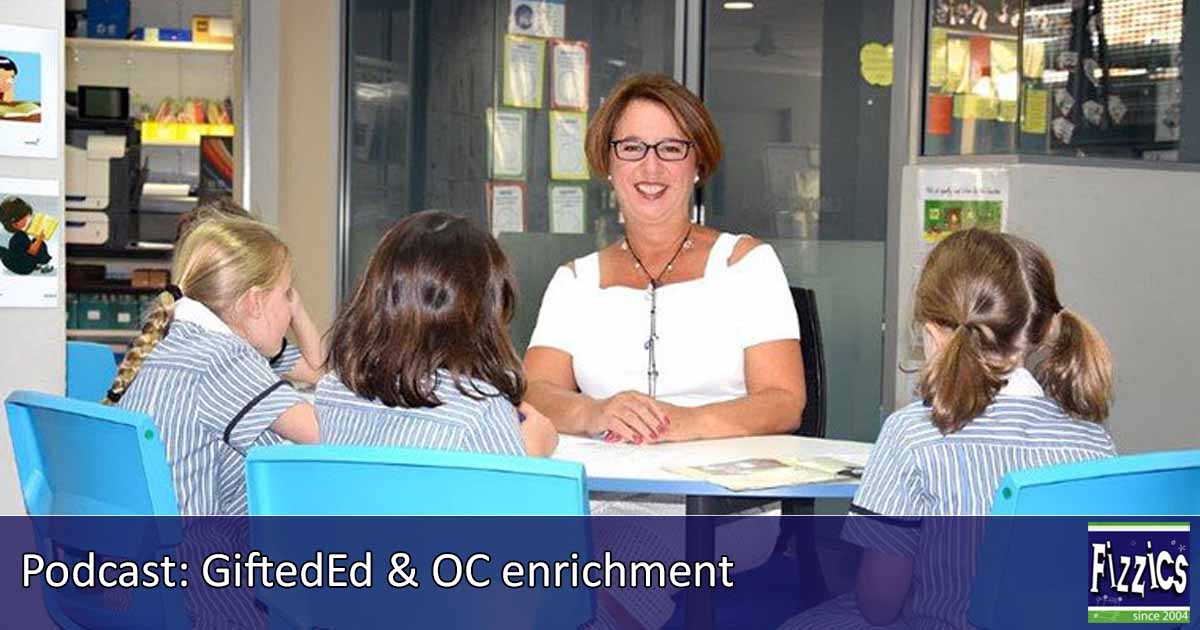
Podcast: Gifted Ed and OC enrichment with Desilee Tait & Dr Haydn Allbutt
Providing science enrichment classes for students makes a huge difference for students, not only for the understanding of science but also in their appreciation of how science fits in their world. For the past 7 years, Desille Tait and Dr Hayden Allbutt have worked with the students of Loreto Kirribilli to provide extension classes for students with great success. We chat with them to find out what they’ve been up to!
How do we push the boundaries of science for high-potential students? In this episode, we explore the seven-year collaboration between Desilee Tait CF and Dr Haydn Allbutt. We discuss how mentorship programmes and authentic scientific research—including heart dissections and physics experiments—are being used to create enrichment programmes that challenge gifted learners to move beyond textbooks and engage with the “messy” reality of science.
About Desilee Tait CF
Desilee Tait is the Gifted and Talented Coordinator (K-12) at Loreto Kirribilli in Sydney. A passionate advocate for high-potential learners, Desilee was awarded a Churchill Fellowship in 2016 to investigate best practices for gifted education in Singapore and the United States. She focuses on identifying gifted underachievers and implementing a mentor-based approach to STEM enrichment.
About Dr Haydn Allbutt
Dr Haydn Allbutt is a Senior Lecturer in Physiology at the University of Sydney’s Bosch Institute. Beyond his university teaching and research in medical science, Haydn has spent nearly a decade volunteering as a mentor for primary science enrichment. He specialises in bringing high-level physiological concepts and hands-on dissections to young students through the STEM Professionals in Schools programme.
Science Enrichment: The Mentor Programme at Loreto Kirribilli
The collaboration between Loreto Kirribilli and the University of Sydney highlights the immense value of the “Scientists in Schools” model. By bringing researchers into primary classrooms, the school transforms science from a subject of memorisation into one of active enquiry and professional practice.
Key Pillars of the Programme:
Authentic Mentor Relationships: Using volunteers from organisations like the CSIRO and local universities to provide students with role models in STEM.
High-Level Language: Introducing senior secondary and university-level terminology (such as “semilunar valves” or “leukocytes”) to primary students to build long-term conceptual foundations.
Hands-on Physiology: Using organ dissections as a hook to engage students in the cardiovascular and respiratory systems, encouraging them to ask “how” and “why” rather than just “what.”
Iterative Learning: Recognising that failed experiments (like solar mirrors on a cloudy day) are valuable teaching moments for discussing experimental design and variables.
Top Episode Learnings: Engaging High-Potential Learners
The Underachievement Factor:
Identification of giftedness must go beyond standardised testing. Gifted underachievers—particularly girls—often fly under the radar to fit in socially, requiring teachers to look for quirky humour or high-level questions as indicators of talent.
The Power of Teacher Coaching:
Drawing from her Churchill Fellowship, Desilee emphasises that teacher coaching is more effective than traditional professional development. One-on-one mentoring helps teachers differentiate their curriculum for gifted students more effectively.
Socio-Affective Support:
Enrichment isn’t just about academic acceleration; it’s about supporting the needs of the student. This includes helping perfectionist students learn the collaborative skills necessary for university and career success.
Education Tip: Look Beyond the Classroom for Mentors.
You don’t need a formal programme to start enriching your science curriculum. As Desilee and Haydn suggest, reach out to local university faculties or use the STEM Professionals in Schools (CSIRO) network. Many researchers are required to perform community engagement and are eager to share their passion with enthusiastic students.
[00:00:18]Ben Newsome: Yes, welcome again to another Fizzics Ed Podcast. I hope you’re having a fantastic day and yet again we’re diving into science education and this time we’re looking at gifted education and enrichment classes, really creating clubs at lunchtime or after school and linking in with scientific researchers who actually do the work for real, which is so important for students to get. And I tell you what, Desilee Tait has been doing this spectacularly well. She’s currently working at Loreto Kirribilli in Sydney as a gifted and talented coordinator for K to 12 and she has a true passion for gifted education and trust me, they do a buckload of stuff.
[00:00:52]Ben Newsome: Now one of the things she’s been doing is for the last seven years been working with Dr Haydn Allbutt, who is a lecturer in physiology at the School of Medical Sciences at the Bosch Institute of the University of Sydney, and together they’ve been running these enrichment classes for their primary kids. And I can tell you this, they have been having a ball and so are the students. So this is what it’s all about. We’re looking at what worked for them, what hasn’t worked for them, all that sort of stuff and we get to hear about what they’ve been doing at Loreto Kirribilli. So look, I hope you have a fantastic time listening to this and let’s get right on into it.
[00:01:26]Announcer: This is the Fizzics Ed Podcast. We’re all about science, ed tech and more. To see 100 fun free experiments you can do with your class, go to fizzicseducation.com.au. That’s physics spelled F I Z Z I C S and click 100 free experiments.
[00:01:44]Ben Newsome: Desilee, Haydn, welcome to the Fizzics Ed podcast.
[00:01:47]Desilee Tait CF: Thanks, Ben.
[00:01:48]Dr Haydn Allbutt: Thank you, Ben.
[00:01:49]Ben Newsome: Especially on a wet, cold, miserable start of winter day.
[00:01:52]Desilee Tait CF: It is, it is. The day before my birthday today.
[00:01:55]Desilee Tait CF: Yes, today, but that’s okay. It can rain today.
[00:01:58]Ben Newsome: Winter warming dinner tomorrow night I hope.
[00:02:00]Desilee Tait CF: Yes, absolutely.
[00:02:02]Ben Newsome: Dear oh dear. So where are we? We’re at Loreto Kirribilli. So tell us, you’ve been doing a lot of gifted science stuff and STEM stuff for a while now. Thanks very much for having me along for a chat with you guys. Tell me, what’s been going on here? What have you been up to?
[00:02:19]Desilee Tait CF: Well, maybe if I tell you a bit about the programme that we’ve got running here. So we have a gifted programme here from K to 12 and sort of the basis of our programme is a mentor programme. So we have a lot of mentors at our school who work with students from Kindergarten through to Year 12. They’re all volunteers and they’re all fabulous people and Haydn, Dr Allbutt here is our longest standing member of the mentor programme. He’s been with us for seven years, I think.
[00:02:47]Dr Haydn Allbutt: Something like that.
[00:02:48]Desilee Tait CF: He’s been mentoring in the programme. So what Haydn and I do is we particularly work with a group of gifted and talented science students who come from Year 4, 5 and 6.
[00:02:58]Ben Newsome: Fantastic. And just quickly Haydn, how did you get involved in this? How did you get roped in?
[00:03:02]Dr Haydn Allbutt: For me it was part of this CSIRO Scientists in Schools programme. So it didn’t have any fancy name I don’t think even back then, it was just Scientists in Schools and there was a sister programme, Mathematicians in Schools. And so I was one of the Scientists in Schools and the CSIRO’s educational team pairs scientists or STEM professionals, I think they call them these days, with schools who wanted to come up with a sort of set of activities that they do with their kids.
[00:03:38]Dr Haydn Allbutt: And whatever the background of their kids is, I think sometimes if I understand the programme correctly out at other schools, it’s students who don’t have as many resources so you’re sort of supporting students, maybe you’re their main exposure to science because they haven’t sort of really seen it much in other ways as opposed to the other end of the spectrum, which is what we tend to do with the gifted students where we’re trying to challenge them even further.
[00:04:06]Dr Haydn Allbutt: So they often have, we’re often surprised in our class just how much the students understand and the words that they remember and the people. I had a picture up on the board of Joseph Priestley, the guy who invented oxygen, and I forget what we were doing at the time, I think we were doing some chemistry activity and the students wanted to do something with the periodic table. And so I had a picture of him up there because he’d identified, I think he’s got the record of identifying I think six elements. And so I had a picture of him and someone said, “Is that Joseph Priestley?” Just out of the blue, this little Grade 4 or 5 girl.
[00:04:41]Desilee Tait CF: How does that happen?
[00:04:42]Dr Haydn Allbutt: How does that happen? On sight, she just recognises Joseph Priestley from the 1700s or early 1800s, whenever he was.
[00:04:51]Ben Newsome: I’ve always found with kids that it’s not so much their age, it’s what they’re into, in a lot of ways. I remember actually running a programme, I think it was for Year 3, doing a simple human body programme. And these kids in front of me were just talking about their red blood cells, their white blood cells and they do stuff in our body. And a child just looked at me and said, “They’re called erythrocytes, they’re called leukocytes and there are various versions of these T-cells etc.” I went, “Yes, that’s right. So you’re going to spend some time with me in Year 11 Biology while the rest of the Year 3 class is doing the other part.”
[00:05:23]Desilee Tait CF: That’s so true. And look, we’re really lucky, Haydn and I, because we actually have just the top students. So most of the time the kids are on board and they’re following what Haydn’s talking about. It’s great. It’s not like a normal classroom. But the same way, mentors are a great value in the normal classroom as well because basically all of us as teachers have got to be differentiating and catering for these students all day long in our science classrooms and our maths classrooms and engineering classrooms. So mentors can help you in the classroom as well.
[00:05:53]Ben Newsome: Absolutely. And I do know that the CSIRO, the Commonwealth Scientific and Industrial Research Organisation, does have a fantastic education outreach team. I used to be involved in that. And the Scientists in Schools, if you are listening, just seriously go type in CSIRO Scientists in Schools, you’ll find it, and you’ll find a way you can get involved if you are of the scientist or engineering type. Or if you’re in the education field, go find that because you can get to find people to partner up and do stuff. And now you’re several years on, Loreto Kirribilli’s been doing this for a buckload of time.
[00:06:21]Desilee Tait CF: We have been. So we’ve been involved with the CSIRO programme. I think it’s now called STEM Professionals if anybody’s looking for it. So we’re very much involved with the STEM Professionals programme and we would have maybe seven or eight mentors coming from the programme, Haydn being our number one, but seven or eight other males and females who are involved in the programme. But we don’t just use mentors from the CSIRO. So if anybody is out there listening, that’s not the only place to get your mentors from.
[00:06:50]Desilee Tait CF: Universities are so happy to offer their time. There are many people out there in the community who want to volunteer. So part of our, we’ve got a student who’s doing very well in geoscience, and so we have the Head Dean of Geoscience from Sydney University who comes out and mentors one of our Year 12 girls once every two weeks. So there are very keen people out there who want to help you with your kids.
[00:07:15]Dr Haydn Allbutt: One of the things we’re expected to do at university is engage with the community, so community engagement is one of the ways in which we’re judged. And so I think there’s many people who genuinely enjoy doing that part of the work. It’s not all about sitting in lectures or, even worse, sitting in committee meetings. It’s about getting out and seeing the enthusiasm or generating the enthusiasm by showing people just what these things that the students experience.
[00:07:46]Dr Haydn Allbutt: The students sit in their classes all day, every day, and they think, “What is this for? What are we learning this maths for? What do you do with this maths? Or what do you do with this biology?” So to hear from people who actually use it as part of their career or their profession, I think makes it real, it makes it interesting.
[00:08:03]Ben Newsome: Absolutely. And I mean, obviously, you can lend your own expertise to a particular area, but then obviously as a science professional, you can deal with a lot of different questions with kids because they’re going to have a lot. I mean, when we walked in the room, you were pulling together some greenhouses by the look of it.
[00:08:20]Dr Haydn Allbutt: Yeah, well we actually find we run out of time almost every single lesson because the students are just racked with questions about what they’ve heard and what they’ve learned or things that they remember because they’ve read about it. I’m fairly sure our group of students are particularly interested in science and we try to do different areas of science or do activities with different fields of science so that they just get a taste, a brief taste of lots of different types of science.
[00:08:46]Dr Haydn Allbutt: A couple of years they wanted to do some chemistry, so we did some chemistry. This year we’re doing some physics and we haven’t done as much of that before. I’m a biologist by trade, so most years we’ll do a fair bit of biology in what we do.
[00:09:02]Ben Newsome: I feel like this is a bit of an almost unfair question in some ways, but for the last few years you’ve been doing lots and lots of programmes, and this is the same for you Desilee as well. Can you think back to a lesson across all these lessons that’s simply sung? It’s simply just worked so incredibly well, more than you expected? I mean we’ve got lots of these ones, let’s be honest, but every now and then you come up with a lesson and go, “You know what? That was such a simple thing and the kids just wouldn’t let it go.” What sort of ones have you seen that you’ve gone, “You know what? That really worked”?
[00:09:29]Desilee Tait CF: Oh, I’ll tell you what that dissection.
[00:09:31]Dr Haydn Allbutt: Yeah, the dissection.
[00:09:32]Desilee Tait CF: Without fail, dissection is the most popular thing that they want to do.
[00:09:38]Ben Newsome: So what do they dissect? Because there’s a few different things they could cut up.
[00:09:42]Dr Haydn Allbutt: Yeah, I do first year all the way through to third year biology at university level, and so we dissect various parts. I lecture in physiology, so we do the whole body over the course of our second year and third year units, but then first year units also do a general sort of biology.
[00:10:04]Dr Haydn Allbutt: So I try to give these students, the primary school students, some organ systems that sort of just take them generally through the whole body. So we’ll do the cardiovascular system, so we’ll bring the heart in and that week we’ll dissect the heart and the students enjoy finding the structures of the heart. Some people will have fed hearts to their cats and will have never even stopped to look at what are all these stringy things on the inside?
[00:10:28]Dr Haydn Allbutt: And to put names to things, to the chordae tendineae and the papillary muscles and the different valves and the semilunar valves as the aorta comes out. Just behind two of the semilunar valves is the opening of the coronary arteries, and so for them to be able to get their probes and stick things into all of these little holes and bits and pieces. And you get them using the names, I find actually that’s the most interesting thing.
[00:10:59]Dr Haydn Allbutt: It sounds really professional and really knowledgeable when you use the proper names for things, but they’re just names, they’re just a language. Atrium is a room. So I find getting the kids just to use the names and the words and things like that, so they use the terms.
[00:11:14]Desilee Tait CF: But it’s fabulous because Haydn uses these terms and uses these words, and sometimes they’re not familiar to me either! But he says to the students all the time, “I’m saying these things to you and I’m talking at a higher level to you because later on, I hope when you’re sitting in that classroom in biology classroom in Year 10 or Year 11, you’ll go, ‘Oh, that’s what Dr Allbutt was talking about three or four years ago.’ You will actually retrieve some of those memories.” So with the dissections, Haydn’s often talking in high-level language but… and sometimes I see some of the little kids, the Year 4s probably looking slightly perplexed, the Year 5s are okay and the Year 6s are fairly much on board most of the time. But it’s okay that they’re exposed to this. These are the gifted students, so this is what they need to be exposed to.
[00:12:00]Ben Newsome: Well, this is the thing, Desilee. Like, this is your major role here at Loreto with gifted education. I mean, there’s the wins and the losses and the challenges, which means that I often saw when we go into a lot of different schools, people have different ways of dealing with the gifted students in certain ways. How do you go about even just identifying a child who needs additional support?
[00:12:23]Desilee Tait CF: Okay. So there’s a variety of ways. We start with, we’ve got a whole lot of tests that we administer to students. Anybody out there in the education field will be familiar with the Raven’s Coloured Matrices, we use those in Kindergarten. We use the MYAT, the Middle Years Ability Test for our Year 5s to 8s.
[00:12:43]Desilee Tait CF: We do Allwell testing in Year 7, and that’s across the whole cohort. And we also use another test called Slosson, which is a one-on-one test, and I find it’s got a great correlation between that result and an IQ result. So as a teacher, we cannot administer an IQ test, we can’t get an IQ, but I find students that do the Slosson and then sometimes go off and have a psychometric test done on them, there’s a lot of correlation between the two tests.
[00:13:10]Desilee Tait CF: So we’ve got all of those objective ways, and then the subjective ways, we’ve got always principal nominations. So the bottom line comes down to our principal can nominate a child to be in the programme because teachers will often say for the gifted student, I mean a lot of gifted kids don’t perform on tests, that’s the bottom line. But you know they’ve got that quirky style, they’re the ones that ask the questions all the time.
[00:13:35]Desilee Tait CF: And teachers will sometimes come to me and say, “Look, this child’s not performing in class. They’re actually a little disengaged, but they’re really funny. They’re really funny and they ask me really hard questions I can’t answer some of them.” So then I look at that kind of child, and you know, between the teacher and the principal and myself, they can enter the programme as well.
[00:13:55]Desilee Tait CF: Our programme from Kindergarten through to Year 6, they enter the programme and they stay in the programme the whole way through, and there’s testing the whole way through. In the high school from 7 to 12, it’s a little bit broader. There’s a whole lot of other areas they can go into. Obviously, the truly gifted mathematician goes into four-unit maths and is extended that way.
[00:14:16]Ben Newsome: And some of those students eventually end up in your class, Haydn.
[00:14:18]Dr Haydn Allbutt: Yes. It’s actually changed a little bit this year, but until this year, I’ve been looking after the advanced cohort of one of our units of study. So I end up getting them once they reach us in second year in the advanced students then. And you know, I find the same thing. What you were saying about some students although they don’t test well, you could still reasonably consider them gifted or they have an approach to it which is quite different from other students.
[00:14:47]Dr Haydn Allbutt: We find in honours, in our honours year, which is our fourth year after they’ve done their three years of their undergraduate, some students just don’t sit exams well. They don’t remember a whole bunch of stuff well. But when you get to honours, all you’re doing is your research project. And so just having a single research project that you then devote yourself to and it’s actually hands-on, so you’re actually doing something rather than just trying to remember a bunch of stuff or even understand it at that point, but it’s a different type of learning and it’s a different type of engaging with the material.
[00:15:20]Dr Haydn Allbutt: And so I think that really does tease those sorts of people out. Some students are gifted in the way they conceive of things, and it’s not necessarily just remembering things well for an exam, I don’t think.
[00:15:31]Desilee Tait CF: And certainly we have a lot of what’s called gifted underachievers. In the gifted population, there’s a lot of gifted underachievers, and it happens a lot with girls, with the females. They just want to fly under the radar and they don’t want to be seen as anything extraordinary. So that’s another thing we have to watch out for.
[00:15:48]Ben Newsome: Is that even in an all girls school?
[00:15:50]Desilee Tait CF: It can sometimes be in an all girls school. I saw it a lot more when I co-ed, but yeah, even in an all girls school, some of them just want to be normal. They consider normal just be like the other girls.
[00:16:05]Ben Newsome: And you do see that. And sad, but at the same point, they need that support to be able to blossom and bloom into all that sort of thing. And actually, I’m going to actually throw to you. You recently were lucky enough to go overseas and do a bit of travelling around to see other schools, how they handle this through a Churchill Fellowship. Where did you get to go?
[00:16:27]Desilee Tait CF: Oh, look, I was really, really lucky. I got to go to Singapore, I got to go to Baltimore and New York and Washington and Indianapolis. I sort of worked my way across the States back to LA. And I got the opportunity to go into many schools, and in all of the schools, I saw a whole lot of different models of education which any of your teachers out there will know things like visual thinking tools and Bloom’s taxonomy. There was a lot of that going on in a lot of schools.
[00:16:56]Desilee Tait CF: But if I was to be honest, by the time I’d finished my Churchill Fellowship, while I travelled to look at how to improve the potential of high potential students, I discovered that probably the number one way the States are doing it is through teacher coaching.
[00:17:12]Desilee Tait CF: So I started my Churchill Fellowship thinking I was just going to be going in and out of classrooms seeing what strategies are just being done in the classroom. And by the time I’d travelled for my eight or nine weeks, I had discovered that America has a whole programme in a lot of their schools for teacher coaching. So there are trained teachers who are coaches and they are coaching their teachers to improve student outcomes. It’s a natural progression. So one-on-one coaching to improve student outcomes. And that’s what we’re here for, to improve student outcomes, make those kids happy, make them achieve.
[00:17:44]Desilee Tait CF: So through the fellowship, that was one of the major findings that I brought back to Australia, was that we need to get coaching up and going for our teachers.
[00:17:52]Ben Newsome: Which is quite an undertaking considering how many thousand teachers there are out there too.
[00:17:56]Desilee Tait CF: Exactly. Exactly. So there’s a whole lot of training going out of people can become coaches and it’s a slowly, slowly programme. And if you’re at a school like say here at Loreto where we’ve probably got 150 teachers, it’s always the one-third, one-third, one-third theory in coaching. It follows that as well. We’ve got one-third that are super keen to be coached, and we’ve got one-third that are looking on and thinking, “I think I want to do that.” And we’ve got one-third that are not interested and that’s fine too. So you work with your one-third that are keen.
[00:18:26]Ben Newsome: Exactly. It’s funny about that.
[00:18:31]Desilee Tait CF: So from the Churchill Fellowship that was one of the major findings, was that coaching vastly improves student outcomes as a form of professional development as opposed to 100 teachers sitting in a room listening to a lecture.
[00:18:45]Ben Newsome: Well actually, I mean we’ve had a lot of opportunity to interact with a lot of gifted students in a buckload of schools all over the place. And also their parents. And it’s always interesting reflecting from the parents’ end like what their expectations might be of said class. And sometimes the teachers that we might come across we go, “Look actually, they’re really, really good at X, but we just want to help them out on might be Y, the social skills or collaborative skills because they’re really, really good at working by themselves but that doesn’t help once they leave the school.” And that’s the challenge, isn’t it? Because it’s not just the child, it’s also the entire family that you’re sort of by surrogate working with too.
[00:19:21]Desilee Tait CF: Yes. Well, I suppose I can speak about that because we work, I work a lot with all the families here. The parents are very involved, and in a good way they’re very involved, and I talk to them a lot about their students. And with the gifted kids, you’ve really got to worry about the socio-affective needs of the student. The academic side, yes, and here we do the academic side well. We’re working on the socio-affective needs of the gifted student and the way we do that is by coaching the gifted student as well.
[00:19:49]Desilee Tait CF: So students come to my room and sit, so the students that work with me come to me one-on-one whenever we’ve got a chance, it can be morning time, recess time, lunchtime, whenever I’ve got a free period or they’ve got a free period, and I coach them through whatever is going on in their life. And I’ve discovered it’s so much about relationships. It’s so much about relationships in every workplace. It’s so much about relationships in every school. Specifically with the gifted students, it’s really important that relationship.
[00:20:15]Dr Haydn Allbutt: Actually, I was, I just finished up a series on Netflix, I’m really terrible with the names of these things, Astronauts: Do You Have What It Takes? The reality, or something like that. It was a BBC thing with Commander Chris Hadfield who was in charge of the International Space Station for a number of years, and a whole bucketload of missions. And they were putting a whole bunch of people through the paces that astronauts have to go through. And of course, people expect a certain aptitude around mathematics and spatial orientation and blah, blah, blah, blah.
[00:20:44]Dr Haydn Allbutt: But at the end of it all, the very last night when it all finished up, when I finally watched it, it was simply just eventually these people have to live in this tin can. It’s simple. They’ve got to, they’ve got to work together and eventually if we can’t split hairs as to who people can work with, I just want to, I mean, this is an education podcast, but the reality is they’re working with adults. I just want to sit down and have a beer with them and work out can I hang out with this person yes or no?
[00:21:07]Desilee Tait CF: Yes. Back to the relationship.
[00:21:09]Dr Haydn Allbutt: Back to the relationship.
[00:21:10]Desilee Tait CF: And you said before Ben the interesting thing about the gifted kids is that they work really well on their own. They really like to work on their own. I would suggest that with the group of kids that I work with, most of the time in any grade if I said, “We’ve got a project, what do you want to do? Do you want to work in partners or do you want to work on your own?”, the majority of them go, “I want to work on my own,” because they’re all, a lot of them are perfectionists and a lot of them just want to go and do their own thing.
[00:21:30]Desilee Tait CF: But within the gifted programme, we have to develop a lot of collaborative programmes because that, I keep saying to them, “This is real life. You won’t be working on your own. You’ll be working, certainly when you go to university and do your degree, when you go to high school, you’ll be working with kids all the time. When you go to university, you’ll be working collaboratively on projects. And then when you go out to the workforce, it’s the same thing. You can’t just go to whatever industry you’re in and say, ‘Well I just want to work in my office on my own.’” So that’s a challenge too.
[00:21:58]Dr Haydn Allbutt: One of the biggest complaints at Sydney Uni, there’s a Facebook page called USyd Rants which is devoted to the students complaining about something that they get up on their high horse about. And one of the biggest, most complained about things, apart from the toilets in the Fisher Library for whatever reason, is the group project. They complain about how they have to carry all the other students in a group project.
[00:22:36]Dr Haydn Allbutt: So you’ll almost always in any group project have someone who does all the work or someone occasionally who just doesn’t, does nothing and the other students in the group you know they try to introduce them and say, “Look, how about you do this? Is that something that you are able to do with the time that you’ve got?” And that person either never gets back to them, doesn’t do it, it’s getting close to the timeline so the others have to do it anyway. So now they’ve done their stuff and his stuff. And then they sort of try to include this person so they can get a grade and then sometimes they try to liaise with the teacher so they can say, “Look, this person didn’t actually do anything, so is it fair that he gets all the marks?” And all that sort of stuff.
[00:23:11]Dr Haydn Allbutt: So it’s a problem, it’s an issue for primary school students, secondary school students and university students. And any committee on the planet!
[00:23:22]Desilee Tait CF: It is. Any committee. Yeah, that’s right. You just could just sometimes think, “I’ll just do the job myself, it’s just easier.” But sometimes you sort of think of a flip…
[00:23:30]Dr Haydn Allbutt: But what you do see, I notice in our students, the primary students, is that you’ve got some super talented ones who delight, is that the best word for it, delight in helping others along. Like they can see that say the Grade 4s aren’t necessarily following along so they sort of bring them in and say, “Oh, do you want to help with this bit? You do that bit and then we do this.” And so they include them. They really go out of their way to sort of be inclusive to the others and help keep them moving as fast as everyone else is, which I think is really good.
[00:23:57]Ben Newsome: I agree. And something I’d like to look at sometimes too is the flip side. The flip side of when you’ve got a class that sings and worked really perfectly well, of course it has some absolute clangers as educators. There’s always a time when we’ve run a programme and it just didn’t work. For whatever reason, I can think of a time where you run a session with some kids and for whatever reason it doesn’t necessarily have to be the materials, but or it’s not worked or maybe just something just outright was hilariously funny that just went totally left field of what you expected for this session. Just out of interest, like what have you…
[00:24:32]Desilee Tait CF: What did we do? One day we… years ago we did something on the tennis courts where we were doing the light with the mirrors and nothing was working with it.
[00:24:43]Dr Haydn Allbutt: Yeah, the mirrors didn’t work. Because it was cloudy! We’re trying to do…
[00:24:46]Ben Newsome: What were you trying to do?
[00:24:47]Dr Haydn Allbutt: We were doing solar energy for a unit and one of the things we try to do is I always try to think of ways of getting the students to experiment, to predict what’s going to happen and then we’ll carry out the activity and see if what they expect to happen does happen. And so in this particular case we were trying to see, so they can reflect sunlight with their mirror. And so we had I think 20 of them out there with their mirrors and we were trying to all heat up a cup of water.
[00:25:14]Dr Haydn Allbutt: So we had a cup of water propped on a ladder, I think, and we were trying to get each of the students to sort of get their mirror reflecting the sun. So then we had 20 suns all directed at that cup. And it just…
[00:25:26]Desilee Tait CF: And I think we were trying to get Blu-Tack as well behind the mirrors to try and even stick them because we couldn’t, we couldn’t hold them in place. In the end, it was just hilarious.
[00:25:33]Dr Haydn Allbutt: Because the students were holding… because we were something like the cup was something like six metres away and so it was miles away. So the tiniest little movement of their mirrors meant their light was flashing all over the place. So it just wasn’t, it just was… it was working. It was fun but it wasn’t working.
[00:25:46]Ben Newsome: So that’s exploration of experimental design just there. I mean, imagine the kids would have learnt a lot out of that failure.
[00:25:54]Desilee Tait CF: Yes. Of course they did.
[00:25:55]Dr Haydn Allbutt: Conceptually on paper it sounds, it’s quite sound. You know, add heat energy to cup will heat up.
[00:26:01]Dr Haydn Allbutt: That’s actually one of the things that I struggle with, or not struggle with is the wrong word, but would like to improve about the way we run the classes here is that often we’ll do a class but then we’ll sort of go on to the next thing. We never get to sort of progress it and to sort of do iterations of it. So as you say, we found out that that way didn’t work, so what could we do instead? So we might bring the distance closer, bring the cup closer to the mirrors. We might do it somewhere where it’s not quite as windy as I think it was that day.
[00:26:33]Desilee Tait CF: Yes, it was windy.
[00:26:34]Dr Haydn Allbutt: Do it in summer when maybe it’s hotter. You know, do it inside so we can sort of on a table so we can sort of hold the mirrors more steady so that the beams actually sum and and sort of heat up a point.
[00:26:46]Ben Newsome: Now totally, the environment can fight against you. I mean, it was only just this morning I was at my daughter’s school and I was talking about maybe setting up some static electricity experiments. It’s wet. It’s going to be hard, you know. I suppose I’ll hear your reports this afternoon on how it went.
[00:27:01]Dr Haydn Allbutt: And that’s the thing. And that’s the issue with the iterative process is you should be, you have a go, you tweak it. You have a go, you tweak it. Etc, etc till a conclusion. But the problem is that of course the curriculum is crowded enough and it’s always the tension that you’ve got and you can’t sometimes win.
[00:27:15]Desilee Tait CF: And that is exactly what Haydn and I suffer with, have suffered with every week on a Tuesday afternoon for seven years because we have something as simple and basic as car line that has to be we have to stop classes at quarter to three. There is no negotiating it. So every Tuesday afternoon we’re often right in the middle of something and “Sorry, stop, you’ve got to go to car line.” End of story. They’re all running out the door still with cellophane in their hands or sticky tape or something.
[00:27:38]Ben Newsome: And you don’t want to squash their curiosity. I mean, the first half of today’s class was all about questions.
[00:27:44]Dr Haydn Allbutt: We got completely sidetracked into photosynthesis and talking about the enzymes that are involved in photosynthesis and what the reverse of photosynthesis is in autotrophs and you know, talking about organisms that can make their own sugars versus the ones that can’t, so the heterotrophs. And then they were asking questions because they’d thought about things saying, “How much, what’s the percentage of CO2 that gets breathed out of a person?” And so we were talking about you know, the physiology of respiratory gases.
[00:28:07]Desilee Tait CF: And that’s great conversation. It’s fantastic.
[00:28:09]Dr Haydn Allbutt: And so you don’t want to squash it! No! Don’t stop your interest! No!
[00:28:18]Ben Newsome: Actually while you’re all listening in on this, and this is not so much a product placement but a suggestion. Go check out Flipgrid because that is an asynchronous learning tool which means that those sort of conversations where those kids can, they just want to ask, they want to ask, they can, I mean, it depends on the school, some people will not have phones in said school, however, if they’re on the bus and they’ve got the phone, they can then go face to face, look at the camera and say, “Hey, I’ve got a question for you, Haydn or Desilee, I’ve got this question or I’ve got my thoughts,” and they can put this up on boards and they can then look at this as you can look at this as educators and also the other students can look back on this series of videos that look like basically like a Pinterest and it means that yeah, the kids can get right into it.
[00:28:59]Ben Newsome: So just an idea, it doesn’t mean it can work for everyone because we’re all a bit busy, but just a thing, but I know what you mean. I mean, I know that certainly as a high school teacher, ex-high school teacher, you’d be right in the middle of a lesson and if you haven’t sorted out time management, kids are out the door because they’ve got to get to history. It’s just what it is. And you see the same thing in undergraduate classes. I mean, they could be right into it in a lecture or a tutorial, but once it’s over, they’re out.
[00:29:22]Dr Haydn Allbutt: I find it at uni though, we’re a little bit luckier in that you can reasonably expect that they’ll actually do something once they leave the room, whereas we can’t expect seven to ten year olds that sort of thing too. Once we tried to get them to do a project when they were because a number of them were going overseas or we were hoping to enter a video competition where they do a, it was a competition for video communication of science or science communication and the students would make up a video.
[00:29:47]Desilee Tait CF: Eureka Awards, wasn’t it Sydney Uni? The Eureka prize, yes.
[00:29:50]Dr Haydn Allbutt: So we were hoping to get them to do that but it just falls at a wrong time of the year and so we can’t get this, and the students are on holidays, so we couldn’t get them to do their project outside of the school.
[00:30:02]Desilee Tait CF: It’s difficult because they have no say over what they do on holidays, it’s their parents that are going to take them and drag them off to wherever they go.
[00:30:08]Desilee Tait CF: Totally, and because this is a different type of programme, it’s not the class Monday to Friday, it’s difficult to follow up on anything. So all of, certainly in the junior school, the gifted programme, there isn’t any homework, there isn’t a lot of follow up because I might sometimes because of a sports carnival or a swimming carnival or a concert or something, I mightn’t see kids for two weeks anyhow. So we don’t tend to give them any homework. It just doesn’t work. I’ve tried it on and off and Haydn and I have tried it and it never works, never works.
[00:30:37]Ben Newsome: So we’ll just, one of the things I always like to always finish up these particular conversations with is just always find out what people have as an idea or advice. Imagine that you had a bunch of pre-service teachers in front of you and they’re about to hit the wide world of the classroom and you wanted to give some advice about how to deal with potentially gifted students that are going to be in their streams. What would you suggest would be some initial things that they should at least look out for?
[00:31:07]Desilee Tait CF: Oh, without fail they should be doing the Certificate of Gifted Education at New South Wales Uni, which is an 18-month course and they can do it straight on after their first degree. And it’s called COGE, Certificate of Gifted Education, but it really should be Certificate of Good Teaching, really, that’s all it is. It’s just good teaching. And it’s a marvellous course and I have no vested interest in New South Wales Uni, but I would be encouraging every first-year teacher to go and do the Certificate of Gifted Education so you can understand how to identify and how to cater for the gifted student.
[00:31:40]Desilee Tait CF: Because as teachers we naturally, it just comes naturally modifying everything for the special needs kids. We all do that and there’s no way we would have a special needs child in our class that we wouldn’t cater for. Then it just, it’s never happened in my career and I’ve never seen any teacher that hasn’t catered for them. We all teach to the middle of the class, but we tend, some teachers tend to leave those really gifted kids and go, “Oh, they can look after themselves.” Because they think they can and also because they think that they don’t know what to do with them. So if you do that Certificate of Gifted Education, absolutely really, really helps you.
[00:32:15]Ben Newsome: And if you’re anywhere around the world, whether you’ve got a Department school, you’re at a school district, Catholic education, independent schools, wherever you are, just ask people, “Where do I get said courses under my belt?” or at least find a professional association, a PLN, so to speak, a professional learning network who can support you in that and help you out to no end.
[00:32:35]Ben Newsome: Look, thank you so much Desilee and Haydn for coming in, especially on this wet, wet, miserable sort of day. Mind you, it’s starting to clear up.
[00:32:42]Desilee Tait CF: It is starting to clear up, yes. Looking good.
[00:32:45]Ben Newsome: Yeah, we’re lucky at Loreto here, just looking across, it’s not like you have a bad view here. You’re doing quite nicely. But look, thank you very much and I’d love to hear more about what you’ve been doing with the Churchill Fellowship and gifted education and the work you’ve been doing Haydn with all these gifted, I mean, seven years or so of working here, that’s awesome. In amongst all the other stuff you’ve got to do. But look, thank you so much for your time and I hope you have a fantastic afternoon.
[00:33:08]Desilee Tait CF: Thanks Ben.
[00:33:09]Dr Haydn Allbutt: Thank you.
[00:33:10]Announcer: You’re listening to the Fizzics Ed Podcast. Why don’t you book us for a science show or workshop in your school? We love seeing students get excited about science, and you will too. Go to fizzicseducation.com.au and click on schools for more info.
[00:33:28]Ben Newsome: Well there we go, we just heard from Haydn and Desilee who have been doing fantastic work when it comes to getting gifted kids and really just kids interested in science in general. And that’s awesome work at Loreto Kirribilli. Now this is the thing, you totally can be doing this yourself at your school, and it can be done worldwide. So no matter where you are in the world, check out nepris.com. Nepris.com will hook you up with researchers no matter where they are with to you via web conference, which is certainly worth your time.
[00:33:55]Ben Newsome: Now if you’re in Australia, there’s a couple of different ways to do this too. Check out the CSIRO Scientists in Schools programme, the STEM Professionals in Schools programme. CSIRO will definitely hook you up with a scientist who’ll be able to work with your students in different ways. And if you can’t get someone through that programme, check out the Tall Poppy Campaign. It’s run by the Australian Institute of Policy and Science. And the idea was it was created, you know, quite a few years ago back in 1998, to recognise and celebrate Australian scientists who are young and doing some fantastic work, and those 200 scientists can be working with your students as well. Why not?
[00:34:30]Ben Newsome: So there’s three different ways you can do it, and I’m sure you probably know a few more. If not, just hit me up. Leave a comment and let us know ways that you can also hook up with local researchers. And by the way, you can also just pick up the phone or send an email to one of the faculties of science or engineering and just see if someone’s prepared to get involved. I mean, the Engineers Without Borders programme, for example, when we were chatting a little bit on one of the other episodes a little while ago, that’s a good example of being able to get people out to sites. They really are, there’s a lot of ways to do this. And I hope you can reach out to one of them to help students understand how STEM works in the real world.
[00:35:07]Ben Newsome: So anyway, I hope you enjoyed that chat. I certainly enjoyed having it with Haydn and Desilee, and we’ve got more coming up on this podcast, and I hope you have a fantastic afternoon. I’ll catch you another time.
[00:35:48]Announcer: This podcast is part of the Australian Educators Online Network. aeon.net.au.
Frequently Asked Questions
What is the STEM Professionals in Schools programme? Formerly known as the Scientists in Schools programme, this is an educational outreach initiative run by the CSIRO. It pairs scientists, mathematicians, and engineers with schools to run collaborative activities. This allows students to experience real-world science from working professionals and provides scientists with a structured way to engage with the community.
How do the educators handle gifted students’ preference for working alone? Many gifted students prefer independent work because they are perfectionists and want to control the outcome. However, Desilee and Dr Allbutt emphasise the importance of collaborative projects to prepare them for real-world scenarios. By mimicking university and industry environments where teamwork is essential, they coach the students through the social and affective challenges of group work.
What was the main takeaway from Desilee Tait’s Churchill Fellowship? During her international research trip, Desilee discovered that one-on-one teacher coaching is highly effective for improving student outcomes, especially for high-potential students. Rather than relying solely on traditional lectures or large seminars for professional development, embedding trained coaches within a school helps teachers refine their differentiation strategies and cater directly to gifted learners’ socio-affective needs.
Discussion points summarised from the Gifted Ed and OC enrichment with Desilee Tait & Dr Haydn Allbutt with AI assistance, verified and edited by Ben Newsome CF
Extra thought ideas to consider
Embracing Experimental Failure
Dr Allbutt and Desilee recounted a solar mirror experiment that failed entirely due to weather and design limitations. In an increasingly outcome-driven education system, how can we intentionally design moments where experiments “fail” to teach students about resilience, environmental variables, and the iterative process of real-world scientific design?
The Socio-Affective Needs of Gifted Learners
It is easy to focus solely on the academic extension of high-achieving students, but their social and emotional development is equally critical. How can schools create structured coaching or mentorship opportunities that help gifted students navigate perfectionism, peer relationships, and the anxiety of group work?
Leveraging Community Mentorship in Education
The success of Loreto Kirribilli’s enrichment programme relies heavily on community volunteers, university lecturers, and CSIRO professionals. How might your school tap into local industries, universities, or alumni networks to bring authentic, real-world expertise into the classroom on a regular basis?
Recognised by
22 years, award-winning work, 1 purpose
Recognition from business, education and industry bodies across Australia.
Australian Small Business Champion
Multiple years
CILC Pinnacle Award and Hall of Fame inductee
Center for Interactive Learning and Collaboration
Western Sydney Awards for Business Excellence
Winner
Top 100 Coolest Company
Listed
Local Business Awards
Winner
We value your privacy
We use cookies to improve your experience. Essential cookies are always active. You can choose which optional cookies to allow.We use cookies. Optional ones stay off unless you allow them.Privacy policy