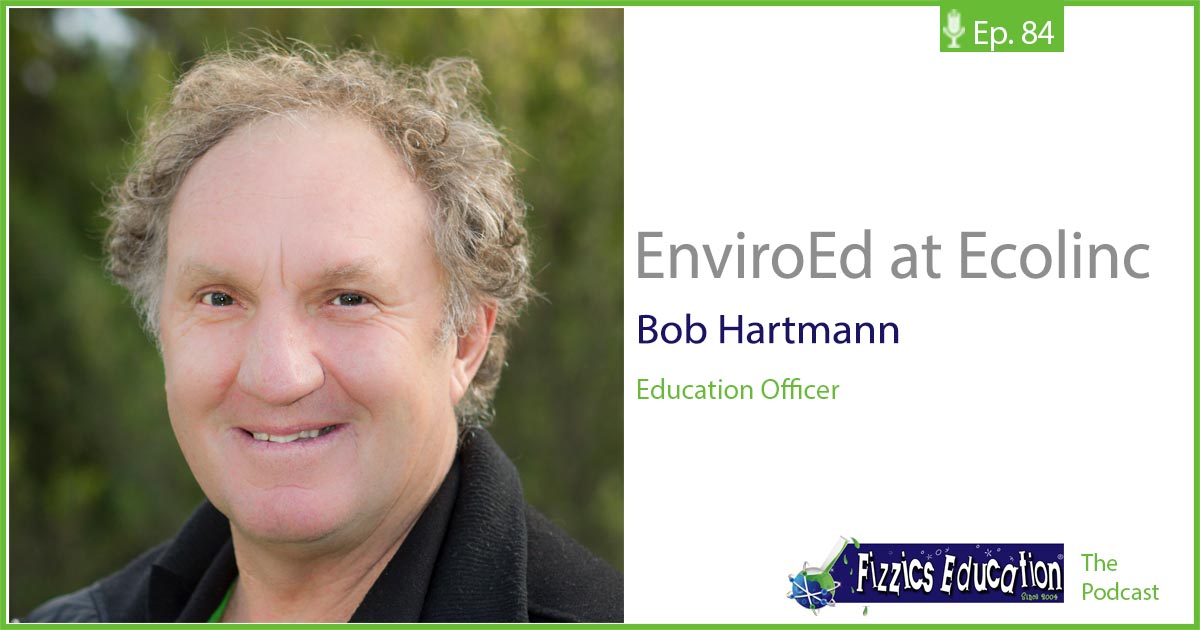
Ecolinc is one of several science & technology innovation centres in Victoria. In this episode, we chat with Bob Hartmann, a highly experienced science teacher who guides us through what is on offer at Ecolinc and his thoughts on helping students understand more about our world.
How do we make complex chemistry and environmental science tangible for students? In this episode, we sit down with Bob Hartmann to discuss the incredible work being done at Ecolinc. We dive into how a specialised science centre can bridge the gap between primary curiosity and high-level VCE Chemistry instrumentation, all while acting as a hub for teacher innovation and professional development.
About Bob Hartmann
Bob Hartmann is a veteran science educator with approximately 40 years of experience. His distinguished career includes roles as a secondary teacher, an Assistant Principal, and a leader in specialised science centres. Before joining the team at Ecolinc as a specialist Chemistry teacher, Bob spent 18 months on-site establishing Earth Ed in Ballarat. He is a specialist in VCE Chemistry and is passionate about professional development, helping teachers across Victoria refine their pedagogy through programmes like VISTA.
Ecolinc: Specialist Environmental Science
Located in Bacchus Marsh, Ecolinc is one of six Victorian specialist science centres owned by the Education Department. It serves as a premier destination for P-12 environmental education.
Key Features:
Curriculum Focus: All programmes are themed around the environment, sustainability, and biology, tailored for students from Prep to Year 12.
Professional-Grade Instrumentation: Students gain hands-on experience with equipment rarely found in schools.
A Network of Excellence: Ecolinc is part of a broader network of Victorian centres, including VSSEC (Space), BioLAB (Sport Science), Earth Ed (Renewable Energy), GTAC (Genetics), and Quantum Victoria (STEM).
Bridging the Resource Gap:
Specialist centres like Ecolinc provide students with access to high-end scientific tools—like digital microscopes for studying macroinvertebrates in high definition—that allow them to see biological processes, such as peristalsis, in real-time.
Collaborative Teacher Development:
Programmes like VISTA provide teachers with the concentrated time and resources needed to revamp their curriculum and explore innovative pedagogical practices outside the daily stresses of the classroom.
The Importance of Educator Passion:
As Bob notes, the most sophisticated laboratory is only as good as the people in it. The ability of a teacher to be flexible, engaging, and creative is the primary driver of student success in science.
Education Tip: Leverage the Power of Home Chemistry.
You don’t need a high-end laboratory to spark a love for science. Bob suggests starting with household products. Vinegar and bicarb soda provide immediate chemical reactions, while beetroot juice or red cabbage can serve as natural indicators. By using familiar items from the kitchen cupboard, you can make science accessible and less daunting for both students and parents.
[00:00:18] Ben Newsome: Yes, welcome again to another Fizzics Ed Podcast. I hope you’ve been having a fantastic week. I certainly have. It’s been very, very busy actually this week, but we certainly get to hear yet again about some awesome people doing some science and technology education. And I tell you what, if you haven’t come across Ecolinc out at Bacchus Marsh west of Melbourne, it is worth your time. They’re actually one of several science and technology innovation centres, and Ecolinc is an amazingly cool site all about the environment where kids can visit all the way from Prep to Year 12 and learn about many, many things.
[00:00:52] Ben Newsome: And our host, the person who’s going to guide us through it all today, is Bob Hartmann, who has been teaching Chemistry and all sorts of environmental sciences for over 30 years. He’s taught at a bunch of different secondary colleges and two specialist science centres in Victoria. He’s got a bucketload of experience when it comes to teaching science and instrumental components of the VCE Chemistry courses. So he’s had an interesting background. He’s taught in primary and secondary science and maths curriculum areas and he’s heavily involved with Ecolinc. And rather than me giving you a full introduction to Ecolinc, I think the best person to do this will be Bob. And I hope you get a bit out of this and maybe consider how might you be able to connect with the team at Ecolinc. So enough from me, I’m sure you want to hear from Bob, so let’s get right into it.
[00:01:53] Announcer: This is the Fizzics Ed Podcast. We’re all about science, ed tech and more. To see 100 fun free experiments you can do with your class, go to fizzicseducation.com.au. That’s physics spelled F I Z Z I C S and click 100 free experiments.
[00:01:56] Ben Newsome: Bob, welcome to the Fizzics Ed Podcast.
[00:01:58] Bob Hartmann: Oh, hi Ben, how are you? Glad to be here.
[00:02:00] Ben Newsome: It’s this is going to be a bit strange when we talk about this because if you’re not wondering what we’re talking about here, we’ve actually been working together all day on this. So anyway, so there are people who haven’t met you, Bob, so what is this place? What are you up to?
[00:02:15] Bob Hartmann: Okay, so I’m Bob Hartmann, I’m a science teacher, science educator. I’ve been teaching for a fair while, probably too many years. And I’m working here at Ecolinc, which is a specialist science centre based in Victoria, Bacchus Marsh.
[00:02:30] Ben Newsome: It’s a beautiful part of the neighbourhood. Like when I was on my way out here to run this session with the high school teachers, on one side of the town was this huge storm cloud and the other side it was lit up and there’s fields and everything, it’s quite a nice place.
[00:02:41] Bob Hartmann: Yes, Bacchus Marsh is out in the country, although it’s becoming fairly suburbanised. It’s a satellite town of Melbourne. It’s about 45 minutes from the centre of Melbourne.
[00:02:53] Ben Newsome: Now if you’ve never been to Ecolinc, this place is amazing and just had a renovation as well. Just describe this space because you know it far better than I do.
[00:03:04] Bob Hartmann: Okay, so what Ecolinc’s about is it’s one of six specialist maths science centres in Victoria. They’re all owned by the Victorian Education Department. Each one of the centres has a theme, and at Ecolinc, our theme here is based around the environment and sustainability. So all the programmes we run here are based on environment, sustainability, biology, and so on.
[00:03:30] Ben Newsome: And it’s a gorgeous place. I mean, in the middle of the day, so just for the heads up, we just ran a bit of a deep dive for some high school teachers in a variety of different schools around Victoria, all around just a project in STEM, which we definitely want to have a chat about soon. But certainly walking around Ecolinc, I mean, you’ve got a lot of stuff in this space. It’s not just a series of classrooms.
[00:03:55] Bob Hartmann: Okay, so at Ecolinc we have programmes here where students come in from all over Victoria, schools from Victoria. So they come in for day programmes and we run things from Prep, Foundation right through to Year 12. And we have a lot of very expensive science equipment that schools couldn’t afford to have.
[00:04:21] Ben Newsome: Oh yeah, I mean, you were showing the gel electrophoresis, we had HPLC, we had all sorts of stuff.
[00:04:30] Bob Hartmann: Ah, we’ve got atomic absorption spectrometers, got infrared spectrometers, we run PCR, polymerase chain reaction machines. We’ve got a whole range of things that are within the curriculum that schools can’t afford the equipment.
[00:04:47] Ben Newsome: Yeah, and specialist teachers have been working in environment and things for quite a while, which is just cool. And so tell me, how long you been doing this sort of stuff?
[00:04:59] Bob Hartmann: Okay, so well the science teaching thing I’ve been doing for about 40 years. But I’ve worked at Ecolinc, this is my fourth year here. And I’m the specialist Chemistry teacher. And so I take a lot of the VCE Chemistry programmes, Year 11 and 12. But then there are some days where they say, “Hey Bob, no Year 11 and 12, you’re teaching Preps.”
[00:05:30] Ben Newsome: What a difference! It’s a bit of a difference.
[00:05:33] Bob Hartmann: It is.
[00:05:34] Ben Newsome: So I mean, as a specialist Chemistry teacher, I mean there’s a whole lot of stuff you can obviously teach about, but what made you go, you know what, I’m going to start working for a place like Ecolinc?
[00:05:46] Bob Hartmann: Okay, so I’ve been science teacher as I said for about 40 years. I went into school administration, so I was an assistant principal at a large secondary school. And I then moved to another one of those which was at a in Warrnambool, so I was living in Ballarat and moved, was about to move to Warrnambool and the specialist science centre was about to be set up in Ballarat. So I applied for the job there and was successful. And so I spent 18 months on a building site getting the building and everything decked out, equipment, staff, and then programmes, and I was there for six years getting that done.
[00:06:31] Bob Hartmann: And then I decided to retire, go and do other things and that lasted three weeks. And I was contacted by Ecolinc to come and work here, which I’ve now four years I’ve been here.
[00:06:45] Ben Newsome: And it’s not just face-to-face with students, which by the way is by and large, I mean you guys do like 20,000 students or something like that, you’re not small. But the professional development though has got to be really rewarding that you do here.
[00:07:00] Bob Hartmann: So we run as we said classroom things for students, but we also run teacher development programmes. So today we’ve been involved in what’s called the VISTA programme. There was some funding from the education department and we’ve put together a programme looking at improving how to for teachers to become better teachers in terms of pedagogy, content knowledge, innovation, and so on. And today was our fourth face-to-face session, but as you know, we’ve been doing a lot of video conferencing as well as part of that.
[00:07:37] Ben Newsome: Yeah, we’re running it through Webex Teams. Anyone who’s familiar with that Cisco product, that’s what we’re using, and that’s been rolled out right across Victoria. But it’s been actually quite fun connecting with the teachers prior to actually turning up on the day, it always produces somewhat of a community.
[00:07:54] Bob Hartmann: Yes, so what’s been really good about this programme is developed some really good friendships, relationships, and so that now we can have some really good clear conversations, honest conversations, rather than if the first time you meet, you’re always a little bit guarded. But now we’ve got to the point where the 20 people involved, it’s become a really good high-quality experience to be involved in.
[00:08:21] Ben Newsome: Absolutely, and so I know that where I was involved is only just one part of a bigger package. I mean you go right through pedagogical principles right through to ideation, the whole kit and caboodle.
[00:08:35] Bob Hartmann: So we’ve tried to cover as I said at the end of the day, a whole range of things, pedagogical practice, the curriculum planning, we’ve looked at a whole lot of different tools, and just trying to make teachers aware of all of the resources that are available and things that you wouldn’t normally think of like Pinterest. Look at that, have a look, and there’s amazing amount of stuff on there.
[00:09:06] Ben Newsome: And that’s actually half the challenge because these days we’re swamped by just information, trying to work out which information’s the best information is half the trouble.
[00:09:16] Bob Hartmann: Yes. I was interested today having a look at how the people that were working on projects here, they just have the time when they can just sit down and spend concentrated quality time on a project. It was fantastic today.
[00:09:34] Ben Newsome: Yeah, it was really a lot of fun. I mean, the thing is though, you’ve been obviously teaching for quite a while and this is going to be an unfair question in a lot of ways. But I mean, if you knew that you had just, school arrives late this afternoon, they’ve arrived on the bus and you really feel sorry for them and you just want to run a thing that makes them happy, whatever it would be. Like out of all these things that are in Ecolinc, out of all the fun different lessons and seriously, there’s a lot of stuff. I just saw just as a side note, I think it’s University of Queensland that created this really back of the you know how to do some gel electrophoresis out of a margarine container which is just brilliant. But out of all the experiments and things that are around here, what’s your go-to that you go, you know what, I know regardless of what kid’s age they’re going to love this?
[00:10:02] Bob Hartmann: The one that it doesn’t matter whether they’re tiny little kids or they’re senior kids, it’s macroinvertebrates and being able to look at pond water and look at the variety of macroinvertebrates and from the little kids, it’s just awe right up to the senior kids where they want to know what these particular bugs are. Macroinvertebrates’ the go-to. Yes, that’d be the one, Ben.
[00:10:33] Ben Newsome: Absolutely, especially with that room it’s been set up with the microscope with a digital camera going through to your interactive whiteboard which is just not so much an interactive whiteboard, it’s something else, isn’t it?
[00:10:46] Bob Hartmann: It’s a high-definition Cisco product, massive big TV screen.
[00:10:52] Ben Newsome: It’s gorgeous. I mean you imagine these little Daphnia just swimming around really fast. In fact, I was struggling trying to keep it on the camera, but once you do, it was in high definition. It looked beautiful.
[00:11:00] Bob Hartmann: Yes, so the new camera we’ve only just bought to go with the microscope. So we didn’t look at the full range of things today with the teachers, but when you put a worm on there and you can actually see the other little bugs that are living on the worm, that’s pretty amazing stuff, you know.
[00:11:18] Ben Newsome: Yeah, when you’re putting a camera through a microscope all of a sudden on a high-definition board, it’s going to be pretty good.
[00:11:24] Bob Hartmann: One of the things that I didn’t show today was that with that particular setup with the young worms that are transparent, you can actually see hearts and all sorts of stuff inside. You can see what’s happening internally in the animal.
[00:11:39] Ben Newsome: Oh, you’d be able to see like see peristalsis in action.
[00:11:41] Bob Hartmann: Yes.
[00:11:42] Ben Newsome: It’s kind of cool. I’d love to see that, it’s cool. Hey now you’re a Chemistry teacher by trade. I mean I just love asking people this sort of stuff because it always just I love to know what makes people tick. Chemistry experiments, there’s so many. And so if you had like not so much in Year 11 or 12 and using all the fancy stuff, but if you’re in front of a I don’t know, bunch of parents wanting to teach their 10-year-old kids just some chemistry that works. I mean what sort of stuff would you point them to?
[00:12:07] Bob Hartmann: I think I’d go to basically the household products you’ve got at home. And there’s so many different chemistry reactions you can just use with household things whether it’s you’ve got vinegar as an acid, you’ve got bicarb soda as a base, you can take beetroot juice or you can take you know, different things as indicators that will change colours. There’s a whole range of things that you can just use with household products at home. That’d be the sort of thing I’d go to encourage people if you want to get your kids involved in things.
[00:12:41] Bob Hartmann: And it can be like if you’ve got Ajax cleaner as a base and you’ve got a whole range of things there. You don’t have to go and buy a chemistry set.
[00:12:48] Ben Newsome: No, absolutely not. I mean you’re right. I mean the anything from the red cabbage or beetroot juice through to I believe you can get this and this is a little bit more specialist, but you can get this pea flower extract which will actually change colour too. Which is very cool and apparently they put it in various drinks these days.
[00:13:05] Bob Hartmann: I’ve actually seen it gives a lovely I think it’s purple colour. A mocktail that’s been used in mocktails. Yeah, we had a bit of a look at that. You can buy it on eBay, I think, the extract.
[00:13:18] Ben Newsome: It’s amazing what you can buy on eBay and Amazon and whatever product you can find on the net, it’s unreal. So I mean that’s what’s awesome about Ecolinc. It’s one of six centres, so what are the other five centres?
[00:13:29] Bob Hartmann: Okay, so the other five centres all have their own themes. So there’s VSSEC, which is Victorian Space Science Education Centre and that’s based at Strathmore High School in Melbourne and they run a whole lot of programmes based around space science. So they have a programme where students can don the space suits and go onto a simulation mission to Mars. And one half of the class is on the Mars landscape and it’s an amazing simulation.
[00:14:02] Bob Hartmann: Yes, and the other half are in Mission Control and they have a programme they have to direct their person on Mars as what they’ve got to do and things like that. They have a number of other programmes as well, so but all they’re themed around space science. BioLAB down in Geelong is based around sports science and material science. So they’ve got a relationship with Geelong Football Club and so they do a lot of sport statistics and data analysis and human physiology.
[00:14:32] Bob Hartmann:Earth Ed, which is based in Ballarat, is Earth sciences, or good old Ballarat and its goldfields, but it also has a strong renewable energy component. And I spent a time there setting that one up. So there’s a lot of wind farms around Ballarat, so we had programmes where you could go out to the wind farm and go right up to the base of the tower and take kids out to that close to the wind farms.
[00:15:00] Bob Hartmann:GTAC, which is the Gene Technology Access Centre, it’s based at University High in the city and its programmes are all around cellular biology, microbiology, probably aimed more at senior senior kids, but they do a lot of programmes as well. And Quantum Victoria is out at Charles La Trobe and it runs a whole lot of STEM-type programmes and activities. Is that six, Ben, I think?
[00:15:26] Bob Hartmann: Five plus ours. Which will keep you busy. I mean these things are amazing because those people not in Australia, Australia has a number of states and they’ve all got different ways of delivering education and Victoria does this really well from a science end by having these specialist science centres which for public schools are very accessible.
[00:15:43] Bob Hartmann: Yes. So for Victorian public schools, the programmes are all free. And for disadvantaged and regional kids, the buses are also supplied. So really it’s only a matter of booking your class in, booking a bus, and the education department then actually pays for that.
[00:16:02] Ben Newsome: Which brings in its own issues, because if you’re free and you’re good, people want you.
[00:16:06] Bob Hartmann: Want you. So we are booked out within two or three weeks of bookings opening each year.
[00:16:15] Ben Newsome: All right, so if you’re listening in, grab a pen or pull over to the side of the road or whatever you’re doing because there is a date that you actually do need to be aware of.
[00:16:21] Bob Hartmann: So most of these centres start their bookings first day of Term 4, which is—oh now, Ben.
[00:16:28] Ben Newsome: I know, I know. All I know is that one of the teachers said October 1 or something like that. She was like on the ball, you’ve got to be there October 1. But I do know that you guys can you can subscribe and find that out, right?
[00:16:34] Bob Hartmann: Yes. So if you go to the websites and look up Ecolinc, and that’s E C O L I N C, Ecolinc, you can find where our bookings are and there’s links to the other science centres off that as well.
[00:16:49] Ben Newsome: Now of course, like every time we always put those links in the show notes so you’ll be able to check those out for sure. Now, what I always like to sometimes get into which is you know, it’s always good. You always hear about what works really well, and then people often don’t talk about what’s not gone well. When things have sort of when things have gone pear-shaped. And the reality is if you’ve been teaching for long enough, things have gone pear-shaped. They just go.
[00:17:12] Bob Hartmann: Oh well, yes.
[00:17:13] Ben Newsome: I mean, it doesn’t have to be you don’t have to incriminate anyone, but have you ever had the situation where you’ve just gone, “You know what, this lesson’s clearly not humming,” and it was kind of funny as to what was going on as to why?
[00:17:23] Bob Hartmann: Oh, I’ve probably got a number of ones that you could go. The day I had to stand up and take over the class from the student teacher when she just froze and said, “Sorry kids, I can’t remember any of this,” and walked out.
[00:17:42] Bob Hartmann: That was a number of years ago. We had one here the other day where one of the Grade 1 kids got so excited they wet their pants when they were doing the macroinvertebrates.
[00:17:53] Ben Newsome: Oh, that’ll happen. Actually I think I’ve had a couple of throw-ups. So there’s a couple of the vomits, especially with a heart dissection, by the way.
[00:17:59] Bob Hartmann: A couple of vomits over the time, yes, they’re always good fun. There’s things that go wrong in the management side, but there’s sometimes you plan a lesson that you think’s going to be a ripper and for some reason it just goes flat. And I think at some stage you need to just look at it and go, “No, not working. We need to sort of review this.” And I think the more experienced you are, you’re actually able to flip it around and usually not overly get hung up about it either and go, “You know what, it’s clearly not working guys, just come back, sit down, we’ve got another plan.” I think if people who know me know that I’m just fairly flexible and you just have to be able to go, “No, clearly that was not going to work.”
[00:18:03] Ben Newsome: Well, the reality is with this lesson stuff, and especially as the curriculum’s moving and whatnot, it’s an iterative process. It keeps changing and you build on what you’ve learnt, what’s worked, and what hasn’t worked. I mean, Rome’s not built in a day. It’s a cliché for a reason, and it’s very true.
[00:18:17] Bob Hartmann: One of the things that I think starting out as a beginning teacher, you’re just swamped with what you have to be able to do. It’s everything from where the biros are kept in the school or the paper to actually planning lessons and things. Beginning teaching must be one of the most stressful things there is to do, because there’s not many other jobs where for 45 minutes or an hour you’re locked in a room with 25 adolescents.
[00:18:47] Ben Newsome: And you’ve got to know what you’re doing and there’s no help coming any time soon. Absolutely right. A mechanic has to learn how to be a mechanic, and then when they’re being a mechanic, they’ve still got people around them to help them while they’re being a mechanic.
[00:18:58] Bob Hartmann: And they’re probably only working on one car at a time.
[00:19:01] Ben Newsome: Yeah, it’s challenging, but also rewarding at the same time.
[00:19:04] Bob Hartmann: Oh yes, look, I’ve loved teaching, I love every part of it. I enjoy working with kids. I’ve really particularly enjoyed this VISTA teacher PD. It’s been an opportunity to meet other teachers that share the expertise. And you know, I’ve been around for a fair while, but I’ve learnt stuff in today’s programme just because people go, “Oh, what have you tried this?” And, “Wow, brilliant idea, I wish I’d seen that 20 years ago.”
[00:19:30] Ben Newsome: And that’s the beauty about actually not just running PD within your own school, but actually spending time with other school leaders. Because then you get to have this cross-pollination and actually have the time to chat. Because I’ve certainly been to enough conferences where it’s a lot of sage on stage, and then you move to the next sage on stage, then you go to lunch. And that’s about it.
[00:19:51] Bob Hartmann: I think that was what was really good about today’s programme. You took us through those planning techniques and then to be able to sit down with people and look at how they developed a concept, an idea, and then took that to now we’re working on this is a project. I was really taken today with how people actually got into that.
[00:20:13] Ben Newsome: It’s good fun, those sorts of sessions. So the idea is that we just basically pose this idea of unlimited budget, unlimited materials resources, time, everything, what would a really cool STEM project look like? Like for real. And give us 100 ideas. And it’s usually daunting to hear that, but once you start actually getting into it, things start to come out and then you go, “Righto, let’s now focus on one that potentially will work,” and then, “How you going to do it? Now give us more ideas.” And it works.
[00:20:40] Bob Hartmann: One of the things that I saw today that came out of today was one of the schools had been talking about revamping their Chemistry 7 to 10 programme. And by the end of the day, it had switched around becoming thematic with food as one part of it. And so they’d moved a long way from a very traditional approach to the teaching science, Chemistry, to incorporating a lot of really innovative ideas. And it was good to see them being able to move through to that.
[00:21:11] Ben Newsome: It’s really nice to watch that happen because you know these sessions are usually working when you can just stand back and it just all just happens at this point. Because it’s amazing just how much people actually genuinely know if they’re given time to actually express it.
[00:21:24] Bob Hartmann: And each group contributing to other ideas that other people have was really important today.
[00:21:30] Ben Newsome: I reckon they could spend a lot of time, they could have easily done that for sure. We did use a lot of post-it notes and butcher’s paper.
[00:21:37] Bob Hartmann: Yes, we kind of, yes we did, but this is an Ecolinc place, so that’s all paper, it’s all recyclable. So we’re okay.
[00:21:42] Ben Newsome: Now, there’ll be science centres listening in, or there’ll be collegiate groups, or in school districts who work together to sort of, you know, do STEM accelerators and things. I mean, what sort of advice would you give to someone running a science centre like this to do this sort of stuff?
[00:21:58] Bob Hartmann: Ooh, that’s a pretty broad general question. It’s very broad and nasty. And you’ve got three minutes, starting now.
[00:22:07] Bob Hartmann: Look, the idea of having these science centres came about. The oldest one’s about 15 years, maybe pushing 18 years old. So the idea’s been around for a while. And they are a great place for innovation, they’re a great place for kids to experience equipment that they would never see and some innovative programmes, they see different way of teaching.
[00:22:41] Bob Hartmann: Part of a science centre like this, if you’re somewhere maybe in different part of the world, is you can’t be a school. You can’t deliver what can be done in school. You have to be able to think outside the box and think how can I be different, a different experience than kids would have at a school. Saying that, we’re not a museum. We’re an educational facility, so we fit somewhere between like a place like the Exploratorium in San Francisco or Questacon in Canberra, but we’re a smaller version, but it’s primarily still teaching kids.
[00:23:23] Ben Newsome: Like a franken-education between a museum and schools. And we feel the same way at Fizzics. We’re extra teachers, we want to be teachers but with stuff that you can’t always get.
[00:23:34] Bob Hartmann: Yes. One of the key, Ben, is that it’s not the facilities, it’s the people within the facilities, their creativity, how they work, the way they interact with the kids and so on that actually makes the centre. You could teach in a tin shed if you’ve got passionate people who are interested in engaging students and have the knowledge of how to do that.
[00:24:12] Ben Newsome: Absolutely. And you see with the World Teacher Prize and whatnot, some amazing teachers really working with very little.
[00:24:18] Bob Hartmann: Yes. And they’re geniuses at what they do to be able to hold those kids. Can you imagine holding these kids around science when you haven’t got even much stuff hanging around in the first place? I think the creativity comes in what resources you can find and adapt. You know, you can suddenly go to the kitchen cupboard or whatever and drag out the vinegar and bicarb soda, use those sort of reagents and get creative and use the resources that are around. But science centres have to be different than a school, but we’re not a museum.
[00:24:52] Ben Newsome: Bob, thanks very much for popping on this and thanks very much also for putting all that effort into the VISTA programme and everything else that you’re doing at Ecolinc. It’s an amazing site. And well done!
[00:25:03] Bob Hartmann: Ben, thank you very much. I’ve enjoyed today. It’s been a great programme.
[00:25:06] Ben Newsome: All right, take easy. Thanks mate. All right, bye.
[00:25:25] Ben Newsome: So there we go. What do you think? Is it worth jumping on Ecolinc’s website? Yes. Is it worth visiting them? Absolutely. Now obviously if you’re overseas, that’s going to be a little bit challenging, of course, but I still recommend getting in touch with Bob and the team at Ecolinc because they can certainly help you out with ideas for teaching environmental science and maybe put you in direction in different ways for other science and technology innovation centres around Victoria.
[00:25:49] Ben Newsome: So, I hope you got a lot out of it. It was really good hanging out with the team when we did that teacher professional development day with a number of schools around Victoria. And I really look forward to catching up with them another time. Anyway, it is the end of this particular episode. We’ve got still more stuff coming up. I hope you have a fantastic afternoon or morning or whatever you’re doing and I’ll catch you another time.
[00:26:47] Announcer: This podcast is part of the Australian Educators Online Network. aeon.net.au.
Frequently Asked Questions
What exactly is Ecolinc and who can visit the centre?
Ecolinc is one of six specialised science and technology innovation centres in Victoria, based in Bacchus Marsh. It focuses on environmental science and sustainability, providing programmes for students from Prep all the way through to Year 12.
How does Ecolinc support teachers beyond student excursions?
Ecolinc runs professional development programmes like VISTA, which focus on improving pedagogy, content knowledge, and innovation. These programmes often use blended learning, combining face-to-face sessions with video conferencing through platforms like Webex Teams to build a collaborative teaching community.
Are there other specialist science centres in Victoria with different themes?
Yes, there are five other centres: VSSEC (Space Science), BioLAB (Sports and Material Science), Earth Ed (Earth Sciences and Renewable Energy), GTAC (Gene Technology), and Quantum Victoria (STEM and specialised technology).
Is there a cost for schools to attend these specialist centres?
For Victorian government schools, the programmes are free. Furthermore, the Education Department often provides funding for buses to support regional and disadvantaged schools, ensuring equitable access to high-quality science education.
Discussion points summarised from the Ecolinc with Bob Hartmann with AI assistance, verified and edited by Ben Newsome CF
Extra thought ideas to consider
The “Tin Shed” Philosophy of Education
Bob Hartmann highlights that while expensive equipment is a fantastic drawcard, the true heart of a science centre is its people. Discuss how the passion and creativity of an educator can outweigh the physical facilities of a school or laboratory.
Equity in Science Technology
Victoria’s model of providing free specialist centres and transport for disadvantaged schools is a unique approach to STEM equity. Consider how similar models could be implemented in other regions to ensure all students, regardless of their school’s budget, can use professional-grade instrumentation.
The Value of Iterative Teaching
Bob shares that even with 40 years of experience, some lessons still go “pear-shaped.” Reflect on the importance of teacher flexibility and the willingness to treat curriculum design as a constantly evolving process based on what works in the classroom.
Recognised by
22 years, award-winning work, 1 purpose
Recognition from business, education and industry bodies across Australia.
Australian Small Business Champion
Multiple years
CILC Pinnacle Award and Hall of Fame inductee
Center for Interactive Learning and Collaboration
Western Sydney Awards for Business Excellence
Winner
Top 100 Coolest Company
Listed
Local Business Awards
Winner
We value your privacy
We use cookies to improve your experience. Essential cookies are always active. You can choose which optional cookies to allow.We use cookies. Optional ones stay off unless you allow them.Privacy policy