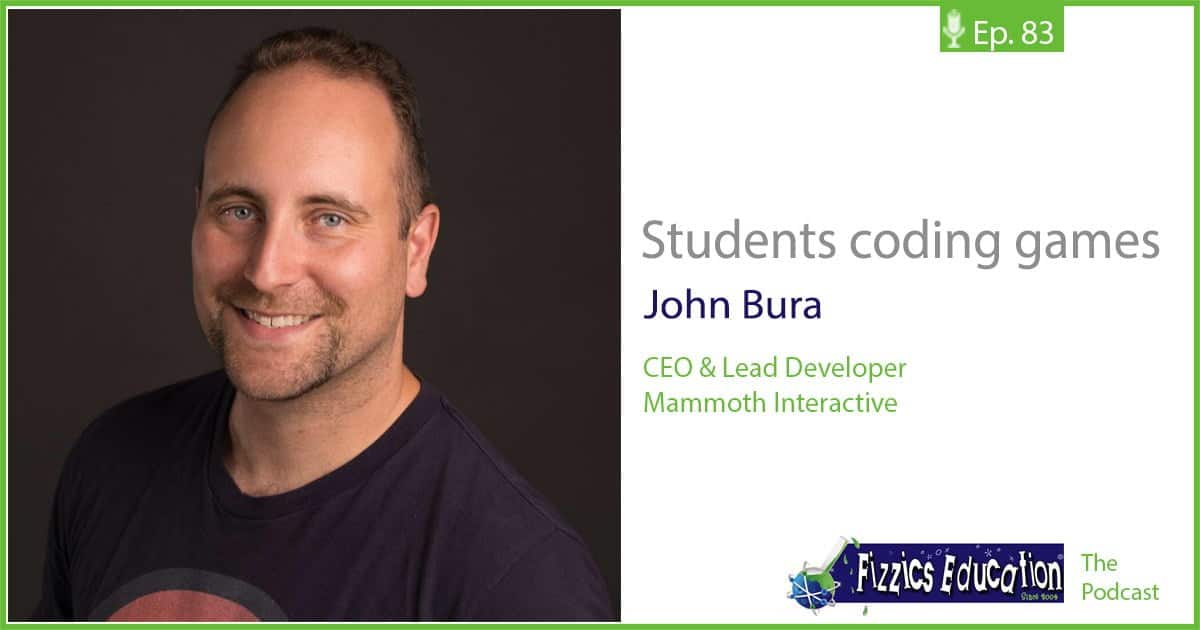
Learn how students of all ages can learn how to code games and more using the e-learning platform created by Mammoth Interactive. We speak with CEO and Lead Developer John Bura about his thoughts on teaching kids how to code.
How do you turn a passion for gaming into a global educational movement? In this episode, we talk with John Bura about the intersection of entertainment and education. We explore how his company, Mammoth Interactive, has taught over 300,000 students worldwide to build their own digital worlds, and what it takes to produce #1 apps for the App Store and Nickelodeon.
About John Bura
John Bura is the CEO and Lead Developer of Mammoth Interactive. A veteran of the industry, John has produced games and apps for XBOX 360, iPhone, iPad, PC, and Mac. Under his leadership, Mammoth Interactive has seen its apps rise to #1 in the App Store and has even had work featured by Nickelodeon. Beyond development, John is a sought-after consultant in programming, music, level design, and business development. His true passion lies in helping STEM shine by making high-level coding accessible to students across the globe.
Expertise: Game Development, Coding Education, App Design, and Digital Entrepreneurship.
Mammoth Interactive: Coding for the Future
With over 300,000 students globally, Mammoth Interactive is a powerhouse in EduTech. Their mission is to demystify the “black box” of game design and provide students with the practical skills needed to thrive in a digital economy.
What Mammoth Interactive Offers:
Multi-Platform Mastery: Teaching students how to code for everything from mobile devices to major consoles like the XBOX.
Comprehensive Skills: Their courses move beyond simple code to include the “art” of games, such as music production and level design.
Industry-Standard Techniques: Students learn the same programming languages and business development strategies used by professional studios.
Real-World Success: By sharing the secrets behind their own #1 apps, John and his team provide students with a roadmap for commercial success in the app market.
Top Episode Learnings: The Game Design Loop
STEM Through Play:
John discusses how Game Development is the perfect “hook” for STEM. To build a game, students must master physics (for movement), mathematics (for scoring and logic), and technology (for the code).
The Importance of Level Design:
We dive into the psychology of Level Design. John explains how creating a successful game requires an understanding of human interaction and progressive challenge—key concepts in both engineering and education.
Coding as a Creative Language:
John shares his belief that coding is the new literacy. By teaching students to create their own apps, we are moving them from being passive consumers to active creators of technology.
Education Tip: The “Paper Prototype” Challenge.
Follow John’s lead by starting a coding unit without a computer. Have students draw a “Level 1” of a game on paper, defining the rules: “If the player touches this, they lose a life.” As John demonstrates at Mammoth Interactive, Logic and Design come before the code. Once students understand the “if/then” logic of their paper game, translating it into a programming language becomes a much more intuitive process.
[00:00:17]Ben Newsome: Yes, welcome again to another Fizzics Ed Podcast. Big week this week. It’s quite an interesting week actually because we’re going to learn about how students can create their own games, actually coding them and getting them out into the real world and seeing what the public thinks. It’s really, really interesting and John Bura knows a lot about this. You see, he’s the CEO and lead developer at Mammoth Interactive and since 2008, they’ve been producing Xbox 360 games, iPhone games, iPad games, PC and Mac apps, all these things, and they’ve been helping students right across the planet, seriously, 300,000 of them, understand how to code in those environments and produce real games, which is so cool. And it just might be something that your students might want to get involved with, all the way from primary school into middle school, high school, all that sort of stuff. Those kids can follow those courses that Mammoth Interactive have created. So, let’s listen to what John Bura has been doing and how easy this can be done.
[00:01:16]Announcer: This is the Fizzics Ed Podcast. We’re all about science, ed tech and more. To see 100 fun free experiments you can do with your class, go to fizzicseducation.com.au. That’s physics spelled F I Z Z I C S and click 100 free experiments.
[00:01:34]John Bura: So I run a company called Mammoth Interactive. We make games, apps and training content. We’re most known for our training content. I started this in my bedroom in 2011 and we’ve sold over 700,000 courses since then. It’s been amazing. It’s been an amazing eight years and everyone loves our courses and we are always trying to produce the next great tech course.
[00:01:56]Ben Newsome: It’s funny how, it’s almost a cliché, the whole out of the bedroom thing, but it tends to be the case, doesn’t it?
[00:02:02]John Bura: Absolutely.
[00:02:04]Ben Newsome: And absolutely. Now, I mean, that’s quite a roll-on since 2011. I mean, it’s 2019, so therefore time-stamping this podcast, but I mean, that’s quite a bit to put out in that short amount of time.
[00:02:14]John Bura: Absolutely. So, at the time, again, I started this in my bedroom. I worked by myself for many, many years. I bootstrapped the business and then in 2016 I got an office and employees and, yeah, it’s been growing ever since.
[00:02:30]Ben Newsome: Well, one of the things I love about what you guys are doing is, it’s clearly not just tech for tech’s sake. I mean, you have a real education purpose and might be some people who’ve not come across Mammoth Interactive before, let me just dive into the sort of things that you kind of do.
[00:02:44]John Bura: So we make mostly training content that teach people how to code. And one of the things that we do is we try to get people to produce practical projects. So a lot of computer science and computer engineering degrees, they give you a lot of theoretical code. But we, like boot camps, want to give people a complete project. And this is what we find that a lot of people who already know how to code or are already engineers that take our courses, they like, because, in maybe 20 hours, they could have a whole course or a whole app that they can release to the App Store and then use it on their LinkedIn resume. And a lot of our courses start from nothing. Like, we have a course that shows kids how to make a game like Fortnite from scratch.
[00:03:26]John Bura: So you start off with nothing and then you code it, you make the levels, you make the art, and then you do all the multiplayer, and then you actually finish the game. And at the end, you have a fully functional kind of Fortnite clone at the end of it. And that way, kids can be like, “Hey, I built this,” at the end of the day, instead of just putting together a few if statements and functions and saying they did something. But this is like a complete project.
[00:03:50]Ben Newsome: Well, that’s really wild because there’s a real push for computational thinking and trying to get kids into coding and whatnot. But actually having a purpose and actually being able to output something of actual value to people is another thing all together. So what are sort of ages are you dealing with here?
[00:04:06]John Bura: So like, that particular course is probably middle school to high school, just because those courses are a little bit, well, the multiplayer, that one’s a little bit bigger, so it’s a little bit harder for young kids to take it. But we’ve, at Mammoth Interactive, we’ve taught kids anywhere from five years old to 90. So we really have the whole range. We have a course called Kids Coding, which a lot of kids have taken, and that starts at around five, six.
[00:04:36]Ben Newsome: So I actually want to dive in onto this because, by the way, 80, 70, 90 years old, we’re still kids at heart in a lot of ways too. So that’s definitely the case. We run coding as well to older students, which we always say it’s irrelevant what your age is, it’s what do you want to do. But working with the really younger ages, I mean, do you find that challenging?
[00:04:58]John Bura: A lot of the stuff that we do is learn at your own pace, which in a lot of, depending on what kind of school system you’re in, you kind of get forced through. So it’s good for kids that maybe learn a bit slower because they can watch the videos two, three times. Or kids that are really gifted and they can just whip through the whole course in a weekend, because kids are really smart these days, right?
[00:05:22]John Bura: So to a certain extent, sometimes if kids watch it two or three times, they usually get it after the second or third time. And because it’s a learn at your own pace, and the videos are very self-explanatory, one of the things that we try to do here is make the tutorials very easy to understand. Like, if you’ve ever taken a drawing tutorial, you have a blank page, three circles, and then the next step the instructor shows you is you have the Mona Lisa. And you feel like there’s something missing in there. We try to go through step by step so that literally anyone can go take these courses.
[00:05:54]Ben Newsome: Which is kind of nice about this, because when you’re dealing with the really younger age thing and then going through to the middle school and high school, and being able to just say, here is a thing on a LinkedIn resume they can present. I actually would say, it’s not just about job prospects, I suspect that some of these kids that you’ve put through these courses will have started up genuine apps that are actually out there in the marketplace. They’ve actually created themselves their own job effectively, their own company and gone from there.
[00:06:21]John Bura: Absolutely. You know, if you’re into game development or app development and you’re in high school, like when I was in high school, none of this was possible, right? Like there’s no App Store, there was nothing, and coding was really hard to even get a game on any kind of console. But if I was in high school right now, I would absolutely put out an Android app. You never know because if it’s good enough, then you’ve paid for your university, right? Or you don’t need that lame summer job. You’ve already made it by making a game. And then you’ve kind of in a sense won the lottery. So I would at least try that. And of course have a backup plan, because it’s really hard, success is really hard, but you should try it.
[00:07:02]Ben Newsome: Well, one of the things that came up on this podcast, we spoke with lots of really interesting people doing really cool stuff. And one of the people who recently was on here was Michael Kasumovic, who founded Arludo, which is this biological app games thing. But he’s not a coder in any way. He’s a professor in biological sciences at the local university around the corner here. And all he was trying to do was help his undergraduate students understand some biological concepts, and suddenly over time, they built this thing out of nothing. And sort of, one of the things that I’d like to sort of talk about, especially for the teachers listening on in is that, if you’ve got some kids, they might be in grade six or grade nine or whatever, building a thing, you don’t always have to have this, we’re going to get to this goal. It could be, you could easily create a skill set which they can apply either later in life, or frankly, can go on a tangent and produce something they never expected.
[00:07:55]John Bura: Exactly. That’s a really good example that you brought up there. Like sometimes the best businesses come, you know, if you find a way to help some people, then chances are there’s thousands to tens of thousands of people that you can help. So if you have a specific need and like a very niche need for an app out there, it could become successful. And if it becomes successful, your customers will tell you what you want in that app. And then it can spiral to something new. And it can be something as simple as you just said.
[00:08:26]Ben Newsome: Yeah, well that’s the thing. Like I mean, we’re talking students a lot here but the reality is that us as educators, we have to sort of have our own skill sets to be able to help these kids. I mean, what are some tips for teachers trying to get their head around how to teach computational thinking, dealing with coding, all that, like really if they’re going right to the basics? They’ve just left university and they want to teach this stuff, but they might not have the skill set themselves yet.
[00:08:51]John Bura: So the best thing to do is I like to think of coding as kind of like an athlete does. Like an athlete, they practice and then they play. And coding is very similar. You have to kind of practice and play. Or a musician is another good example. So if you want to teach coding, then I would consider trying to make like a full app from scratch.
[00:09:14]John Bura: And the thing about coding is that whenever you learn something, even if it’s a different language, like let’s say you start out in JavaScript and then you move to C++ or something like that, a lot of the concepts tend to compound on one another. So if you learn something, then you’ll probably have that for a long time, and you’ll be able to transfer it over. So the more you kind of just immerse yourself in code, the better you’ll be.
[00:09:38]Ben Newsome: Yeah. No, fair enough. I mean, I imagine that you’ve obviously had teachers arrive or adults arriving with all sorts of different skill sets. I mean, with the stuff that Mammoth Interactive does, is it able to be combined with other chunks of code that exist out in the environment, out in the world?
[00:09:57]John Bura: So that’s a really good question. So a lot of the reasons why people buy our courses is we go from start to finish. Like, a lot of people, believe it or not, come from YouTube, because they’re trying to patch code together.
[00:10:20]John Bura: And imagine if you’re trying to build a machine, and one tutorial is in metric, the other’s in imperial, and then the other is in some kind of weird other thing, right? It would be very difficult to make sure that you patch these two together. So in essence, we take someone from start to finish. And we try to teach the best way of doing things. And once you have that foundation, you can go elsewhere and get your code, but eventually you’ll be so good at your own code that you won’t need to do that as much.
[00:10:48]Ben Newsome: And that’s I suppose where the fun starts, right?
[00:10:50]John Bura: Yes, exactly, right.
[00:10:52]Ben Newsome: I guess the only thing that could be challenging, though, is working in these online learning environments can be difficult for some learners because in some ways they could feel themselves quite isolated. I mean, is there sort of like a network or a community of learners where they can sort of mix and say g’day, or even like through whether it’s blogs or MOOCs or whatever, like trying to work in an online environment can be tough. I mean, how do you sort of work with those kids?
[00:11:17]John Bura: Yeah, so you bring up a really good point. So, online learning, like if you’re an introvert and you’re just sitting in front of your computer all day, right, I mean, online learning is like your best place to go. But there’s lots of forums out there and recently there’s a bunch of different channels like on Discord that you can go talk to. And a lot of them are private and you just have to basically search for them.
[00:11:45]John Bura: Often the best thing to do is to go meet other developers. And this doesn’t matter whether you’re a really good developer or you’re just starting out, you need to go talk to other people in real life, too. Because I have this theory that you need a balanced diet of education, meaning you’ve got to go to class, you’ve got to learn online, and you also got to meet people in real life, too, and talk about it. I’ve learned so much about coding talking with other coders over beer, right? And we get into some heated arguments about, you know, just some heated arguments and I’ve learned so much from that, too. So it is important to go meet people elsewhere.
[00:12:16]Ben Newsome: Yeah, it’s funny, you know, how you get people around a particular subject that they’re interested in, how much arguments around the water cooler so to speak start. I mean, I know a lot of scientists and they will happily argue for hours about the date of a particular rock or whatever. Or a dinosaur bone or whatever it is, and coding is no different, right?
[00:12:34]John Bura: Absolutely. And especially because it’s a process. There’s different ways you can do things and you talk through that and even if someone has a completely different way of doing something, you’ll probably learn something from that.
[00:12:47]Ben Newsome: Yeah, that’s it. Now, I’d love to just sort of dive into just a little bit, into like if people listening to this are going, you know what, maybe this might be for me. So they jump on Mammoth Interactive‘s site, where should they sort of kind of start?
[00:13:03]John Bura: Sure. So our flagship course is called Hello Coding. It’s got 170 hours of content. It takes you from knowing nothing about coding, starts you out with web development. It gets you into app development making Android and iOS apps. It also teaches you game development. And then at the end, it teaches you Python, artificial intelligence, and machine learning. So it’s really the complete bundle. And you can see all of that at mammothinteractive.com. Also, if you have an institution or you want our courses at an institution, we have really good competitive licensing deals. So you can email us at [email protected] if your institution is interested in licensing some of our products.
[00:13:44]Ben Newsome: No, that’s right. I just out of interest, I mean, because I have not created an app, and I’m going to say yet, by the way. Because I shouldn’t just say I haven’t done it and therefore never going to do it. I think I should do it at some point. Do you find that it’s difficult for people to be able to swap and change between the different platforms, like going from iOS now where they’re playing in another area? Is that a difficult transition or do you find that it’s not too bad once they get the basics?
[00:14:11]John Bura: So most of the languages out there derive a lot of their kind of syntax from C++. And so if you learn one language then you could probably learn a few others. The real difference comes to like the big picture on how they actually make an app. Because if you want to make an iOS app in Xcode, it’s different from making it in Flutter. Like they’re two totally and it’s a little different from making it in Android Studio. So they’re a little bit different here and there.
[00:14:40]John Bura: I would suggest just picking one and sticking with that for a while. And if you need to change, then change later. But you know what, if you learn something and you feel like that wasn’t the best start for you, don’t feel bad about that because programmers change their languages all the time, it’s just part of the industry.
[00:14:57]Ben Newsome: Oh, the number of languages out there is insane. I mean, every now and then we’ll get software companies contacting us saying your website’s in this code, you really should be on Ruby on Rails or whatever it is, there’s so many different versions of stuff out there, then people create their own things as well. I guess as long as the browsers can work it out and it’s downloadable, it’s probably a good start.
[00:15:18]John Bura: Yeah.
[00:15:18]Ben Newsome: Look, John, thank you very much for popping on this. I just wanted to get a bit of an idea of what you guys are doing and also some of your thoughts about how to get kids into coding, it sounds like probably the bottom line is start.
[00:15:31]John Bura: Yeah. You know, even if you have, even if you’re a coder and you’re having trouble getting things done, the number one thing you can do, sit in front of your computer and just start doing it. And then later you’ll get pushed down the rabbit hole of coding and maybe your hit app will reach the App Store.
[00:15:48]Ben Newsome: Exactly. And actually just before you go, I might just ask it in terms of your own rabbit hole. I mean, it’s now 2019, it’s eight years since you founded Mammoth Interactive. Where can you imagine you going next with the company?
[00:16:01]John Bura: Oh, so we plan to continue doing what we’re doing and that is putting top-line courses out. So our latest course is how to build a complete Airbnb app from scratch. That should be out fairly soon, depending on when this podcast gets released. But we’ll continue to put out really excellent content. We’re also since I have two kids I’m making apps for my kids. So you can check those out on mammothinteractive.com. And you can also subscribe to our Twitter which is @MammothCompany, you can check out all the latest news. And there will probably be some big news within a year from now. That’s all I’m going to say right now.
[00:16:41]Ben Newsome: Understand. So there you go guys, you suppose heard it first, go check out what they’re getting up to because you’ll see transitions. Tell you what, that Airbnb thing’s going to be very interesting. I’d imagine you might get hammered with inquiries once that goes out.
[00:16:54]John Bura: Absolutely. This one’s one of our bigger courses where, often times we show you how to build a small version of these top apps, but this literally shows you how to build a real clone of Airbnb. And if you go through this course, then you’ll be definitely ready for a junior developer job.
[00:17:14]Ben Newsome: Ah, that’s awesome. Look, John, thanks again for hanging out at the Fizzics Ed Podcast and look, glad to see that you’ve created this thing. And more importantly, you’re giving people genuine, true tools to build real things that aren’t just sort of stuck in the classroom somewhere. I mean, these students can do this and who knows where they’ll go next.
[00:17:31]John Bura: Absolutely.
[00:17:32]Announcer: Not all TPL for teachers is as awesome as it could be. I feel like there’s a lot of PowerPoint presentations, a lot of sitting and listening to someone talking. Well, if you want a break from that, Fizzics TPL sessions are fully hands-on, fully integrated with the curriculum and full of amazing science ideas that you can put in your classroom right now.
[00:17:55]Ben Newsome: So, what do you reckon? Coding, do you reckon you could do it? I reckon so, considering just how easy it can be. Getting your students involved in tech in all these different ways is certainly one thing, but actually being able to make real games that kids can actually upload into the real world that people can actually use, that’s going to be so much more valuable to them in their future. And let’s be honest, it makes it more real. So why not, go jump onto the Mammoth Interactive website and just find out what they’ve got to offer, I reckon it’s really worth your time.
[00:18:28]Ben Newsome: And let’s be honest, as adults it’s probably not a bad idea to learn how to code games ourselves. It’s not a bad way of just, you know, learning what is this platform and how can we then use this to teach kids to do it themselves. And hey, you might be creating a few games yourself. Look, that’s enough from us from the Fizzics Ed Podcast, I hope you’ve enjoyed it. And look, coming over the next few weeks we have a few more things coming up, I guarantee. But look, for now, enjoy your afternoon or your morning or whatever you’re getting up to and I’ll catch you another time.
[00:19:21]Announcer: This podcast is part of the Australian Educators Online Network. AEON.net.au.
Frequently Asked Questions
What is the primary focus of Mammoth Interactive’s coding courses?
John Bura emphasises practical, project-based learning over pure theory. Instead of just learning snippets of code, students work towards building complete, functional projects—such as a Fortnite or Airbnb clone—that can be released to an app store or used on a professional resume.
What age groups are suitable for learning to code?
Coding is accessible to almost any age. Mammoth Interactive has taught students ranging from 5 to 90 years old. Their specific Kids Coding programme is designed for children as young as five or six, while more complex multiplayer game development is typically geared toward middle and high school students.
How does John Bura suggest teachers approach the learning process for coding?
He compares learning to code to being an athlete or a musician, where you must “practice and play.” The best way to learn is through immersion and the attempt to build a full application from scratch, allowing concepts to compound and skills to develop through repetition.
If a student learns one programming language, can they easily switch to another?
Yes. Many modern programming languages derive their syntax from C++. Once a student understands the foundational logic and structures in one language, those concepts are highly transferable. John notes that professional programmers frequently change languages as part of their career in the industry.
How can online learners overcome the isolation of digital education?
John advocates for a “balanced diet” of education. While online tutorials are excellent for self-paced learning, students should also seek out communities on platforms like Discord or attend real-world meetups to discuss code with other developers, which can provide fresh perspectives and deeper understanding.
Discussion points summarised from the Mammoth Interactive with John Bura with AI assistance, verified and edited by Ben Newsome CF
Extra thought ideas to consider
The Shift from Digital Consumer to Creator
John highlights that high school students today have the potential to release commercial apps that could fund their university education. Discuss how schools can shift their focus from teaching students how to use technology to teaching them how to build and monetise their own digital products.
The “Balanced Diet” of STEM Education
Consider the importance of social networking in technical fields. How can educators facilitate “real-world” arguments and discussions among students to mimic the professional developer environments John describes, where peers learn through debate and collaborative problem-solving?
Logic Over Language
Since syntax is often transferable across languages like JavaScript, Python, and C++, should coding curriculum focus less on memorising specific commands and more on the universal logic of building a complete project? Discuss the benefits of starting with a complex goal (like an Airbnb clone) to drive the need for specific technical skills.
Recognised by
22 years, award-winning work, 1 purpose
Recognition from business, education and industry bodies across Australia.
Australian Small Business Champion
Multiple years
CILC Pinnacle Award and Hall of Fame inductee
Center for Interactive Learning and Collaboration
Western Sydney Awards for Business Excellence
Winner
Top 100 Coolest Company
Listed
Local Business Awards
Winner
We value your privacy
We use cookies to improve your experience. Essential cookies are always active. You can choose which optional cookies to allow.We use cookies. Optional ones stay off unless you allow them.Privacy policy