
Image: Time Warner
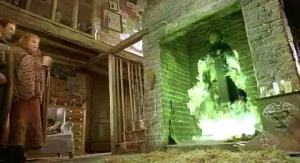
I am not ashamed to admit this, but for the last 12 years of my life, I have wanted nothing more than to be able to toss some Floo powder in a fireplace and walk through that beautiful green flame to the land of Harry Potter. With the last instalment of the 7+1 part movie series being released in Australia tonight, I have been thinking about movie magic, especially that green flame.
I often find myself watching movies, and trying to work out how they make that magic happen. It’s an occupational hazard associated with being a scientist. Most of the time, special effects are created using science – some of it very complicated, but some of it very straightforward and simple. I had a revelation in year 12 chemistry about how they might create the magical Floo network flame, and it is something that I now discuss in our Chemistry workshop.
The demonstration shows how different metal salts can change the colour of a flame. It is a test that is used commonly in chemistry to identify unknown metals in salts. For example, copper salts will turn a flame blue-green and potassium will turn it lilac. This demonstration was originally included in the workshop to explain how fireworks are coloured, but I often have students drawing a parallel to the Floo Network when I create a blue-green flame with copper sulfate in the workshop. Additionally, when I do some demonstrations, students will often say that they are like “magic” and I often find myself reminding them that I’m not a magician but a scientist – I am there to explain how things work, not trick them. So whether it is how I turn the flame green, or why I can sit on a bed of nails they need to be reminded that it is not magic, but great science.
As an educator, I am always learning new things and am constantly reminded of the need to regularly reassess the content of our workshops to ensure that they can continue to inspire our students. References to popular culture (particularly visual mediums like movies and television) can help a student see the relevance in a scientific concept or demonstration because it gives them an additional visual example of what is going on. However, I also have to remember to keep these examples generation appropriate. I have learnt the hard way that references to Harry Potter work, but E.T. and Dumb and Dumber will get blank stares every time.
Bye for now!




