


STEM workshop content
What Students Experience: A Foundation in Computational Thinking
This workshop is part coding, part mapping, and part mathematics. Students transition from being passive technology users to active creators by learning how digital systems follow precise, sequential instructions.
1. Defining the Logic
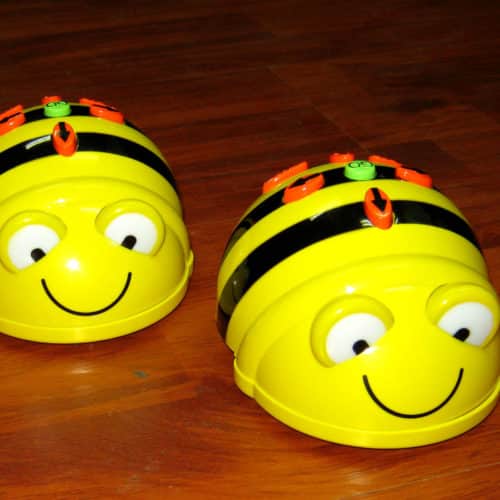
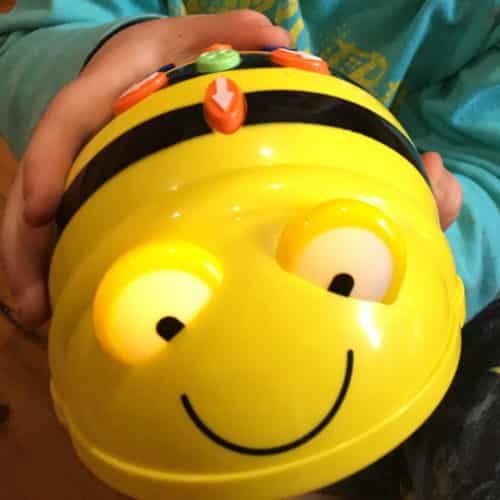
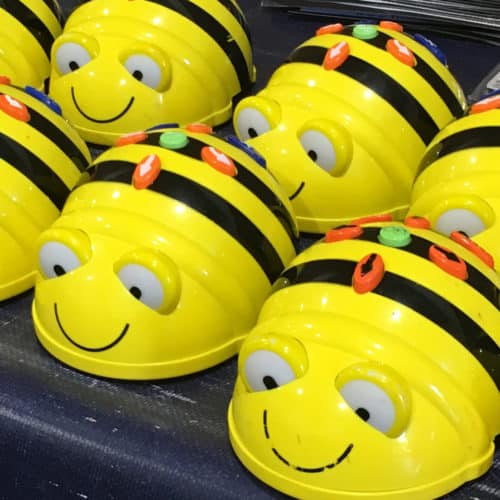
We begin by defining what a robot is and how we control it. Students learn that Bee-Bots follow sequential steps, requiring them to plan their commands both spatially and in a specific order to achieve a goal.
2. Guided Exploration
Students are given their first coding challenge: programming the Bee-Bot to move from a flower to the hive and back. This builds the foundational confidence needed for complex multi-step navigation.
3. Collaborative Challenge
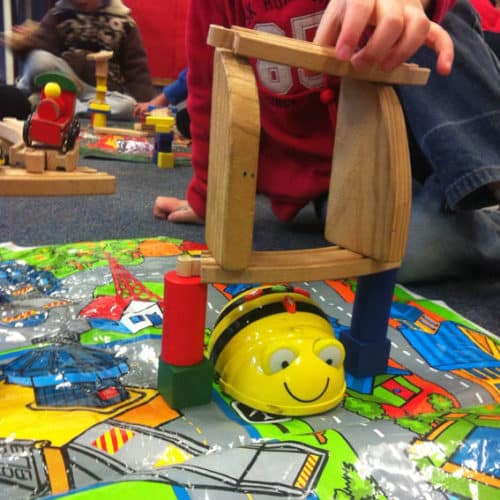
Working in small groups, students navigate specialised maze challenges, word mats, and maths mats. Finally, groups construct their own mazes for their peers to solve, demonstrating mastery of directional logic.
Real-World Connections
The lesson concludes with an interactive discussion on the role of robotics in our daily lives. Students identify robots they may have at home and explore how automated systems are used across industries to solve problems and assist people.
Our students had an incredible time learning to code with Fizzics Education! It was wonderful to see them collaborating to solve maze challenges and building their computational skills.
View on FacebookBee-Bots in action! A fantastic hands-on day of discovery. Thank you to the Fizzics team for making robotics so accessible and engaging for our students.
View on FacebookOur Commitment to Quality Science Education
A Trusted School Partner for hundreds of schools.
At Fizzics Education, we know science is naturally captivating. Our 20-year history is built on delivering reliable, syllabus-aligned visits that engage students and meet the curriculum & practical requirements of the classroom.
Consistency & Care
Supporting Australian schools and teachers since 2004.
Real Feedback
Guided by unedited reviews from educators and principals.
Qualified Presenters
Facilitated by experienced science educators focused on student learning.

Australian Curriculum Mapping
Australian National Curriculum Mapping for all our science incursions
Australian ACARA Content Outcomes:
Science F-10 Version 9.0
Foundation
- describe how objects move and how factors including their size, shape or material influence their movement AC9SFU02
- pose questions and make predictions based on experiences AC9SFI01
Year 1
- describe pushes and pulls in terms of strength and direction and predict the effect of these forces on objects’ motion and shape AC9S1U03
Year 1 & 2
- describe how people use science in their daily lives, including using patterns to make scientific predictions AC9S1H01, AC9S2H01
- pose questions to explore observed simple patterns and relationships and make predictions based on experiences AC9S1I01, AC9S2I01
- compare observations with predictions and others’ observations, consider if investigations are fair and identify further questions with guidance AC9S1I05, AC9S2I05
Digital Technologies F-10 Version 9.0
Foundation
- recognise and explore digital systems (hardware and software) for a purpose AC9TDIFK01
Years 1 & 2
- identify and explore digital systems and their components for a purpose AC9TDI2K01
- investigate simple problems for known users that can be solved with digital systems AC9TDI2P01
- follow and describe algorithms involving a sequence of steps, branching (decisions) and iteration (repetition) AC9TDI2P02
- use the basic features of common digital tools to create, locate and communicate content AC9TDI2P04
- use the basic features of common digital tools to share content and collaborate demonstrating agreed behaviours, guided by trusted adults AC9TDI2P05
Mathematics F-10 Version 9.0
Foundation
- name, represent and order numbers including zero to at least 20, using physical and virtual materials and numerals AC9MFN01
- recognise, copy and continue repeating patterns represented in different ways AC9MFA01
- identify and compare attributes of objects and events, including length, capacity, mass and duration, using direct comparisons and communicating reasoning AC9MFM01
Years 1 & 2
- recognise, represent and order numbers to at least 120 using physical and virtual materials, numerals, number lines and charts AC9M1N01
- describe the position and location of themselves and objects in relation to other people and objects within a familiar space AC9MFSP02
- compare directly and indirectly and order objects and events using attributes of length, mass, capacity and duration, communicating reasoning AC9M1M01
- measure the length of shapes and objects using informal units, recognising that units need to be uniform and used end-to-end AC9M1M02
- give and follow directions to move people and objects to different locations within a space AC9M1SP02
Australian National Curriculum Mapping for all our science workshops & shows

NSW K-10 Science Syllabus Mapping
NSW K – 10 Science Syllabus mapping for all our incursions
NSW Science Syllabus Content
A student:
- STe-7DI-T identifies digital systems and explores how instructions are used to control digital devices
- STe-1WS-S observes, questions and collects data to communicate ideas
- STe-2DP-T develops solutions to an identified need
- ST1-11DI-T identifies the components of digital systems and explores how data is represented
- ST1-1WS-S observes, questions and collects data to communicate and compare ideas
- ST1-2DP-T uses materials, tools and equipment to develop solutions for a need or opportunity
- ST1-3DP-T describes, follows and represents algorithms to solve problems
NSW Science and Technology K–6 Syllabus (Implementation from 2027)
For explanatory points & implementation advice for each dot point, please visit the NESA Science and Technology K–6 Curriculum site
Early Stage 1
STE-PQU-01 poses questions based on observations to collect data
- Identify and safely use digital devices and apps for a purpose
- Follow a series of steps to record, save and retrieve data
Stage 1
ST1-PQU-01 poses questions based on observations and information to investigate cause and effect
ST1-DAT-01 collects, represents and uses data to identify patterns and relationships
ST1-PQU-01 poses questions based on observations and information to investigate
- Describe how digital systems are used in everyday life and for learning
- Create a sequential algorithm that controls a digital device
- Use the basic features of common digital tools to capture, save and retrieve data to communicate and collaborate following agreed rules
NSW Mathematics K – 10 Syllabus Content
A student:
Early Stage 1
- MAE-RWN-01 demonstrates an understanding of how whole numbers indicate quantity
- MAE-FG-01 recognises, describes and continues repeating patterns
- MAE-GM-01 describes position and gives and follows simple directions
- MAE-GM-02 describes and compares lengths
- MAE-GM-03 identifies half the length and the halfway point
Stage 1
- MA1-GM-01 represents and describes the positions of objects in familiar locations
- MA1-GM-02 measures, records, compares and estimates lengths and distances using uniform informal units, as well as metres and centimetres
- MA1-GM-03 creates and recognises halves, quarters and eighths as part measures of a whole length
NSW K – 10 Science Syllabus mapping for all our incursions
Print a PDF detailing NSW K-6 mapping

VIC Science Syllabus Content
VIC Curriculum F–10 Version 2.0
For explanatory points & implementation advice for each dot point, please visit the VIC Curriculum F-10 site.
Digital Technologies Curriculum
Foundation to Level 2
- explore patterns in data and represent data as objects, pictures, symbols, numbers and words. VC2TDI2D01
- explore and use the basic features of common digital tools to create, locate and communicate content for a diverse audience. VC2TDI2D02
- explore and use the basic features of common digital tools to share content and collaborate, demonstrating agreed behaviours and supported by trusted adults. VC2TDI2D03
Mathematics Curriculum
Foundation
- name, represent and order numbers, including zero to at least 20, using physical and virtual materials and numerals VC2MFN01
- identify and compare attributes of objects and events, including length, capacity, mass and duration, use direct comparisons and communicate reasoning VC2MFM01
- describe the position and location of themselves and objects in relation to other people and objects within a familiar space VC2MFSP02
Level 1
- recognise, represent and order numbers to at least 120 using physical and virtual materials, numerals, number lines and charts VC2M1N01
- measure the length of shapes and objects using informal units, recognising that units need to be uniform and used end-to-end VC2M1M02
- give and follow directions to move people and objects to different locations within a space VC2M1SP02
Level 2
- recognise, represent and order numbers to at least 1000 using physical and virtual materials, numerals and number lines VC2M2N01
- measure and compare objects based on length, capacity and mass using appropriate uniform informal units and smaller units for accuracy when necessary VC2M2M01
- identify common uses and represent halves, quarters and eighths in relation to shapes, objects and events VC2M2M02
- locate positions in two-dimensional representations of a familiar space; move positions by following directions and pathways VC2M2SP02
Science Curriculum
Foundation to Level 2
- experiences can be used as a basis for posing questions to explore observed patterns and relationships, and to make predictions. VC2S2I01
- observations, findings and ideas can be shared with others by using everyday and some scientific vocabulary. VC2S2I06
VIC F – 6 Science Syllabus mapping
Print a PDF detailing VIC P-6 mapping
Incursion Requirements
🔬 The Setup
📐 Physical Space
Pair with a Large Stage Show
Combine this workshop with a school favorite for a full-day experience:
Go Further!
Complete Units of Work to Support Your Teaching
Support your classroom with 270+ syllabus-linked lessons, high-quality videos, and marking rubrics.
Support your classroom with 270+ syllabus-linked lessons, high-quality videos, and marking rubrics.






