


STEM workshop content
What Students Experience: The Engineering Challenge
This workshop transforms the classroom into an engineering lab. We move from the history of Rube Goldberg’s whimsical designs into a high-stakes, hands-on mission where failure is just a step toward a better solution.
1. Inspiration & Logic
We begin with an engaging discussion and video showcase of complex Rube Goldberg machines. Students analyse how simple triggers lead to massive chain reactions, setting the stage for their own design thinking process.
2. The Build Challenge
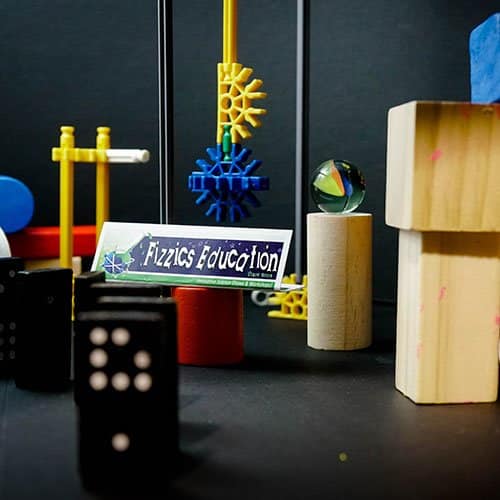
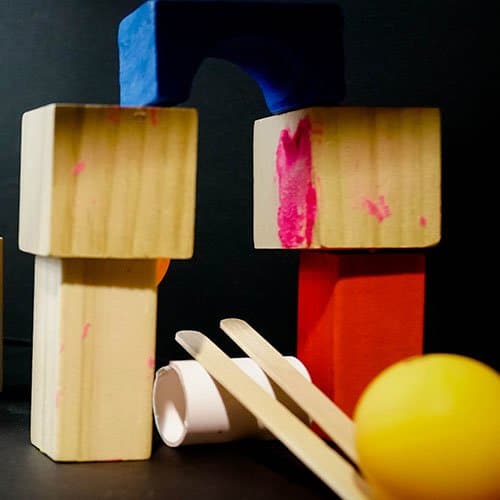
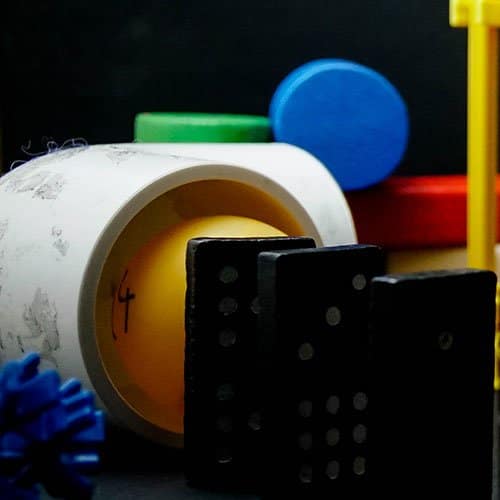
Armed with everyday materials and unexpected items, teams must build a contraption that harnesses potential and kinetic energy. The goal? Creating a precise sequence of events that successfully rings a desk bell.
3. Defining STEM
We wrap up by connecting the fun back to the real world. Students discuss what STEM actually is: the powerful combination of materials, scientific knowledge, and collaboration to solve a given problem.
Our students absolutely loved the Rube Goldberg challenge! It was amazing to see them working together, testing ideas, and learning that “failing” a build is just part of the engineering process.
A fantastic day of engineering! The Fizzics team challenged our students to think outside the box. The buzz in the room as they designed their machines was incredible.
Our Commitment to Quality Science Education
A Trusted School Partner for hundreds of Australian schools
At Fizzics Education, we know science is naturally captivating. Our 20-year history is built on delivering reliable, syllabus-aligned visits that engage students and meet the practical requirements of the Australian classroom.
Supporting Australian schools and teachers since 2004.
Guided by unedited reviews from educators and principals.
Facilitated by experienced science specialists focused on student learning.

Australian Curriculum Mapping
Australian National Curriculum Mapping for all our science incursions
Australian ACARA Content Outcomes:
Science F-10 Version 9.0
Year 4
- identify how forces can be exerted by one object on another and investigate the effect of frictional, gravitational and magnetic forces on motion AC9S4U03
- examine properties of natural and made materials and consider how these properties influence their use in engineering AC9S4U04
Year 3 & 4
- examine how people use data to develop scientific explanations AC9S3H01, AC9S4H01
- consider how people use scientific explanations to meet a need or solve a problem AC9S3H02, AC9S4H02
- pose questions to explore observed patterns and make predictions based on observations AC9S3I01, AC9S4I01
Year 5 & 6
- investigate how scientific knowledge is used to identify problems, consider responses and make decisions AC9S5H02, AC9S6H02
- pose investigable questions to identify patterns and test relationships AC9S5I01, AC9S6I01
- compare methods and findings with others, recognise sources of error and draw reasoned conclusions AC9S5I05, AC9S6I05
Design and Technologies F-10 Version 9.0
Years 3 & 4
- describe how forces and the properties of materials affect function in a product or system AC9TDE4K02
- test materials, components, tools, equipment and processes needed to create designed solutions AC9TDE4P01
- generate and communicate design ideas and decisions using appropriate technical terms and graphical representation AC9TDE4P02
- sequence steps to individually and collaboratively make designed solutions AC9TDE4P05
Years 5 & 6
- explain how characteristics and properties of materials, systems, components, and tools affect their use in designed solutions AC9TDE6K05
- investigate needs or opportunities for designing, and the materials/processes needed to create solutions AC9TDE6P01
- select and use suitable materials, components, tools, and techniques to safely make designed solutions AC9TDE6P03
- develop project plans that include consideration of resources to collaboratively make designed solutions AC9TDE6P05
Australian National Curriculum Mapping for all our science workshops & shows

NSW K-10 Science Syllabus Mapping
NSW K – 10 Science Syllabus mapping
NSW Science Syllabus Content
A student:
- ST2-9PW-ST describes how contact and non-contact forces affect an object’s motion
- ST3-7MW-T explains how the properties of materials determines their use for a range of purposes
- ST3-9PW-ST investigates the effects of increasing or decreasing the strength of a specific force
- ST3-2DP-T plans and uses materials, tools and equipment to develop solutions
NSW Science and Technology K–6 Syllabus (Implementation from 2027)
For implementation advice, visit the NESA Curriculum site.
Stage 3
ST3-SCI-01 knowledge used to develop sustainable practices
- Recognise that in a fair test, an independent variable is changed while controls remain the same
ST3-DDT-01 uses design processes to create, evaluate and modify solutions
- Develop design ideas to build a prototype using specific design criteria
- Test, evaluate and modify the prototype to meet those criteria
NSW K-10 Science Syllabus Mapping
Print a PDF detailing NSW K-6 mapping

VIC Science Syllabus Content
Science (Version 2.0)
Levels 3 & 4
- Properties of materials influence their use and re-use. VC2S4U05
- Direct and distance forces affect the motion (speed and direction) of objects. VC2S4U10
- Planning scientific investigations using fair test attributes. VC2S4I02
Design and Technologies
Levels 3 & 4
- Describe how forces and material properties affect system function. VC2TDE4C01, VC2TDE4C04
- Generate and communicate design ideas using technical terms. VC2TDE4D02
- Select and use tools and techniques to safely make solutions. VC2TDE4D03
- Sequence steps to collaboratively make designed solutions. VC2TDE4D05
Levels 5 & 6
- Explain how properties of components and tools affect their use. VC2TDE6C04
- Generate, iterate and communicate design processes. VC2TDE6D02
- Develop project plans that include consideration of resources. VC2TDE6D05
VIC F – 6 Science Syllabus Mapping
Print a PDF detailing VIC P-6 mapping
Session Requirements
👥 Capacity & Timing
👨🎓 Attendance: Max 32 students per class.
🏫 Target: Appropriate for Years 3 to 6.
⏰ Duration: 60 or 90-minute versions available.
🛠️ Setup: 30 mins set/pack required.
🛠️ Engineering Tools: All specialised building materials and tools are provided. Students are guided through safe construction techniques.
📍 Space Needs
🏗️ Room Layout: 7 tables arranged around the perimeter.
🧱 Wall Space: Access to clear wall space is essential for building.
🪑 Seating: Chairs are not required for students.
Go Further!
Complete Units of Work to Support Your Teaching
Support your classroom with 270+ syllabus-linked lessons, high-quality videos, and marking rubrics.
Save time and engage students in engineering with high-quality videos, printable experiments, and full marking rubrics.
Extend the Experience
Combine this engineering workshop with one of our high-impact stage shows:






