




Science Show Demonstrations
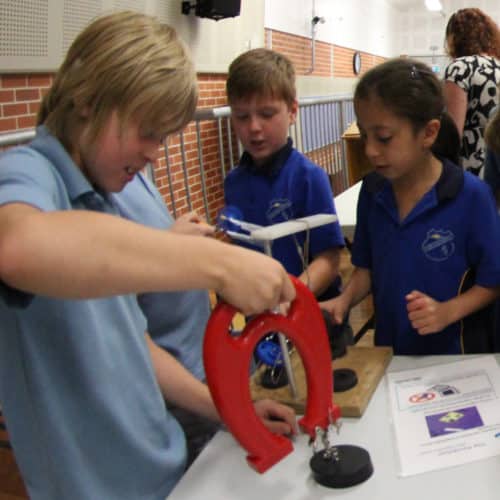
- Bumper Cars – Magnetic North and South Poles in a different way!
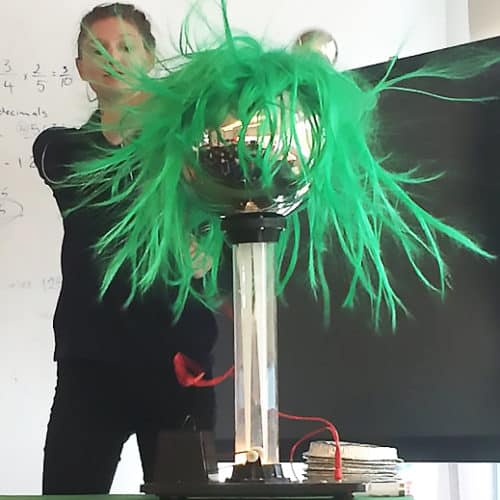
- Van de Graf hair rise – Opposite charges attract, like charges repel…
- Magnetic Fields – Observe the iron shapes formed by the magnet
- Levitating Larry – Why can you make him float?
- Circuit Constructor – Can you make the bulb light up? What about the buzzer?
- Skill Tester – Guide your loop along the wire. Don’t be the switch!
- Hand Generator – Create a buzz with the hand driven dynamo!
- Traffic Light – Make all of the lights turn on in this electronic puzzle.
- Resist the flow – What does electrical resistance look like?
- Electric Fleas – Create a static charge to make them move!
- Magnetic Mayhem – Place all of the magnetic balls on the square. Good luck!
- Sweaty hands – There is salt in sweat? Does salt conduct electricity?
- The Pendulum – Predict which way the magnet will swing
- Is it Iron? – Discover which materials are attracted to magnets
- Electromagnets – Make a magnet turn on and off
- Lemon Clock – Make a clock turn on with fruit power!
- Finding North – Use the magnet to show where north is
- Magnet Racing – Race the supermagnets down the tubes, which will win?
- Twisted TV – How do magnetic fields affect electrical appliances?
Science show & workshop ontent
What Students Experience
Whether delivered as a deep-dive workshop or a high-impact show, students journey through the fundamental forces of electromagnetism. We move from massive static discharges to the intricate logic of modern circuitry.
1. Sparks & Plasma
We launch with an engaging look at static vs. current electricity. Using the Van de Graaff generator and plasma balls, students witness the power of 100,000 volts and learn the vital difference between open and closed circuits.
2. Hands-On Exploration
In the workshop version, students rotate through active stations to construct series vs. parallel circuits and experiment with magnetic repulsion. (In the show version, these are delivered as large-scale front-of-room demonstrations).
3. The Invisible Link
The experience culminates in the bridge between forces: Electromagnetism. We use a high-powered electromagnet to show how electricity can create a magnet, using clear circuit diagrams to solidify their understanding.
Which electricity workshop is right for me?
We offer several specialised programs. Click a title below to see if another focus fits your current lesson plan better:
Our students were “electrified” by the Fizzics Education visit! A fantastic deep dive into circuits and the physics of electricity. The hands-on stations were a highlight for our Year 6 cohort.
Thanks to Fizzics Education for our expert talk on electricity and circuits. A great way to kickstart our unit on energy transformations!
Our Commitment to Quality Science Education
At Fizzics Education, our 20-year history is built on delivering reliable, syllabus-aligned visits that engage students and meet the practical requirements of the Australian classroom.
Supporting Australian schools and teachers since 2004.
Guided by unedited reviews from educators and principals.
Facilitated by experienced science educators focused on student learning.

Australian Curriculum Mapping
Australian National Curriculum Mapping for all our science incursions
Australian ACARA Content Outcomes:
Science F-10 Version 9.0
Year 4
- Examine the properties of natural and made materials, including metals, and consider how these properties influence their use (e.g., conductivity) AC9S4U04
Year 3 & 4
- Examine how people use data to develop scientific explanations AC9S3H01, AC9S4H01
- Consider how people use scientific explanations to meet a need or solve a problem AC9S3H02, AC9S4H02
- Pose questions to explore observed patterns and relationships and make predictions AC9S3I01, AC9S4I01
Year 6
- Investigate the transfer and transformation of energy in electrical circuits, including the role of circuit components, insulators and conductors AC9S6U03
Year 5 & 6
- Investigate how scientific knowledge is used by individuals and communities to identify problems and make decisions AC9S5H02, AC9S6H02
- Pose investigable questions to identify patterns and test relationships AC9S5I01, AC9S6I01
- Compare methods and findings with others, recognise possible sources of error, and draw reasoned conclusions AC9S5I05, AC9S6I05
Design and Technologies F-10 Version 9.0
Years 5 & 6
- Explain how electrical energy can be transformed into movement, sound or light in a product or system AC9TDE6K02
Australian National Curriculum Mapping for all our science workshops & shows

NSW K-10 Science Syllabus Mapping
NSW K – 10 Science Syllabus mapping
NSW Science Syllabus Content
A student:
- ST2-8PW-ST describes the characteristics and effects of common forms of energy, such as light and heat
- ST3-8PW-ST explains how energy is transformed from one form to another
- ST3-9PW-ST investigates the effects of increasing or decreasing the strength of a specific contact or non-contact force
NSW Science and Technology K–6 Syllabus (Implementation from 2027)
For implementation advice, visit the NESA Curriculum site.
Stage 2
- ST2-SCI-01 Recognise that matter consists of very small particles and investigate energy effects
- ST2-PQU-01 Poses questions to create fair tests that investigate the effects of energy on physical systems
Stage 3
ST3-SCI-01 Uses evidence to explain how scientific knowledge can be used to develop sustainable practices
- Recognise that an electrical circuit transfers energy from a source through a pathway to be transformed
- Plan and construct simple electrical circuits to model the transfer and transformation of energy
- Safely conduct fair tests to identify materials that act as electrical conductors or insulators
ST3-PQU-01 Poses questions to identify variables and conducts fair tests to gather data
NSW K-10 Science Syllabus Mapping
Print a PDF detailing NSW K-6 mapping

VIC Science Syllabus Content
Science (Version 2.0)
Levels 3 and 4
- Forces (frictional, gravitational, electrostatic, magnetic) can be exerted by contact or from a distance. VC2S4U10
- Scientific investigations to answer questions can be planned and conducted using fair test attributes. VC2S4I02
Levels 5 and 6
- Materials may be electrical insulators or conductors; energy can be transferred and transformed in circuits. VC2S6U09
- Repeatable scientific investigations can be planned, deciding the variables to be changed, measured, and controlled. VC2S6I02
Design and Technologies
Levels 5 & 6
- Explain how electrical energy can be transformed into movement, sound or light in a product or system. VC2TDE6C01
VIC F – 6 Science Syllabus Mapping
Print a PDF detailing VIC P-6 mapping
Session Requirements
👥 Capacity & Timing
👨🎓 Attendance: Max 32 students per class.
🏫 Target: Appropriate for Years 3 to 6.
⏰ Duration: 60 minutes.
🛠️ Setup: 45 mins set/pack required.
⚡ Equipment: All specialised electrical components and Van de Graaff generators are provided. No hazardous mains-voltage exposure for students.
📍 Space & Power
🏗️ Room Layout: 7 tables required for hands-on stations.
🔌 Power: Access to 3 electrical power sockets.
🪑 Seating: Chairs are not required for students.
Go Further!
Complete Units of Work to Support Your Teaching
Support your classroom with 270+ syllabus-linked lessons, high-quality videos, and marking rubrics.
Save time and engage students in STEM with high-quality videos, printable experiments, and full marking rubrics for your Electricity unit.
Extend the Experience
Pair this workshop with a larger stage show for groups of up to 240 students:






