


STEM workshop content
What Students Experience: Medieval STEM in Action
Explore the mechanical advantage of the medieval world! Our presenters guide children through the physics of tension and structural geometry, demonstrating how ancient engineers used triangles to manage the massive forces imposed on their machines.
1. Engineering Principles
Students compare Catapult vs. Trebuchet mechanics. We delve into how structural strength and structural geometry are essential when building machines designed to withstand high tension.
2. Hands-on Construction
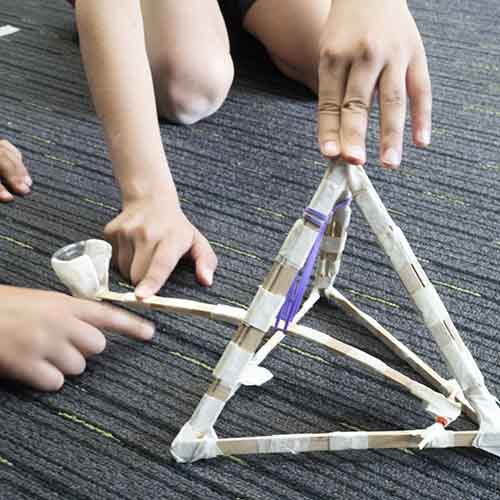
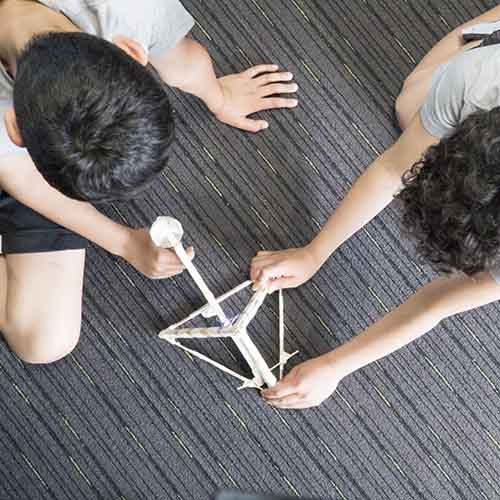
Using timber kits, hot glue guns, and work mats, students work collaboratively to assemble their devices. They apply their knowledge of tension and potential energy to create a functioning machine.
3. The Siege Test
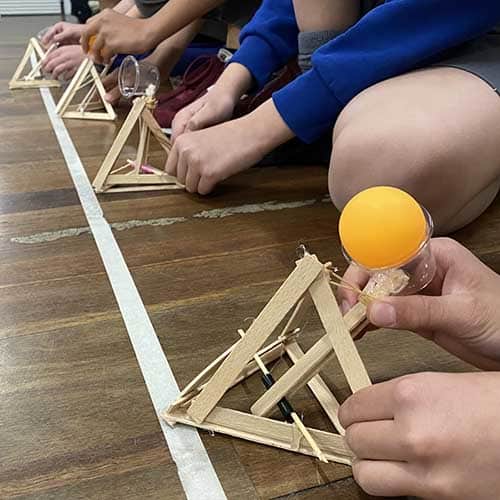
Once construction is complete, students put their creations to the test! We aim for distance and accuracy by launching ping pong balls at targets. Best of all? Students get to take their catapult home.
⚠️ Safety Note: Hot glue guns are used throughout this workshop. While we provide full safety instructions and all care is taken, we do not take responsibility for injuries caused by the misuse of equipment.
Our Commitment to Quality Science Education
A Trusted School Partner for 100’s of schools
At Fizzics Education, we know science is naturally captivating. Our 20-year history is built on delivering reliable, syllabus-aligned visits that engage students and meet the curriculum & practical requirements of the classroom.
Supporting Australian schools and teachers since 2004.
Guided by reviews from educators and principals.
Facilitated by experienced science educators focused on student learning.

Australian Curriculum Mapping
Australian National Curriculum Mapping for all our science incursions
Australian ACARA Content Outcomes:
Science F-10 Version 9.0
Year 4
- identify how forces can be exerted by one object on another and investigate the effect of gravitational forces on the motion of objects AC9S4U03
- examine the properties of natural and made materials, including timber and adhesives, and consider how these properties influence their use in engineering AC9S4U04
Year 3 & 4
- examine how people use data to develop scientific explanations AC9S3H01, AC9S4H01
- consider how people use scientific explanations to meet a need or solve a problem (siege engineering) AC9S3H02, AC9S4H02
- pose questions to explore observed patterns and relationships and make predictions based on observations AC9S3I01, AC9S4I01
- compare findings with others, consider if investigations were fair, and draw conclusions AC9S3I05, AC9S4I05
Year 5 & 6
- investigate how scientific knowledge is used to identify problems, consider responses and make decisions AC9S5H02, AC9S6H02
- pose investigable questions to identify patterns and test relationships and make reasoned predictions regarding momentum and range AC9S5I01, AC9S6I01
- recognise possible sources of error and select evidence to draw reasoned conclusions AC9S5I05, AC9S6I05
Design and Technologies F-10 Version 9.0
Years 3 & 4
- describe how forces and the properties of materials affect function in a product or system AC9TDE4K02
- explore needs or opportunities for designing, and test materials, components, and tools needed to create designed solutions AC9TDE4P01
- select and use materials, components, tools, equipment and techniques to safely make designed solutions AC9TDE4P03
- sequence steps to individually and collaboratively make designed solutions AC9TDE4P05
Years 5 & 6
- explain how characteristics and properties of materials, systems, components, and tools affect their use when producing designed solutions AC9TDE6K05
- investigate materials, components, tools, equipment and processes needed to create designed solutions AC9TDE6P01
- select and use suitable materials, components, tools, equipment and techniques to safely make designed solutions AC9TDE6P03
- develop project plans that include consideration of resources to individually and collaboratively make designed solutions AC9TDE6P05
Australian National Curriculum Mapping for all our science workshops & shows

NSW K-10 Science Syllabus Mapping
NSW K – 10 Science Syllabus mapping
NSW Science Syllabus Content
A student:
- ST3-7MW-T explains how the properties of materials determines their use for a range of purposes
- ST3-9PW-ST investigates the effects of increasing or decreasing the strength of a specific contact or non-contact force
- ST3-2DP-T plans and uses materials, tools and equipment to develop solutions for a need or opportunity
NSW Science and Technology K–6 Syllabus (Implementation from 2027)
For implementation advice, visit the NESA Science and Technology site.
Stage 3
ST3-SCI-01 uses evidence to explain how scientific knowledge can be used to develop sustainable practices
- Recognise that in a fair test, variables are measured and controlled to ensure valid results.
ST3-PQU-01 poses questions to identify variables and conducts fair tests to gather data
ST3-DDT-01 uses design processes to create, evaluate and modify designed solutions
- Develop design ideas to build a prototype (catapult) using design criteria.
- Test, evaluate and modify the prototype to meet accuracy and distance criteria.
NSW K-10 Science Syllabus Mapping
Print a PDF detailing NSW K-6 mapping

VIC Science Syllabus Content
Science (Version 2.0)
Levels 3 & 4
- The properties of natural and made materials influence their use. VC2S4U05
- Forces, including gravitational, can be exerted by one object on another and affect motion. VC2S4U10
- Scientific investigations can be planned and conducted identifying fair tests. VC2S4I02
Levels 5 & 6
- Repeatable scientific investigations to answer questions can be planned and conducted, identifying variables to be changed, measured and controlled. VC2S6I02
Design and Technologies
Levels 3 & 4
- Describe how forces and properties of materials affect function in a product. VC2TDE4C01, VC2TDE4C04
- Select and use materials, components, tools and techniques to safely make designed solutions. VC2TDE4D03
- Sequence steps to individually and collaboratively make designed solutions. VC2TDE4D05
Levels 5 & 6
- Explain how characteristics and properties of materials and tools affect their use. VC2TDE6C04
- Generate, iterate and communicate design ideas, decisions and processes using technical terms. VC2TDE6D02
- Develop project plans that include consideration of resources to collaboratively make solutions. VC2TDE6D05
VIC F – 6 Science Syllabus Mapping
Print a PDF detailing VIC P-6 mapping
Session Requirements
👥 Audience & Timing
👥 Attendance: Max 32 students per class.
👥 Target: Years 5 to 6 preferred.
⏰ Duration: 60 or 90 minutes.
🛠️ Set/Pack: 45 mins setup + 45 mins pack down.
⚠️ Safety Notice: Hot glue guns are used. Appropriate safety instructions are provided. We do not take responsibility for injuries caused by the misuse of equipment.
📍 Space & Power
🏗️ Tables: 5 large tables minimum (8 trestles preferred).
🔌 Power: At least 2 power sockets (4 preferred).
🪑 Seating: Chairs are not required for students.
Go Further!
Complete Units of Work to Support Your Teaching
Support your classroom with 270+ syllabus-linked lessons, high-quality videos, and marking rubrics.
Save time and engage students in STEM with high-quality videos, printable experiments, and full marking rubrics for your Chemistry unit.
Extend the Experience
Pair this workshop with a larger stage show for groups of up to 240 students:






