



Science of the Deep Blue!
Dive into the science of the sea as we explore the physical factors that determine life underwater and along our coastlines.
- Learn about what drives ocean acidification and its effect on coral.
- How do heat and salt drive our ocean currents?
- How does pressure change underwater and what does this mean for marine life as well as scuba divers?
- Why do light wavelengths & intensity change as you go deeper and what does this mean for organisms?
- How do whales and dolphins use echolocation to locate prey?
- Which technologies are being used in current ocean research?
- … and more!
This show & workshop was specially designed for National Science Week 2020 ‘Deep Blue: innovations for the future of our oceans.’
Available as a primary school science incursion within Australia or as a video conference to any school around the globe!
Online Class Version
We’ve run live interactive distance programs since 2010 and are highly experienced in making online classes engaging for students on a variety of web conferencing platforms.
- All of the same curriculum points will be covered, but the activities may vary from those listed for face-to-face incursions.
- Our online classes include opportunities for students to ask questions.
- Full child protections are in place
- We usually connect to classes & homes via Zoom, however if you wish to use a different software we can work with you on getting the connection live.
If you connect with us via Zoom
- Full system requirements for Zoom here
- Each student should test their Zoom connection here.
- Once the date & time is arranged we will send you simple connection instructions (one click & you’re in!)
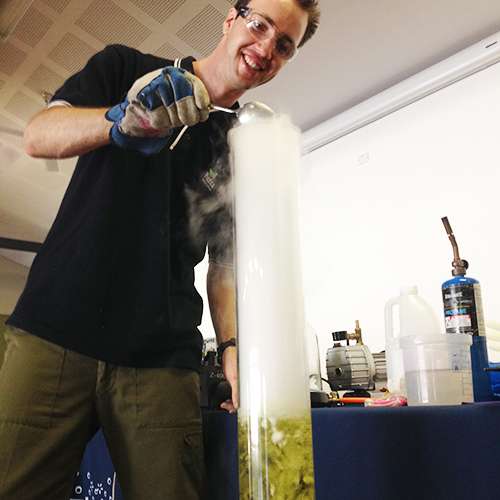
Science Show Demonstrations
- Light attenuation – What happens to light as we go deeper?
- Under pressure – How does pressure change as you descend into the ocean?
- Colourful currents – How do heat and salinity affect ocean currents?
- Echolocation – We look at how whales & dolphins hunt prey
- It glows! – How is luminescence used by some organisms underwater?
- Science of SCUBA – Divers avoid decompression sickness… how & why?
- Ocean acidification – Corals can’t handle big changes in pH. How is this a problem now?
- Hydropower – We can harness the energy of the waves!
- Weird sealife – We look at the diversity of life underwater
- Whale snot sampling – Seriously, this is a thing! Using drones in current research
- Fresh vs salt water – How much freshwater is there really in the world?
- Cleaning our oceans – How are scientists & engineers combating pollution in our oceans?

Australian Curriculum Mapping
Australian ACARA Content Outcomes:
| Code | What students learn |
|---|---|
| ACSSU002 | Living things have basic needs, including food and water |
| ACSSU211 | Living things live in different places where their needs are met |
| ACSSU072 | Living things have life cycles |
| ACSSU043 | Living things have structural features and adaptations that help them to survive in their environment |
| ACSSU005 | The way objects move depends on a variety of factors, including their size and shape |
| ACSSU033 | A push or a pull affects how an object moves or changes shape |
| ACSSU020 | Light and sound are produced by a range of sources and can be sensed |
| ACSSU049 | Heat can be produced in many ways and can move from one object to another |
| ACSSU076 | Forces can be exerted by one object on another through direct contact or from a distance |
| ACSSU080 | Light from a source forms shadows and can be absorbed, reflected and refracted |
| ACSSU095 | Changes to materials can be reversible, such as melting, freezing, evaporating; or irreversible, such as burning and rusting |
| ACSSU077 | Solids, liquids and gases have different observable properties and behave in different ways |
Australian National Curriculum Mapping for all our science workshops & shows

NSW K-10 Science Syllabus Mapping
NSW K – 10 Science Syllabus mapping for all our incursions
NSW Science Syllabus Content: A student:
| Code | What students learn |
|---|---|
| STe-5PW-ST | observes the way objects move and relates changes in motion to push and pull forces |
| STe-3LW-ST | explores the characteristics, needs and uses of living things |
| ST1-8PW-S | describes common forms of energy and explores some characteristics of sound energy |
| ST2-4LW-S | compares features and characteristics of living and non-living things |
| ST2-6MW-S | describes how adding or removing heat causes a change of state |
| ST2-8PW-ST | describes the characteristics and effects of common forms of energy, such as light and heat |
| ST2-9PW-ST | describes how contact and non-contact forces affect an object’s motion |
| ST3-4LW-S | examines how the environment affects the growth, survival and adaptation of living things |
| ST3-6MW-S | explains the effect of heat on the properties and behaviour of materials |
| ST3-8PW-ST | explains how energy is transformed from one form to another |
| ST3-9PW-ST | investigates the effects of increasing or decreasing the strength of a specific contact or non-contact force |
Science and Technology K–6 Syllabus
(Implementation from 2027)
For explanatory points & implementation advice for each dot point, please visit the NESA Science and Technology K–6 Curriculum site
| Code | What students learn |
|---|---|
| STE-SCI-01 | identifies and describes characteristics of living things, properties of materials, and movement |
| STE-PQU-01 | poses questions based on observations to collect data |
| ST1-SCI-01 | measures and describes changes in living things, materials, movement, Earth and the sky |
| ST1-PQU-01 | poses questions based on observations and information to investigate cause and effect |
| ST2-SCI-01 | uses information to investigate the solar system and the effects of energy on living, physical and geological systems |
| ST2-PQU-01 | poses questions to create fair tests that investigate the effects of energy on living things and physical systems |
| ST3-SCI-01 | uses evidence to explain how scientific knowledge can be used to develop sustainable practices |
| ST3-PQU-01 | poses questions to identify variables and conducts fair tests to gather data |
NSW K – 10 Science Syllabus mapping for all our incursions
Print a PDF which details K to 6 mapping of all our science visits

VIC Science Syllabus Content
Victorian Science Syllabus
| Code | What students learn |
|---|---|
| VCSSU058 | Different living things have different life cycles and depend on each other and the environment to survive |
| VCSSU063 | Heat can be produced in many ways and can move from one object to another; a change in the temperature of an object is related to the gain or loss of heat by the object |
| VCSSU064 | Forces can be exerted by one object on another through direct contact or from a distance |
| VCSSU074 | Living things have structural features and adaptations that help them to survive in their environment |
| VCSSU075 | The growth and survival of living things are affected by the physical conditions of their environment |
| VCSSU080 | Light from a source forms shadows and can be absorbed, reflected and refracted |
Print a PDF which details P to 6 mapping of all our VIC science visits
Requirements
- Appropriate for Years K to 6 with a maximum of 240 students per science show
- Access to 2 electrical power sockets and 2 tables
- Chairs are not required
- Duration 60 minutes, set up time 45 minutes and pack up time 45 minutes
- Ability to darken the room for some of the demonstrations
- *Some science experiments may be varied depending on the age of the attending audience
Go Further!
Complete Units of Work to Support Your Teaching
Support your classroom with 270+ syllabus-linked lessons, high-quality videos, and marking rubrics.






