Microplastics under the microscope – water filtration lab
A lab on how microplastics can be found in laundry lint for classrooms
Adult supervision for setup
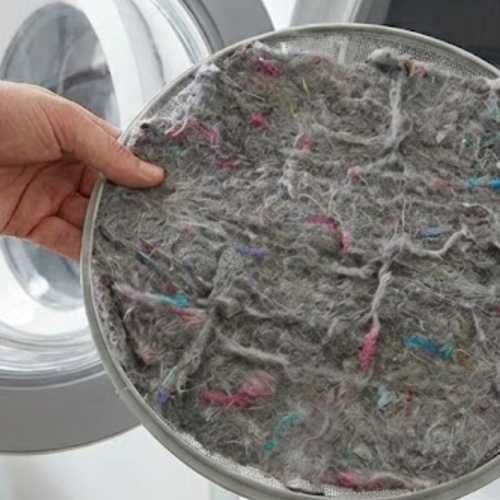
You will need
- Lint from a dryer (try lint from washes of different fabrics)
- A digital or standard microscope (or a magnifying glass if unavailable)
- A Funnel
- Filter paper
- A clear glass to hold the funnel
- Spoon
- Petri dish or clear glass slide for sorting
- Tweezers or a probe
- Pipette or eyedropper
Method
-
Take a pinch of laundry lint and add this to 100mL of water. Stir this vigorously to separate the fibres into a suspension.
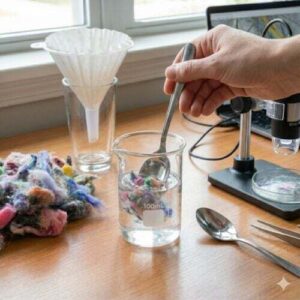
-
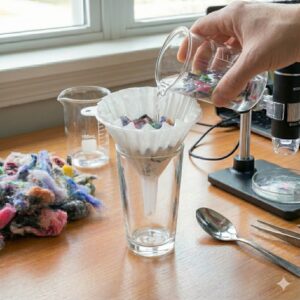
Place the funnel into the glass. Add the filter paper to the funnel and pour the suspension through the filter paper.
Option 1 – Investigate the filter paper.
Allow the filter paper to dry. Once the filter paper has dried, place the paper under the digital microscope (scrape this onto a glass slide for a standard microscope).
Can you count how many distinct coloured lint fibres there are?
Additionally, how many of these fibres will form microplastics?
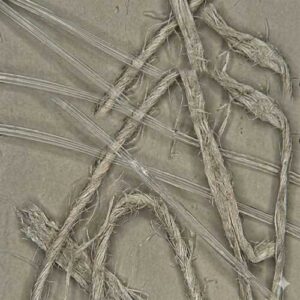
- Synthetic Fibres (Polyester, Nylon, Acrylic)
These usually look like fishing lines. They are often uniform in thickness, very smooth, long, and may be shiny under a light source. These are the microplastics. - Natural Fibres (Cotton, Wool)
These tend to look rougher. Cotton often looks like a twisted ribbon or has frayed edges. Wool may look scaly (like human hair).
- Synthetic Fibres (Polyester, Nylon, Acrylic)
-
Option 2 – Investigate the suspension
The smallest microplastics will have passed through your filter paper and into the water. Use the pipette or eyedropper to sample towards the bottom of the water and place this on a petri dish or glass slide and then place under a microscope.
You may have trouble viewing this under low magnification; increase the magnification and change the amount of light coming through the petri dish or glass slide to see the tiny microplastics that are in the water.
The science behind it
What is going on?
Microplastics Under the Microscope
Research shows that a single load of washing can release hundreds of thousands of microfibres into the wastewater system. Most modern clothing is made from synthetic polymers—such as polyester, nylon, and acrylic—which are essentially types of plastic.
During a wash cycle, the mechanical agitation and the chemical action of detergents cause these fabrics to shed tiny filaments. Because these particles are so small (often less than 5 millimetres in length), many pass through wastewater treatment plants and end up in our oceans.
The cumulative impact of this is significant: millions of loads of washing globally are contributing to a massive microplastic problem. These fibres are easily ingested by small marine organisms, allowing plastic to enter the food chain and eventually impact larger animals and even humans.
Variables to test
Find out more on variables here.
-
Fabric Composition
Does it matter if you wash different brands of shirts or shorts? Compare a “fast fashion” polyester shirt with a high-end synthetic garment to see if one sheds more fibres. -
Dye and Degradation
Does a certain fabric colour break down more than another? Sometimes the chemicals used in specific dyes can weaken the structural integrity of the synthetic fibres. -
Wash Temperature
Does washing in hot water versus cold water change the amount of microfibres shed? (Hint: Heat can soften some plastic polymers!)

Teacher's note
Curriculums change, and so does the way you implement them in your classroom. Please use your own experience and knowledge of your students to use these resources to best effect for student learning.
Still want the curriculum links?
Here are the suggested links:
Australian Curriculum (ACARA) Science:
NSW Science syllabuses:
Victorian Curriculum Science:
Want this experiment — and many more — running in your classroom?
Have us visit your school — every student gets three hands-on experiments in 60–90 minutes with a qualified presenter.