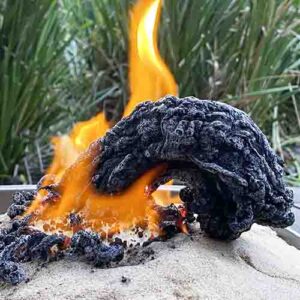
Rocky Roller
Investigate what happens when you roll objects with inconsistent densities. A strange rolling motion can be seen in this one!
Adult supervision for setup
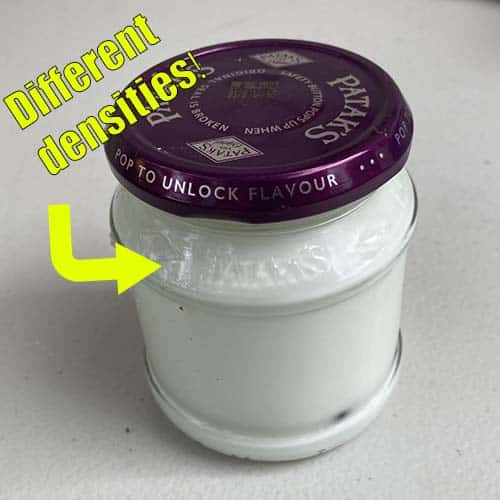
You will need
- 1x cup of corn starch / cornflour
- ¼x cup of water
- One glass jar or another sealable round container
- Wide plank of wood for the ramp
- Small cardboard box for the ramp
- One ping pong ball or golf ball
Method
-
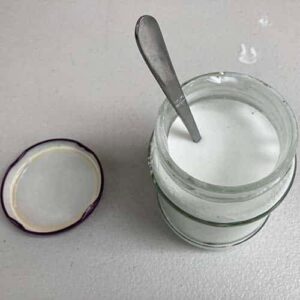
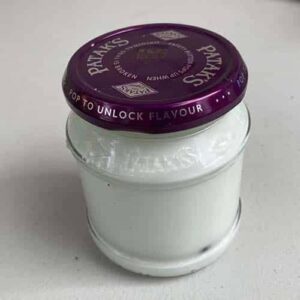
Put 1 cup of corn starch/ cornflour in the glass container slowly add water to the cornflour while mixing with a spoon (aim for about ¼ cup of water). The mixing is done when the liquid has the texture of honey.
-
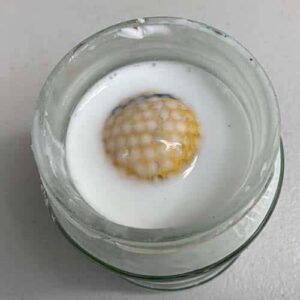
Add the ping pong ball or the golf ball into the corn starch mixture.
-
Seal the jar tightly. You may want to add tape around the seal to ensure that you don’t leak your experiment everywhere!
-
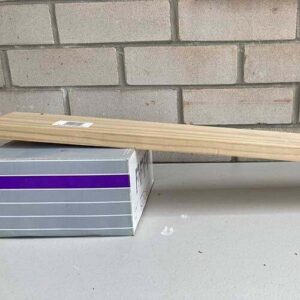
Set up a ramp using the cardboard box and plank of wood.
Start rolling! Try different angles to see if the motion of the roller changes. What do you observe?
-
Get the Unit of Work on Forces here!
- Push, pull
- Friction & spin!
From inertia to centripetal force, this unit covers many concepts about Newton’s Laws!
Includes cross-curricular teaching ideas, student quizzes, a sample marking rubric, scope & sequences & more

-
School science visits since 2004!
– Curriculum-linked & award-winning incursions.
– Over 40 primary & high school programs to choose from.
– Designed by experienced educators.
– Over 2 million students reached.
– Face to face incursions & online programs available.
– Early learning centre visits too!
-

The science behind it
What is going on?
The Science of the Rocky Roller
The “Rocky Roller” experiment is a fascinating study of fluid dynamics and the centre of mass. An object’s centre of mass is the specific point where its mass is perfectly balanced in all directions. Usually, a symmetrical object like a jar has its centre of mass right in the middle—but not in this experiment!
Because the jar contains a mixture of cornflour slime and a ping pong ball, its density is non-uniform. The air-filled ping pong ball is much less dense than the heavy slime surrounding it. As the jar rolls, the ball constantly tries to “float” to the top, while gravity pulls the heavy slime to the bottom. This tug-of-war shifts the centre of mass back and forth, creating the erratic rocking motion you see on the ramp.
Non-Newtonian Fluids: Shear-Thickening
The cornflour slime used here is a Non-Newtonian fluid. Specifically, it is “shear-thickening.” According to Newton’s law of viscosity, a normal fluid (like water) flows at a constant rate regardless of the force applied to it. However, the viscosity of this slime changes depending on shear stress (pressure).
- Low Pressure: The starch particles have time to glide past each other, allowing the mixture to act like a liquid.
- High Pressure: If the jar moves or hits an obstacle suddenly, the starch particles lock together, causing the fluid to behave like a solid.
Real-World Applications
This “liquid-to-solid” magic isn’t just for toys! Engineers are using these properties to develop:
- Liquid Body Armour: Vests that remain flexible for the wearer but turn rock-solid the instant they are struck by a bullet.
- Smart Speed Bumps: Speed bumps filled with non-Newtonian fluid. If you drive slowly, the fluid moves out of the way; if you speed, the fluid hardens to give you a jolt!
Variables to test
-
Fluid Viscosity
Can you recreate this effect using plain water? Since water is a Newtonian fluid with low viscosity, will it provide enough resistance to push the ping pong ball around effectively? -
Gravitational Potential
Does the slope of the ramp change the rocking motion? Does a steeper incline provide more energy, perhaps overcoming the fluid’s resistance? -
Object Density
Try using a heavy glass marble instead of a ping pong ball. Does a denser object sink faster than the ball floats, changing the rocking frequency? -
Volume Displacement
What happens if you use multiple ping pong balls? Does having more buoyant objects create a more chaotic movement or a smoother roll?
To ensure a fair test, try to use the same jar and the same consistency of slime while changing only one of these factors at a time!

Teacher's note
Curriculums change, and so does the way you implement them in your classroom. Please use your own experience and knowledge of your students to use these resources to best effect for student learning.
Still want the curriculum links?
Here are the suggested links:
Australian Curriculum (ACARA) Science:
NSW Science syllabuses:
Victorian Curriculum Science:
Want this experiment — and many more — running in your classroom?
Have us visit your school — every student gets three hands-on experiments in 60–90 minutes with a qualified presenter.