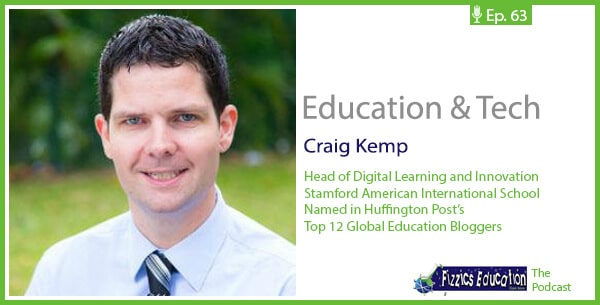
Creating vibrant classrooms with meaningful technology applications is so important! Craig Kemp has tremendous energy when it comes to supporting teachers integrating educational technology across the world. Craig is a highly sought education speaker and his blog was recently named one of the world’s top 12 education blogs by the Huffington Post. For Craig it’s not just about the technology, it’s the “why” that really matters!
How do you move beyond “tech for tech’s sake” in a school of over 3,000 students? In this episode, we talk with Craig Kemp, a global leader in educational innovation. Based in Singapore, Craig shares his roadmap for the authentic and purposeful integration of technology, exploring how student leadership programmes and a focus on the “Why” can transform classrooms into global learning hubs while supporting 500+ staff members through the transition.
About Craig Kemp
Craig Kemp is a New Zealand-born educator and a renowned “change agent” with almost 15 years of experience in classroom teaching and school leadership. Currently serving as the Head of Digital Learning and Innovation at the Stamford American International School in Singapore, Craig leads a team that supports 3,000 students and 500 staff in leveraging technology to enhance learning outcomes. A powerhouse in the global educational community, Craig is well-known for his massive social media presence and his work on the #AsiaEd and #PubPD hashtags. As a global speaker and consultant, he specialises in motivating educators to prioritise pedagogy and student voice in digital practice.
Innovation at Stamford American International School
At one of Singapore’s leading international schools, Craig manages a massive digital ecosystem. His approach to Digital Learning and Innovation focuses on moving from isolated ICT lessons to a fully integrated model:
The STEAMin Programme:
Innovation Focused: This programme integrates Science, Technology, Engineering, Arts, and Maths with a core focus on innovation. It is treated as a way of thinking and doing, rather than a standalone subject.
Student Voice: The programme encourages students to have a significant say in what and how they learn, fostering a sense of ownership over their educational journey.
Student Leadership via Techperts:
Techperts Programme: Craig founded this initiative to empower students to lead technology integration. These student leaders act as facilitators for teachers and parents, building community confidence in digital tools.
Global Standards: The school utilises the ISTE standards for students, educators, and leaders to ensure a world-class framework for digital literacy and leadership.
Top Episode Learnings: Leading Educational Change
Pedagogy First, Technology Second:
Craig emphasises that the “Why” must always come before the “What”. Technology should only be used if it adds clear value to the learning process and fits purposefully into the curriculum.
Upskilling the Staff Cohort:
The goal of a digital learning leader is to “work themselves out of a job”. By focusing on upskilling classroom teachers rather than just teaching kids’ skills in isolation, innovation becomes sustainable across the entire school.
The Entrepreneurial Mindset:
From student-run water-saving apps to Braille makers made of LEGO, providing students with the tools and the “permission to fail” allows them to solve real-world problems and become entrepreneurs while still at school.
Education Tip: The Power of the PLN.
Take a leaf out of Craig’s book and start building your Personal Learning Network (PLN) via social media. Craig credits much of his learning to being connected on Twitter. By sharing ideas and joining global conversations, you can bring world-class innovation into your classroom without teaching in a silo.
[00:00:57] Ben Newsome: Yes, welcome again to another Fizzics Ed Podcast. It’s a big week this week. We are speaking with Craig Kemp, who is the Head of Digital Learning and Innovation at the Stamford American International School. I tell you what, he is incredibly busy helping out over 500 staff, 3,000 students and the wider community to get some seriously authentic and purposeful integration of technology into the classrooms.
[00:01:20] Ben Newsome: Now, you might have come across Craig before. He is very, very well known through social media. Seriously, check him out on Twitter. Thousands and thousands of followers checking him out, doing all sorts of stuff around education. He’s a highly sought-after professional development speaker who does a bucket load of workshops, seminars and keynotes all about not only motivating and inspiring people to do stuff, but he’s very much about the practical and creative ways you can implement your ideas for technology into your classrooms.
[00:01:46] Ben Newsome: Today is all about getting passionate about some serious education change in your classroom. More importantly, how you go about doing that in the wider school community and beyond. Let’s listen in to Craig. He’s got a lot to say.
[00:01:58] Announcer: This is the Fizzics Ed Podcast. We’re all about science, ed tech and more. To see 100 fun free experiments you can do with your class, go to fizzicseducation.com.au. That’s physics spelled F I Z Z I C S and click 100 free experiments.
[00:02:17] Craig Kemp: I’m a Kiwi. Don’t hold that against me. Most of us are pretty good people.
[00:02:22] Ben Newsome: Except for the Bledisloe last night, or over the weekend, we won’t mention that.
[00:02:26] Craig Kemp: No, I decided I wouldn’t bring that up at all.
[00:02:30] Craig Kemp: My family and I moved to Singapore six years ago, almost seven years ago actually. We decided that we’d come here to have a bit of a change. We thought we’d come here for a year or two, but we’ve been here almost seven years now and absolutely love it. My career as an educator started almost 15 years ago back in Dunedin in New Zealand. I’m a Nelson boy, South Island, taught in Dunedin for seven years. I’m primary trained, taught in grade 2 through grade 10 in the past 12 years.
[00:03:10] Craig Kemp: Since being in Singapore, I’ve been particularly interested in design and STEM. We’ve developed our new STEAMin programme here at Stamford, which I could talk about a little bit later.
[00:03:23] Craig Kemp: My job here, I have a team of six staff that support the effective and purposeful integration of technology into the classroom. We’re pretty lucky; we have 3,000 students from K through 12, and I have 500 teachers that I work with. Thankfully not on a daily basis, but I work with them every day. I have two young daughters, one is four and one is six months old, and they are absolutely amazing.
[00:03:52] Craig Kemp: On top of that, I am lucky enough to travel the world speaking, running workshops. I’ve just got back from a week in Sydney, Melbourne, and Newcastle, running workshops with schools over there about effective and purposeful integration of technology. I’m super excited about being here to talk about my passion today as well.
[00:04:12] Ben Newsome: Absolutely. I must say, hearing all that, having a four and a six-month-old, how’s that sleep treating you?
[00:04:21] Craig Kemp: It’s getting there. We’ve started the new school year here and I’m pretty exhausted, but that’s just the way it is, right? All parents know that.
[00:04:30] Ben Newsome: Yeah, absolutely. I’ve got young kids as well. I just honed straight in on that going, okay. On top of being involved… Did you say 3,000 students? That’s not a small school.
[00:04:40] Craig Kemp: Yeah, no, we’ve got two campuses. We’re actually from two years of age to 18 years of age.
[00:04:45] Ben Newsome: Wow. No, that’s awesome. Now, I definitely want to go down the purposeful digital integration and all that type of stuff. That’s exactly why I wanted you on this podcast, because you do a lot of it. But I always just wonder where people have actually come from. You were down in Dunedin doing some teaching and whatnot, and obviously teaching from grade 2 to year 10 means you’ve had a lot of learners in front of you. What sent you down the education path in the first place?
[00:05:12] Craig Kemp: Good question. I guess the one thing that got me going was my mum was a teacher. She was a late training teacher, so she started training when I went to high school, and before that she was a teacher aide. She’s just one of those sorts of people that is caring, giving, just interested in helping others. My dad is an information technology manager at a hospital. So I had both pathways and I didn’t really know what I wanted to do.
[00:05:42] Craig Kemp: I thought, let’s just do teaching, see what happens. As soon as I started, I absolutely loved it. So that’s what started me off in the career. As far as my transition to becoming a digital learning leader, it started from social media, being connected on Twitter.
[00:05:58] Craig Kemp: I love social media, I’m addicted to social media. That’s where I do all my learning and a lot of sharing. I started blogging, and then I just realised that people had a real need for learning how to do stuff. It’s no longer acceptable to dump stuff in people’s classrooms and expect them to do it. We have to invest time in people. So that’s where my passion has come from, and I think a bit of it’s from my mum and a little bit from my dad.
[00:06:26] Ben Newsome: I bet. Just thinking about that, it’s quite a palette you’ve got to paint from. In terms of digital integration and helping people actually understand what these hardware and software tools actually are and what they can be useful for, for learners or their own back-end tasks. That’s quite broad. I’m just kind of thinking, I know there’s a few people I know who definitely do that sort of work, and there are others who don’t. What does that look like on a week or month basis? What sort of things come across your plate?
[00:07:00] Craig Kemp: I guess the biggest focus is on… I’ll take it back a little step. I’ve been at my current school, Stamford American International School, and you can look it up on social media, on Twitter it’s #SAISRocks, and our teachers tweet and share learning out on there all the time. I started my journey here about four years ago, and in that time we’ve transitioned our digital learning programme from where we had ICT teachers going into classrooms and teaching ICT lessons, and that’s three years ago, to now where we’ve just developed a series of what our digital learning framework is, that will be released very soon. It’s just been released to our staff here and we’ll share it publicly soon, but it’s sort of 18 months in the working of what a digital learning framework looks like.
[00:07:50] Craig Kemp: On a weekly basis, it’s an emphasis shift from focusing on teaching kids skills, which we used to do and some people still do, moving towards focusing on upskilling our staff so they can effectively and purposefully use the technology that we need them to do to add value to student learning. The whole shift from being student-focused to teacher-focused was very difficult in the start, and we’ve faced many challenges, many challenging people, many challenging circumstances, but it’s the best thing we ever do. I think one of my mottos here is that our job is to work ourselves out of a job. We know we’ve done well when we’re no longer required to support teachers in the classroom.
[00:08:35] Craig Kemp: So that’s what my team are trying to do here, and I’m very lucky I’ve got an amazing team, and you can see that using the hashtag as well. But on a daily basis, it’s meeting with teachers, going in, modelling lessons in classrooms. It’s bringing in new technology, trialling it and testing it. Running parent workshops, running community workshops. Getting our teachers connected with the world, providing opportunities for our kids to be entrepreneurs, to create, to design. We’ve developed our STEAMin module here at school as well, which is done from our early years all the way through to our high school. So all sorts of things. It keeps us very, very busy.
[00:09:16] Ben Newsome: I think you’re just having fun, aren’t you? It’s a pretty cool job to be able to do that. Absolutely. In fact, when you said work yourself out of a job, I used to work in environmental science and in some ways we used to sort of joke about that too. That if we’re doing our job properly, we’ll have no job soon. But then again, let’s be honest, the learners keep coming and the technology just keeps on changing.
[00:09:42] Ben Newsome: That’s where it really is interesting because at the coalface now, we’ll be obsolete potentially in a couple of years time. That means that when we’re integrating these type of things, you don’t want to always just say here is the newest, shiniest thing. It’s also like, well, what’s the point of this new shiny thing, or do we really need it yet?
[00:10:00] Craig Kemp: Yeah, so I guess our biggest emphasis is on the why. Our whole model is focused on why. If you can’t answer why you do it, and if people want to follow up a little bit about where that why comes from, look up Simon Sinek. He’s an amazing, amazing speaker. We’ve focused on the why, so everything we do comes from that why. Why are we doing it? Why will it add value to students? And where and how does it fit into our curriculum is really important without giving teachers more workload, because we know how busy they are already. We’re all educators here, and we want to make sure that we’re saving people time, not giving them more things to work on.
[00:10:40] Ben Newsome: And that’s definitely the challenge, isn’t it? Obviously rolling out new programmes, I’d love to hear more about this STEAMin programme, because that really intrigues me, and obviously as a science educator, my ears prick up straight away.
[00:10:52] Craig Kemp: Yeah. It’s something that was launched here a couple of years ago at Stamford, and the STEAMin, of course, the STEAM, which I’m sure the listeners have heard about, but the ‘in’ being the innovation side of things. So making sure that we are innovative in our practices. So the STEAMin, we run the IB curriculum here with US Common Core standards. We have tried to transition what was a very traditional curriculum to be more innovative, more forward-thinking, more suitable to our learners.
[00:11:28] Craig Kemp: Part of that is developing our inquiry units and moving towards incorporating STEAMin into everything we do. It’s not just a topic, because that’s not what STEAMin is. It’s not a topic, it’s not a thing that you go and do, it’s like a way of being, a way of doing, a way of thinking. So we’re transitioning and training our staff up on utilising tools effectively and purposefully.
[00:11:52] Craig Kemp: The T and the E are a very small portion of what this whole thing is. It’s incorporating and changing the way we think about maths teaching, incorporating and changing the ways we connect and engage with the world. Science, engineering, so our design classes here are adapting and changing to this as well. It’s making sure that we have projects, ideas that are not just made up by someone, but are also student-focused. So the students have a big say in what and how they learn as well.
[00:12:22] Ben Newsome: Yeah, I kind of always wonder, it is sometimes easy to throw in a quick word like innovation and whatnot, but actually making it actually happen is a whole other story. And also imagining what that picture looks like. Just thinking about a classroom itself, what would make you go, you know what, this place is completely humming in terms of a brilliant innovative space, kids are doing a bucket load of stuff, versus not?
[00:12:50] Craig Kemp: I think to me it’s two things. One is the people in the room. So for me it’s all about the teacher. And two, it’s about the space. I don’t even consider innovation to have anything to do with a tool or technology. I think what I’m most passionate about and what we see a lot here, the emphasis shifting towards focusing on people. As an educator, how are you making sure that your learning space is alive? How are you actually educating these kids to be our leaders in the future? Are you allowing them a voice and a choice in what they do and how they do it? Changing the way we do things and changing people’s mindsets is huge.
[00:13:31] Ben Newsome: Yeah, absolutely. And it’s something that is a real theme that comes out. You mentioned before that you’re on Twitter, and I 100% know you are, because you can’t help but see you’re involved in that. I only was in the #AussieEd chat last night and it was all about innovation when it comes to PBL projects and all those projects and things like that. And permission to fail, which is somewhat useful for kids, especially when it comes to resilience and building capacity in students.
[00:14:03] Ben Newsome: I know briefly you mentioned before about winding in a little bit of entrepreneurship into some of these lessons and things. What kind of things would you love to see happening? Just imagine we get out the wand. We wave the wand, and the wand says there’s no worry about time anymore, and there’s no worry about resources anymore, there’s just people wanting to do cool stuff. With that in mind, what sort of things would you love to see happening in schools, irrespective of it being at Stamford or anywhere else?
[00:14:31] Craig Kemp: For me, it’s all about student voice. I would love to see more student-initiated programmes, more opportunities for students to lead learning, more opportunities for them to actually transfer what they’re doing into the real world, which could mean creating a business, starting something up. A couple of examples that I’ll share. One is a programme that I created called the Techperts, which we use here, and you can find them on Twitter, Techperts EDU. It’s a programme of student technology leadership.
[00:15:06] Craig Kemp: We’ve actually introduced it to several Australian schools. It’s in about 15 schools now, where student tech leaders in the school lead learning with their school. It’s focused not on technology ability, but confidence. It’s all about having children speak, share, they become facilitators in their school for staff, for parents, for other kids, whole community.
[00:15:28] Craig Kemp: Our Techperts here are grade 4 and 5 students. So that’s about 10 years of age. Just spoke to a conference here, EduTECH Asia in Singapore last year, to an audience of about 500 teachers, talking about virtual reality and how they use it in their classroom. We empower that by giving them voice and choice on what they could share on.
[00:15:49] Craig Kemp: The other thing that we are trying to do is develop opportunities for students to take their ideas further. We’re actually starting up a competition here working with the Young Founders Summit with a company called Smarter Me here in Singapore, where there’s going to be an opportunity for our 10 to 17-year-olds to not just enter a competition to develop a business or to create a product, but then take it further and get seed investment.
[00:16:16] Craig Kemp: There’s actually going to be a whole lot of investors coming in, listening to their ideas, helping them grow and develop their idea into a business or an opportunity to actually have that as something. It comes from a US competition which last year funded all sorts of projects, but in the last 12 months, a 12-year-old boy from Israel is a good story. He created a water-saving app, and he’s just ticked over a million dollars value in his business. It’s pretty amazing to see these sorts of ideas coming through, and that’s what I would like to see more of.
[00:16:49] Ben Newsome: Absolutely. No, I agree. This student entrepreneurship, like you say, it doesn’t have to be… nothing wrong with a lemonade stand, it does its job, but I’ll tell you what, if you’re creating a business with literally a million dollars down the line, that’s actually quite serious and also obviously game-changing. It’s good for the student itself, but also considering that it’s about water saving, that’s brilliant.
[00:17:13] Ben Newsome: It kind of reminds me of… Have you heard of that platform Braigo? Where…
[00:17:18] Craig Kemp: Yep.
[00:17:19] Ben Newsome: Yeah. Those people who haven’t heard, think of a LEGO EV3 robot that was turned into a Braille maker. It’s just brilliant for visually impaired people. I mean, that was done by a student.
[00:17:29] Craig Kemp: Yeah, incredible.
[00:17:30] Ben Newsome: And that’s the thing. I kind of feel that if you give the kids capacity to do stuff and the tools to do it and a little bit of room within the syllabus to actually make it happen, really cool things can happen. Actually, just out of interest, were you doing IB stuff back in New Zealand, or is it…?
[00:17:48] Craig Kemp: I was not. No, it’s new here.
[00:17:50] Ben Newsome: What was it like transitioning across?
[00:17:53] Craig Kemp: I’ve taught using the New Zealand curriculum. My first international school was teaching with the Australian curriculum. So adapting from New Zealand to Australian curriculum was pretty simple. There’s a lot of similarities there. I think transitioning across to which was the MYP programme, the Middle Years Programme here, wasn’t too hard. Curriculums around the world to me, I’ve seen several now in countries all over the world, and they’re all very similar.
[00:18:26] Craig Kemp: I guess the differences with the IB curriculum is that it’s pretty open. It allows learners to explore in their own way. There’s a lot less fine line on making sure you’re tested and assessed all the time, but also giving them opportunities to grow and learn. So I think transitioning from one to the other wasn’t too hard, but I sort of had to open my mind to what the possibilities could be.
[00:18:53] Ben Newsome: Which would be interesting if you went back to the previous ones you were working in, because you’d then bring that headspace into the confines of that other syllabus too. I suppose there’s got to be something to be said for actually swapping things around a bit because it keeps you as an educator open to things and seeing new ways of doing things, which is fantastic.
[00:19:15] Ben Newsome: I kind of wonder, you deal with a lot of digital tech and we don’t have to go down the different rabbit holes of the different ones out there. But there are certain broad topics that are certainly coming. I know when I went to ISTE out in Chicago, there was a lot of people very curious and interested about doing VR and AR and drones and 3D printing and bits. How could you imagine the future classroom actually embracing these?
[00:19:46] Craig Kemp: Part of me worries about the focus on AR, VR, mixed reality. We are invested in it, we’ve got a lot of that stuff happening here, but I think what we’re trying to do is target it and focus it on the learning and not on the tool. I think as things transition and change to the classroom of the future, which I’d hope that we’ve stopped now talking about 21st-century classrooms, because we’re well and truly beyond that now. We should be.
[00:20:16] Craig Kemp: We should be focusing on what’s going to be in the classroom. And to me, I’ll go back to what I said before as well. It’s all about the people. Technology’s going to change the way we do things, but it’s not going to take away those human-only elements like creativity, caring, empathy. Those things are really important for teachers to be having now. Providing opportunities to connect and engage to me is one of the best things that you can do in a classroom.
[00:20:41] Ben Newsome: Well, absolutely. Despite all these digital tech bits around, still some of the best technology ever invented is simply just a pen and paper, or a whiteboard. Somewhere where you can converse and collaborate around. It doesn’t have to be anything more than that, which is, you’re right. It’s good if you can have your VR and AR and every other R that you want to add, but I tend to agree.
[00:21:10] Ben Newsome: I think of some of the simple, even just on the science side of things, just the simplest engaging experiments for students can simply just be stuff with water. It doesn’t have to be over the top. And that’s something we’re certainly asked a lot about when we do our own TPL programmes, just going, well, we need all the fancy stuff. And going, well, just hang on. Do you know how to run an experiment yet? Let’s do that first. Absolutely. It’s good fun.
[00:21:35] Ben Newsome: Now, you’ve had to go around to a lot of conferences and bits and pieces around the place. What’s that like trying to fit that amongst your schedule with 3,000 students and a bucket load of teachers needing support?
[00:21:46] Craig Kemp: It’s really important that first and foremost, my priority is here at the school. So I’m invested here and I do do a lot of hours, but it’s all invested into making sure that our programme and what we’re developing and delivering here is world-class and world-leading. But I guess I do do a lot of speaking and workshops and a lot of that happens in my own time. A lot of it is weekends.
[00:22:14] Craig Kemp: My school holidays is when I do a lot of the Australian trips. I come out at least twice a year for a week each time to run workshops in Australia. It’s all in my own time. I’ve got a very understanding wife who sees the passion that allows me to go and do these sorts of things. It’s very exciting. It’s just investing time in doing what I love and making sure that the focus is first and foremost on the school.
[00:22:42] Ben Newsome: Now, obviously as part of talking at these conferences and bits and pieces around the place, inevitably that means part of your job is also advice. If you had people who had taken on a brief of upskilling their staff cohort within a school, or even a school district for all we know, what first steps would you suggest that they’d need to start considering as they start to roll out a digital learning programme?
[00:23:13] Craig Kemp: The first thing I would say is that it’s always pedagogy first, technology second. Too many schools start with the technology and try and make things work. We’ve been in a situation where we’ve been technology-heavy and we’re trying to adapt that now for pedagogical purposes. Think about the learning. Always start with the why. Why are you trying to develop a programme that’s going to include technology in it? You must know your why before you continue further.
[00:23:48] Craig Kemp: For me, it’s all about that why. Then following that up with how are we going to use this to add value to student learning. And then really working together as a team and making sure you’ve got good people that are backing this. Making sure you’ve got the innovators, the people that are going to try things, and people that understand that mistakes are okay. Because when we trial and test things, I always say to people here that mistakes are great, and we should be making more mistakes in front of our kids, because mistakes happen. Mistakes are the way we learn, and we should be promoting and adapting that.
[00:24:21] Craig Kemp: I think the fear of making a mistake often stops us from going that next step. I would 100% encourage people to get involved in making sure that if you’re trying to develop a technology-rich programme, start with the people, start with your why. The resource we use are the ISTE standards. You talked about going to ISTE, we use the ISTE standards here, and we use the ISTE standards for students, the ISTE standards for educators, and this year we’re rolling out the ISTE standards for education leaders as well. 100% takeaway from here, go and have a look at those.
[00:24:58] Ben Newsome: Absolutely. So if you’re not sure what ISTE is, it’s the International Society for Technology in Education. It is a big group of really passionate educators right around the planet. Not just in schools, by the way. They’re in libraries, museums, zoos, aquariums. They are all over the place. But predominantly schools in different ways and guises, from the very big of 3,000 students down to the very small of only 20 students. It can be very rich, with a good 70-odd countries getting involved with that every year, which is fantastic and a great PLN to get involved with. Actually, there’s a bunch of PLNs in different areas, but really, really cool.
[00:25:38] Ben Newsome: Look, Craig, I know you’ve got to run off to another meeting and look, before you do so, there’ll be people who’d love to get in touch with you. How would they do that?
[00:25:46] Craig Kemp: Yeah, absolutely. You can find me at my blog, mrkempnz.com. M-R-K-E-M-P-N-Z dot com. You can find me on Twitter @mrkempnz. If you’re on Facebook, you can search Mr Kemp NZ as well, and you’ll find the Facebook page where I’m sharing things out. And all the other social medias as well. You can reach me at [email protected]. And if you’re interested in when I’m coming out to Australia or New Zealand over the next 12 months, you can check out the website as well. There’s a piece there where you’ll see all my dates when I’m going to be out and we can be in touch.
[00:26:21] Ben Newsome: Absolutely. And like always, we’ll pop that in the show notes so we can find stuff. I imagine if you’re visiting Mr Kemp’s blog, I guess you could subscribe to that RSS. There’d be something there and you’d hear what’s going on with that too. Look, much appreciated Craig. Clearly you are a very passionate educator and I can imagine that when you were face-to-face with students, the kids would be buzzing. But now I suppose your job now is getting the teachers buzzing too, which must be a lot more fun from a capacity-building point of view. Do you miss teaching the kids?
[00:26:52] Craig Kemp: Oh, absolutely. I do my best to get into classrooms whenever I can. I absolutely miss it. I think that I wouldn’t be doing my job right if I wasn’t connected in some way, shape or form. Through our Techperts programme, I’m connected on a weekly basis with kids. I pop into our grade-level classes all the time, running CCAs as well. I coach volleyball here, so I can’t get my hands off it.
[00:27:16] Craig Kemp: As an educator, I think all leaders in leadership should be involved somehow in the teaching component and that should never change. I think you lose a lot when you step outside of the classroom and you need to keep that connection going.
[00:27:28] Ben Newsome: I agree. Actually one thing that I like to do, because it can allow me to do this as well as do other things, is I’m literally sitting in amongst a whole bunch of renewable energy stuff because I was teaching a school up in Queensland. I’m down here in Sydney, so I’ve got all this… I know it’s an audio thing, but I’ve got all these little experiments, wind turbines and bits around me, and we connect by video conference because I can do work from here and then connect with a school, then go back to doing the other work I’m meant to be doing. So there are ways you can still teach without always being in front of the kids too. You can have your cake and eat it too.
[00:28:06] Ben Newsome: Well, thank you very much, Craig. Much appreciated for coming on. Have a fantastic evening and a great start to your school year.
[00:28:13] Craig Kemp: Thank you so much, Benno. I appreciate it.
[00:28:35] Ben Newsome: Well, there we go. We’ve just heard from Craig Kemp, who is seriously an all-round good guy from New Zealand. But I must say, he is doing some fantastic work in Singapore at the Stamford American International School. Tell you what, you really can connect with him. Check out @mrkempnz. Again, @ M-R-K-E-M-P, N for Nelly, Z for zebra, something like that. Mr Kemp NZ on Twitter, because he really does do a lot of work.
[00:29:03] Ben Newsome: Check out the hashtags for his school, #SAISRocks, #AsiaEd and #PubPD. He is a creator of all those three hashtags and really has a lot of insights when it comes to doing technology in education. I tell you what, even though he does a lot of work in schools, his headspace around doing this could be used anywhere. Museum, zoos, aquariums, you name it, some of the things he’s getting up to certainly are applicable in your areas too.
[00:29:29] Ben Newsome: Anyway, I hope you enjoyed listening to Craig. I certainly had a great time having a chat with him, even though his New Zealand team did beat us in the Bledisloe Cup this year. Yes, I am a rugby tragic and fanatic. But look, we won’t hold that against him. The All Blacks do a fantastic job. Until next week, I hope you have a fantastic week. I hope you’re being inspiring and as innovative as you can. And I hope you’re having a fantastic time doing it. You’ve been listening to me, Ben Newsome from Fizzics Education. And you’ve been listening to the Fizzics Ed Podcast. I will catch you next week.
[00:30:25] Announcer: This podcast is part of the Australian Educators Online Network. AEON.net.au.
Frequently Asked Questions
What is the “Why” behind technology integration according to Craig Kemp?
Craig emphasises that every use of technology must start with a clear “Why”. Drawing inspiration from Simon Sinek, he argues that if an educator cannot explain how a tool adds specific value to student learning or fits purposefully into the curriculum, it should not be used. This approach ensures that pedagogy always drives the technology, rather than the other way around.
What is the STEAMin programme mentioned in the episode?
STEAMin is an innovative programme developed at Stamford American International School that combines STEAM (Science, Technology, Engineering, Arts, and Mathematics) with an explicit focus on Innovation. Craig describes it not as a standalone topic, but as a “way of being, doing, and thinking” that is integrated across the IB curriculum from early years through to high school.
How does Craig support a staff of over 500 teachers?
The strategy has shifted from having specialist ICT teachers delivering isolated lessons to focusing on upskilling all classroom teachers. Craig’s team provides instructional coaching, models lessons in classrooms, and runs workshops. The goal is to “work themselves out of a job” by empowering every teacher to integrate technology effectively and independently.
What is the “Techperts” programme?
Techperts is a student technology leadership programme created by Craig that has been implemented in numerous schools globally. It focuses on building student confidence rather than just technical ability. Students as young as 10 years old become facilitators, leading learning sessions for their peers, staff, parents, and the wider community.
Why does Craig believe educators should have a “permission to fail”?
Craig believes that making mistakes is a fundamental part of the learning process. By being open about failures and technical glitches in front of students, teachers model resilience and problem-solving. This “safe-to-fail” environment encourages innovation and removes the fear that often prevents staff from trying new digital tools.
Discussion points summarised from the Education & Tech with Craig Kemp with AI assistance, verified and edited by Ben Newsome CF
Extra thought ideas to consider
The Human-Only Elements of Education
Craig mentions that while technology is changing the way we do things, it cannot replace “human-only” elements like creativity, caring, and empathy. Discuss how your school can use technology to actually enhance these human connections rather than distract from them.
Transitioning to Student-Led Entrepreneurship
With examples like the 12-year-old student creating a million-dollar water-saving app, there is a clear pathway for students to move from consumers to creators. Consider how your school syllabus can provide the “voice and choice” necessary for students to develop real-world business solutions while still in the classroom.
Recognised by
22 years, award-winning work, 1 purpose
Recognition from business, education and industry bodies across Australia.
Australian Small Business Champion
Multiple years
CILC Pinnacle Award and Hall of Fame inductee
Center for Interactive Learning and Collaboration
Western Sydney Awards for Business Excellence
Winner
Top 100 Coolest Company
Listed
Local Business Awards
Winner
We value your privacy
We use cookies to improve your experience. Essential cookies are always active. You can choose which optional cookies to allow.We use cookies. Optional ones stay off unless you allow them.Privacy policy