Transcript
[00:00:00] Voiceover: You’re listening to the Fizzics Ed podcast. For hundreds of ideas, free experiments, and more, go to fizzicseducation.com.au. And now, here’s your host, Ben Newsome.
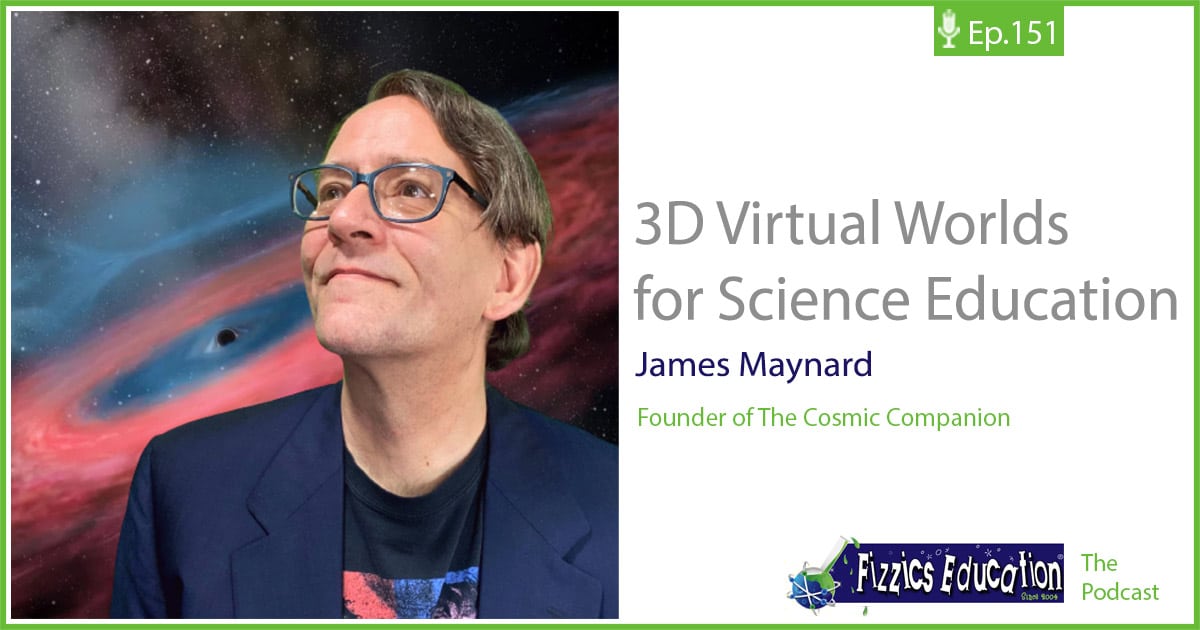
[00:00:19] Ben Newsome: Welcome again for another Fizzics Ed podcast. Glad to have you again, no matter where you are around this planet of ours. In this particular case, we’re hanging out with someone who really loves talking about astronomy, space exploration, science education, and the future. We’re hanging out with James Maynard, who has lately been designing virtual 3D worlds to help kids understand just how the world works. You might remember James’s name. James Maynard has a podcast of his own called The Cosmic Companion, where he’s explored all different ways we can look at science education. He’s talked with a number of people, including Neil deGrasse Tyson, Kathy Sullivan, Sylvia Earle, to name just a few. You can definitely tell he really loves his science education when you get talking into this, but listen on in, because we’re going to be talking about Second Life and all these different ideas that can help your kids to get into science in a few different ways. Let’s get into it.
[00:01:21] Voiceover: This is the Fizzics Ed podcast. For all about science, edtech, and more, to see 100 fun free experiments you can do with your class, go to fizzicseducation.com.au. That’s physics spelled F-I-double Z-I-C-S and click 100 free experiments.
[00:01:30] James Maynard: Thanks for having me, Ben. Fabulous being here.
[00:01:34] Ben Newsome: I am really curious about what you get up to. As I’ve looked before at The Cosmic Companion, there are a lot of things that you’ve been involved in—things cosmic or not—but you really have a science bent. So what is it that you get up to?
[00:01:50] James Maynard: I think sometimes I want to know what it is I’ve been up to. I grew up… my parents met on the Apollo project, my dad worked on the space shuttle. I grew up around rocket scientists, literally.
[00:02:15] James Maynard: I absolutely became enamoured when I was a kid with Carl Sagan, Cosmos. Cosmos did something that no other show, no other book had ever done before, which is bring people onto other worlds, bring them out into space.
[00:02:45] James Maynard: Sagan wasn’t sitting up there saying, “Well, the surface of Mars is roughly 25% iron oxide and that’s why it’s red.” He was saying, “Here we are on Mars. Walk with me across the surface. Here are the Viking Landers.”
[00:03:15] James Maynard: That humanised science education in a way that nothing else did. He did that by using the greatest technology of his time, television, to make that happen, to have people sitting in their living rooms exploring nebulae or other galaxies.
[00:03:45] James Maynard: What I’m up to now is doing my best in my little way to try to continue that work using every medium at my disposal: podcast, newsletter, video series. What’s really exciting me now is the metaverse, virtual reality, and augmented reality. That’s what I’m really trying to bring into science education.
[00:04:50] Ben Newsome: Isn’t that just fun that there are so many different mediums that you can do this in?
[00:04:59] James Maynard: It’s so incredible. I get so excited, and I love listening to the same show sometimes. I don’t get a lot of chance to listen to my own show back, but when I hear it on podcast, it feels different than it does if it’s on video or in the metaverse.
[00:05:18] Ben Newsome: True. There are different ways that people interact with media for sure. For me personally, I love a podcast while either walking the dog or frankly in the car. It’s a bit more intimate in a lot of ways and you get more ponderous, I suppose. Whereas if you’re flicking through TikTok, it’s totally different. It’s just how it is. You mentioned doing science education briefly just then around the metaverse. If I challenge people to put their finger on what is even a metaverse, they go, “Huh?” What are you imagining with that?
[00:06:04] James Maynard: What I’m imagining with that is fulfilling those first steps that Sagan took, which is humanising science education.
[00:06:30] James Maynard: What you can do, imagine this: learning about the surface of Venus by being able to actually walk across a virtual version of Venus.
[00:07:00] James Maynard: Right now, I’m finishing up designing an interactive 3D environment of a lava planet. You can look at some of these exoplanets that are small, rocky, and close to their sun, bubbling over with lava.
[00:07:30] James Maynard: Instead of just hearing about it or having it in words or images, imagine being able to walk across these surfaces and learn about the geology there from a talking rock.
[00:07:54] Ben Newsome: This is really awesome because I was just thinking then, a student can experience said worlds and people can craft them. What would be fun would be having a series of set rules for the kids to create. So if you say, “Here’s what it’s like around Gliese” or whatever it is, choose your favourite exoplanet—and there’s a lot of them, 5,200 I just read this morning—
[00:08:33] James Maynard: They just keep on going. It’s nuts.
[00:08:37] Ben Newsome: Imagine the kids working with, “Here are your known laws of the universe that are currently immutable,” and maybe they’re not later, but for now they’re immutable. “Here are the chemical elements. What would the terrain and life be like on said things knowing that the current observations… this is what it currently looks like, this is its orbit, this is what it does, its inclination, everything else.” The kids could have their own creativity mixed with real deep facts. That could be a bit of fun.
[00:09:12] James Maynard: Exactly. That’s when you bring together what I love to call edutainment. Education in the guise of entertainment. You can teach some really great science and make it enjoyable, and people will respond to that. Students of all ages will learn.
[00:09:41] Ben Newsome: This actually reminds me… I spoke last year with Gillian Hewitt, who’s the founder of Imagine Naturalist, and she’s a genius at creating botanical drawings and things that are so lifelike they’re crazy, by simply using pencil.
[00:10:10] Ben Newsome: What she does, she challenges kids to go, “Right, what does Mars 2.0 look like if there were living things on Mars based on the parameters that exist on Mars, whether it’s thin atmosphere, etc. What could life be like knowing biology and how it works?” It’s fun watching what kids could create on a handwritten thing.
[00:10:35] Ben Newsome: But the metaverse is digital. So how would that operate? Would it be in one of the metaverse platforms that they might create? I’m curious to see where your mind’s leading with that because there are a few different ways it could be created.
[00:10:49] James Maynard: Absolutely. I think all of those ways should be pursued by people whose talents and desires want to push them down those roads. You can create it in the metaverse, in Second Life, and in others. Although no one on the podcast can see it, I’m actually sitting in front of a 3D environment I created of a spaceship approaching the moon.
[00:11:05] James Maynard: What’s cool is especially like in Second Life. One of the main ideas is that if you can imagine it, you can build it. You start with the simplest of shapes and they have an extremely powerful scripting system that only has 300 commands. It’s so easy to learn relatively for a programming language.
[00:11:15] James Maynard: You get the kids in there, and some of them are going to want to build. They can create their own devices and their own artefacts and buildings and even whole environments. If you unleash a kid’s imagination and get them in a place where they can make a concrete thing, you’re going to have the basis for some really good education. In addition to that, professionals, teachers, educators, developers, are also putting together their own more intricate labs.
[00:11:30] Ben Newsome: This actually reminds me of a big teacher movement around Minecraft. They love doing that sort of stuff.
[00:11:35] James Maynard: Minecraft’s a perfect example.
[00:11:38] Ben Newsome: They really love that sort of thing. My brain flicked towards this old app, I think it’s still kicking around, called Beaker, where they turn your phone into effectively a beaker, funnily enough. You add your different elements and things, and you add whether it’s going to be heated or cooled or if you’re going to throw electricity through it.
[00:11:55] Ben Newsome: You don’t just watch the equations turn up, you watch the thing bubble, you watch the gases release, you see what will happen if we put a watch glass over it. You watch the things change and fizzle. It was fun, and it was all done on your phone. Where I’m going with this is thinking about what you’re describing in Second Life, knowing that there are these 300 commands and there are physical parameters within this software that you’ve got to code to. That means kids, if they’re in an environment like that, and it’s got to be a safe environment, protected from crazy people, but—
[00:12:08] James Maynard: Sometimes I feel like as an adult I have to be protected from crazy people.
[00:12:12] Ben Newsome: This is true. But as long as it’s done on a safe server, the kids could explore and lab test their ideas without expensive, crazy equipment nor risk.
[00:12:17] James Maynard: Absolutely right.
[00:12:21] Ben Newsome: That could be interesting. Not every kid’s going to be able to get to be on the mission to Mars at some point. Sadly, it’s just the reality. What if they explored designing said craft, designing how we land on this particular planet with a different gravity, different substrate and everything else? All that sort of stuff can make sense and be a little fun in the process.
[00:12:46] James Maynard: Absolutely. Have it be fun in the process. There are tens of millions of people in Second Life alone. There are some amazing, incredible places. I’ve flown on eagles in there and swam with the Loch Ness Monster and seen multiple people’s versions of Atlantis.
[00:13:21] James Maynard: But the thing is that a lot of those places are abandoned. There’s just not enough people in there. I think one of the problems is it’s not interactive enough. People aren’t getting enough from it to go back to a place. Where was I going with this?
[00:13:56] Ben Newsome: That’s all right. I was just thinking, what makes people go to the Great Pyramids of Giza or the Amazon rainforest? There’s a tangible experience that happens when you go to the place and you experience history that’s in front of you, or there’s some cool thing you get to whitewater raft on the Zambezi River. There’s always that interpretive signage that turns up to explain the reason whatever it is that you’re seeing in front of you has happened.
[00:14:31] Ben Newsome: I suppose for an interactivity point for a Second Life space, especially if it’s abandoned, is there’s a whole bunch of people listening into this particular podcast, a lot of them are amazing educators. You could turn those into interactives.
[00:14:46] James Maynard: Yes, and that’s my point exactly. I have to admit this, I have spent thousands of hours on World of Warcraft or the game Alpha Centauri or Civilization, pretty much anything Sid Meier puts out. Why is that? Because I have a character who’s able to grow, and I’m able to grow with it, and the environment around me changes. You’re not in the same place at level 40 in World of Warcraft that you were at level 10.
[00:15:32] James Maynard: I think if we can take some form of the metaverse, some form of virtual reality, and add in that element of feedback, so it’s not just output but a circular thing, you can build that sort of devotion to virtual worlds that you have within some of those games now. If that was fed with good science and networking with others, that could be a really powerful tool.
[00:16:21] Ben Newsome: It’d be really powerful thinking about AR and the metaverse in its purest form. When you go to a space—I’m in Sydney, so there are plenty of national parks down this way and various museums—we all carry around our smartphones. We take happy snaps, and in these modern days everyone knows how to use a QR code. There was an app called HP Reveal, and there are others around, whereby you just scan a thing with your phone—
[00:17:01] Ben Newsome: —and suddenly stuff pops out at you. That stuff could be just trivial, or it could be very deep. There’s the potential to have something that is co-created by the users themselves. It would have to be moderated to some degree within an education landscape, but wouldn’t it be interesting if a teacher was attending a museum, and the museum’s got not just their AR stuff shoved over the top of it, but you’ve then got the thoughts coming through of what class 3B thought of this yesterday?
[00:17:40] Ben Newsome: Even thinking like 10 years ago there was Google Sphere, whereby you’d rock up and there’d be 360 degrees of pictures around someone and you got to experience what that space was like back then. I feel like as people walk through their physical environments, there is an opportunity to learn a lot more about the trees and the rocks around us, just through pattern recognition done with AI and crowdsourcing some of this content.
[00:18:09] James Maynard: Right. Of course, one popular app now that I use all the time is PictureThis. You’re trying to learn about plants, you go around, click a picture of the plant, and boom, it tells you what it is. What you’re talking about is so cool because you can build that into a real-time data delivery system sent through eyepieces.
[00:18:41] James Maynard: You can be walking down the street and you’ll have little words telling you what kind of trees you might be looking at, or what kind of rocks you’re looking at, and maybe more practically, what street you’re on, or directions to the nearest coffee shop. You can use that as another place where people are going to be learning about things without even realising that they’re learning.
[00:19:16] James Maynard: Someone who may not know much about plants may see one of their bushes being labelled hibiscus. Next time they see it out in the world, they’ll say, “Hey look, there I see a hibiscus there.”
[00:19:31] Ben Newsome: I was just thinking right now, it’s an audio medium, but behind me I’ve got a picture book, General Relativity for Babies. I love it, genius series by that author. The science is very correct, it’s very real, and yet it’s simplified to the nth degree. Very simple language and you can understand Einstein’s ideas around general relativity, done as a picture book.
[00:20:01] Ben Newsome: Where I’m going with this is thinking about when these AI things get produced, they’re often produced by teens and adults, and there’s a certain language level. However, nowadays there’s a lot of AI, for example GPT-3 and others, where they’re language-based AI that could potentially simplify some of that same content that’s produced by a user and you could put it to a year level. So Grade 12, Grade 9, Grade 5, or 1.
[00:20:34] Ben Newsome: Content is always hard to simplify or alternatively go the other way, make it harder. Wouldn’t it be interesting if that person walking down the street keys in, or maybe the teacher does, what their reading age is at right now, and now they’re getting the content that’s curated at a level they can understand? I can walk into an art museum and appreciate their pretty pictures, but I don’t really know my difference between a Cézanne and whatever. Someone could curate that for me, but in a language that I could understand.
[00:21:08] James Maynard: Right, and that’s again where you could be using these real-time AI things, walking through the museum. There’s Gauguin, there’s his birth and death years and a little bit more, and you could probably access, “Would you like to know more about Gauguin?” I think that is another great example of the way that we get what I love to call subversive education. Teaching people who don’t even know that they want to learn.
[00:21:51] James Maynard: I think that’s really important because most people among us can agree that learning should be a lifelong process. There’s no reason to stop learning. I also think it’s important that learning isn’t seen as something you do from 3:00 to 5:30 every Tuesday afternoon like going to the gym. It should be something that just happens organically, and it’s something that people should be able to absorb while they’re playing, while they’re entertaining themselves.
[00:22:42] Ben Newsome: For sure. I’m actually thinking of those kids, like I mentioned Minecraft before. Do you know the number of kids who know what obsidian is now? I had no idea what obsidian was before. They can certainly tell you everything about it now. You mentioned Sid Meier, so as a kid, I played Civilization II. I learned a lot of my ancient history that way, at least a little bit of it.
[00:23:02] James Maynard: Right, yeah. I actually heard that some kids built a replica of the Library of Alexandria within Minecraft.
[00:23:10] Ben Newsome: Nice. I mean, how cool is that, right? It’s amazing. I know a lot of the mathematics teachers love this too because of the nature of being a pixelated system, you’ve got measurement tools everywhere, and they’re the blocks. It’s perfect. It’s really good for volume discussions for sure. It is how you want to learn and how you pitch your learning.
[00:23:38] Ben Newsome: This is outside the scope of what we’re discussing for now, but I remember having a chat with these guys out at the Challenger Learning Centre out of Rochester, New York. Apart from doing distance learning programmes in their special space about the Challenger missions, they were teaching mathematics in scuba gear.
[00:24:00] Ben Newsome: They figured if you’re going to teach about volume, most people think of volume as a liquid. Now it doesn’t have to be, it’s a solid or gas too, but if you’re dealing with a liquid as a volume, why not swim in kick cycles with your scuba gear the length and breadth and height of a cube?
[00:24:15] Ben Newsome: And go, “This is what the volume of it looks like in your scuba gear.” They had OtterBoxes around their phone, and you can talk with the person live. Fantastic! They were doing that years ago.
[00:24:35] Ben Newsome: Distance learning’s been going on for over 25 years, 30 years and then some. That’s just on the digital side. School of the Air here in Australia has been doing it since we had radio. It’s been around for a long time. I thought that was neat. That is bringing a mathematical concept that’s rather simple, but turning it into something that someone’s going to pay attention to.
[00:24:54] Ben Newsome: We can do the same thing with Second Life and all these different new apps, and undoubtedly 10 years from now it’s going to be something else that’s far better than what we’re talking about now. There’s always another application.
[00:25:05] James Maynard: Right. It really makes for the ultimate in immersive learning. I’m working with some people now within Second Life to build a highly realistic lunar base. How many people would ever have a chance to go within a mock-up of a realistic lunar base? With 3D design, you can make that happen.
[00:25:49] Ben Newsome: So what we’re really talking about is the future of education in a lot of ways. I’m guessing that you’re rather a proponent of this sort of area.
[00:26:09] James Maynard: To me, it’s really the future of education, and not only that, I think it’s essential for solving so many of the problems we have in the world today. I think there’s a good argument to be made that things like racism and sexism and homophobia just really have their roots in a lack of science knowledge. When you realise the amount of DNA we all share, it really brings about a realisation of the fact that we’re all brothers and sisters and others on this one pale blue dot together.
[00:27:04] Ben Newsome: It is. If you had a bunch of educators in front of you and you were able to give a piece of advice if they were considering bringing their class into that sort of experience, what would that advice be?
[00:27:21] James Maynard: My best advice probably stems from my own time as a student. I was never interested in things that I thought were something I could just look up in a book. But if it’s something that I thought could really teach me something, I would just go full bore into it and go above and beyond what was asked in an assignment like that.
[00:28:09] James Maynard: About half of my teachers from grammar school through college loved me, and half of them probably hoped I never took their class again. I think it’s really important to recognise those signs within students who may not be doing half the assignments not because they’re lazy, but because their mind is focused on the other half.
[00:28:50] Ben Newsome: For sure. Ages ago I spoke with Dr. Simon Crook, and he said a very simple phrase: “Engage me or enrage me.”
[00:29:06] James Maynard: I think that’s spot on.
[00:29:12] Ben Newsome: It is. Thanks very much for popping on and describing a little bit of a vision, and not just a vision, it’s happening right now in Second Life and whatnot. How would people be able to get in touch with you?
[00:29:26] James Maynard: I put everything on thecosmiccompanion.net, newsletter is.com. Just search for The Cosmic Companion, I’ll come up somewhere, I assure you. There’s a newsletter at thecosmiccompanion.com and you can sign up for that. We put out a weekly show featuring friendly interviews like this with scientists, authors, and developers around the globe.
[00:30:08] James Maynard: I get in a bunch of people from National Geographic and Scholastic Press and HarperCollins and some amazing publishers and universities around the world. My big thing is to bring science education to everyone. By tearing down barriers to that, we can make for a better world, and that’s what I’m trying to do.
[00:30:37] Ben Newsome: Such a very awesome goal, and frankly shared by anyone listening to this, because otherwise why would you be listening to this in the first place? You’re clearly into doing some form of science education that matters. Thank you very much for describing just a bit of what you get up to, and I think that there is generally something that students can get involved with. It’s well worth doing. Thanks very much for hanging out!
[00:30:59] James Maynard: Thanks for having me, Ben. It was a pleasure.
[00:31:03] Voiceover: You’ve been listening to another Fizzics Ed podcast. Why don’t you book us for a science show or workshop in your school? We love seeing students get excited about science, and you will too. Go to fizzicseducation.com.au and click on schools for more info.
[00:31:21] Ben Newsome: Well, I hope you enjoyed that chat with James Maynard. I certainly did, especially thinking about different ways we can teach science using 3D virtual worlds. Really fun and fascinating.
[00:31:40] Ben Newsome: I think as AI gets going, it’s really going to help augment some of our ideas, even if you haven’t got the ability, the capability to produce graphically beautiful worlds. You can get AI to do this, or maybe you can find different images out on the net that are very clearly copyright-free, or you can help design them yourself and really build out these really cool things. I hope you enjoyed this. Go onto his website, thecosmiccompanion.net, and you can find out more.
[00:31:55] Ben Newsome: So, that’s enough of this particular episode. I hope you enjoyed it. You’ve been listening to me, Ben Newsome for Fizzics Education. This is the Fizzics Ed podcast. And as always, I hope to catch you another time.
[00:32:06] Voiceover: You’ve been listening to another Fizzics Ed podcast. We’re excited about science. Subscribe to us on iTunes for the next episode as soon as it’s released. And don’t forget, for hundreds of ideas, free experiments, our new Be Amazing book and more, go to fizzicseducation.com.au. That’s physics spelled F-I-double Z-I-C-S.
[00:32:34] Voiceover: This podcast is part of the Australian Educators Online Network. AEON.net.au.
Frequently Asked Questions
What is “edutainment” in the context of science?
Edutainment refers to education delivered through the guise of entertainment. By making science enjoyable and engaging—using platforms like the metaverse or interactive storytelling—students are more likely to respond positively and retain complex information without the process feeling like a chore.
How can the metaverse be used for science education?
The metaverse allows for immersive, interactive experiences where students can “walk” across the surface of planets like Venus or Mars. It provides a platform to build 3D environments where kids can explore geology, chemistry, and physics in a virtual space that is both safe and cost-effective compared to traditional laboratories.
Why is “humanising” science education important?
As pioneered by Carl Sagan, humanising science involves moving beyond dry facts and figures to place the learner directly in the environment. Instead of just hearing about chemical compositions, students “experience” the world, which makes the scientific enquiry feel more personal and relevant to their lives.
Can virtual worlds like Second Life be used for lab experiments?
Yes. Virtual platforms allow students to test hypotheses and interact with physical parameters (like gravity or chemical reactions) without the risk or expense associated with real-world equipment. It provides a safe server environment where creativity and deep facts can be mixed through scripting and 3D design.
How could AI assist in teaching science to different age groups?
Large language models can be used to curate and simplify scientific content for specific reading levels. This means the same complex data about general relativity or planetary science can be automatically adjusted for a Grade 5 student or a Grade 12 student, making high-level science accessible to everyone.
Extra thought ideas to consider
“Subversive Education” or “Education by Stealth”
Consider the concept of “subversive education” as James Maynasrd consider this; where learning happens organically while students are playing games like Minecraft or Civilization. When students learn about resources like obsidian or ancient history through gameplay, they absorb knowledge as a natural part of their experience rather than a scheduled task.
Lifelong Learning Through AR
Imagine a future where augmented reality (AR) provides real-time data overlays on our daily lives. Whether identifying a plant species in a park or learning the history of a museum artefact, technology can turn the entire world into a classroom, fostering a culture of lifelong learning.
Discussion points summarised from the FizzicsEd Podcast, verified and edited by Ben Newsome CF