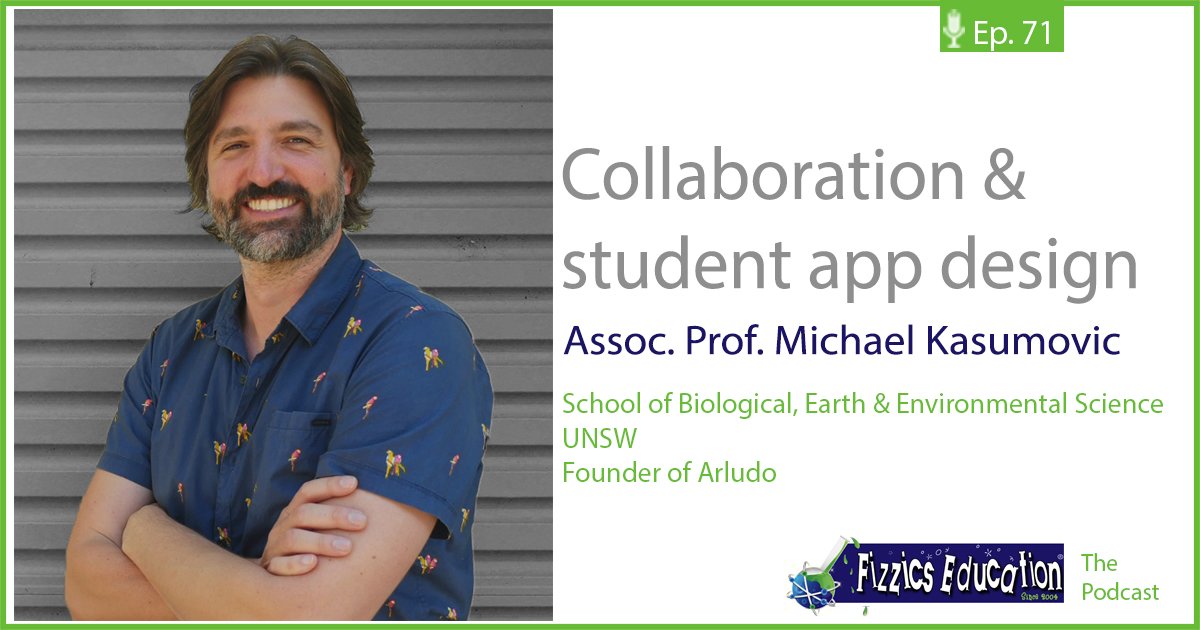
Podcast: Collaboration & student app design with Arludo
Meet Michael Kasumovic, a highly motivated evolutionary biologist from UNSW who started creating apps for his students so they could understand biology concepts. From this Arludo was born, a team of dedicated people that empower students to understand scientific thinking through gaming. We explore just what is truly important for people to consider when creating apps and as you’ll find, it’s not just about the coding.
What do spiders, crickets, and video gamers have in common? In this episode, we chat with Associate Professor Michael Kasumovic about the fascinating links between evolutionary biology and modern technology. We explore how his research at UNSW led to the creation of Arludo, a platform that turns smartphones into scientific instruments and students into data-gathering researchers.
About Michael Kasumovic
Michael Kasumovic is an Associate Professor at UNSW Sydney and an award-winning evolutionary biologist and science communicator. Throughout his career, Michael has explored how the social environment influences development and behaviour across various species, including birds, spiders, and crickets. By using video games to study human choices, he has discovered surprising similarities in behaviour across millions of years of evolution. Michael has translated these insights into the educational sphere through his company, Arludo, creating games that allow teachers and students globally to perform authentic science experiments.
Arludo is on a mission to democratise scientific thinking for students of all genders, ages, and backgrounds. They achieve this by building a library of free educational apps and mobile games designed for collaborative problem-solving and authentic inquiry.
How it Works:
Implicit Data Collection: As students play the games, they collect real scientific data based on their interactions. For example, in Blue Steel, they act as male spiders offering gifts to females.
Real-Time Analytics: This data is instantly aggregated and displayed anonymously to the class, allowing teachers to bypass the slow process of manual data entry.
Working Scientifically: By spending less time on collection and more time on analysis and interpretation, students learn how to test hypotheses and identify biological patterns.
Inclusivity: Arludo’s mobile-first approach ensures that schools with limited resources can still access high-level scientific inquiry via simple digital devices.
Top Episode Learnings: Evolutionary Insights & EdTech
The Power of Collaboration:
Michael highlights that creating great educational technology requires a diverse team. It isn’t just about coding; it requires artists, psychologists, and designers working together to create a seamless user experience.
Accelerating the Scientific Method:
Gathering enough data for a classroom experiment can be a struggle. Michael discusses how Arludo compresses collection into minutes, leaving more time for the critical phase of analysing results and discussing outliers.
Data Literacy for the Future:
With data becoming increasingly central to society, Michael emphasises the need for students to understand how data is collected, the biases involved, and how to interpret the results accurately through live class distributions.
Education Tip: Data-Driven Discussions.
Take a leaf out of Michael’s book: the next time your class does an experiment, don’t just look at the average. Use a tool like Arludo to show the live distribution of results. Ask your students: “Why is there an outlier here?” or “What changed if we grouped the data differently?” As Michael emphasises, Data Literacy starts when students realise they are looking at their own collective behaviour on the screen.
[00:00:18]Ben Newsome: Yes, welcome again to another Fizzics Ed Podcast. Big week this week! We are speaking with Michael Kasumovic, who is an Associate Professor at the University of New South Wales in Sydney and an evolutionary biologist of some renown. He’s actually quite award-winning and very much a science communicator. But something he truly loves, and it’s really gone right into this, is creating apps, actually video games, on how biology truly works. It started out in just a little small area to be able to help his postgraduate students and it has exploded into this fully-fledged software house called Arludo.
[00:00:56]Ben Newsome: We’re going to spend a bit of time talking with Michael about his headspace when it comes to creating apps that are useful. Now, what’s this got to do with students? A lot! There’s so much out there about coding these days, but why not hear about it from someone who never planned to be head of a software house effectively, who is a scientist and is really just trying to get people to understand how evolutionary biology truly works through the use of his video games? He’s got a bunch of them, so this is going to be really handy if you are in a primary school, middle school, high school, wherever it is that you actually are. The headspace around design thinking around creating an app is brilliant and it can be applied in so many ways. So, I hope you get a lot out of this. I really love speaking with Michael and catching up with him at any time. He’s a great guy and quite vibrant when you get to know him. But there’s still a lot of education in here for ourselves as professional educators. So, grab your pen and paper ready.
[00:01:45]Announcer: This is the Fizzics Ed Podcast. We’re all about science, ed tech and more. To see 100 fun free experiments you can do with your class, go to fizzicseducation.com.au. That’s physics spelled F I Z Z I C S and click 100 free experiments.
[00:02:04]Ben Newsome: Michael, welcome to the Fizzics Ed Podcast.
[00:02:06]Michael Kasumovic: Thank you so much for having me.
[00:02:08]Ben Newsome: Mate, I am stoked to have you here. And actually, there’ll be some people who have actually, without even realising, they already have come across you in some way, shape or form, but maybe they didn’t quite realise that you’re in behind all of it. Michael, tell us what you do.
[00:02:21]Michael Kasumovic: So, I’m an Associate Professor at UNSW. I do a lot of teaching. I’m an evolutionary biologist. I study mating system evolution. I do that in spiders and crickets and in humans. To do that last little bit, I use video games to explore human behaviour in a lot of different ways. But that has led me down another path of using video games to teach. Over the last three years, I’ve built a company called Arludo, and we make mobile games to help teachers teach science in the classroom. So, that’s me in a nutshell.
[00:02:53]Ben Newsome: I love how it’s almost like those sliding doors moments where you start one way and then you go to the next thing, and now you’re making apps and video games as an evolutionary biologist. But that’s a really great intersection.
[00:03:09]Michael Kasumovic: It is. People always ask me how did you get into this, and it’s just like, I just kind of did. I think it’s really important for kids to understand that there’s not this ultimate goal that you need to achieve. Sometimes if you just put yourself in the right place at the right time with the right frame of mind, you find a path that you never even knew existed.
[00:03:30]Ben Newsome: Absolutely. I mean, it reminds me of that graph that I think goes through Facebook or something saying, “Here I am here, and here’s where I want to get to in the future,” and reality is like this curly line with snakes and crocodiles and things. Stuff happens and you make stuff happen as best you can whilst the stuff is happening to you.
[00:03:46]Michael Kasumovic: Yeah, and stuff happening is fun, and meeting people is fun. That curly line is a journey and it can be really interesting.
[00:03:53]Ben Newsome: And I tell you what, in a couple of years, Arludo really has smashed it out. Now by the way, heads up everyone, we’re not just going to be doing a whole “hey let’s spruik Arludo”. Genuinely, Michael really does know quite a bit about forming educational gaming and also just coding out of the middle of nowhere. I mean, just even looking at your “about us” page on Arludo, self-professed, you didn’t know that much about coding, and now you’ve got 21 apps.
[00:04:19]Michael Kasumovic: Yeah, well, this is the interesting thing to me about coding, is everyone says you’ve got to learn how to code. I’m a perfect example of how you don’t have to learn how to code to be able to create these kinds of things. Ben, I’ve got no skill in coding. I tried to learn, and I just don’t have the time. But I’ve got an awesome team. I think this is really the key. When you don’t have a skill that you need, there are so many people who do. You just work with them. And if they get excited as you do, then so many incredible things can really happen.
[00:04:53]Ben Newsome: Absolutely. So, I know you started off with one app. Was it Blue Steel?
[00:04:57]Michael Kasumovic: It was. That was our first app. It still holds a special place in my heart. It’s really, really fun.
[00:05:03]Ben Newsome: Well, I like it because of the name.
[00:05:04]Michael Kasumovic: Yeah, I know. It was a name by Maddie Girard, who was an old PhD student that I co-supervised, and she came up with that name and it just stuck. It’s just perfect.
[00:05:16]Ben Newsome: That’s cool. Obviously, we can talk about all the different apps and bits and pieces you’ve got, and there’s quite a suite of them for all sorts of learners from all over the world. But I just want to get my head around it. So, you’re an evolutionary biologist, you’re looking at how relationships happen in different ways and things, and you go, “Righto, I’m going to go make an app.” So, let’s go right to step one. I’ve got to make an app and I don’t know how to code. What’s your first step without a team initially? Because that’s a big step to take.
[00:05:48]Michael Kasumovic: It is. And you’re right, it didn’t start with me building a team right away. Before Arludo was really born, I struggled a lot with my own students at university teaching them because some evolutionary concepts are just abstract and they just don’t make sense. Because evolution takes such a long time to happen, you don’t see it happening. I wanted to really find a way that I could put students in the frame of the animals that we actually research often.
[00:06:25]Michael Kasumovic: What I did is I went online and I found a location-based system where you can create games really easily. It’s called ARIS games. You could use that system to create really simplified location-based games. In this case, what I did, and it’s no coding necessary, it was all just logic gates. If this happens, then that. So it’s pretty straightforward. All you have to do is sit down with a piece of paper, make an idea of what you want to do, and you can just write these ‘if this, then that, greater than this, less than that’ kind of logic gates, and you’ve made a game, which is really cool.
[00:07:02]Ben Newsome: Which is not that much different to what year two is doing with Sphero or Lego robotics. It’s a thing that primary students are doing, and they’re getting their head around it, and us as teachers have to get our head around it too, otherwise it’s really hard to teach it. But you go onto a platform with pre-built chunks of code, all of a sudden you’ve got yourself an augmented reality app.
[00:07:20]Michael Kasumovic: And that’s why I think those kinds of tools are amazing because they can give anybody an opportunity to get that foot in the door, and I think that makes a huge difference.
[00:07:31]Ben Newsome: Yeah, I bet. Alright, so you’ve gone onto ARIS games, A-R-I-S?
[00:07:37]Michael Kasumovic: Yeah, ARIS, A-R-I-S, games. It’s only for Apple, or it was when I was using it at least. They were talking about trying to make it for Android. But it’s pretty straightforward and it’s kind of neat. But the reason why I got out of it is because although I could do some things, I couldn’t do all the things that I wanted.
[00:07:56]Ben Newsome: So when you first created this, playing around with ARIS and making your initial game, was this initially for your students in your own class at uni?
[00:08:06]Michael Kasumovic: That’s correct. Yeah, exactly. Things didn’t work perfectly, but to give you an idea of what I did with the game really quickly is each student had their own device, like their own Apple phone or iPad, and what they pretended to be was male spiders. Their goal was to run around in this field where I set up these drops to occur of different females, different predators, or different food items. These students had to run towards different areas to collect food, eat, and offer them up as gifts to different female spiders.
[00:08:45]Michael Kasumovic: It was really fun because for about five, ten minutes you had students running around collecting food, finding females, trying to avoid predators and things like that. But the neat thing is, after that ten minutes, they just got it. It just made sense because they were doing those behaviours. That’s what really clicked to me that this could really work.
[00:09:02]Ben Newsome: I bet. And if they brought the wrong gift to the wrong female spider, the female spider then eats you for doing it.
[00:09:07]Michael Kasumovic: Exactly. And that’s where you can have a lot of fun bringing in that biology into things and making it more of an artistic kind of thing. And that’s why STEM is great, but blending it with art, with computer science, with all these different avenues is really, really important because it’s not just one thing.
[00:09:23]Ben Newsome: Alright, so you’ve got these undergrad students, or postgrad students that you’re playing with?
[00:09:32]Michael Kasumovic: These are undergrad students. There were about 40 of them at the time.
[00:09:58]Ben Newsome: Right, so they’re playing around with it, and I can imagine that would really help them, especially as this is part of a biological context. You’ve got to, if you’re going to do biology, you kind of need to learn evolution. It works really well with that generation and older generations as well. But you’ve then gone, “Righto, well, we’ve created one,” and then you create the next one. Was that still again to the same class or you started looking at taking that a bit further?
[00:10:48]Michael Kasumovic: Well, that’s when I started to take it a little bit further. At that point, I knew I didn’t have any coding skills, or not enough to really make something fresh and new and different, and something kind of unique that did all the things from a teaching perspective that I wanted it to do. That’s where I knew I needed help, both from a coding perspective and a design perspective. That’s actually when I approached SAE Quantum, which is a college for game development amongst other media. They actually have a program where they place students in different internships as part of the degree that they do. I had three students who decided, I went in and gave a talk, and three students came up to me afterwards and said, “I think what you’re doing is kind of cool. Can we do an internship with you?” And we worked together for about four weeks, and that’s when we built Blue Steel.
[00:11:24]Ben Newsome: Wow. That’s really, really cool. And that’s got the whole, I suppose, the reality of any tech application, it often sounds a bit Silicon Valley, as in it’s just going to be built in the garage. And that’s exactly what you’re doing. People have their spare time, you’ve got yourself and three others, and all of a sudden you’ve got an app which is out on the iTunes store and off they go. I mean, how long did that take to throw together? In terms of going, “Okay, we’re going to do this, we’re going to plan it out.” How many coding hours do you think it genuinely took to put together something that someone who’s not in your class could get involved with and understand what you’re doing?
[00:12:02]Michael Kasumovic: If I look back and think back, I think it took about a month’s time to build a prototype. Usually, when we prototype a game, it actually doesn’t take long to build the basics of it. What often takes the longest is all the bugs and all the nuances within the game, all the really specific coding parts. So, you can usually get something built relatively quickly, but making sure everything really works and plays nicely with each other, that takes a while. But Blue Steel was just so simple that we finished it in about a month’s time.
[00:12:45]Ben Newsome: Yeah, right. Mind you, with the bugs, you can even make that kind of fun. I think of an app like Slack. Slack does these really fun things when they throw out their new patches and say, “Yeah, we probably should have thought about that. Here’s your fix.” It’s a bit of fun. But the reason I want to ask about this, and forgive me if I ask some fairly inane questions in some ways, but I’m imagining a year 10 student or a year 6 student, someone who’s not at an undergraduate level at all, they just want to make a thing that might represent some sort of science topic they’re doing at their class right now.
[00:13:04]Ben Newsome: So, they’re by themselves, and they might coerce or co-opt a couple of students or be put in student groups to produce something. Obviously, a month straight is not going to happen in real-time school because you’ve got to teach everything else. But assuming that they were able to put this stuff together, what do you just press play and upload it to iTunes and suddenly things are live, or do you have to put some code around making it actually work to someone who’s never ever seen it or done it before?
[00:13:40]Michael Kasumovic: It’s always more complex than you think it’s going to be. So, we use Unity to create all our games, and Unity is quite nice, it’s free. It’s a pretty big learning curve. You can make some simple things on it, and they have a lot of tutorials, which is great. But all the students that I’ve worked with have done degrees at SAE, so they have a lot of background. A lot of them actually taught themselves at home before they ended up going into SAE. So, these aren’t insurmountable things that students in year six couldn’t do. They would just need the drive. The reality of things is what ends up happening is there’s always little humps that you end up coming into which are difficult to surpass on your own. Google is actually really good. Even all my coders right now to this day, still the first thing they end up doing if they have to hit a problem is Google it, and someone’s usually come up to that problem and solved it. So, students can find those things on their own.
[00:14:07]Ben Newsome: Yeah, and I actually started thinking too that, yes, of course, you can fumble your way through Google and you will find through the myriad of blogs and questions and Quoras and whatever else how to fix something. But I kind of wonder, wouldn’t it be interesting if a class, let’s just use high school for topics like, let’s say they were doing biology because it’s something you and I did, imagine you’ve got a set of really hot-to-trot kids who really want to genuinely build this thing, whether it’s on their own time or a project-based learning thing.
[00:14:40]Ben Newsome: They could almost take that as a pitch to a place like SAE and say, “Here’s my thing, can someone come play?” Because I imagine an internship by definition is about getting experience and also being able to put something on your resume to be able to get a job later. That would be useful for an undergraduate to get involved with high school or primary kids, perhaps.
[00:15:06]Michael Kasumovic: Yes. And you’re touching upon something I’ve been thinking about for a really, really long time. It’s hard for me not to say anything, so I’m going to bring it up. I would love to be able to work with high school students in that kind of way. It’s something that I want Arludo to get big enough so it can sponsor a nationwide kind of competition where it can help coordinate getting students into these different design spaces. Whether it’s SAE or AIE, getting university students to work directly with primary or secondary students to create these kinds of apps. Because the thing is, I think right now what we do is we have too much of a focus on the coding aspect of any one thing. ACARA has that coding challenge, which I think is absolutely awesome, and it’s a necessary thing, and I’m so glad they do it.
[00:15:45]Michael Kasumovic: But along with creating any app, there is so much design that goes into that. There is so much art. There’s so much of a user interface, understanding how users use it. There’s a lot of psychology, a lot of interviews. So, a team needs to be really diverse. A team is not just a bunch of people coding. Coding is just one small aspect of that thing.
[00:16:20]Michael Kasumovic: What I would love students to learn is, let’s get a diverse group of people working together to solve a problem together. And rather than us worrying about the actual coding aspect of it, let’s design a game that teaches a scientific topic. Let’s create the art and the characters behind that game. Let’s talk about how the player would actually learn something from that game, and let’s write a story about that. Then I’d love to see what students come up with in that regard. I’d love to be able to work with students to be able to create some of these ideas that they’ve come up with. I’m hoping that when Arludo is big enough, we can actually run a national competition where we can do those kinds of things. Because what you’re talking about, that’s exactly it. I’d love to be able to see students do it.
[00:16:54]Ben Newsome: It’d be a lot of fun. I mean, obviously, you’ve got the Working with Children Checks and all that sort of stuff, but part from once you get that rigmarole out of the way, you’ve got people who are just creating cool stuff and sharing it, and it’s been built by the learner in the first place.
[00:17:07]Michael Kasumovic: Yes, and that’s when it’s so amazing, and that’s when you get the best kind of stuff.
[00:17:12]Ben Newsome: Absolutely. I mean, I could imagine this being like a storyboard. You know when you look at the way Hollywood and Disneyland and everyone else, they create stuff, it’s all artwork before they put it to a full digital display. You could do it with Post-it notes.
[00:17:24]Michael Kasumovic: That’s exactly it. And I think that’s what I want students to learn and teachers to understand as well. You do not have to be techy to be able to do these kinds of things. The coding is the end thing that happens. You’re right, the Post-it notes, the drawings, those are the things that happen first.
[00:17:40]Ben Newsome: Yeah, that would be really interesting. I really hope to hear Arludo does this in a year or so ago. Because seriously, I could see this actually humming. We do a bucket load of visits to schools, and we speak with a lot of teachers in lots of different ways. It’s often about resourcing and time, and the reality that’s always a beast that will always happen within a school. But if you can outsource some of that stuff to a motivated person who’s from an intern point of view, who can help guide these students to create something that genuinely is useful to their own classroom context…
[00:18:10]Ben Newsome: Let’s be honest, it would be really cool if a school in Sydney is now helping a school in Wisconsin because they can. It’d be fun, and the collaborative stuff, just even learning to use collaborative software, is a thing, let alone what you’re going to collaborate on in the first place. Times are changing and those skills are necessary.
[00:18:37]Ben Newsome: So look, you’ve obviously got this passion for this. You’re an Associate Professor, you have to funnily enough still run classes and things. Is this like an evening thing you have to do? Are you constantly balancing between UNSW and yourself?
[00:18:57]Michael Kasumovic: Yeah, so it’s always a balancing act. At UNSW, I have my own research programme that I’m looking after. I teach in two different terms right now. I have two PhD students that started, two honours students that have started. So I’m supporting all these people. And my job has changed dramatically from doing the research myself to ensuring that all the people that I work with have the support they need to do that research. I’ve definitely changed there.
[00:19:25]Michael Kasumovic: But yeah, that’s a full-time gig. And then the Arludo stuff is really, you know, we talked about the garage thing, yeah, it’s literally done in my garage. And my team is working there today, actually.
[00:19:47]Ben Newsome: Did you dig it out? Is it not dank and dingy?
[00:19:51]Michael Kasumovic: It’s a pretty sweet garage. I’d live there. It’s fine.
[00:19:59]Michael Kasumovic: The really neat thing about what we’ve built, and I definitely say ‘we’, is our team works together so well, and they don’t need me on a day-to-day basis. They know what they’re doing, and I trust them implicitly, which is just so awesome.
[00:20:14]Ben Newsome: Oh, that is so important. I just think of our own team here. We have nearly 30 staff members across a number of states, and…
[00:20:24]Michael Kasumovic: It got so big now! I can’t believe it’s grown that big.
[00:20:26]Ben Newsome: Oh, it’s nuts. Mind you, by the way, there’ll be people listening going, “What are you talking about? We’ve got 150 people in our faculty.” But that’s different, though. It’s a thing. But what you were just saying there about implicitly trusting and empowering your staff, the thing is, it’s exactly the same thing we do with our students as much as possible. You’ve got to trust them to do the thing because generally people will do the best they can and they will come up with some really cool stuff, especially if they have the incentive to do so.
[00:20:55]Michael Kasumovic: Absolutely. I mean, you’ve got your people in your garage. Hire the people in the garage, by the way.
[00:21:00]Michael Kasumovic: They are all paid now, yeah. There’s no way I would keep them as interns for this long. I’ve actually hired a lot of the people who were interns. They’re all working now. That’s actually how internships should actually work.
[00:21:24]Ben Newsome: I’ve got to ask though, who’s in charge of the titles? Because you’ve got Eat Prey Live, you’ve got Hungry Birds… who’s having the fun there? I think it’s you.
[00:21:33]Michael Kasumovic: Oh man, you know, I’d like to take credit for all of those, but it’s a team effort. There have been times that we have literally sat there for three hours trying to find the right name for a game. Some just come within minutes and some take a really long time. But some of the best, yeah, they’re all team efforts. They’re hilarious. I do love it a lot.
[00:21:54]Ben Newsome: It’s a lot of fun. Hey, I’m going to ask you a difficult question. What’s your current favourite that you’ve made?
[00:22:00]Michael Kasumovic: Oh yeah, you know, I still really do love Blue Steel because it was the first one. But we’ve got a new one coming out pretty soon which I’m really excited about, which is a multiplayer game where students are lizards and they have to fight each other for food and for sunny spots. They have to stay away from different predators and different pathogens and things like that so they can understand physiology, behaviour, ecology, and all these interacting things. But we do it in a way like those IO games, you know how you have that little worm that… you’re a cell and you have to eat as many other cells as you can to grow as big as you can?
[00:22:50]Ben Newsome: My little daughter loves IO.
[00:22:54]Michael Kasumovic: And everyone does. So we built the same kind of thing to teach these different concepts where students are playing in this multiplayer interactive kind of world.
[00:23:02]Ben Newsome: Yeah, it’s so cool. Actually, I was just thinking, one of the challenges as any educator is you stumble across a resource through whatever networks you’ve got to find the resource, then you’ve got to map the resource to what you’re actually meant to be teaching. Otherwise, you’ve got to justify what you’re doing. I suppose that’s challenging because by its very nature, having an app means it’s not just New South Wales based, we’re talking global. Anyone in Zambia or Uzbekistan, they could use this thing. And it’s interesting, now as I imagine you could download this stuff, but just linking it to curriculum, do you have it so that the teachers sort it out themselves? Because teachers are professionals, they know pretty much how to link it up, but it would certainly help them if you had it there. But then again, you’ve got all these curricula because you’ve got hundreds of countries. What do you do about that?
[00:23:47]Michael Kasumovic: So right now we’re focused on Australia, mapping directly to the Australian curriculum, obviously because we’re here. But to step back one second, there’s mathematics and there’s reading eggs and things like that because those things map really easily to different curriculum points. There’s different concepts that you have to learn and those concepts build on one another. This is why maths, reading, and coding are so commonly used and there are so many apps to help teach those different concepts. It’s relatively straightforward across the world.
[00:24:15]Michael Kasumovic: Science is a bit different, and it’s also odd because it’s exploratory, right? So what we really focus on in a lot of our apps is all the ‘working scientifically’ curriculum points.
[00:24:38]Ben Newsome: Yeah, well that makes a lot of sense.
[00:24:40]Michael Kasumovic: So that’s really common across the world. Learning to understand what a hypothesis is, how to create predictions, how to test those predictions, how to gather data, how to understand what the data mean and interpret those data. Those are things that any student anywhere needs to learn, doesn’t matter what career they enter. So those are the things we really focus on. And then we focus on topic-specific things depending on the type of game that we create as well.
[00:25:05]Ben Newsome: That’s awesome. And really valuable. I mean, with data being the next gold rush, we’re using data to understand society more and more. And it’s really, really important that the people who are looking at those data know how to interpret them properly and understand the biases behind the collection of those data.
[00:25:25]Michael Kasumovic: Well, that’s right. The thing is like the students using these apps are effectively creating a data set which teachers could then almost look at and go, “Actually, this is what Johnny or Sally were thinking when they were doing the thing,” because they, I don’t know, they put the spider in the wrong spot or whatever they did.
[00:25:40]Michael Kasumovic: Yeah, but that’s exactly what our apps do. But rather than pointing it out that it’s Johnny or Sally or whoever it is, all that data from all the students are aggregated and totally anonymous, and then they appear in front of the class. And that’s when a teacher can have that discussion about it.
[00:25:54]Ben Newsome: Yeah, that’s really, really powerful. And also it isn’t confronting to the one child in the room who didn’t quite get it, because the reality is there’s always going to happen in the classroom that someone’s not going to quite get it.
[00:26:05]Michael Kasumovic: Exactly. And that’s what I really wanted to create, is a system where students don’t have to worry about making mistakes. Because the best way to learn is to make mistakes. And those things should not be recorded. Have a free play, and then everyone just moves across. That’s really good.
[00:26:24]Ben Newsome: So you’ve got new apps coming up and whatnot, and you’ve now got a potential national competition, don’t you Michael, coming up?
[00:26:31]Michael Kasumovic: It’s feeding me out for like three years, I think. There’s a lot of work to do in that regard. But we are always making new games, we’re always looking for new topics if teachers ever want to suggest them.
[00:26:44]Ben Newsome: Yeah, well that is what I was going to ask. There’ll be people who would love to get in touch with you, either to suggest some really awesome students to engage with Arludo or whatever else. How would they get in touch with you?
[00:26:57]Michael Kasumovic: Through the website or just directly through email, to be honest. [email protected]. That’s simple. We have a contact page on our website, arludo.com. Send me an email, join up. Send me a tweet on Twitter, @mkasumovic. Just search my name, there’s not many Michael Kasumovics around so I pop up pretty quickly.
[00:27:23]Ben Newsome: That’s right. And if you put in Arludo, A-R-L-U-D-O, and type in Michael, you’d find him. Pretty simple.
[00:27:31]Michael Kasumovic: But yeah, we’ve got games on biology, psychology. We’re starting on maths now, we’re starting on chemistry and science ethics as well.
[00:27:40]Michael Kasumovic: But we really need games for physics. So if there’s some physics teachers out there, get in touch. I’d love to chat with you to create these kinds of games.
[00:27:46]Ben Newsome: Oh dude, there are so many physics motion simulator type games out there, there’s heaps. And I’d imagine people would have used some good ones, some mediocre ones, and some less so. And this is what I need to hear from teachers. Tell me what you need. We’re creating this for you. So we always have an open dialogue with teachers. Teachers that I trust, that I think are amazing.
[00:28:08]Ben Newsome: Please, I encourage you. And don’t worry if you’re teaching infant school or whatever, there’ll be something that could be really handy for your six-year-olds through to your 18-year-olds, it doesn’t matter. And if you’re at university and you want something created for undergraduate stuff, that’d be awesome. Get your students potentially in touch with Michael’s students and you can create something together. It’d be really fun.
[00:28:30]Ben Newsome: Hey, before you run. Imagine that you had a group of students in front of you who really wanted to just create cool stuff using science and apps and whatever else. What would be some advice that you’d just give them before they even started off on their journey?
[00:28:49]Michael Kasumovic: Talk to some potential users and see that idea that you have, see if whether it aligns to something that somebody wants. That’s one of the biggest problems with a lot of the things that people end up creating early on, is, “Oh, I’ve got this great idea, everyone’s going to love it.” Do you think so? Go ask somebody. Some random person, one of your friends, a family member, whoever it is. Hey, do you think this would be useful? But when you ask, be ready to take any kind of explanation, positive and negative.
[00:29:15]Michael Kasumovic: Because when you really take that feedback, that’s when you have that opportunity to create something incredible. Because you’re listening to your users, and that’s super, super important.
[00:29:35]Ben Newsome: Michael, you’re a sage and a guru. That’s really good advice. That is totally it. Because how many times do you hear they build it and they come, and they don’t really come because you put your thing in the middle of a desert where no one’s going. And even if they were there, they don’t want to go into the store based on what you’ve created.
[00:29:54]Michael Kasumovic: And there’s so many people creating so many things, it’s really hard to make yours stand out if it’s something that is not useful to them.
[00:30:01]Ben Newsome: Yeah. That’s it. And anything that’s designed and asked for from the users is always going to be better because funnily enough, they are the users.
[00:30:09]Michael Kasumovic: That’s exactly it.
[00:30:11]Ben Newsome: Now really, wish all Arludo all the best. I love the fact that you still got the garage startup mentality, even a couple of years in. I’m totally with that. And more importantly, you’re very, very well respected from an educational apps point of view. I’ve heard a few people going, “Oh, Arludo,” and I’m sitting there going, “Actually, I know Michael.” But it’s really cool that you’re doing this stuff. And I love the fact that this came out of nowhere just to look after your students, and now look where it’s gone.
[00:30:45]Michael Kasumovic: Yeah, you know, if you’d asked me three years ago and told me I’d be here, I wouldn’t have believed you. It’s funny how things can really happen, you know, just like we said at the beginning.
[00:30:55]Ben Newsome: That’s actually right. And that’s the thing that students need to hear in primary and high school, because there’s 100% chance that kids could do this in their evenings and in six months later they’ve created their very first thing.
[00:31:06]Michael Kasumovic: Yeah, that’s exactly it. Yep. But please, find a team. It’ll happen faster.
[00:31:12]Ben Newsome: Yeah, absolutely. Work with a diverse group of people, people you never thought you’d be able to work with, and see what the things you can create can be incredible.
[00:31:18]Ben Newsome: Michael, it’s been a pleasure. Thank you very much for coming along.
[00:31:21]Michael Kasumovic: Thank you very much, Ben, for having me. It’s been great. Can I just say one last thing if that’s okay?
[00:31:28]Michael Kasumovic: Teachers, please get in touch. Sign up to the dashboard, it’s free. I’d love to hear from you. The more people we get using this stuff, the more cool games we can create that can help you out. And that’s really why we’re doing this, just so that we can help teachers excite their students about science. And it would be so amazing if we had a group of students that went into the next generation fixing all the problems that we ended up creating for them unfortunately.
[00:31:54]Ben Newsome: Because you can hear that Michael’s got a free diary, he’s got nothing to do, so give him something to do.
[00:32:00]Michael Kasumovic: It’s true. I have so much free time. I don’t even know what to do with it anymore.
[00:32:03]Ben Newsome: Yeah, somewhere between 1:00 AM and 3:00 AM, I’m sure there’s time. Who needs sleep anymore?
[00:32:08]Michael Kasumovic: It’s for the weak. We need sleep too.
[00:32:10]Ben Newsome: Actually, that’s something, by the way, before we sign off I’m going to say this: please teach your students balance. I have come across a few students that are really pushing far too hard with stars in their eyes, and they’ll burn out before they’re 20. So, just take your time. Rome was not built in a day.
[00:32:30]Michael Kasumovic: I’ve seen that with university students. So Ben, you’re 100% correct.
[00:32:34]Ben Newsome: We just joke about it, but the reality is sometimes we get a bit busy, let’s be honest.
[00:32:38]Ben Newsome: Look, thank you very much, Michael. I’ll say goodbye, and I know you’re going to have a fantastic time this year creating more stuff. I want to see what comes out in the new year.
[00:32:47]Michael Kasumovic: Yeah, well, it should be fun. Stay tuned, we’ll see how things happen. But Ben, thanks so much for having me.
[00:32:53]Announcer: Not all TPL for teachers is as awesome as it could be. I feel like there’s a lot of PowerPoint presentations, a lot of sitting and listening to someone talking. Well, if you want a break from that, Fizzics TPL sessions are fully hands-on, fully integrated with the curriculum and full of amazing science ideas that you can put in your classroom right now.
[00:33:14]Ben Newsome: Yes, those TPL sessions, by the way, are a lot of fun. I really enjoy them. I must say it’s one of the best highlights of my week when I get to do these programmes with teachers. And I tell you what, who is someone who really loves doing stuff with teachers and students, is Michael Kasumovic. How energetic he is! I mean, he’s an Associate Professor at the University of New South Wales, he is a busy guy. But going and setting up Arludo out of this one game and letting it grow organically is just brilliant. And I guess, considering he’s a biologist, letting it grow organically is probably a good thing.
[00:33:50]Ben Newsome: Now here’s the thing, you probably can reach out to him. Why not? Put forward some ideas about how you might be able to link up with his students, his people helping develop some of these apps he’s doing. Maybe your students could be involved too. This could be interesting. I love the idea about creating something that is real, based in the real world that students can really hook their teeth into. How cool would that be for a student leaving high school with that under their belt, that experience? That would be unreal, and I know Michael would be open to it. So please, reach out to him.
[00:34:25]Ben Newsome: Anyway, I hope you enjoyed this podcast. We’ve got plenty more coming up, trust me, we really do. Next week we are speaking with Zeina Chalich, which you might actually come up with. Zeina is heavily involved in AussieEd, and I got to speak with her just recently, and that will be coming out in the next episode. But until then, have a fantastic week. Make sure that your classroom, museum, zoo, aquarium, wherever it is that you are working in, is as vibrant and as awesome as possible, and hope the kids are getting a lot out of it no matter where you are teaching. Have a fantastic time. I will catch you next week.
[00:35:15]Announcer: This podcast is part of the Australian Educators Online Network. aeon.net.au.
Frequently Asked Questions
What is Arludo and how does it change the way science is taught? Arludo is a library of mobile games designed to turn classrooms into active research centres. Instead of students just reading about biology, the games turn them into the subjects of an experiment—such as male spiders or lizards—where their gameplay choices generate real-time scientific data for the class to analyse.
Do you need to be an expert at coding to create a science app? No. Michael Kasumovic emphasises that despite running a software organisation, he has no professional coding skills. He suggests that the key to app design is building a diverse team that includes artists, psychologists, and designers, rather than just focusing on the technical aspect of coding.
How do these games help with the “Working Scientifically” curriculum? By using games to collect data implicitly, the time-consuming process of manual data entry is removed. This allows students and teachers to spend more time on higher-order thinking, such as forming hypotheses, interpreting graphs, and discussing outliers and biological patterns.
What is the benefit of aggregating anonymous student data in class? When data is aggregated and kept anonymous, it creates a safe environment for students to make mistakes and learn from them. It shifts the focus from an individual student’s performance to the collective behaviour of the class, making data-driven discussions less confronting and more inclusive.
What advice does Michael have for students interested in app design? The first step is to talk to potential users. Michael advises students to pitch their ideas to friends or family early on and be open to both positive and negative feedback. Understanding how a user interacts with an idea is far more important than the initial code.
Discussion points summarised from the Collaboration & student app design with Arludo with AI assistance, verified and edited by Ben Newsome CF
Extra thought ideas to consider
The Importance of Interdisciplinary STEM Teams
Michael discusses how a successful app requires more than just code; it needs art, psychology, and user interface design. How can schools encourage students to see the value of “non-technical” roles in the technology and science sectors?
Focusing on Analysis Over Collection
Traditional science experiments often spend 90% of the time on data collection and only 10% on analysis. If we use technology to reverse this ratio, how does that change a student’s understanding of what it means to be a scientist?
Implicit Learning Through Gamification
By having students play as a specific organism (like a spider or a lizard), they learn biological behaviours through experience rather than rote learning. Are there other complex scientific concepts that could be better understood by “becoming” the subject of the study?
Recognised by
22 years, award-winning work, 1 purpose
Recognition from business, education and industry bodies across Australia.
Australian Small Business Champion
Multiple years
CILC Pinnacle Award and Hall of Fame inductee
Center for Interactive Learning and Collaboration
Western Sydney Awards for Business Excellence
Winner
Top 100 Coolest Company
Listed
Local Business Awards
Winner
We value your privacy
We use cookies to improve your experience. Essential cookies are always active. You can choose which optional cookies to allow.We use cookies. Optional ones stay off unless you allow them.Privacy policy