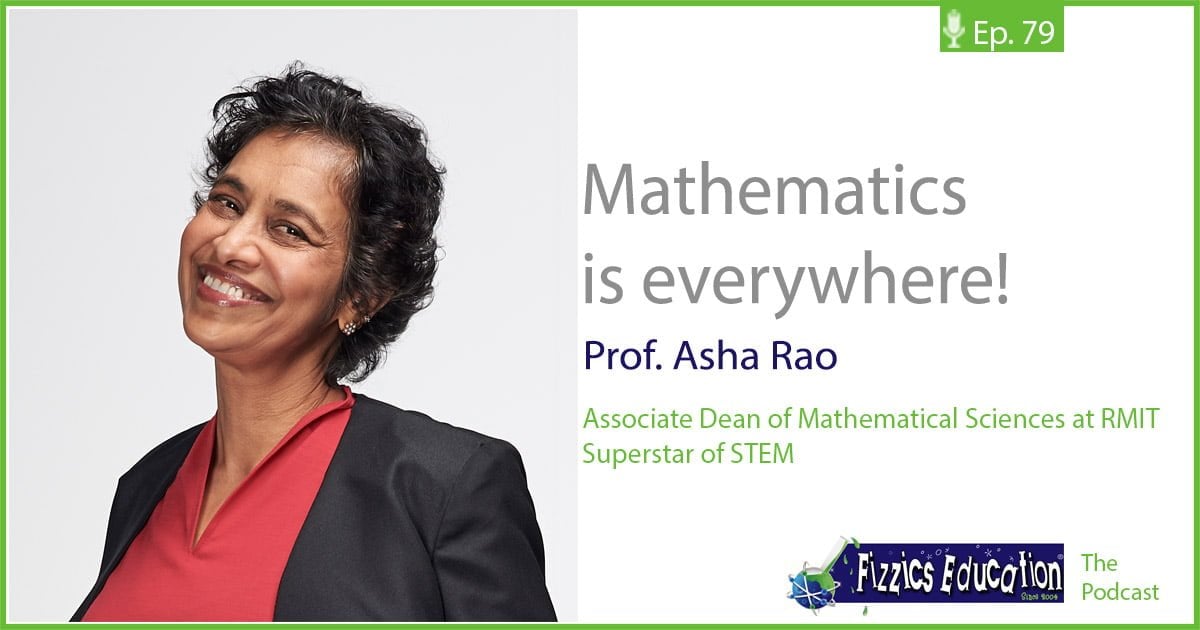
You can’t help but be enthusiastic about mathematics when you hear from Asha Rao! Hailing from RMIT as a Professor and Associate Dean of Mathematical Sciences, Asha is a 2019-2020 Superstar of STEM and she brings a real passion and authenticity to mathematics with her undergraduate students. Her enthusiasm is infectious!
How does an mathematician help catch money launderers or design a one-of-a-kind dress? In this episode, we speak with Professor Asha Rao about the incredible versatility of mathematics. We explore her work as a Superstar of STEM, her role at RMIT, and how she uses complex networks and hyperbolic geometry to bridge the gap between abstract equations and real-world applications like cybersecurity and textile design.
About Professor Asha Rao
Asha Rao is a mathematician and a 2019-2020 Superstar of STEM. An algebraist by training, she applies algebraic techniques to a wide variety of problems, ranging from designing better codes for communication to detecting money laundering and describing human interactions in physical space. Currently serving as Professor and Associate Dean of Mathematical Sciences at RMIT, she is deeply passionate about mathematics and addressing the issues that stymie the progress of women and girls in STEM careers.
Outside of her academic work, Asha enjoys reading and sewing, where she often incorporates higher mathematics—such as hyperbolic geometry—to create unique garments that showcase the beauty of maths in the material world.
Mathematics: The Universal Language of Problem Solving
Professor Rao’s work demonstrates that mathematics isn’t just about numbers on a page; it is a powerful tool for security, engineering, and social justice.
Key Areas of Impact:
Cybermathematics & Risk Management: Using algebra and probability to assess risks in information systems and digital worlds.
Forensic Mathematics: Applying complex network theory to identify patterns in data (like the Enron dataset) to detect money laundering.
Superstars of STEM: Asha works to smash society’s gender assumptions about scientists and increase the public visibility of women in mathematical sciences.
Mathematical Infrastructure: Explaining how maths prevents structural disasters, such as understanding resonance in the West Gate Bridge or London’s Millennium Bridge.
Top Episode Learnings: The Power of Algebra
The Longevity of “Pure” Maths:
Asha highlights how number theory from the early 1900s—once thought to have no practical use—is now the essential foundation for internet encryption and secure transactions.
Losing the Fear of Failure:
Professor Rao discusses the importance of making mistakes in the classroom. By being open about errors, educators can show students that mathematics is a living, evolving process of discovery rather than a rigid set of rules.
Education Tip: The “Geometry of Everything” Challenge.
Follow Professor Rao’s lead by showing students that maths is everywhere. Use a coffee mug to explain surfaces of revolution or an apple to demonstrate fractions. Challenge students to find a mathematical principle in their own hobbies, whether it is the hyperbolic geometry in sewing or the complex networks in their social media feeds. As Asha demonstrates, when students see maths as something eternal and universal, it ceases to be a chore and becomes a way to understand the universe.
[00:00:18]Ben Newsome: Yes, welcome again to another Fizzics Ed Podcast. It’s another big week this week, and I must say, it’s about time we did some mathematics. Considering that we’ve been talking STEM for so long, we should deal with the M, the mathematics part of that acronym STEM. And I tell you what, Asha Rao is the person to do it. She is the current professor and associate dean of mathematical sciences at RMIT, which is a university down in Melbourne. And trust me, she is incredibly passionate about mathematics. You listen to this chat; she exudes enthusiasm, and you can’t help but be carried along with her as she talks about her background in mathematics, why she cares about it so much, and helping students truly understand about how mathematics can be found all over the world.
[00:00:59]Ben Newsome: She’s right into code breaking for communication, detecting money laundering, and describing human interactions in physical spaces. And behind it all, she doesn’t mind solving a bit of hyperbolic geometry. And she says it herself: she doesn’t mind doing a bit of reading and sewing on the side and creating some one-of-a-kind garments, which is a nice way to think about what she gets up to. Asha is incredibly passionate about mathematics and, as such, was rightly awarded one of the Superstars of STEM for 2019 and 2020. There’s quite a bit of a chat here and you will get carried along with her enthusiasm. I hope so; I personally thought, “Wow, how cool is she?” And you will get a bit out of this, certainly about how you can get your students engaged in mathematics in your own classroom. Let’s get right into it. Let’s listen in to Asha.
[00:01:45]Announcer: This is the Fizzics Ed Podcast. We’re all about science, ed tech and more. To see 100 fun free experiments you can do with your class, go to fizzicseducation.com.au. That’s physics spelled F I Z Z I C S and click 100 free experiments.
[00:02:03]Ben Newsome: Asha, welcome to the Fizzics Ed Podcast.
[00:02:05]Prof. Asha Rao: Thank you, thank you, Ben. I am Asha Rao and I basically live and breathe mathematics. I think that would be the best way to put it. I see mathematics in everything I do, and I must say as I have grown older, it has happened more and more. I can look at things and I think, oh my God, why didn’t I see that before? I can see mathematics everywhere, which is kind of crazy, but…
[00:02:34]Ben Newsome: No, it’s not crazy. Not crazy at all. You’d be singing to the heart of a few people listening in, I reckon.
[00:02:38]Prof. Asha Rao: Yes, I hope so. That’s what I want for young people to understand, to realise that mathematics is not something separate, that we are here and mathematics is there. One of the things I learnt the other day is that ‘MA’, the start of mathematics, stands for measuring. And apparently, that’s also one of the names for God. I don’t know which religion, but somebody turned around to me and said, “So you mean God is mathematics?” and I said, “Absolutely, that’s what God is. Mathematics is God. God is mathematics.”
[00:03:18]Ben Newsome: Well, that’s often the question about whether God rolls dice, I suppose.
[00:03:22]Prof. Asha Rao: Yes, I don’t know. I think he knows more mathematics. That’s the funny thing is that mathematicians either count cards and play blackjack or they don’t gamble at all because we know the odds that are against us.
[00:03:38]Ben Newsome: The thing is that mathematics, it’s somewhat clichéd, but clichés exist for a reason. It truly is everywhere. Everything from the golden ratio through to… I’m sitting amongst buildings here. There’s quadrilaterals surrounding me.
[00:03:55]Prof. Asha Rao: Absolutely. That’s the fascinating thing. I was reading Yuval Noah Harari’s book, Sapiens, and he starts off with a timeline. He says 13.6 billion years ago matter comes into existence; physics and chemistry are created. You know what it said to me was, oh, before that there was only maths. And sometime in the future when everything… because everything which is born has to die, because you will run out of energy, in the end there will be only mathematics. Physics and chemistry will also end and we will have only maths.
[00:04:31]Ben Newsome: Well, that’s right. By current research, we’re expecting an infinite universe. Infinity is involved in mathematics, so by definition, you’re correct.
[00:04:44]Prof. Asha Rao: Yes. So that is it. It’s eternal. Mathematics is the only thing which is going to be eternal.
[00:04:50]Ben Newsome: Oh wow. I couldn’t expect nothing less. You have been heavily involved in mathematics for many years. I’ve got to ask you though, what grabbed your fascination to start down this path in the very first place?
[00:05:04]Prof. Asha Rao: Mathematics to me was always easy. It never… I must say, funnily enough, I never thought of it as a challenge. For me, it was chemistry which was the challenge. I always went around and I was doing uni, I did a Bachelor’s degree in physics, chemistry, and mathematics in India. I always told all my professors that if I did want to do a PhD, it would be in analytical chemistry. I wanted to do chemistry, but I wanted to do the most mathematical of the chemistry fields.
[00:05:37]Prof. Asha Rao: But when it came down by the time I got around to doing a Master’s in mathematics, I had a two-and-a-half-year-old son and my idea was that, oh, mathematics has got no practicals. I did a pure mathematics Master’s and I needed only pencil, paper, and my brain. I thought, yep, I think that works for me. So that’s all the reasons I did mathematics.
[00:06:01]Prof. Asha Rao: Some of the things I always look back now and think about mathematics and growing up in India, mostly the idea is that if you’re good, you would either do engineering or medicine. So just doing mathematics really did not occur on my horizon. I did mathematics just because it was there, which was very strange when I look at it. I think how did I do mathematics when I was in school and when I was in uni? I would do the problems in the textbook because I couldn’t find any other problems. I would just do them again and again, so I got them, I don’t know, letter-perfect.
[00:06:45]Ben Newsome: It almost sounds like it was almost a game.
[00:06:47]Prof. Asha Rao: Yes, it was. Can I get it better? Can I do it faster? Can I do it more abstractly? So I still remember when I started my PhD, I was asked to teach a part of a course which was related to my PhD. And first I was asked to do the course, so I did the first half of the course as part of the students, and then I taught the second half of the course in a period of three months.
[00:07:14]Prof. Asha Rao: It was funny when I did the start of the course and I did the tests and the exams, I would solve everything very abstractly. And the lecturer would be always surprised saying, why do you approach things from such an abstract way? And I think I just realised the power of algebra. So I’m an algebraist, so my PhD and my training is in the algebra side, though I did have to learn all the mathematics, but algebra is what really attracts me.
[00:07:47]Prof. Asha Rao: It is in many ways patterns and how do you find those patterns. And I remember when I did it, I had to do it when I was doing my undergraduate, but it never sort of clicked. I would do it, it didn’t mean anything. And then when I did my Master’s four years after my undergraduate, that’s when it was like, oh my God, why didn’t I see this? This is the most fascinating thing I’ve ever seen. All the patterns and trying to explain to my younger cousins or my nephews, I had a few nephews and nieces by then, about how addition would then give you multiplication, of what was a group. Of course, I’m now going into structures.
[00:08:26]Prof. Asha Rao: Those things when you learn in school, you learn things like (a + b)2. You look at that formula and then suddenly when you do these higher algebraic structures, that’s when you understand what that meaning is. Why do we have (a + b)2? What does that mean?
[00:08:42]Ben Newsome: And that’s half the challenge, isn’t it? Because you can have kids rote say to you a particular formula and they look great on paper, they look perfect, you can give them full marks. But actually getting them to truly understand what it was about moving these integers around on the page…
[00:08:58]Prof. Asha Rao: That is very true. That is what I think was that innate understanding. I remember people saying, do you rote learn? I remember thinking back, I know all the formulae, I never used… I never had a calculator. It was very strange because both my brothers were learning engineering, one was two years older to me, the other was two years younger to me, so both of them while I was doing my degree, both of them were doing engineering, both of them had calculators. Nobody suggested I get a calculator, nobody offered me a calculator, and I could do mathematics faster than both of them.
[00:09:34]Prof. Asha Rao: And I knew that is the amazing thing about maths. If you actually do it, you don’t go to a calculator, you start seeing patterns that you can use.
[00:09:43]Ben Newsome: You sound very similar to a friend of mine, Steve Sherman, who runs an outreach programme in South Africa called Living Maths. He lives and breathes mathematics and it truly is about just that, if you truly understand what you’re doing, you don’t need the other peripheral tools to use the central tool in the first place.
[00:10:07]Prof. Asha Rao: Absolutely, absolutely. Just by you saying that, a couple of things occurred to me. One was I remember years ago there were a couple of kids who were selling, during Christmas time they were trying to make a bit of money so they were coming around and spraying little Christmas cartoons or comics on windows. I thought alright fine. And then they needed to work out how much each person would get and who had put in money, and I was explaining fractions to them. Telling them what a fraction was and how it worked. And they just looked at me and said, oh I wish you were in class with us and would teach us fractions.
[00:10:46]Prof. Asha Rao: It was just like, this is what a fraction is. What is three-fifths? You take an apple, you cut it into five pieces, and you take three pieces, that’s three-fifths.
[00:10:56]Ben Newsome: Yeah, that’s it. Actually, a lot of primary teachers will be thinking, yeah, I do pizza maths and it works.
[00:11:03]Prof. Asha Rao: Yes, absolutely. You know the amazing thing, last year I was in Barcelona and I went to the Sagrada Família. I noticed Gaudi using things like hyperbolic paraboloids. I was like, I wish I had known this when I was teaching calculus. Volumes of revolution, volumes of rotation, surfaces. I was trying to explain to some of the other Superstars of STEM, what is a surface of revolution. So I just picked up a mug and I said, you know what, this mug is a surface of revolution. Because if you think about it, there is a base and then there is an equal side, so you can actually draw a line for the base and then you can draw a line which goes along the side of the mug and then you can rotate the whole thing and you get a mug. And that’s exactly how a mug is made.
[00:11:55]Ben Newsome: It’s fun, I mean actually sometimes you look at structures and I actually generally just want to ask to see whether I’ve been just making stuff up or not, but even just a circle is really just an infinite version of levers all stuck together.
[00:12:08]Prof. Asha Rao: Yes. That’s the thing. That’s what I find, is that all of us have an innate understanding of mathematics. It’s in us. And sometimes we’re just… I remember speaking to a daughter of a colleague who has just started to teach maths and she turned to me and she said, oh I’m scared of making mistakes. And I said, why? Why are you scared? I said that’s the whole thing about being a mathematician, is the first time I go into any class, I always say, I never said I wouldn’t make mistakes. It’s up to you to catch me.
[00:12:51]Prof. Asha Rao: Yes, and I will catch myself. And I know I have spent sometimes the whole night because I’ve gone to class and then done something and said, oh, and then spent the entire night worrying about that mistake, I need to fix it. And I go into class the next morning and of course none of them, and these are undergraduate students or postgraduate students, and none of them have noticed it.
[00:13:10]Ben Newsome: You know what, the number of people I’ve been lucky enough to speak with over the years who have been incredibly experienced, been teaching for decades, and they all often, no matter what their background is, this worry about this fear of failure just seems to dissolve the longer you do this. Because after a while it’s like, you know what, I messed up, but here’s a better way. And suddenly it becomes interesting. Like once you lose that fear, I think that’s when you get to play properly.
[00:13:43]Prof. Asha Rao: Absolutely. And I think that is what makes me a mathematician. The fact that I am not afraid of failing. I’m not afraid of mistakes. I don’t want to fail massively, but I am not afraid of mistakes. One of the earliest things I learnt was I think I must have been in Year 9 or Year 10, when I was that sort of kid, and I changed about five schools in my ten years of schooling because my father kept moving around. He first moved around, and then he kept moving me around because I was in a co-ed and then he wanted me to go to a girl’s school, so all of that.
[00:14:19]Prof. Asha Rao: And I would spend, I remember I would get into a school and of course the teachers, especially the maths teachers, wouldn’t have a clue of how good I was at maths. And I can still remember in I think Year 7 or Year 8, the teachers sort of whispering to each other going, have you seen that new girl? She’s really good at maths. Because I would go, it would take me sort of two tests to work out exactly how the teachers wanted the maths to be presented. So the first test I would do okay, you know like five or six out of ten or whatever, and then the second one I would get a nine or ten and they were like, oh my God, that girl’s good. I was just trying to work out your system.
[00:15:00]Ben Newsome: I remember actually, it actually reminds me of this, my late father-in-law was an engineer and he told this story and I’m going to mess this up, sorry family if you’re listening in, I’m probably going to mess this up, but he told a story where he got marked down on a particular engineering problem, I believe it was around fluid dynamics I think, off the top of my head, and he went to first principles. So the physics teachers there, he used PV=nRT, those letters mean stuff and it allows you to work out fluids. And he got this big red mark through his paper and he said, well hang on, I got the right result, I just used a different tool to get there.
[00:15:37]Prof. Asha Rao: Yes, and that is what I love about maths. When I teach students, that’s what I’m looking for. So I would sit and I will mark things, I will never say you need to follow my formula. You need to get the answer, because I have always worked from first principles, always, every time. I would go back because I was, you know for years I could not remember what was the derivative of cos or sin or the higher ones, so I would go and derive it. I would go and lock it out.
[00:16:03]Ben Newsome: I’m going to be honest, I tend to not remember that stuff. What I’ll do is I’ll either go look it up quickly and then I then apply the tool, because I’ve now looked it up, now it’s fresh in mind. That’s the way I work. But everyone’s got a different way of working things out.
[00:16:17]Prof. Asha Rao: Absolutely. Because half the time, if you’re in a test, you’re not allowed to have any material that you can look at. It is almost never you had to remember everything. And so I was like, I can’t remember this. And that’s what I tell people, I seem to have missed because of the way I changed schools, I seem to have always missed the classes where they rote learnt the tables. I never rote learnt the tables. I never ever rote learnt the tables, but I know that now I could do even the 12, 13, 14, 15 times tables. Not the tables, I could rattle off the tables. Why? Because every time I needed something, I would have to say the whole table. I could never, nobody could ask me what was 6 x 7 when I was say about in Grade 6 or 7 or something. I wouldn’t be able to tell you, so I would have to do the entire 6 times tables.
[00:17:05]Ben Newsome: Yeah, but you know what, adults to this day, just stepping away from maths just for a moment, double dare just everyone listening in right now, how many days does May have? And I wonder how many people go, 30 days hath September…
[00:17:19]Prof. Asha Rao: September, yes, April, June and November. I still do it.
[00:17:23]Ben Newsome: I still do it. I mean there’s mnemonics…
[00:17:26]Prof. Asha Rao: I totally agree with you. I still do it. 30 days have September, April, June and November. Yes, yes. We all do it. All the rest have 31 except February which has 28. Yes. All of these ditties, yes.
[00:17:39]Ben Newsome: They use, they’re again a tool. I know that when I had to go through university, I did a biology degree and so I had to learn the main cranial nerves coming out of the brain. And there’s again another way of learning it, there’s a nice way and there’s a probably more an adult version, but either way you do remember it because of these mnemonics and it’s important. And again, it’s not so much hey you’ve rote learnt it, it’s can you apply the information after the fact.
[00:18:08]Prof. Asha Rao: That is right. Because I know a lot of friends were very good at rote learning, but the issue was once the test was over, and you talked to them about six months later, they couldn’t actually remember a single thing that they got their high distinction for. That’s right. And it was also if you, if you take one little thing out, they’re stuffed.
[00:18:53]Prof. Asha Rao: Oh right, yes.
[00:18:54]Ben Newsome: But I don’t know if it’s a story or if it’s real. So that’s where I don’t know if it’s real or not. I personally like the story, so I just say I don’t know if it’s real. But I mean, I think yeah, sometimes people actually work that way in real life.
[00:19:07]Ben Newsome: Hey, so one of the things, you teach mathematics professionally, it’s part of your job, researching stuff and all the rest. So obviously you work with undergraduate students and what not, and they all come from different persuasions and different abilities and all the rest. What are some of the activities or at least ways to teach mathematics to make it real to these students that you find just really works?
[00:19:33]Prof. Asha Rao: So what I always do, whether I’m teaching maths or anything else, because most of the stuff that I teach these days is actually risk management. So what I try to do is bring it into their lives. OK. So one of the things I teach is how to manage risks in information systems. I teach into cybersecurity. Most of my mathematics is I now call it cyber mathematics. It’s related to cyber, the digital world, all of that. So I always go, don’t separate it and say OK, that’s a computer system and that is a risk. So you have to think… and I said, no, think about when you cross the road. What do you do? Do you just walk across the road? Well, that is risky. So what do you do? You look right, you look left. And so that is how I try to bring it as much as possible into real life and say, forget the computers, think about you, how do you do it.
[00:20:25]Prof. Asha Rao: I was trying to explain to somebody yesterday saying, he was like, OK, I can do this because I’ve got all the numbers, and I’ve got all of these numbers. And I said, alright, so numbers, you’ve got to be careful with numbers. I tell you, you can have lunch but it’s going to cost you $100. What are you going to say? He says, oh, I’m not going to have lunch. And I said, why? That is the reasoning you need. Why are you not going to have lunch? All information, all numbers are relative.
[00:20:53]Ben Newsome: Well, absolutely. I suppose I mean, you’re working in cybersecurity and what not, which means it’s a major deal. I mean, these days it turns out it is. But understanding the motivations and how people think if they’re trying to get into a system means that you can at least find the areas they might try and go. I mean, I suppose the analogy would be if you know that they like to go through a particular back window because it’s close to the creek line where they can hide under cover so they’re not seen by the street lights, that’s where they’re going to come. So maybe it’s the same thing.
[00:21:26]Prof. Asha Rao: Yes, it is the same thing. And that’s the thing with maths, because I go back to when I was teaching maths and I was doing a lot of mathematics, and that’s what I would do, try and bring… so we would talk about the West Gate Bridge. So if you’re looking at resonance and things like that, the West Gate Bridge, the fact that why is it that when you go on the West Gate Bridge suddenly the speed goes down from 100 to 80.
[00:21:50]Prof. Asha Rao: One, of course, is because, if you go faster you have more chances of having an accident, but the real reason actually is that you know how the soldiers never march across a bridge?
[00:22:00]Ben Newsome: Ah, I think I know where you’re going with this. The Tacoma Narrows Bridge comes to mind.
[00:22:05]Prof. Asha Rao: That’s right. That’s right. The one which collapsed, and the whole idea is you do not want to get to that resonance.
[00:22:12]Ben Newsome: No, actually, is it true that they had an issue like that, and again going on tangents, Asha, you’re going to have to deal with me, I do a lot of tangents, but I’m just thinking that something like that happened with I can’t remember if it was called the Millennium Bridge or something like that in London where people, for the Olympic Games or something, they walk across the bridge and once it starts swaying, they all start walking in unison, which then amplifies that particular wavelength that was going through the bridge and it messes it up.
[00:22:38]Prof. Asha Rao: That’s right, and causes the bridge to sway faster. So the question is, yes, why do you have bridges on average have a slower speed than after you’re off the bridge? And it’s mainly because of that. You do not want to, I’m sure the resonance that will cause the bridge to break is much, much higher than even if the cars went at 100 on the West Gate Bridge, but you do not want to take the chance.
[00:23:04]Ben Newsome: No. Everyone would go in unison.
[00:23:06]Prof. Asha Rao: Yes, and match the resonance of the bridge.
[00:23:10]Ben Newsome: I must say, the thing is with, what I love talking with mathematicians about just the world is that there isn’t a single situation that you can’t apply mathematics to.
[00:23:23]Prof. Asha Rao: I know, not to be dreadful.
[00:23:26]Ben Newsome: It makes it fun though. I mean, it’s not like a dreary thing. It’s an interesting head space to be in. It means that you might be relaxing, you’re not in front of a class, you’re not trying to do a certain thing, but it’s really hard not to notice things.
[00:23:44]Prof. Asha Rao: Yes. Not to notice, because I’m sitting in my office and I now have a window, for 24 years or some odd years or something like that I had no window, now I have a window, and I’m looking out of that and there is this building which is going further and further up, and to me it basically looks like the towers that where the space shuttle takes off. You know they build those little towers sort of a thing and they have the space shuttle in the middle and then the space shuttle takes off and the whole things fall apart, and that’s what it looks like, and I keep wondering if one day there’s a space shuttle which is going to go out of there.
[00:24:18]Ben Newsome: Funnily enough, of all things, just a weird thing, we’re actually doing some measuring, so you’d be happy, we were doing some measuring to actually create scale models of the SLS rocket system that’s going to take people to the moon in a few years, and comparing it to the old Saturn V rockets because we’ve got to run a show called Destination Moon because it’s 2019 in this podcast, and it’s the 50th anniversary of the Apollo Moon landing. It’s kind of fun to just sort of use random parts to create something that’s a scale model, and I suppose when you’re looking out the window, you’re looking effectively at an almost scale model.
[00:24:55]Prof. Asha Rao: Yes, yes, almost scale model. And there’s something coming down on the side of it, I keep wondering if there’s a huge slide, you know, for an emergency exit.
[00:25:06]Prof. Asha Rao: Yes. So that’s the thing is, when I would say to teachers, just try to engage, try and bring it down to the level of the students. Once you get them hooked, then it becomes easier.
[00:25:14]Ben Newsome: You have to find that hook. And that’s the key, isn’t it? It absolutely is key, and so it doesn’t matter whether you’re dealing with parabolas or just a quadratic equation, it’s just got to be what works.
[00:25:25]Prof. Asha Rao: Doesn’t matter, yes. Doesn’t matter. And I do remember, I remember years of when I’m teaching, I would bring in, every year it would be different. In one year it was Star Trek.
[00:25:34]Ben Newsome: Oh wow, please tell me how the mathematics of Star Trek surely is a rabbit hole we should go down.
[00:25:39]Prof. Asha Rao: Absolutely, the mathematics of Star Trek, but using the words in there, think like may the power be with you or stuff like that. And I’d say, yes, if you’re going across the West Gate Bridge and you’re going faster and this is what happens, and the power will be with you. Yes, the power or the force will be with you, and that’s the police force. Things like that, trying to make sure that they were there with me and not, had not wandered off in some other parallel universe.
[00:26:07]Ben Newsome: That’s fantastic. And this is one of the things, you’ve been one of quite a few people who are involved and actually a lucky few who are involved in the Superstars of STEM programme, which is a fantastic programme put on by Science and Technology Australia. Can you just let us know what you’ve been learning up until this point, being just about the middle of June 2019, what have you been doing?
[00:26:30]Prof. Asha Rao: So what we have been learning is how to convey our message, how to be more relaxed when talking to people, how to, yes, how to basically sell our message. One of the major problems with scientists, STEM, mathematicians, all of us, we tend to, we understand the world around us in a different way. And we, I know I go to, sometimes I go to conferences and things like that and I just think, oh, this is what I’m telling you, it’s talking to my colleagues and it seems fairly obvious and I talk really fast. And the audience is like, no, they don’t understand, and that is one of the messages that the Superstars programme is trying to do is trying to get us to give our message, to talk about what we love in a way that other people can understand us, and that we are not in this esoteric, we are not on Venus while everybody else is on Earth.
[00:27:21]Ben Newsome: And that’s tough too because I’m completely guilty of talking really fast too, like this too, because I get really excited about a certain subject, I get really excited, because this is what we do, especially if you’re passionate about an area, you will do that. Getting a cadence to your talk means that people can follow you.
[00:27:37]Prof. Asha Rao: That is true. And I remember doing this last year, I was talking to the final year students of our bachelor’s degree in mathematics and stats, and I was telling them about honours and how you should do an honours and how, this is my project, and I was, I really, I’d done the whole introduction, everything, and a few people, and then I got up to speak about my projects and then I started to talk about the area and suddenly I started so fast and I realised about three sentences down, I was talking really fast, so I stopped and I said, OK, let’s start again, and I slowed down, and I could see that the students found it really funny that I had consciously stopped myself and because I was getting so excited, I was just talking too fast.
[00:28:19]Ben Newsome: And the thing is that it’s not also the speed, it’s we got clarity and things as well we’ve got to deal with, but it’s the choice of the words that matter as well. Because sometimes because you can’t help yourself, you’re passionate about an area, you’ve done a lot of study, that means that you can’t help but drop the big words which may not be appropriate for this particular audience.
[00:28:43]Prof. Asha Rao: Yes, that is right. And that’s what, learning that, learning not to say the big words, not to assume that everybody is exactly as au fait with your area.
[00:28:52]Ben Newsome: And then at the same point, once they’re, once they understand what you’re talking about, then start to slide in those big words but with a scaffold they can build from so they actually know what you’re talking about.
[00:29:04]Ben Newsome: It’s certainly something you can’t turn on overnight, but I must say, I’ve been lucky enough to speak with, I think in the mathematics area we got to speak with Dr Linda McIver last year, who’s done a lot of work with data science and she was incredibly passionate about what she’s doing but also incredibly good at enunciating exactly why does it matter when it comes to data science and into education, and it very much sounds that you’ve got that same passion.
[00:29:35]Prof. Asha Rao: Yes, yes. And that is what the Superstars of STEM is teaching us, how to slow down and how to, and the other thing I’m learning with the Superstars of STEM is how to tell my story and not just to talk about mathematics, which is what I, I am so passionate about it, I just go and talk about mathematics. And sometimes and even if you ask me a question about myself, I tend to go off and talk about maths because I find it so fascinating, so one of the things that the Superstars of STEM is doing is trying to slow me down so I can talk about myself.
[00:30:08]Ben Newsome: If you’re listening on in, if you’re an educator, a scientist, an engineer, a mathematician, technologist, whoever you happen to be in Australia, there is this fantastic programme for women to really accelerate and excel in STEM and communicating that message, and I must say this programme is, it’s not just a once-off, this is a genuine deep dive that will really make huge inroads, dividends and all the rest into Australia. I really love supporting it, it’s a fantastic programme.
[00:30:38]Prof. Asha Rao: Thank you, Ben. That is really good. That’s really good to hear.
[00:30:42]Ben Newsome: So I must gotta ask, so you’ve got, I mean I suppose if you’re working in cybersecurity, I’ve often liked to ask people what you’re working on in the future or what’s coming up, how much can you actually say here?
[00:30:52]Prof. Asha Rao: Oh yeah, no, most of what I do is not super secret stuff. So some of the things I have done, what I love to do is I’ve got a whole bunch of fingers in a whole bunch of pies. I am what is called a transdisciplinary researcher, so I try and use my mathematics in wherever I can. So some of the things I have done is I love to, I would love to actually do this, but I have tracked, tracking money laundering.
[00:31:22]Prof. Asha Rao: Yes, so we have done that, I’ve done it with a former PhD student, and but unfortunately nobody will give us real data. So we used, if you have heard of Enron, this huge company which went down around the same time as 9/11, I think just a year before, events around…
[00:31:42]Prof. Asha Rao: Yes, yes. So 9/11 went down, same time as Ansett went down and HIH in Australia. So around the same time Enron went down and Enron, in Enron there were about 10 people who were later convicted of money laundering. And the good thing about Enron and money laundering is that around 2002 somebody got hold of all the emails, the company emails, and dumped it on the internet.
[00:32:07]Prof. Asha Rao: So we have a massive dataset where we could track the money laundering and see if we could actually put in ideas and see if you know, use what is called complex networks. So complex networks, so a network is basically you have nodes and you have people, vertices we call them nodes, and you have links between the nodes. So for example if you have two different emails, you can consider the emails as the nodes, and if one email has, or one email address rather, the email addresses are the nodes, and if an email has gone from one email address to the other email address, then you think of a link or an edge.
[00:32:49]Prof. Asha Rao: So you build an entire network, like a graph. You build a graph. And then you try and do different things like you try and find the nodes which have the most number of edges going out, the most number of links going out. You try and find among all the nodes is there a middleman? Is there a node which is sort of causing everything to go, what we would call in traffic as a bottleneck.
[00:33:14]Prof. Asha Rao: So complex networks are used for all sorts of networks, whether they are technology networks, computer networks, you know the routers and all of that, but also traffic, road systems, shipping lanes, you could think of people as well travelling across different countries, the aircraft coming in and going out. So that network science is, uses the power of data. So now, as I was saying to somebody else, the computing now is allowing us to harness more mathematics because these ideas were there, graphs, but without computers being able to churn through data, without computer algorithms, to actually search it would be very hard to do it by a person to find these patterns.
[00:34:07]Ben Newsome: Absolutely. It sounds like this monster almost like those word clouds you see on people’s blog sites where certain words are responding larger than others because they’re being mentioned more in the blog, but to linking them together and knowing what’s coming out of them at the same time is highly highly important. And I’ve got to say that this means, like this is an only one area of mathematics, but the more you hear about how maths can be applied, this is really important for kids to get because eventually when they leave school, no matter where they’re going to be, absolutely if you have numerical skills it’s going to be somewhat handy.
[00:34:43]Prof. Asha Rao: Yep. And so you know what, one of the things we do is online, everything is online shopping now. So if you do online shopping, one of the things you will notice is there is a little lock on your browser. Now that lock comes from one of the purest branches of mathematics called number theory. So if you go back to early 1900s, 1910, 1911, 1912, you will have heard of Ramanujan?
[00:35:08]Prof. Asha Rao: This very famous mathematician, there was also Hardy and Littlewood, and they worked on number theory. So number theory is the theory of numbers, 1, 2 and going on, and numbers, you know, integers, just looking at integers. And as they go larger, you’re trying to find patterns in them. And it’s one of the hardest branches of mathematics, just ordinary numbers, but when you look at the numbers it’s very very hard to come up with patterns. And so back then they did all of that work and there is this very famous quote from Hardy saying that you know somebody asked him what is the use of this mathematics and he said, you don’t do mathematics because it’s useful. And he must be spinning in his grave because the number theory that they did then is now used in cryptography.
[00:35:56]Ben Newsome: Absolutely. And can I just interject just with this, that anyone who ever says that mathematics is too pure and it can’t be applied, dude, often centuries after the fact someone realises what to do with it and…
[00:36:09]Prof. Asha Rao: That is what, that is what I try and get the message out saying that pure mathematics has to be done now so that in 40, 50, 100 years time we have something to use. If the mathematics is not done now, there’s not going to be anything to use in 40 years or 50 years or 100 years. Because the deepest results, the most earth-moving results come from mathematics and pure mathematics.
[00:36:36]Ben Newsome: I absolutely agree, and especially with as quantum computing moves ahead, it’s only going to speed up faster and people are going to create more stuff. It’s a very exciting time.
[00:36:44]Prof. Asha Rao: Yes, it is a wonderful time to be a mathematician, to know mathematics.
[00:36:49]Ben Newsome: Look, Asha, thank you very much for your time. Obviously making a huge impact with your students without a doubt, that’s for sure. I bet it’s not a quiet classroom in your room. I bet they’re all humming. But also spreading the word around and getting involved in programmes like Superstars of STEM is really important. Look, hey, there might be some people who might want to get in touch. How might they get in touch with you?
[00:37:17]Prof. Asha Rao: I am on, so if you just go onto the RMIT website and or even you don’t even have to go to the RMIT website, just put my name in with RMIT on Google, I should come up.
[00:37:30]Ben Newsome: Fantastic. So now look, we’ll put all…
[00:37:31]Prof. Asha Rao: I am on Twitter as well as Asha at, I think it’s AshaRaoRMIT, so everywhere, because I’ve been at RMIT so long. This has been my first job out, not really my first job, but after I did my PhD, this was my first job and only job and I’m still here, part of the furniture.
[00:37:51]Prof. Asha Rao: I try hard, that’s what I tell people, I’m part of the furniture and I try hard not to let anybody sit on me.
[00:37:56]Ben Newsome: I don’t think anyone would dare, anytime soon.
[00:38:00]Prof. Asha Rao: Oh they wouldn’t dare.
[00:38:02]Ben Newsome: Oh dear. As usual we’ll put those links in the show notes and feel free to check those out, and we’ll certainly have them there. Look, hey, thank you very much for your time, it really was a pleasure and I’d love to catch up with you another time because it sounds like you’re doing some amazing stuff and really making maths sing, truly.
[00:38:20]Prof. Asha Rao: Yes, yes. The music of the spheres, Ben. The music of the spheres.
[00:38:24]Ben Newsome: Absolutely. Have a fantastic afternoon and I’ll see you another time.
[00:38:28]Prof. Asha Rao: You too, Ben. See ya. Love to talk again.
[00:38:32]Ben Newsome: Not all TPL for teachers is as awesome as it could be. I feel like there’s a lot of PowerPoint presentations, a lot of sitting and listening to someone talking. Well, if you want a break from that, Fizzics TPL sessions are fully hands-on, fully integrated with the curriculum and full of amazing science ideas that you can put in your classroom right now.
[00:38:54]Ben Newsome: Well, there we go, we just heard from Professor Asha Rao, who you can truly tell loves mathematics but also telling people about it, getting them enthusiastic themselves. And I must say she would have really been a blast if she was in my high school back in the day, helping me understand how mathematics actually works, and in her undergraduate classes, I bet she is really, really, really good to have as your lecturer.
[00:39:16]Ben Newsome: Hey, if you want to reach out to her, she is at RMIT University, so look up Professor Asha Rao, that’s R A O, or if you want, we’ll put a link to her own personal webpage on the show notes. It’s a bit of a long link, so it might be a bit hard to say on this podcast, but you’ll be able to check out what she’s been up to and what she’s thinking about.
[00:39:33]Ben Newsome: So, are you enthusiastic? Are you going to be looking at how you can get kids to see, well, maths everywhere in your classroom? Start with shapes, look at geometry, look at what’s happening with timings and all that sort of stuff. Get kids, no matter if they’re in kindergarten right through to Year 12 and beyond, get them to work not just in the abstract but also in the real, in the real world about how the world’s working and they can see why they should be learning mathematics in the first place, and that’s what Asha is completely nailing, I’m sure. And a very interesting story around how they’re doing all that code-breaking and stuff. That’s very, very interesting, I must say.
[00:40:05]Ben Newsome: Hey look, enough from me, enough from Asha for now, and we have more podcasts coming up. You’ve been listening to me, Ben Newsome from Fizzics Education, and you’ve been listening to this podcast, the Fizzics Ed Podcast, and I’ll catch you another week.
[00:40:45]Announcer: This podcast is part of the Australian Educators Online Network. AEON.net.au.
Frequently Asked Questions
What is the primary focus of an algebraist like Professor Asha Rao? An algebraist looks for patterns within structures. Professor Rao explains that while algebra can seem abstract, it is essentially the study of patterns that can be applied to diverse fields such as cybersecurity, coding for communications, and even detecting money laundering through complex networks.
How can teachers introduce the concept of resonance using real-world examples? The interview highlights how bridges, such as the West Gate Bridge or London’s Millennium Bridge, are subject to resonance. When people walk or drive at a specific frequency that matches the bridge’s natural vibration, it can cause the structure to sway or even fail. This explains why soldiers do not march in unison across bridges and why speed limits often change on these structures.
Why is “pure” mathematics, like number theory, important if it has no immediate use? Professor Rao points out that number theory from the early 1900s was once considered “pure” and useless for practical applications. However, those same theories are now the foundation of modern cryptography, allowing for the secure “lock” symbol on your web browser that protects online shopping and banking.
What is a “surface of revolution” in everyday terms? A surface of revolution can be explained using a common coffee mug. By taking a two-dimensional line representing the side of the mug and rotating it around a central axis (the base), you create the three-dimensional volume of the mug. This makes the abstract calculus concept of “volumes of revolution” tangible for students.
How does Professor Rao suggest teachers handle mistakes in the classroom? She encourages educators to lose the fear of failure. By being open with students about making mistakes and even challenging them to “catch” the teacher’s errors, the classroom environment shifts from a rigid set of rules to a space for discovery and play, which is essential for becoming a mathematician.
Discussion points summarised from the Mathematics with Prof. Asha Rao with AI assistance, verified and edited by Ben Newsome CF
Extra thought ideas to consider
The “Pure” to “Applied” Pipeline
Consider the ethical and economic importance of funding “pure” mathematical research. If scientists in 1910 hadn’t explored number theory for its own sake, we might not have the encryption technology required for the modern internet today. How do we balance the need for immediate results with the long-term necessity of abstract discovery?
Mathematics as an Innate Human Trait
Professor Rao suggests that we all have an “innate understanding” of mathematics within us, from the way we perceive shapes to how we instinctively understand fractions through sharing. How can we shift the curriculum to focus on this natural intuition rather than relying on rote learning and calculators?
The Power of Representation in STEM
Through the Superstars of STEM programme, Professor Rao works to increase the visibility of women in mathematics. Discuss how seeing diverse role models in “hard” sciences like algebra can change a student’s perception of who a scientist is and what they look like.
Recognised by
22 years, award-winning work, 1 purpose
Recognition from business, education and industry bodies across Australia.
Australian Small Business Champion
Multiple years
CILC Pinnacle Award and Hall of Fame inductee
Center for Interactive Learning and Collaboration
Western Sydney Awards for Business Excellence
Winner
Top 100 Coolest Company
Listed
Local Business Awards
Winner
We value your privacy
We use cookies to improve your experience. Essential cookies are always active. You can choose which optional cookies to allow.We use cookies. Optional ones stay off unless you allow them.Privacy policy