Transcript
[00:00:00]
Announcer: You’re listening to the Fizzics Ed Podcast. For hundreds of ideas, free experiments and more, go to fizzicseducation.com.au. And now, here’s your host, Ben Newsome.
[00:00:17]
Ben Newsome: Welcome to another Fizzics Ed Podcast. No matter where you are around this world of ours today, it’s really worth your time as we hang out with Kate Kennedy White, who is an accredited philosophy teacher trainer in Australia and the United Kingdom. She helps teachers get students to think deeply about their world around them, very much so. She has done a lot of work presenting papers in Vancouver, Seattle, Cape Town, London, Auckland, Wellington, many other places. She has done a lot of work, and so much so, she was awarded the Outstanding Professional Service Award by the Institute for Educational Leadership in Australia for her voluntary work with Philosophy in Schools Association New South Wales. She understands how to help students to think, and today, that’s exactly what we’re going to learn about, how to do it in your classroom too. So, let’s head on right over.
[00:01:03]
Announcer: This is the Fizzics Ed Podcast. We’re all about science, ed tech and more. To see 100 fun free experiments you can do with your class, go to fizzicseducation.com.au. That’s physics spelled F I Z Z I C S and click 100 free experiments.
[00:01:21]
Ben Newsome: Oh, look, I’m really looking forward to this. I mean, as I think about all the different episodes over the years with this particular thing, it’s always been very topical, it’s always been on a particular subject, but the work you do is rather broad. It really is.
[00:01:36]
Kate Kennedy White: Yes, you know, I could spend a long time even defining the words, but I won’t do that. That’ll be too boring.
[00:01:45]
Ben Newsome: No, well, that’s it. It definitely will not be. I know because we hung out recently at a farewell for a good friend of ours and I know that the conversation’s vibrant because the nature of what this is like. So, there’d be some people Kate who haven’t had a chance to meet you yet. Could you let people know what you get up to?
[00:01:58]
Kate Kennedy White: What I get up to? Well, at the moment I’m a teacher trainer at a private boys’ school in Sydney where what I am is a philosophy teacher for children. And this is a movement we can talk about in more depth in a minute. So I take classes of boys in this particular school and they have philosophy sessions with me once a fortnight which is motivated by what they are thinking about and what they’re wondering about and what they’re curious about.
[00:02:29]
Kate Kennedy White: Basically, the big concepts in life that are contestable or abstract that we all struggle with all our lives. Not just what is the meaning of life, but any other question that fits into philosophical questions. So that’s what I do at the moment. I’m in a class and then the secondary part of that is I’m training teachers to do this within their classrooms as well.
[00:02:53]
Ben Newsome: This is fantastic. What grade levels are you working with for this?
[00:02:58]
Kate Kennedy White: From kindergarten to Year 6. So kids from 5 to 12. And a lot of people go, “How can kids do philosophy at six or eight years old?” Well, if you know anything about children, they’re asking you why from the time they’re two. Why does this happen? Why does that happen? That isn’t fair, Dad. All those things that you’ve had. And is Father Christmas true? Are you telling the truth, Mum? These are questions that really underpin the ideas of what is truth, what is reality, what is fairness. Kids ask these questions and then they come and nobody answers them. So philosophy with children gives the opportunity for children to ask the questions that matter to them.
[00:03:42]
Ben Newsome: When you talk about philosophy for children, I can kind of get this construct of what it might look like, but a lot of us will have been exposed to philosophy in lots of different ways at different backgrounds that sort of produce this image of what they think it might be. But what does it really look like?
[00:03:55]
Kate Kennedy White: It’s really interesting because it is really deeply philosophy in the Greek, Socratic way. It emerged in America in the ’60s, led by John Dewey as an educationalist as you will know. And it was really what Matthew Lipman discovered and Ann Sharp, that graduates coming to the university in Columbia in New York were not able to say what they thought about anything. These are 18, 19-year-olds.
[00:04:28]
Kate Kennedy White: So, his hands were in the air saying, 12 years of school and they don’t have the confidence, they don’t have the curiosity, they’re not wondering about things. And so he went back into a school in New Jersey and started taking philosophy lessons with eight-year-olds. And what emerged from that is something we call Philosophy for Children.
[00:04:52]
Kate Kennedy White: And it’s very much a dialogic methodology. Just to describe what the kids do in my class, they come into a room that’s a bespoke room which has no desks and no chairs. We sit on the floor in a circle or we sit on little benches on circles and we collaborate with each other, stimulated mostly by a question that children ask.
[00:05:18]
Kate Kennedy White: So today, as I told you earlier, the big discussion was that somebody wasn’t being fair in the playground and we had to dissect the word fairness. Did fairness mean, was there a distinction between fair and equal? And is it possible, is it necessary to even have fair if nobody’s fair, then what’s the point of the word fair? These are the questions that eight-year-olds are asking and we talked for an hour and then off they went. But they did reflect on the idea that maybe fairness wasn’t as easy as saying, “That’s not fair, that’s my chair, you’re sitting on my chair.”
[00:05:52]
Ben Newsome: What’s interesting about this is as I think about some of the conversations I have in a science classroom whereby there’s this assumption that a young child, because you’re working with young kids from kindergarten to Grade 6, that a young child may not be able to grasp a complex topic, but often it’s a language barrier, it’s not necessarily the thought process. They get what they want to say, they just can’t say it. Do you feel the same thing happens in the philosophy classroom?
[00:06:14]
Kate Kennedy White: A lot of people will say that, it’s a very common thing. But being in a classroom, when I’m in a classroom of Year 2s, what are they, seven, eight? They are very able to talk and discuss and then simultaneous with running this discussion, I give them, they’re asked to justify things.
[00:06:34]
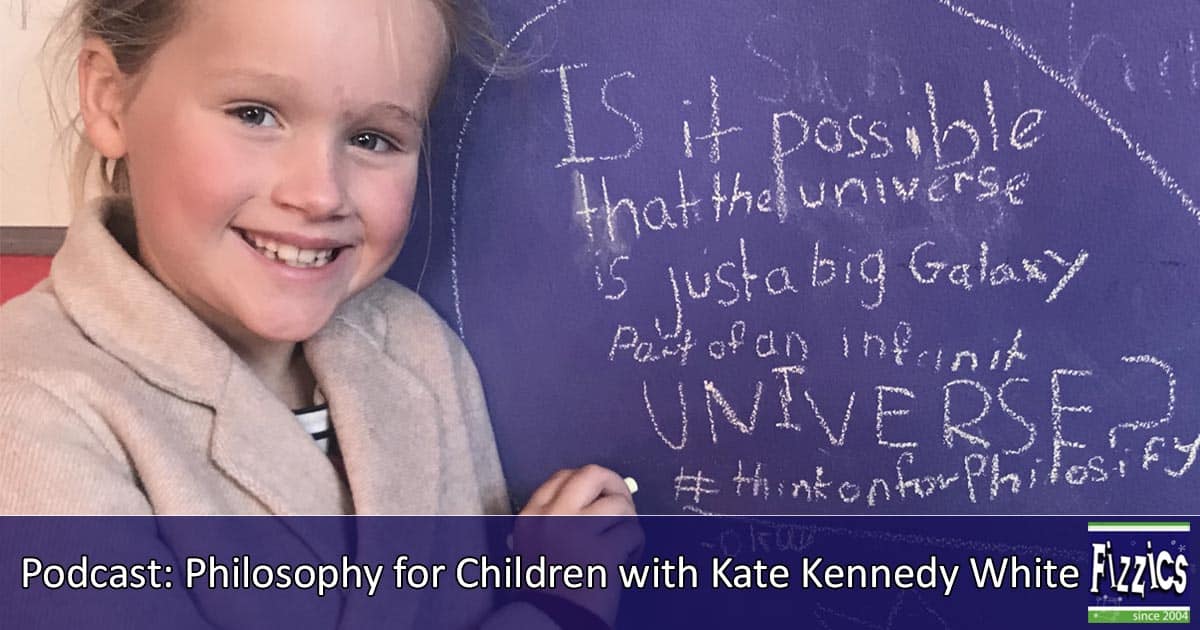
Kate Kennedy White: First of all, there’s the motivation to ask questions, to wonder, to interpret, to be curious. And that’s just wow, we can talk at last in school! In fact, I’ve painted the walls of my classroom in chalk paint. And the kids, when they have this bursting question, and they’ve said it out loud to me, and it’s not a library question or a factual question, it’s an open-ended question, because they now know what an open-ended question is, one that needs discussing.
[00:07:04]
Kate Kennedy White: So they go and scrawl it on the wall. In fact, during a discussion today on fairness, one boy said, “Look, I’ve just noticed on the wall last term, some boy asked another question about fairness, but it’s different to what we’re asking, but it fits in with what we’re asking.” So they all talk about fairness and friendship and truth and things like that.
[00:07:26]
Kate Kennedy White: So that’s the first thing, but what I meant to do is that’s backed up by very explicit teaching of skills to give rigour to their thinking. So those skills at the very early age are justifying. Justifying what you say with a quality reason. Or it could be to make an inference about something. I teach inferences to Year 2s. I’m teaching a very basic form of logic right from Year 3.
[00:07:56]
Kate Kennedy White: So that if the premise is true and there’s two premises that are true, the conclusion will be. And if there’s no premise, then the conclusion is just an assumption or a generalisation. And they use these words in the class. Even today one boy will say, “Well, I’m going to disagree with Ben because when he said that, he wasn’t thinking that that’s not always true. Therefore, his reason isn’t justified.” They’ll speak like this.
[00:08:24]
Ben Newsome: That’s awesome.
[00:08:25]
Kate Kennedy White: And it’s a language. And I don’t back down from this. They’ll go, “I’m not clear what you’re saying,” and someone will say, “Well, give us an example.” And that’s really fantastic. Another boy will say, “I could give you a different example,” and then some boy will say, “And I can give you a counter-example to that.” And this is their language. Just like in mathematics they have a language, in philosophy we have a language.
[00:08:50]
Kate Kennedy White: And it’s not fancy. It’s interesting when I listen to politicians talk and you know which politicians have actually done some really good thinking and training and which haven’t. Someone will call for a distinction when somebody fumbles over two words that sound alike but actually mean something different. So there’s a lot of support for the children to take them through this scaffold. So by the time they’re in Year 6, I have an expectation in a variety of areas of an ability to have really good rigour, to identify when they’re generalising, to question an assumption, to note…
[00:09:32]
Kate Kennedy White: Well, to note that inferences could have many reasons, not just one. You observe something and you know this from science. You infer something, therefore, you know, you see something happening, observe it, doesn’t necessarily mean that what you’re inferring is the only answer. And they get that.
[00:09:49]
Ben Newsome: Which is fantastic, because even just as you’re saying that, it just popped to my mind, like one of the things to really keep in mind when we’re doing science is correlation does not imply causation. It just doesn’t. And as humans, we look for patterns and assume things constantly. And then when a kid finds out, actually, you have to test it, and this is why we have a fair test. I mean, doing this sort of work early in Grade 2 must prepare them beautifully for primary school science.
[00:10:18]
Kate Kennedy White: It does. And in fact, when I do staff development, I use plenty of examples, really fun examples. I’m going to struggle just off the top of my head here, but there’s something ridiculous, like the number of murders in some state is correlated with the amount of cheese bought in the same state or something ridiculous. Makes no difference, but the maths works. It’s interesting to show these things to the kids.
[00:10:43]
Ben Newsome: So that’s what you do. Are you training the teachers?
[00:10:47]
Kate Kennedy White: I do. I run training courses for teachers. That’s the core of what I love to do the most. So we take courses, it’s a two-day introduction course that I’ll run with some of the other people, nearly all of them I’ve trained myself years ago. But I’ve been training for two days where they’re sort of equipped to understand what’s this community of inquiry that we work in, because it’s a collaboration between people.
[00:11:13]
Kate Kennedy White: And what that develops, like if we’re having a discussion, it automatically encourages open-mindedness, because you can’t have a collaboration if you don’t listen to the other person. Even if you’re going to disagree with them, you must listen to their reasons and understand. And even halfway through a lesson today, it was so lovely. A boy in Year 4, I made them sit in pairs to say, “Is there a distinction between fairness and equality?”
[00:11:41]
Kate Kennedy White: And this boy said, “No, they’re both exactly the same.” And his little mate next to him said, “Well, I disagree with him because I think they can be different.” And they all give their reasons for distinction. And halfway through the conversation, the first boy said, “You know what, I’ve just changed my mind.” This is what, as teachers, we love to hear. I listened to him, I thought about what he said, and it made more sense than my argument.
[00:12:06]
Ben Newsome: Yeah, and yet we watch adults many a time. We find a hill to die on, don’t we? With our ideas, it happens all the time.
[00:12:12]
Kate Kennedy White: I know. So I guess what I think is not what the critical thinking skills are, but how do you develop a critical thinker? So I’m focused on the boys to have this disposition to wonder, be curious, ask questions confidently, to have a disposition to be open-minded, which are all the things that we wish mature people would have, and these kids have it.
[00:12:43]
Ben Newsome: Which is interesting as I think about what it’s like in the formal schooling world, saying, you know, we’ve got a curriculum, we’ve got hopefully a measurable output, etc. And yet, just like you were talking about the ’60s, you’re preparing kids for thinking into the university courses even when they’re young, to actually really think about how, what is a good question and how do we follow reasoning, how do we question the reasoning, is it valid, is it not?
[00:13:10]
Ben Newsome: How do you go about that, especially considering that you’re setting this and getting it in motion in the current school that you’re at? I mean, were there many barriers? Was it easy to set up? And how’s it all sort of going?
[00:13:24]
Kate Kennedy White: I was at a fantastic school and I set up, we called it the Philosophy School. It was in Bondi, Bondi Public School, state school. And I had the support of a principal who really believed in this. And I had free hand. 600 kids every week came through that classroom with me. It was wonderful, because I can’t work out how many classes that were. Most of them came for an hour.
[00:13:51]
Kate Kennedy White: But I actually did some mapping against NAPLAN over three years to see what had happened. And maths and literature zoomed way up to that top level when it was below the line where it should have been in a school of that socio-economic barrier. And this correlated, mine was just a tiny little me study, but it correlated precisely with studies that have been done all over the world.
[00:14:18]
Kate Kennedy White: In England, 4,000 kids did philosophy, and they used a test on those children with another school that weren’t doing it. And the correlation was amazing. The advances in the children’s thinking, in their ability to confidently approach problem-solving. So they didn’t need to regurgitate what the content was in the class, but to think it out for themselves. You show them a map of the world, and it might show the vegetation of the world. And look at it, what does it make you think? What could you deduce from what you’re seeing? Be curious about it.
[00:14:59]
Kate Kennedy White: What happens, though, that although I’m doing this philosophy as a sort of standalone subject, one of the things I’m doing with the staff, and I’ve done it in other schools too, is make sure it’s embedded within the subject areas. So if we’re doing oceans, which they were doing in Year 6 a few weeks ago, you start looking at things like ownership, rights, cultural interpretations of the value, responsibilities.
[00:15:30]
Kate Kennedy White: If you start talking about these things, this lifts it up and above the content. Not to say the content isn’t essential when you’re studying anything, let’s call it oceans, my go-to word, but to consider that people have a different interpretation of what is the ocean. If you look at the Northern Indigenous people in Australia and what they think the ocean is, is where the high watermark is in tide. So therefore, they own part of that. And then you have the Western view is the ocean belongs to everybody and nobody can own it.
[00:16:08]
Kate Kennedy White: And how do you discuss this conflict? It is a conflict between those two ways of thinking. I embed it very heavily into mathematics because in mathematics it’s a conceptual language. But what happens with kids, if you don’t start talking about what is zero or what is infinity or what is a pattern, then you don’t understand maths at that concept level and you suddenly hit the brick wall.
[00:16:44]
Kate Kennedy White: Year 4, Year 5, you can’t do maths because you just didn’t really get it. Even as much as what are the symbols and signs, and how they are, we make assumptions when we teach maths without stepping back going, well, what do the kids not know? So if you allow them to ask the questions, you soon find out. You know, “Why then does a triangle like this always happen to be like this?” And you realise, wow, this is fantastic that they’ll talk maths in the classroom.
[00:17:15]
Kate Kennedy White: And they’ll think mathematically in the classroom. So it goes across all subjects. So the training of teachers is really, I’m very keen that it’s embedded into the methodology. It’s a methodology that you use in the classroom in whatever you’re doing. You’re reading a novel, you might be reading Fantastic Mr Fox, but boy, there’s some really big topics buried in there. On justice and doubt and environmental rights and theft. There’s all sorts of things buried that you can then deepen those discussions.
[00:17:50]
Kate Kennedy White: So when the kids come to write about that novel or whatever, it’s not comprehension questions they’re getting. And it’s not just defining the characters, it’s deeper stuff that they can write about because they’ve talked about it. There’s been a lot of talk in the classroom over not just Fantastic Mr Fox, but about the issues that he obviously had to think about or lie about or survive about. And you see the writing is richer because it’s the discussion on the big questions that the kids will in fact ask.
[00:18:27]
Ben Newsome: G’day, it’s Ben here. I hope you’re enjoying this particular chat, and guess what? There’s so much more you can do with your science teaching. Head on over to fizzicseducation.com.au. There are complete and comprehensive teaching units that you can get your hands on. If you click on the top, you will find there are a whole bunch of scope and sequences, cross-curricular teaching ideas, hundreds of printable experiments and activities, videos, risk assessments, marking rubrics, you name it, it’s all there, and it’s all linked to the curriculum, and it’s something that you can implement right now. Head on over to fizzicseducation.com.au and check out what’s on offer.
[00:19:04]
Ben Newsome: Which I love. I mean, I think about people that are listening to this, a lot of science and STEM practitioners in different forms listening to this. And STEM by its very nature is solving problems with things. There’s a lot of ways. And I think about what I’ve come across with students in different schools, how they define the problem, is it worth solving?
[00:19:26]
Kate Kennedy White: Yeah.
[00:19:27]
Ben Newsome: And it seems to me that a lot of kids, I mean I was one of them as a really young one, I was very keen, very, very keen to just get going, I just wanted to start. I wanted to rush it, rush it, rush it.
[00:19:37]
Kate Kennedy White: Yeah, totally. I was like, “Oh, that’s the one thing, let’s go for it.”
[00:19:40]
Ben Newsome: And that pause is really needed, especially when we’re about to embark on a very large build or solving of something. If you’re not solving the most critical problem, you’re still at the periphery.
[00:19:53]
Kate Kennedy White: Yeah, because what’s the point of doing it? Yeah, that’s true. And people are a little bit, teachers are a little afraid to let go and let the children ask the questions. I mean, the other day the STEM teacher at this school was doing anatomy and the kids wanted to get into human organs and the trade of them and all that stuff.
[00:20:18]
Ben Newsome: Oh, really?
[00:20:19]
Kate Kennedy White: These are Year 5 boys, you know that. And she so lovely said, “Why don’t you bring this question up in philosophy? You know, what do we own and what don’t we? What rights do we have over our own body? Is it appropriate to charge money to the highest bidder for your kidneys so you can leave your family rich?” I mean, they’re issues that, I didn’t bring them up and neither did the STEM teacher. The kids bring them up. So why not talk about them?
[00:20:51]
Kate Kennedy White: Which is fantastic, because I often think about transdisciplinary delivery. I mean, the idea, you’ll go to plenty of schools that are very much siloed. We’re doing English now, we’re doing English now, now we’re doing maths, now we’re doing science, now whatever we’re doing. And yet that’s not how the human brain works.
[00:21:05]
Ben Newsome: Not at all.
[00:21:06]
Kate Kennedy White: Not at all. And you know, we’ve got this interdisciplinary subject, we have maths, we know, and we’ve got English, but we’ve now appointed in this school an interdisciplinary expert. And I’ve worked so closely with her, writing, going through the programme for Term 1, Semester 1, and looking what the kids are doing. And thinking, well, where… because it’s not natural for the teachers to think like that I’m suggesting.
[00:21:32]
Kate Kennedy White: But I remember that Year 1 were doing palaeontology. And with the flash words as well. So I decided that we’d have a question of what do we know and what don’t we know. Just so the little Year 1s love talking about what I know and what I don’t know. And one little boy said, “And what do we need not to know?” Okay, what things don’t we need? I don’t need to know when I’m going to die. This is how they talk.
[00:22:00]
Kate Kennedy White: So we got to that, what do we need, so what do we know? And then we went on to the dinosaurs and we found the big heaps of bones. And how can we be absolutely sure that that’s the way they were? If you join all those bones together, maybe whatever. Now this is just, of course we know we can, but you know, something like, we really don’t know, they could have been purple and pink for all we know, but we don’t know that. We don’t know everything about dinosaurs. Now that’s just, you know, I dread the science teachers hearing me talking like this. But what it was, is the kids were curious enough to think a little more deeply about fossils and what they tell us and what they don’t tell us.
[00:22:42]
Ben Newsome: What I love about these questions though, in the science classroom, it doesn’t matter whether they’re really young ones or Grade 12 students. If someone asks what might be perceived as a question that’s not worth asking, which is ridiculous because all questions are worth asking. You can then actually go, “Well righto, well let’s look at how they might know the colouration of a dinosaur.”
[00:23:02]
Ben Newsome: I mean, as you were talking, I was just thinking about one of the very first examples of a dinosaur known, the Iguanodon. So they find this thing in a coal pit in the UK and they think, because we’re used to looking at rhinoceroses, that these little thumb spikes are actually on its nose. In fact, you can go to a park and you can still see this four-legged creature walking around that looks like a rhinoceros and it wasn’t. Those spikes are on their thumbs.
[00:23:28]
Ben Newsome: And so they had their preconceived notion of what they think a thing looks like, and they applied it. And these are adults, right. And the reality is, as we talk with students, is that science is really just a body of work. It’s just, here’s what we currently know, and we’re about to go into the future a bit further. That means as soon as we go into the future, that means we’re now working in the unknown. And sometimes, occasionally, it goes against what we currently know. And to be comfortable with it.
[00:23:55]
Kate Kennedy White: Well, and that’s how the great things have happened. In fact, I was just reading a paper last night on what philosophy does is allows the uncertainty.
[00:24:04]
Ben Newsome: And are they comfortable with it?
[00:24:05]
Kate Kennedy White: Well, to be comfortable with uncertainty is pretty important, isn’t it? But it’s not, like when the boys left today, and I mean this wasn’t my best lesson for sure, but I’m just thinking of it because it was just an hour ago. As they walked out, I asked each boy, “Do you think now you know how to use the word fair in the playground?” They go, “No way. It means too many different things in different contexts.”
[00:24:36]
Kate Kennedy White: And I, okay, right. In the context of a STEM podcast, a fair test is the heart of scientific reasoning.
[00:24:48]
Ben Newsome: Mmhmm. Absolutely being fair.
[00:24:50]
Kate Kennedy White: So, in other words, for those people listening in, like, if you’re going to measure the speed of something, all the other variables need to be rather controlled, otherwise you might be measuring something else.
[00:24:59]
Ben Newsome: Yes.
[00:25:00]
Kate Kennedy White: Fair testing is the heart of it. We make this big deal of what science is, and the reality is it’s not actually that difficult apart from all the content that we have to certainly learn. It’s just keep everything the same, change one thing, measure the effect of that change, keeping everything else the same. That is a three-year degree in about two or three sentences, ishly.
[00:25:21]
Kate Kennedy White: I mean, of course, we’ve got to learn all the content about what science is, but fair in this context is, were you testing something fairly? Were you making it unfair with an experimental plot or something? And perhaps this might be put against what you were doing with your classes this afternoon. I mean, yeah, that… but I find I don’t know, I just see my kids and they’re quite, they’re adults now, but they’re really good. What people will say, your kids are really creative thinkers.
[00:25:52]
Kate Kennedy White: And I don’t mean creating, they create, not in the creative, arty, create, but I think that they have just often gone back to what they call their first principles. And let’s ask the really basic question first. What do we know? What don’t we know? Or what can we know for sure? Or what doesn’t matter that we don’t know. I mean, these are the questions that children love to talk about.
[00:26:22]
Kate Kennedy White: You know, when I visit my grandchildren, we sit around the table and they’ll go, “Grandma, can we have a philosophy chat over dinner?” And it will be, “Okay, whatever you want, what do you want?” And then, “Well, you know, Daddy the other day said…” and then we’ll find the question. But it’s a way of thinking, it’s a deep way of thinking that comes from the child or from the student and it gives them the agency over the conversation.
[00:26:46]
Kate Kennedy White: It’s not us saying, “You’re going to learn today this. I’m going to say it three times and then you’ll know it at the end of the lesson.” And you and I know that tomorrow they haven’t learned a thing. But I just wanted to make reference, for people not to freak out. Of course content’s important. But I always think content has to have some relationship to their prior knowledge or their experience. Otherwise it just sits out there.
[00:27:10]
Ben Newsome: I suspect that the questions that you would ask prior to doing a science experiment are critical.
[00:27:15]
Kate Kennedy White: Yeah.
[00:27:16]
Ben Newsome: It makes me think about the schools that haven’t embarked on this process yet that possibly would like to. So, it’s going to take a leap of faith in some ways. How would they go about that?
[00:27:27]
Kate Kennedy White: Well, you know, we run these training sessions on a needs basis. I’ve done quite a lot where I just go into a school for a day and do a whole-of-school PD. Or a new mention, you’ve been to Dubbo, you know, I was in Dubbo three weeks ago where they’d done a two-day course, but they wanted a third day just to ask a lot more questions before they put their final lesson in for the certificate.
[00:27:51]
Kate Kennedy White: And it was just a wonderful, wonderful day of, yeah, it was just I went there for the day to Dubbo, just helping the teachers. They got the theory of it, they thought, but they didn’t know what would happen on a very practical day-to-day level, an hour-by-hour, five-minute-by-five-minutes. How would it look in the classroom? And it was a question of allowing the children to chat in a fairly controlled way.
[00:28:16]
Kate Kennedy White: Controlled meaning one person’s talking, everyone’s listening. Someone else gets a chance to talk about what that person wants or maybe a new idea they’re stretching into their head. But once you do this, what we call a community of inquiry it’s called, and it’s been probably around since Dewey, where kids collaborate and it’s very much based on the same methodology as scientific inquiry. Philosophical inquiry. In fact, the pattern is very much the same.
[00:28:50]
Kate Kennedy White: And just so the answer is yes, you know, do a two-day intro course and then we offer support to do it or observation or whatever. Whole of school or just send two or three teachers that have a bit of an interest in this. And what I want to say is it’s not about having done philosophy at university. It’s a way of thinking. It’s not a, we don’t teach, we don’t need to teach the philosophers.
[00:29:16]
Kate Kennedy White: Although I had the joy once of having a mother who wanted to know about it, she had a PhD in philosophy. And at the end of each lesson she had looked at me and she said, “Do you know they compared Philosopher A with Philosopher B?” I go, “The kids were talking about Bondi Beach and the sand!” But she said, “But they brought up David Hume.” But I didn’t know, and the kids didn’t know, and it didn’t matter at that point.
[00:29:43]
Kate Kennedy White: What mattered is that they will bring up, well, we know what, some of the things we know is that we know we’re here because we wouldn’t be able to think that if we didn’t know if we weren’t here. Which is Descartes. I don’t even mention those words to them. They don’t need those words yet. I just want to answer their words.
[00:30:03]
Ben Newsome: As I think about this, there is a strong value in putting this in place in schools from a getting kids to really be able to think really deeply about what they might be needing to do in all their different other subjects. So they can be more efficient. I mean, there’s an old quote, there’s the danger of quotes because you always misquote a quote and sometimes they’re misattributed as well. So I’m just going to say it and I don’t care whether it’s right or wrong, but the essence of the quote is still true.
[00:30:31]
Ben Newsome: There was one that was attributed to Abraham Lincoln and simply said, “Give me six hours to chop down a tree and I’ll spend the first four hours sharpening the axe.” So, efficiency. Spending the time to think really deeply about a problem and looking at all the different machinations about what might be right, what might be true, what might be false, what are our assumptions, all those things.
[00:30:52]
Ben Newsome: Knowing where we’re really sitting within a problem is rather important before we try and embark on solving said problem. And it means we’re going to be more efficient in the process. It seems to me that as I think about what might be happening in the school where you’re working with, whereby they’re going into their science, their English, their maths and all these other different subjects for these kids, but they’re still being now directed back to you to think deeper about a problem, which is fantastic.
[00:31:36]
Kate Kennedy White: I’d have to say that nearly half the teachers at the school I’ve trained since I’ve been here. So that they know what I’m talking about, which is why they come and say, “I’ve got this novel, I can’t quite find the big question in it, can we sit down for five minutes, we’ll find it. It’s about hope, or it’s about wants and needs, or it’s about this.”
[00:32:06]
Kate Kennedy White: But just to go to your lovely tree example, I heard a quote which I’ll misquote, it says, “In philosophy, you think twice. You think, and then you think again.” And I thought that was a beautiful thing. And I say to the kids, “Sometimes that’s what we do. We think, we chat, and then we think again. And we often changed our mind or changed our position or moved it a little bit or learned something to find that we don’t know anything now.”
[00:32:32]
Ben Newsome: And that can be applied in lots of ways. So even when you’re writing out an email, stop, go have a coffee, have a tea, have a break, come back to that email and maybe you might delete it rather than send it. Who knows? But thinking twice is rather useful in our own personal lives let alone subject areas.
[00:32:48]
Kate Kennedy White: Yeah, well you know philosophy goes right through life. You know, and I find the value of it is being able to listen to a conversation with two people banging against each other and saying, “Well, what are we really talking about here? Aren’t we talking about the concept of ownership and is there such a thing anyway?” Oh, oh, just lift it away from the personal to the big concept and talk about that instead.
[00:33:14]
Ben Newsome: Which is where the fun is. This is awesome. Kate, thank you so much for hanging out with me this afternoon.
[00:33:20]
Kate Kennedy White: Thanks so much, Ben. It was a pleasure to talk. I haven’t hung out with you in my life, Ben! It was good though.
[00:33:27]
Ben Newsome: I like doing this. I mean, I reckon there’d be other people who’d love to hang out with you further. I mean, how might they get in touch? Because there’d be some people who’d love to know, righto, this is clearly a potential possibility in their world. How do they do that?
[00:33:43]
Kate Kennedy White: Okay, a couple of things. Via you. Via my email which I can give to you for people to contact. I also have a website which I’m about to bring down, I think. It’s my training website called Kinder Philosophy. Kinder in the Germanic word of the child, kinderphilosophy.net. And there’s quite a bit up there still of what philosophy can do for your school, what the training sessions are, who I am.
[00:34:10]
Kate Kennedy White: And in fact, my co-teacher is in fact a high school science teacher. Sally, you know Sally? And Sally and I, so I get an enormous amount of how to embed what the theory of what I do into subject areas like maths and science and technology. So that I’ve learned as much from Sally as she’s learned from me and we team together sometimes to do that. So did I answer the question? I’m typical, I go off on a random excitement.
[00:34:55]
Ben Newsome: I think you very much did. And as usual, the links are in the show notes, so you can click to your heart’s content and find out more.
[00:35:03]
Kate Kennedy White: You can put the Kinder Philosophy into that, the link, yeah.
[00:35:06]
Ben Newsome: No, look, absolutely. Well, no doubt the next time we catch up you will have had more conversations with these blossoming adults effectively.
[00:35:16]
Kate Kennedy White: I have to say, any teacher that’s done the philosophy course, just as I said, it’s a two-day basic, there’s lots more courses but the two-day basic, for a teacher gets you into a different way of being in the classroom. Not all the time, but allowing yourself to listen to the kids freely. But teachers will say, I am so motivated by my teaching. It excites you to be in the classroom when you hear the children talk.
[00:35:42]
Kate Kennedy White: Which we think we hear them talk, but you know in classrooms with the pressure teachers are under even in primary school to get the curriculum done and ticked off, they say “I’d love to do it but I don’t have time.” Have 20 minutes twice a week where you chat about something that they’ve raised. That’s enough.
[00:36:11]
Ben Newsome: Yeah, that actually reminds me before we close out this episode, that reminds me of a chat I had with someone who’s a very, very, very well-versed distance learning specialist. It’s incredibly, very, very good person doing this and he actually tracked student motivation during the start of COVID and through that time. It wasn’t about the content, he’d bang on about his history teaching for sure. But he tracked what was working, what wasn’t, and he was actually open enough for kids to actually physically give him a rating out of 10 per lesson.
[00:36:43]
Ben Newsome: Which is pretty bold, right? Very bold. And he noticed a reduction in his score over several months. And what he discovered and was able to turn around was that during the COVID meltdown, he became so hyper-focused on getting the content out like a shovel, out, out, out, got to keep on doing it over and over and over.
[00:37:04]
Ben Newsome: He’d forgotten that what actually made his class hum prior to COVID, when he wasn’t doing the distance learning stuff as well, he actually found that it’s the hallway conversations and the chats, those three to five minutes while you’re marking the roll or whatever else you’re doing, that were bridging connection with his students. And then the content flowed easier.
[00:37:27]
Ben Newsome: He had made the mistake, and he openly said so, he’d made the mistake that he was so busy trying to shovel his content out because he had to because he felt, “Oh my gosh, COVID,” he’d missed the point and the students were starting to disconnect from him. And he turned it around.
[00:37:40]
Kate Kennedy White: That’s a brilliant, I mean it’s a brilliant study, but it’s a brilliant point to make, you know, to question yourself and evaluate yourself as a teacher on how much do I know about these kids? I went into a class once and I was relieving and I was observing the teacher and she said, “Okay, good morning boys, whatever, blah. Anyone got a question?” And one boy said, “Yep, I want to say to you that last night my dog died.” “Yeah, okay. Anyone got another question?”
[00:38:09]
Kate Kennedy White: And it’s like, wow, you know, I want to stop everything. We need to have a little chat here. Not endlessly about that, but let him talk a little bit more, what’s he doing and how is he, and then we’re into the busy… but you know it was like, ah, I could have built whole days’ lessons on that stuff.
[00:38:29]
Ben Newsome: Yeah.
[00:38:30]
Kate Kennedy White: And we still could have done, you know, we could have done statistics on whatever, don’t go there. But I love the truth that he found and the joy in listening to the kids and letting them talk.
[00:38:43]
Ben Newsome: Yeah, and being open to that feedback.
[00:38:45]
Kate Kennedy White: And I think too that kids talk less and less than maybe when you were a kid or I was a kid because we didn’t have devices. We had a radio that was put on for the news and then when the news was finished, we had dinner and the room was quiet. There was just the kids around the table talking. Talking to your parents. And you know, we talked about all sorts of things. That was the 20 minutes a day talking.
[00:39:10]
Ben Newsome: Well, there’s a couple of good friends of mine who know I have a very good chat with my son on the way to basketball every week, travel with my little boy. So we just ask any random question and lately it’s been space and the human body. But then his mind just blips off to somewhere else and it’s just alright, we just chat and because you’re stuck in traffic for 50 minutes, those conversations are rather broad and they’re important. I don’t turn on the radio for a good reason because he just drifts.
[00:39:48]
Kate Kennedy White: That’s beautiful.