Transcript
[00:00:00] Voiceover: You’re listening to the Fizzics Ed Podcast. For hundreds of ideas, free experiments and more, go to fizzicseducation.com.au. And now, here’s your host, Ben Newsome.
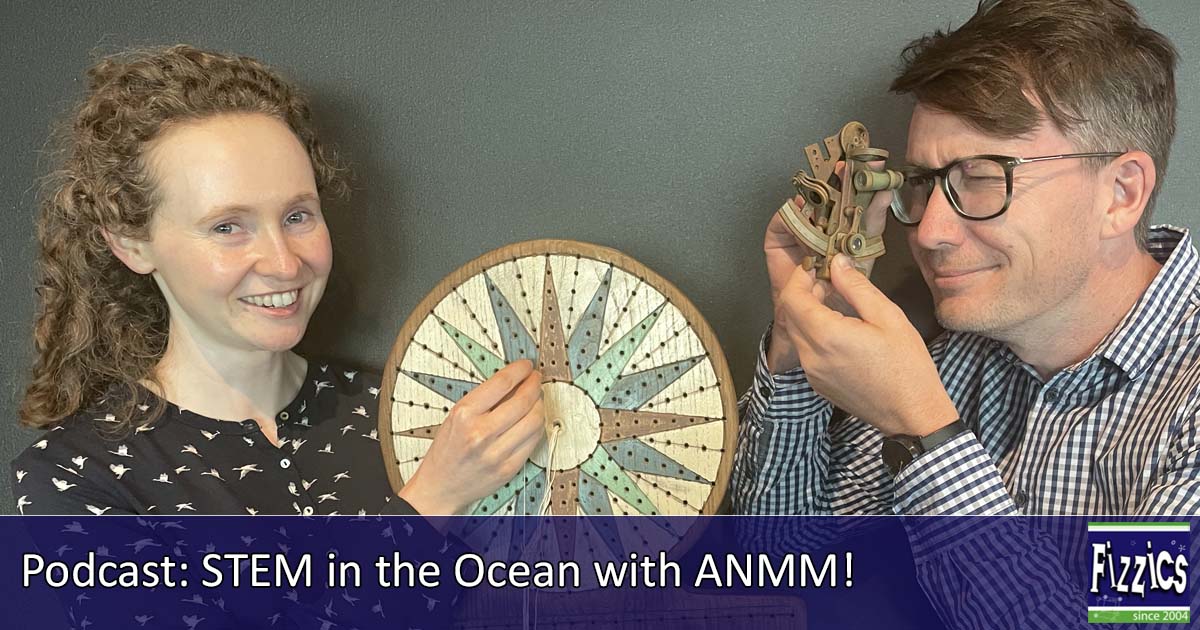
[00:00:19] Ben Newsome: Welcome to the Fizzics Ed Podcast. Glad to have you in for another chat around STEM, and in this particular case, we’re talking about STEM in the sea, STEM underwater, STEM on top of the water as we hang out with Anna Gregory and Mathew Sloane from the Australian National Maritime Museum. We’re talking about marine oceanography, we’re talking about marine archaeology, all things sea science, and importantly, how you can get your students involved with the Australian National Maritime Museum. They’ve got a Women in STEM programme coming up amongst many, many other programmes, including—and this is kind of cool—a programme involving LEGO underwater. Seriously. Hey, why not? It’s an awesome thing to check out. Let’s get right into it.
[00:00:59] Voiceover: This is the Fizzics Ed Podcast, for all about science, EdTech and more. To see 100 fun free experiments you can do with your class, go to fizzicseducation.com.au. That’s physics spelled F-I-Z-Z-I-C-S, and click 100 free experiments.
[00:01:21] Anna Gregory: Thanks very much. It’s lovely to speak with you.
[00:01:22] Mathew Sloane: Thank you. It’s great to be with you, Ben.
[00:01:25] Ben Newsome: As we chat, it’s the start of 2023. I just dropped my kid off at school this morning and there’s that buzz of the start of the year. In our world, in outreach land, in museum land, in doing all the enrichment programmes that we do, this is really a busy time as we get ready for the year, hey?
[00:01:52] Anna Gregory: Absolutely. We’re just starting to kick off programmes for the year, and we’ve got new exhibitions starting as well, so it’s all happening here.
[00:01:59] Ben Newsome: What new exhibitions have you got coming?
[00:02:02] Anna Gregory: We have a new exhibition at the Maritime Museum called Brickwrecks, which is a combination of maritime archaeology and LEGO.
[00:02:12] Ben Newsome: That’s awesome. The archaeology component has always been interesting from a high school science point of view. Looking at reduction-oxidation reactions, what happens when a metal thing sits in seawater for a while? But with LEGO, that’s kind of fun.
[00:02:26] Mathew Sloane: It’s an awesome exhibition that combines LEGO models, and you can really zoom in and look at the little figures. It’s like bringing that event to life before the ship actually sank. There are also some real artefacts collected from different shipwrecks like Pandora. I went there with my boys, and it’s a great combination of activities for parents and kids because the kids get to go to the LEGO tables and build a lifeboat for the Titanic, and then the adults can absorb that more detailed information as well. It’s fantastic.
[00:03:06] Ben Newsome: Fantastic. Curiosity got the better of me straight away; I wanted to know what you guys get up to. Anna, what is your role? What do you do?
[00:03:19] Anna Gregory: My role at the Maritime Museum is Lifelong Learning, which is adult education programmes. It encompasses all sorts of things. We do training programmes for staff and volunteers from regional maritime museums right through to public talks and events for teachers, and also programmes for people with dementia. It covers a lot of ranges with lifelong learning.
[00:03:48] Ben Newsome: For sure. Programmes for dementia, that’s interesting. What do you do?
[00:03:55] Anna Gregory: It’s a new programme that we’ve started, and it has a couple of components. One is a hands-on reminiscence session where people with dementia and their carers can come along and touch and hold objects from the education collection, and people can share their own stories, memories, recollections, and reflections.
[00:04:19] Anna Gregory: It’s a really beautiful environment where people can share stories. Sometimes they might go a little bit off track, but it’s a very safe and welcoming space for everyone. There’s the opportunity for the group to have morning tea together, which has been a great way to see some friendships starting up there, and there’s also a tour through the museum as well.
[00:04:43] Ben Newsome: Fantastic. By their nature, they’ve lived a long and fulfilling life, so you might get some really interesting stories just come out of left field.
[00:04:53] Anna Gregory: Absolutely, you hear some amazing stories. We’ve heard stories of people being surf lifesavers at Bondi Beach, people going on cruises for two weeks when they were young and taking a different outfit for every night of the cruise, and just really beautiful and inspiring stories.
[00:05:11] Ben Newsome: That’s awesome. So Mathew, what do you get up to?
[00:05:14] Mathew Sloane: Up until now, I’ve been the Education Programme Manager at the Maritime Museum and just taken on a new role as the Acting Head of Education. I’m mainly managing our education experiences for schools at the museum. We have a range of workshops and tours that we run for primary school and high school students.
[00:05:35] Mathew Sloane: I’m managing that with our team of museum educators, coming up with new resources and programmes for new exhibitions. For example, we’ve got a new one called Shaped by the Sea, which looks at Australia’s connection with the ocean, going deep back in time. Looking at the geological formation of the oceans and how First Nations peoples have connected with the oceans for thousands of years, and then looking at European or Western methods of interacting with the oceans as well.
[00:06:05] Mathew Sloane: It’s an exhibition that offers different perspectives on the oceans. That’s one of our new ones we’re developing programmes around. We’ve also got tours on our vessels. We’re famous for our replica vessels such as the Duyfken and HMB Endeavour, James Cook’s vessel that he explored the world in. We’ve got some military vessels as well. There are lots of really great experiences for kids. They go into those vessels and almost go into another world. It’s a great immersive experience. We combine that with different workshops and tours as well.
[00:06:30] Ben Newsome: And there was no pun in immersive whatsoever, was there? This is truly cool. I wonder about the public and students as they walk in the door. What are the misconceptions that they think about when they say, “I’m going to a sea museum?” Do they just think it’s going to be a bunch of boats?
[00:06:53] Mathew Sloane: That’s a great question. Out there people think the Maritime Museum is just a museum about vessels, and it definitely is. Our connection with the waterways has been shaped through the use of vessels going back 60,000 years up until the present. But the Maritime Museum is now shifting into the ocean science world.
[00:07:20] Mathew Sloane: If you come to the museum, you’ll also hear about climate change, how we’re measuring the oceans, and what types of equipment we’re using. We’re very famous for maritime archaeology, one of the leaders in the world. Our team worked with a team in the US and just discovered the final resting place of Endeavour over in the US. So it’s definitely a place of science, different types of sciences in addition to history. One of our key focus areas as well is migration. Obviously, people have come on boats to Australia over hundreds of years, so looking at how migration has shaped Australia as well. It’s a very multifaceted museum, not just about vessels.
[00:07:54] Ben Newsome: For sure. Especially these days when everyone loves to talk about STEM careers, and for good reason. Career pathways are an important thing. I think about when I go out to schools, and a lot of them will think about land-based things. Yet we are girt by sea, and we have massive naval architecture opportunities. The sheer amount of things, and not just on the military side, that can be built, created, and discovered.
[00:08:24] Ben Newsome: I watched a Netflix documentary late last year about when we finally won the America’s Cup in the early ’80s, and the architecture, the design, and the sheer mathematics required to pull that off. There are a lot of different ways you can go when it comes to naval architecture through to oceanography. I think about what happens at Woods Hole and other places like that. It’s fascinating.
[00:08:52] Anna Gregory: Absolutely. Museums are traditionally thought of as history and art institutions, but actually, there’s a lot of maths and science that goes into what we do in terms of the content we have in museums, and also the work behind the scenes.
[00:09:15] Anna Gregory: In the conservation department at the museum, they are caring for all of the objects we have, and there’s a big diversity in terms of those objects. There are paper-based objects which you would look after completely differently to how you look after a metal ship or naval vessel, for instance. That’s all chemistry and science that goes into how the conservators look after these objects. Right down to putting an exhibition on, a designer needs to use a lot of maths to work out how to lay out the exhibition space. There’s maths and science imbued in all aspects of the museum.
[00:09:51] Ben Newsome: I kind of wonder, there must have been people listening going, “I’d love to work in museums and perhaps be a curator.” What passes as, “Hey, we really need to show said object,” or maybe this one isn’t quite what the public needs? It must be a hard decision when you think about what the curators have to do.
[00:10:11] Anna Gregory: Absolutely. It’s a really long and detailed process for the curatorial and exhibitions team to put an exhibition on. It’s a process that involves lots of stakeholders and lots of community. An exhibition with a First Nations focus involves a lot of work with different community locally and throughout the country as well.
[00:10:41] Ben Newsome: For sure. This is audio-based, and I was just thinking, just behind your shoulder there is a sailboat. I remember coming into the museum and watching this very simple installation. It was really cool whereby kids simply had to make this trolley with a sail move.
[00:10:58] Mathew Sloane: Sounds easy.
[00:11:00] Ben Newsome: It does sound easy, especially if you just put the fan behind it, it’ll be fine. Then they say, “Fine, right, tack it then. Make it go against the wind.” That’s quite extraordinary when you think about the physics behind it and watching seven-year-olds try and sort this thing out. It’s amazing as a bystander.
[00:11:19] Mathew Sloane: I was just still thinking of the America’s Cup, Ben, because that’s still burned into my memory. I think I must have been four years old and Mum and Dad dragged us out of bed to watch. I can still see the smoke coming out of the guns as they went past the finish line. It was a big thing back then.
[00:11:35] Ben Newsome: The Winged Keel was amazing and it was effectively an upside-down wing. It’s amazing. I do like the secrecy and how it was all kept under wraps. And for good reason.
[00:11:50] Mathew Sloane: Just on the physics of boats. There’s a wooden boat festival happening in Tasmania in about a week or so, and one of our vessels has just sailed down there. It’s called the Duyfken, meaning little dove in English, and it’s a replica of a Dutch tall ship from the 1600s. They’re old school. They’re sailing down. It does have a motor on it, but they’re using the wind.
[00:12:18] Mathew Sloane: It’s quite remarkable. I’ve been on this vessel, and I wouldn’t be travelling down to Tasmania on it! It takes a lot of skill. It’s old-fashioned science, looking around, observing, knowing what the wind and the currents are doing. Using modern technology like the Bureau of Meteorology weather forecasts and modern GPS tracking helps them find their way, but you’re still out there in the elements.
[00:12:42] Mathew Sloane: It’s still a very dangerous thing to be doing, but it is helped by science and technology. Just the simple thing of getting a boat to float. We take it for granted; they’re heavy things. How do they float on the water? We often do that little buoyancy activity: get a ball of plasticine and make it float, then see how many marbles you can put in it and still get it to float.
[00:13:06] Ben Newsome: Totally. The usual misconception is, “Oh, it’s heavy.” I challenge them, “Well, there’s a 100,000-ton boat in Circular Quay right now, and it’s perfectly fine.” From a classic demonstration point of view, getting a kid to float a mandarin and then take the skin off, and then it doesn’t float. Simple as that. It has something to do with displacement.
[00:13:31] Ben Newsome: As you mentioned modern technology, in October last year, I was able to visit Southern Florida in Biscayne Bay National Park. We worked with the National Park team there and asked them, “What is your biggest issue in this park?” They said, “Honestly, it’s marine debris. It’s rubbish.” When you think about modern technology, a lot of people will think, “We’ve got to use satellites,” or use all the fancy stuff.
[00:13:58] Ben Newsome: While we have the capacity to do that, it feels removed from a high school or primary student—thinking, “I can’t fix this bay.” But we worked with them around an idea: what if we could create a simplistic little sensor system out of a Raspberry Pi that could track the currents and take photos on the hour? Because their actual issue was sending volunteers to the wrong spot.
[00:14:26] Ben Newsome: They only get a day a month to clean up the place, and the bay is big. If they send them to the wrong spot, they don’t clean up the rubbish, and it just builds up. The reason I bring up this tangent is that with oceanography and currents, people can help with the right partners. They can make a difference and use technology which actually isn’t that expensive.
[00:14:49] Ben Newsome: You don’t need the drones and the satellites, though it’s certainly helpful if you can do it. I’m curious, since you mentioned technology, what sort of STEM programmes do you do with the students, especially looking towards this year coming up?
[00:15:03] Mathew Sloane: We’ve got a range of programmes covering history and science at the Maritime Museum. In terms of STEM-based ones, we’ve just launched some new primary school programmes touching on ocean debris. One of them is called Solutions to Ocean Pollution, done in collaboration with the Seabin Project. They’ve developed…
[00:15:25] Ben Newsome: Yes, I know those guys.
[00:15:28] Mathew Sloane: …new technology—basically bins in wharf areas and marinas. They just sit there, bob up and down, change the surface tension in the water, and plastic falls in for collection. They’ve actually got their lab here on site, the Ocean Health Lab, where they sort through the plastic to get a better understanding of what plastic is in the ocean and where it’s coming from.
[00:15:52] Mathew Sloane: Using that data will inform management decisions around plastic waste in the future. That’s their long-term goal. Locally, it cleans up the harbour as well. So that’s Solutions to Ocean Pollution. The other one is Underwater Microbeasts. We’ve got some digital microscopes where students can go out to the harbour right at the front doorstep.
[00:16:08] Mathew Sloane: They use a plankton net to collect plankton and get a feeling for the diversity of life in the ocean that we’re dependent on. Those are our big ones for primary school kids.
[00:16:19] Ben Newsome: They’re good fun. I was lucky enough last year to co-curate the Volvo Ocean Lovers Festival, which is a lot of fun. With COVID, we finally got it up and running on the third try. I know you guys are going to be involved in that again. There are a lot of different ways you can help the public get involved in sea science.
[00:16:45] Ben Newsome: It’s neat. I was actually thinking, I believe someone got an Order of Australia this year for rip mapping. They’d put the fluorescein dye into the waves and watch where all the currents go. It’s all these different ways the oceans really do impact our lives.
[00:17:05] Mathew Sloane: It’s not just about the technology; it’s empowering all of us to take action. With our Solutions to Ocean Pollution, students learn how to properly dispose of waste, and the best thing to stop plastics getting into the ocean is not to use it. It’s really hard, as plastic is useful stuff. But getting everyone to think, “Do we really need to use that plastic bottle? Do I need a plastic toothbrush?” Small behavioural changes can make a difference if we’re all doing them each day.
[00:17:31] Ben Newsome: Totally. Now Mathew, I’m curious. You have a PhD in genetics. How did you end up in this?
[00:17:40] Mathew Sloane: I was a geneticist for about 15 years working on a range of topics, including animal conservation and working with families who unfortunately have bowel cancer. Some people get that at a very young age, caused by mutations they inherit from their parents and grandparents.
[00:18:08] Mathew Sloane: I worked on identifying where those mutations were and how they caused the disease. It was a very fulfilling and satisfying job. I love teaching, and while supervising students in the lab I thought, “Maybe I can do another degree.” I did a teaching degree and discovered education teams within museums. I got my first job at the Australian Museum and then my position at the Maritime Museum. Science education is my thing, so I can apply that here at the Maritime Museum as well.
[00:18:36] Ben Newsome: 100%. And Anna, you trained as a French and geography teacher. Now you’re at a maritime museum!
[00:18:42] Anna Gregory: Yes, probably not the logical career path! I trained as a teacher but also worked in museums. Kind of like Matt, it was really the education sphere that I liked. This job at the Maritime Museum came up after having worked in Sydney and regional New South Wales. I started here about eight or nine months ago.
[00:19:10] Ben Newsome: The geography aspect would be interesting—the sociological impacts of how our oceans have impacted our lives over time, as well as the straight-up geographical side of things. It got me thinking: it is a sea museum. How far up the estuary before you stop? When do we say, “Actually, we need a different museum to work with freshwater”? How far up would you go before you can’t go any further?
[00:19:36] Anna Gregory: We call ourselves the Museum of the Sea, but we like to consider ourselves encompassing all waterways—freshwater, saltwater, inland lakes, and rivers. We like to cover all of it. We’ll swim in any water, Ben. We’ll swim in any water.
[00:19:54] Ben Newsome: That’s awesome. I imagine if you had a bunch of teachers wanting to help kids understand that this is a field to get involved in—that it’s not just history and not just boats, but all sorts of things—what advice would you give to help imbue a bit of inspiration?
[00:20:19] Mathew Sloane: For me, being a scientist from a young age, it’s just in everyday life: taking the time out to look at the things around you and being inspired or in awe of those everyday things. We walk to work and might not take notice of the trees, or as we were talking about boats earlier, we don’t really think about why they float. Getting kids to slow down, take notice of things, and get them to observe and question them is really important.
[00:20:50] Mathew Sloane: I’ve got young boys at home, and I’m constantly looking through the garden. We might find a praying mantis and talk about why it’s on that leaf. Just taking notice of things is pretty simple advice. I don’t know if it’s going to change the world, but that’s my philosophy on life.
[00:21:10] Anna Gregory: Specifically for ocean science, ocean health is also our health. The two are so closely interconnected and related. For teachers, it’s a really useful and practical concept to share with kids: what happens in the oceans and how healthy they are impacts how healthy we are as people, and as a nation.
[00:21:42] Ben Newsome: This is good advice, and it doesn’t have to be over the top either. It’s quite simple: we’re connected to the ocean, so look after it and observe it. Easy. It’s fantastic. How do people find out more, get involved, and all that sort of thing? Where would they need to go?
[00:21:59] Anna Gregory: One event we have coming up at the museum is a Women in STEM event for high school girls in years 9 to 11. It encourages them to consider a career in STEM and introduces them to the array of opportunities available now. At the museum, we will have a range of activities going on that particular day.
[00:22:25] Anna Gregory: We have hands-on ocean science activities for students. There’s a careers expo for girls to learn about what careers there are in STEM, and the next steps in terms of how to get there. We have some amazing, inspiring female speakers coming along on the day as well—some ocean science speakers, but we also have a range of STEM areas represented.
[00:22:51] Anna Gregory: From palaeontology and maritime archaeology to optometry, we’re trying to include the full range in the day. As we were talking about earlier, we’ve also got some behind-the-scenes tours at the museum so people can learn about the science and maths components that you don’t necessarily see when you visit.
[00:23:24] Ben Newsome: It’d be fantastic. I suspect we just type in Australian National Maritime Museum or Sea Museum and education, I guess.
[00:23:35] Mathew Sloane: Click on “Learn” at the top of the page, and you’ll see primary school programmes and high school programmes. If you want more information about Women in STEM, you’d find it in the secondary or high school section of our webpage.
[00:23:48] Ben Newsome: Seriously, it’s a really good event. We’ve been involved with that for several years now. It’s always nice to see the high school students. I don’t get to go as much myself, as I’m usually caught up with other bits, but I know when the team goes they have a really good time, and the kids really enjoy it. You put on a great event.
[00:24:02] Anna Gregory: Thank you.
[00:24:04] Mathew Sloane: It’s good to be back. Last year because of COVID, it was virtual, and there’s nothing like getting together. We’re social beings, and being able to touch things and talk to people working in professions is wonderful. Online is great, but seeing people face-to-face is a great experience for students.
[00:24:25] Ben Newsome: 100%. I couldn’t agree more. Thank you very much, Anna and Matt, for joining me. I hope you enjoy the preparations for this upcoming event.
[00:24:32] Anna Gregory: Thanks very much. It’s been lovely talking to you.
[00:24:34] Mathew Sloane: Thank you.
[00:24:36] Voiceover: We hope you’ve been enjoying the Fizzics Ed Podcast. We love making science make sense. Why don’t you book us for a science show or workshop in your school? If you’re outside of Australia, you can connect with us via a virtual excursion. See our website for more.
[00:24:53] Ben Newsome: There we go, we just hung out with Anna Gregory and Matt Sloane from the Australian National Maritime Museum. If you want to know more, head on over to the Sea Museum’s website. All you’ve got to do is type in sea.museum and you’ll find a heap of information. Click on the “Learn” link at the top of the page to find out how you can get involved. I hope you enjoyed this particular chat; I certainly did. This is Ben Newsome from Fizzics Education. This is the Fizzics Ed Podcast, and as usual, we’ll be talking STEM another time.
[00:25:21] Voiceover: You’ve been listening to another Fizzics Ed Podcast. We’re excited about science. Subscribe to us on iTunes to download the next episode as soon as it’s released. And don’t forget, for hundreds of ideas, free experiments, our new Be Amazing book and more, go to fizzicseducation.com.au. That’s physics spelled F-I-Z-Z-I-C-S and click 100 free experiments.
[00:25:48] Voiceover: This podcast is part of the Australian Educators Online Network. AEON.net.au.