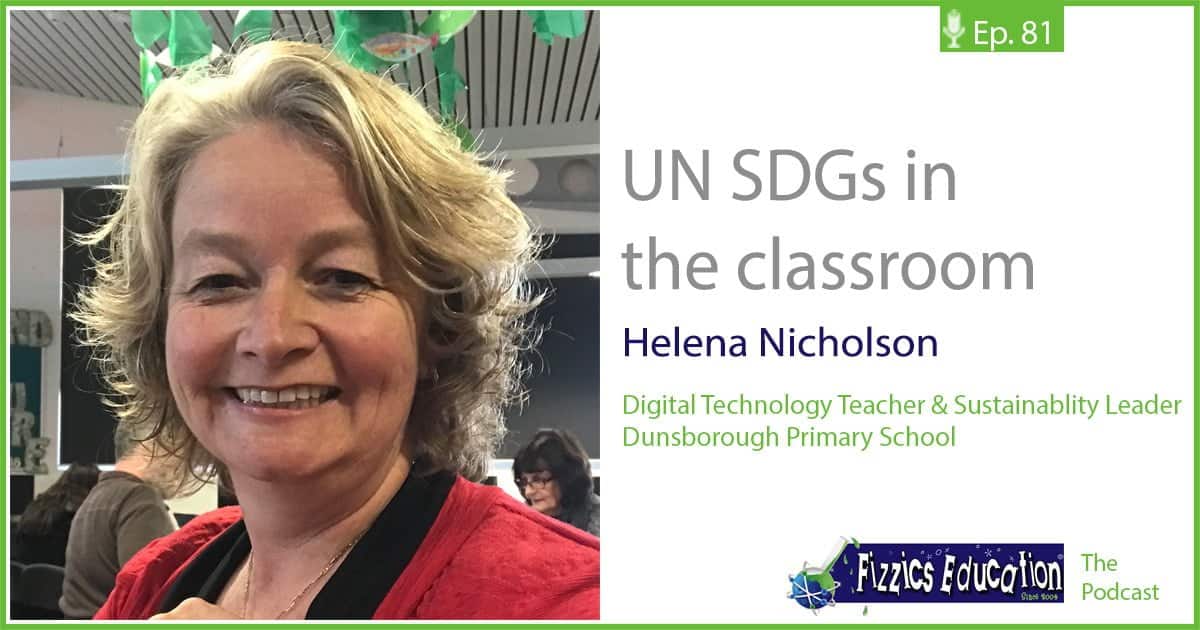
Podcast: UN SDGs in the Classroom with Helena Nicholson
The United Nations Sustainable Development Goals are so important and they represent an opportunity for you and your students to make a real impact in your local community and beyond! We chat with Helena Nicholson, a Digital Technology teacher and sustainability leader in South West Western Australia who is doing just that!
How do we give primary science a global purpose? In this episode, we talk with Helena Nicholson, a K-6 Digital Technology specialist in Western Australia, about her mission to align STEM education with the United Nations Sustainable Development Goals (SDGs). We explore how her background in drama and her role as a sustainability leader have shaped a “purposeful and flexible” approach to technology, where students solve real-world problems for authentic global audiences.
About Helena Nicholson
With 20 years of experience, Helena Nicholson is a lifelong learner and the President of the Dunsborough Coast Care group. After eight years as a drama teacher, she transitioned into her current role as a Digital Technologies specialist, where she drives STEM learning underpinned by the UN Sustainable Development Goals. Helena’s STEM journey was significantly influenced by her time at the STEM X Academy in Canberra in 2017, leading her to embed sustainability into the very culture of her school through student-led passion projects and local community partnerships.
Helena believes that for STEM to be effective, it must have a meaningful context. By using the Sustainable Development Goals as a framework, she helps students see themselves as global citizens capable of tackling issues like clean water, life below water, and gender equality.
Key Educational Philosophies:
Authentic Audiences: Helena advocates for learning where students present findings to the community or professional networks (like her students’ work being recognised by Ozobot), giving projects real-world impact.
Bay OK Day: A massive annual event involving 750 students and 28 concurrent sustainability activities, connecting kids with experts from Fisheries and Surf Life Saving.
Lifelong Learning: Helena emphasises that teachers don’t need to be the “experts” in every tool; instead, they should learn alongside students, fostering a collaborative culture of inquiry.
Integration Over Isolation:STEM is not just a curriculum area; it is a way of teaching that allows for the differentiation of learning and the integration of mathematics and science.
Top Episode Learnings: Sustainability in STEM
The “Why” of STEM:
The 17 Sustainable Development Goals provide a ready-made framework for scientific inquiry. Whether it is Goal 14: Life Below Water or Goal 6: Clean Water and Sanitation, these goals give students a clear purpose for learning new technologies.
Student-Led Pedagogy:
By allowing students to choose which SDG they focus on for “passion projects,” engagement levels skyrocket. Helena shares how students naturally gravitated toward topics like Gender Equality in sport because it was topical and relevant to their lives.
Tech as a Formative Tool:
Tools like Plickers and Spheros are not just for fun; they allow for effective formative assessment and help students understand complex systems through hands-on coding and data collection.
Education Tip: The Passion Project Approach.
Follow Helena’s lead: let your students drive the direction of their STEM inquiry. Provide a framework using the Sustainable Development Goals and give them access to various digital tools (like Scratch or Makey Makey). When students are empowered to find their own “Why”—and when you act as a co-learner rather than a lecturer—the resulting curiosity and problem-solving are unstoppable.
[00:00:18] Ben Newsome: Yes, welcome again to another Fizzics Ed Podcast. I’m so glad to have you yet again to talk STEM and science and all that sort of thing. Someone who is going to help us out is Helena Nicholson, who is a K to 6 digital technology teacher, but I’ll tell you what, she’s also a sustainability leader in South West, Western Australia. And this is the thing, today we’re talking about the United Nations Sustainable Development Goals and these things are so important.
[00:00:50] Ben Newsome: Helena really has been doing a lot of work to get sustainability in all different facets of education to happen in her classrooms. She’s got a bucketload of experience. She’s been teaching for 20 years and I tell you what, you can tell throughout this chat she is very passionate about this particular topic. So, let’s dive right into this chat. Helena has a bucketload to say and we’re going to share a bunch of links where you can get involved in these SDGs, they’re so important and I know that you can implement them too.
[00:01:11] Announcer: You’re listening to the Fizzics Ed Podcast. Why don’t you book us for a science show or workshop in your school? We love seeing students get excited about science, and you will too. Go to fizzicseducation.com.au and click on schools for more info.
[00:01:29] Helena Nicholson: Thank you very much, I’m honoured to be here.
[00:01:31] Ben Newsome: Look, I’m very happy to meet with you, especially considering it’s 7:00 am over in Western Australia right now. That’s very nice of you to join me, especially on your holidays.
[00:01:40] Helena Nicholson: Yes, well, I did say to you that I’m a morning person, so nice fresh start.
[00:01:45] Ben Newsome: Considering you’ve got teaching and you’re studying and you’ve got a life to lead as well, it is a bit much to juggle sometimes, isn’t it?
[00:01:53] Helena Nicholson: It is, but I certainly think that this is a really valuable thing to talk about. Fizzics Ed rocks, so it’s interesting, I’m really honoured to be chatting to you today.
[00:02:02] Ben Newsome: Oh gosh, thank you, and we’ll send the cheques in the mail! Look, no really, I wanted to have a chat with you because you are really big on SDGs. This is just the spot where I really want to chat with you because chatting through the Primary STEM chat on Twitter, you ran a whole session on that and there’s so much you could help and share with other people. But then again, there’d be other people going, “SDGs, what on earth is that?” So, kind of a broad sort of thing, but maybe just give me an overview of what that is and what you’ve been doing.
[00:02:38] Helena Nicholson: Sure. So the Sustainable Development Goals were developed by the United Nations and the aim is to achieve these 17 goals by 2030. They’re really user-friendly as far as kids go. They’ve got an awesome website and the website has lots of animated videos that really put it into a child-friendly context.
[00:03:04] Helena Nicholson: And SDGs not only target kids but certainly industry and adults around the world. And when you start with the Sustainable Development Goals, the aim is to tell everyone all about them. So that’s a really good starting point and the videos are a great springboard.
[00:03:20] Ben Newsome: Absolutely. And when you sort of think about these SDGs, I’m just going to keep saying that because it’s kind of a mouthful to say Sustainable Development Goals each time, but these things are attainable. Mind you, 2030 is not that far away when you think about it.
[00:03:34] Helena Nicholson: I know, that’s exactly what I say to the kids. And I think the thing that struck me most about the SDGs with the students was playing that first introductory video that Malala stars in. It really struck a chord with them and I had feedback from parents and kids. So just having that awareness of others globally.
[00:03:59] Helena Nicholson: Maybe I’ll wind back a little bit. I teach at a primary school in the South West of Western Australia. My role is a digital technologies specialist teacher at the moment after about eight years teaching drama. That’s my background. And sustainability has been something that I’ve been driving in the school for about 11 years.
[00:04:21] Helena Nicholson: And we’re achieving a lot in the sustainability space. And when I started to talk about these goals, they resonated really well with the kids, but it was beyond just sustainability in our own community. It was looking at others.
[00:04:35] Ben Newsome: So it’s this thing, there are 17 very explicit goals. I mean it’s everything from climate action to vaccination to all sorts of stuff. And when you present it initially to the students, does it come across as overwhelming or how’s the initial feedback from the kids before you even start implementing anything?
[00:04:51] Helena Nicholson: Well, the way that I did it was I actually made all these little mix-it cards, little tiny ones which you could turn into fridge magnets quite nicely and the icons are really eye-catching for the students. And I was teaching at the time students between Year 3 and Year 6, so 10 to 13 or 12.
[00:05:13] Helena Nicholson: And so the icons tell a little story but then there’s also one-liners. So the way I presented it was right, oh no, I’ve made all these things and I’ve muddled them all up. So I had hundreds of these beautiful brightly coloured squares in the middle of the classroom. I said right, go find a partner and get me a set of 18 of these and arrange them. So they had to actually really look to individualise each of the icons.
[00:05:37] Helena Nicholson: And then I said right, okay, arrange them. And then I had a sheet that had a one-liner for each of them. So and I think this is one of the challenges in the primary sphere with the SDGs and that is that some of them are really quite easy for the kids to understand and others are a little bit harder. So the website’s really amazing at giving you lots of opportunities and ideas about how to implement them.
[00:06:03] Helena Nicholson: So poverty, zero hunger, good health and wellbeing. SDG 12 is responsible consumption and production and I put it in the context of when you are using a pump soap, if you take one squirt instead of two, you’re going to halve your consumption. Just simple little actions, behavioural change that you can do.
[00:06:26] Ben Newsome: Well absolutely, I mean responsible production and consumption makes sense considering that we do have a lot of stuff that we consume especially in the first world. I mean the thing is that that pairs very nicely with I think it’s Goal 9 where it’s all about thinking about innovative different ways to repurpose old material, which is effectively what the maker movement is in a lot of ways. It makes some stuff that’s good out of other stuff.
[00:06:48] Helena Nicholson: Yes, absolutely. And so that’s industry, innovation and infrastructure, which you know are fairly higher order concepts in the primary space, but you’re right. When we are using STEM, doing STEM, then we are going to do that. And one of the recent STEM activities that I did with the students was to repurpose PET plastic because recycling is really expensive.
[00:07:14] Helena Nicholson: So that was the context that I put it in and then the students went on to find a new use for a PET bottle. So that was really fun and really focused and it ticks off a lot of the goals because the kids understand, well Goal 14 is life below water. So understanding that if we reduce the amount of possible litter, by recycling or making sure that we manage our waste, it’s not going to end up in the ocean.
[00:07:38] Ben Newsome: I always get the feeling when you sort of look through this that a lot of people are actually hitting at least some of these goals without even realising it.
[00:07:46] Helena Nicholson: Absolutely. Absolutely. I think the thing in Australian schools, it was about eight years ago that the Australian Sustainable Schools Initiative began and schools could choose to take that on or not. And if they did, they had what’s called the sustainable footprint that you aimed to decrease with the five areas.
[00:08:08] Helena Nicholson: And because we were already doing that, you’re right, that ticked it off. So that was managing your energy, managing your waste, managing your water, biodiversity, and active transport, which is related to your climate action. So those five things in different ways are happening across the school and well embedded in our school culture. And yes, you tick lots of the goals with those kinds of things.
[00:08:30] Helena Nicholson: Number six is clean water and sanitation. So understanding about conservation as well as providing clean water globally.
[00:08:37] Ben Newsome: So out of all these sort of things, which are the ones that are most sort of challenging? I mean, you’re talking sort of the upper primary, so early middle years trying to think of the different places. But I mean some of these things are very straightforward. I mean affordable and clean energy for Goal 7, that would make sense. But then there’s others that are a little bit more challenging, I mean looking at reducing inequality and things like that. Has there been any sort of ones that you go, “You know what? This might be actually a bit more tough than I thought”?
[00:09:04] Helena Nicholson: Yes, there are, and I’m okay with that, and I actually let the children choose the direction they take within the SDGs in their passion project space in digital technologies. So despite the fact that we might think that gender equality is something that 11-year-olds wouldn’t really want to talk about, I had three groups do gender equality.
[00:09:26] Helena Nicholson: And of course they looked at the income in sport because that’s been quite topical. So they managed to tie it in at their own volition, which was really impressive I thought.
[00:09:37] Ben Newsome: Well it’s actually completely topical which effectively timestamps this podcast, but on the way into work this morning they were talking about the recent winners the USA women’s soccer team. Smashed it out, well done, congratulations American people. Did a very good job. But in the meantime they were talking about well it was actually up against some of the men’s finals and so actually split the viewership. So it’s like well these sorts of things happen without even people sort of realising it’s actually happening.
[00:10:01] Helena Nicholson: Absolutely. Yeah, that’s true.
[00:10:04] Ben Newsome: Which is always can be a bit of a minefield. But alright, so I want to focus in on these passion projects because this could look like a whole bunch of different ways that students could deliver said projects. I mean what have they been making? What have they been doing?
[00:10:16] Helena Nicholson: Well, it is very open-ended and the task is for the children to either teach a Sustainable Development Goal, work towards an SDG or teach their audience something else. And they have access to, because we’re in the digital technology space, they have access to lots of digital devices. So Spheros, the Ozobot robots and Makey Makey interfaces.
[00:10:48] Helena Nicholson: They’ve learned to write animations using online Scratch 3.0. We have Edison robots, we have green screen, the kids are really big on green screen. I sort of did that in my drama programme before I started this digital technology role 18 months ago so the kids are all over iMovie and smashing their apps and joining them all together.
[00:11:10] Helena Nicholson: So they just flew with their interest. Sometimes the links are a little tenuous but I don’t really mind. I think the power of the SDGs is that purposeful context for learning. And when I was asked to do the digital technologies role as a specialist teacher I went, “Oh this is great, I can teach them this and this, but why?” And it didn’t sit quite right with me until I thought well this is really a powerful “why”, which is why I took them on.
[00:11:37] Ben Newsome: That makes a lot of sense because I mean sometimes people get served a curriculum or even just a job role saying, “Please deliver the stuff,” whatever the stuff might be, and without the why there’s kind of no purpose. And being able to hang your hat on these 17 goals is really useful because now you’ve got like, “Now I’m going to learn how to use green screens to then deliver a thing about Goal 5 or Goal 9 or whatever it is.” That means that you can kind of mesh a lot of your learning together which makes it a lot easier in the long run if you have the time to do the planning in the first place.
[00:12:09] Ben Newsome: Which actually brings up the point, was there a lot of effort in behind this to be able to go right, I want to do the SDGs, but I’ve got to do digital technology, I’ve got all these different years to deal with because you’re the specialist. Was it a lot of work prior to delivering these sort of things or do you sort of co-create it with your students as you go along?
[00:12:28] Helena Nicholson: I absolutely co-create. I confess after 20 years of teaching and being a busy person with lots of hats that I wear in the school community. I’m the president of the Dunsborough Coast Care group so I’ve got a lot of links in our learning ecosystem. So there’s a lot going on and I think it’s really important for the kids to drive it for themselves. And the power of that for me as an educator and a lifelong learner is to find out things that I didn’t even know existed.
[00:13:00] Helena Nicholson: So there’s this amazing clean water and sanitation, so about conserving water that a couple of the Year 5 students did. And they created this green screen, they had their amazing characters and they were talking about water conservation and they came across this website that actually shows the consumption of water around the globe in real time.
[00:13:26] Helena Nicholson: Oh I’ve got this iPad up in facing the camera and it’s just ticking away at this humongous number and they’re telling me how many seconds, minutes and hours of water is consumed. And I’m going, “Far out, thanks for that!”
[00:13:41] Ben Newsome: And then of course if you want to get hard nose about curriculum now they can start ticking off mathematics and all this sort of stuff as they’re going along.
[00:13:48] Helena Nicholson: Well you’re absolutely right and that’s it. It’s all about having purposeful context for learning and integrate, integrate, integrate. And that’s what STEM is all about. You know, it’s not a curriculum area, STEM is a way of teaching and learning. It allows the children to be creative, it allows the children to create solutions and it’s just so motivating, engaged, and every child can achieve something. So it also differentiates for all those educators out there.
[00:14:17] Ben Newsome: And no doubt because you know a lot of educators, you would have come across other people doing some interesting stuff too around this. I mean, what have you seen out and about?
[00:14:25] Helena Nicholson: Well, I can’t shout out to Twitter any stronger, and I think in Western Australia, educators are a little bit behind on joining the Twitter-verse, but I’m forever, certainly in the digital technologies sphere generally, picking up a great deal of, heaps of ideas all the time.
[00:14:48] Helena Nicholson: So, you know, when I rocked up to day one with my Merge Cube at the beginning of the year and showed the teachers and they all fell off their chairs and then you know now you can’t get them because they’re so popular, this augmented reality. But then again, where’s your context? Why do you have this cube that creates a hologram in your hand? How’s that going to help the children and how are you going to use it as a learning tool in the classroom?
[00:15:14] Helena Nicholson: You know, that’s the challenge. It’s great to be a springboard, it’s great to be inspiring and engaging for the kids, but you have to step a little further than that.
[00:15:22] Ben Newsome: It’s a little bit tough actually. I remember speaking with Craig Kemp a little while ago around educational technology and it’s often about “what’s the next shiny thing?”
[00:15:30] Helena Nicholson: Yes! Oh, absolutely. And the thing is that most of the shiny things are really expensive. And I think the objects like Spheros and so on, they’ve made huge gains in that technology, even in the probably four years that we’ve had them in the school.
[00:15:49] Helena Nicholson: I remember going to a science teachers’ conference and going, “Oh crikey, I definitely need one of those.” We bought a set for the school and they wouldn’t pair and we had to match this one up to that one and there was all sorts of technology issues with them. Whereas the latest version has its nice little antenna inbuilt and the kids can actually see the way that the signal is strong if you’re next to it and you hook up and you can have six of them running in a really small area and they don’t even interfere with each other. So, yay!
[00:16:18] Ben Newsome: Absolutely. I mean, I know we’re sort of going on a tangent but I don’t mind going down this path because a lot of these tools can be effectively really good for formative assessment. One of the ones I’ve recently come across with, which I think has been around for a while, is Plickers.
[00:16:32] Ben Newsome: Which, if some people haven’t heard about Plickers, it’s basically when kids don’t have devices but you do, you can still do surveys in your classroom where they hold cards and they just simply twist their cards around to reflect whether they’re answering A, B, C or D.
[00:16:46] Ben Newsome: And because these cards almost look like QR codes, just black and white squares, no real kids really get what the other kids are trying to answer, which means you can almost get a survey of what kids are thinking without the kids understanding what the others are thinking so they’re not like biasing their results.
[00:17:02] Helena Nicholson: Yes, that’s absolutely true and we have used Plickers quite a lot in the science space. So before digital technology, I worked in science teacher development for implementing the science curriculum in Western Australia for a few years.
[00:17:17] Helena Nicholson: We were sort of leading the way at our school across the state developing resources and assessment tools and planning documents and things. And Plickers through that science network came into my space and we were using it quite a lot. Although with the Plickers, you actually need to obviously create your questions that you’re assessing. So a lot of time goes into that, but you’re right, as a quick formative assessment, it’s really valuable.
[00:17:40] Ben Newsome: It’s a bit of fun. And that’s again, it’s yet another tool. I kind of feel like I get lost in the maze of tools sometimes. I really do. But look, focusing back in on SDGs. So clearly, they’re doing these works, their passion projects. What are you hoping to see by the end of the year?
[00:18:00] Helena Nicholson: Well, I’m going into a junior space for the next six months. So because the school’s so big, we actually split it and I only have half of the school for six months and half of the school for the other half. So I’ve only got the Year 1s to 3s for the next six months.
[00:18:18] Helena Nicholson: So I’ll certainly be introducing and talking about the goals, but in that digital technology space where the curriculum is pretty computer science based and understanding digital systems and so on, it’s pretty hard at that year age group to integrate them with the kids. So, yeah, they’ll tonk along, I’ll keep sharing with my colleagues and they’re very much in the sort of psyche of the kids that I work with already, so we’ll just have a bit of a recess with the big kids.
[00:18:49] Ben Newsome: Well makes sense. I mean they’ve got to know how to pick up the tools before they can use the tools.
[00:18:53] Helena Nicholson: Yes. Oh, absolutely. Absolutely.
[00:18:56] Ben Newsome: Yeah, absolutely. No, cool. So I mean there’ll be people sort of going, “Right, so I’ve been doing SDGs in my school,” there’ll be others people listening in going, “I’m looking at genuinely diving into this.” What advice, I guess, initially would you say for someone going, “You know what? I want to start, what would you suggest first?”
[00:19:15] Helena Nicholson: I’d suggest going to the website, because it’s really, really comprehensive and as I was saying earlier, watching the animated videos and they produce new ones all the time. So the latest one that I’ve shared with the students is about how you can actually do something in your own context and own space.
[00:19:37] Helena Nicholson: So it actually breaks it right down and it makes kids think about their skill set and their own home and environment and whether there’s a little space that you could actually improve that might be a little bit dark and scary and let’s turn it into a community garden.
[00:19:55] Helena Nicholson: And this is what it’s all about, sustainability. It’s enough for all forever and the SDGs and capacity, it’s from the ground. We’re not going to change the whole world all at once, but we can work in our own backyard but then we can also work and outreach. And I think that’s one of the motivating things for these passion projects for the kids.
[00:20:19] Helena Nicholson: I say to them if you have a Scratch animation or some video that I think I’d like to send to United Nations then I will. So I have a whole bunch of videos because the assessments all finished at the end of last week and there are a couple that I will get out there in some way.
[00:20:41] Helena Nicholson: I upload onto Twitter short videos and I had this really amazing success story a couple of weeks ago where I posted this road safety video that these Year 6 boys had created with an Ozobot Evo. So they actually have to code this little robot to drive. And they coded another one and they dressed one up as a car and the other one up as a pedestrian and well, there was a collision, but it’s okay because if you don’t look both ways this can happen but they just made it of paper.
[00:21:12] Helena Nicholson: And then they coded the character to look both ways, the car went past and so on. I posted this 20-second video with music and a couple of examples of the code on Twitter and I tagged Ozobot in America and they contacted me and said, “Thanks Helena, this is great, we’d like to use this video in our upcoming social ads, is that okay?” And you’re like, “Yeah sure.”
[00:21:33] Helena Nicholson: And I said, “Yes!” So back to school, show the screenshots of this Twitter conversation with the boys and the rest of the students and they were pretty chuffed. So that’s just amazing because we do talk in education about having an authentic audience and it is, it’s just wow.
[00:21:54] Ben Newsome: And this is the thing, what I’d imagine sort of meshing the tech with just the simple visceral hands-on paper and cardboard type stuff as well, almost creating some form of festival whereby the community can come in and learn what your school has been doing and then hopefully then take that knowledge back to go then do other stuff.
[00:22:14] Ben Newsome: I mean you could do some community businessy collaborative projects on a particular topic or grades could choose different things. You could highlight an entire wall or a whole classroom around a particular goal that really sings to certain students. It really is open-ended. I mean the point is just make a start and make it engaging and something that kids can get behind.
[00:22:35] Helena Nicholson: Well you’re absolutely right and I think the thing about all of this is it is engaging and motivating and everyone loves coming to DT. I think, yes, having perhaps a STEM expo, I’ve certainly done sustainability expos in the past and can I talk about this amazing sustainability day that I do?
[00:23:02] Ben Newsome: Sure, whenever someone asks that I sometimes want to go, “No!” Of course you can, of course you can.
[00:23:09] Helena Nicholson: I think the reason why I want to talk about it is the fact that the audience for this podcast is so broad and what I created about eight years ago was an annual event called Bay OK Day.
[00:23:22] Helena Nicholson: And we have 750 students who can actually see the ocean from where we are in our school, which is pretty rare. We all walk down the beach and we have 28 different concurrent sustainability, environmental education, and marine safety kind of activities at the same time over this day. We’re up to year number eight.
[00:23:42] Helena Nicholson: And I think this is a really important thing about education, about sustainability, SDGs, about environmental education, and our learning ecosystem, and that is engaging so many of our providers. The thing is that it’s a win-win because providers have KPIs that they need to achieve and here’s your audience, bang, we’re all at the beach and it’s amazing.
[00:24:04] Helena Nicholson: So Department of Fisheries, Biodiversity Conservation and Attractions, Smith’s Beach Surf Life Saving Association, catchments groups, fishing, actually kids down there having a fish. We’re pushing some STEM into it this year because that’s really been another whole school direction.
[00:24:24] Helena Nicholson: But I think it’s really important for the kids to have this context. Whether it’s SDGs or whether it’s being in their own backyard, learning from experts about any of these issues is just really, really cool and valuable. So last year another school up the road took it on as well. So get out there and contact your schools if you don’t have a relationship already. And schools, get out there and contact these amazing experts because they love to come and have their captive audience too.
[00:24:54] Ben Newsome: Absolutely. And these things, they don’t have to happen overnight. I mean you say you’re at year eight now, so these contacts have to develop over time. I can’t imagine, although some people can kind of go gung-ho and smash it out all in one year, but they tend to be a thing that grows over time.
[00:25:11] Helena Nicholson: They do and they morph too, which is really interesting. What we had in year one, we do have some people that have carried through the whole time, but then other people actually ask to join in. And sometimes there’s a shift in the interest. So when there’s a big focus on seagrass beds in the bay and there’s a study going on and I’ve got someone who wants to talk about that in Fisheries, yep, come on down.
[00:25:40] Ben Newsome: Absolutely. And one of the things I just wanted to put out there is a thing to consider if you’re listening in and going, “You know what? I want to create something like this,” is concentrate on the word “sustainable” when you’re doing Sustainable Development Goals. Not just from the environment point of view, but think of the other organisations of what’s going to work for them from a fiscal point, from a logistical point and whatnot.
[00:26:01] Ben Newsome: Because sometimes you’ll have things that have got some really great ideas but feasibly can’t be delivered because the economics are well out or just logistically that particular time when you want to run it, it just doesn’t work for that particular company or organisation because that’s their busy time in what they normally do day-to-day.
[00:26:15] Helena Nicholson: That’s right. That’s right. And also having the big lead time, that’s the other thing, save the date 12 months out.
[00:26:21] Ben Newsome: Oh absolutely. And the thing is, you can also do these things asynchronously too. So you can have people on the ground doing the stuff, which is really, really cool, but you can also be connecting with people globally around what you’ve been doing. I mean yeah you can use Twitter and whatnot, but there’s a lot of different technologies which allow you to connect with other students all over the place or other organisations as well. Let it be open, let it just morph and change as need be.
[00:26:46] Helena Nicholson: Yeah, absolutely. I mean I’d say year one we didn’t have any iPads down the beach, but by about year three we did. And we’ve got these amazing iScope stands that are made in Western Australia by a retired scientist. And they are cost recovery and they have this really high-power microscope lens inbuilt in them and they’re really easy for the kids to use.
[00:27:07] Helena Nicholson: So they are out there in the big yonder with these iPads on stands and looking at all these amazing sea creatures and enjoying those. And the kids actually do sampling in the ocean, so they get the macroinvertebrates out of the seaweed area and look at them.
[00:27:24] Helena Nicholson: And there’s another lady who’s a retired scientist, she comes and talks about the Leeuwin Current and does a model with ice and hot water and food colouring and teaches the kids about that because on our coast we have the Leeuwin Current come down, which is why I live in a town that’s got a jetty that is one mile out to sea. And under that jetty there’s an observatory and an incredible ecosystem of coral like a barrier reef.
[00:27:50] Helena Nicholson: Yeah, yeah, it’s beautiful. It’s the longest wooden jetty in the Southern Hemisphere. It’s massive, it’s amazing. And because of this Leeuwin Current and the warm water that comes down, we can have basically an equatorial environment at one kilometre out to sea in this bay that we live in.
[00:28:09] Helena Nicholson: So the Busselton Jetty come down to Bay OK Day and talk about that with the kids too. And over the course of their eight years at school, they go through this scope of activities and come out the other end with a nice broad education, including a live show that teaches them about staying off the dunes and not overfishing the big blue groper and things like that. It’s just cool.
[00:28:31] Ben Newsome: That’s so cool. I think you’re kind of just having a bit of fun, really.
[00:28:37] Helena Nicholson: Of course! And Ben, truly, that’s what education has to be about. If you are not having fun in your classroom you should retire. You know, it’s about igniting passions, it’s about igniting curiosity and just having a good time and having a laugh.
[00:28:53] Helena Nicholson: And I think that was another thing that I thought to talk about today and that is absolutely not being the expert. And that’s my space, you know, my learning curve in digital technologies coming from drama has been exponential. And there’s great online learning that I’ve done and so on, but the best teachers are the kids. And you know, one of them will work it out and then we’ll stop the class and share it with everyone and keep ploughing forward.
[00:29:22] Helena Nicholson: And especially with the passion projects, off you go and if you don’t know how, keep trying. Such-and-such, can you come and give these guys a hand? And being able to let go and not feel like you need to actually know everything as an educator is a big shift in pedagogy that we need to make.
[00:29:39] Ben Newsome: No, I agree. And they often talk about the collective genius idea. You’ve got a whole bunch of different brains in that room. I mean yes they’re still developing, but they’ve still got their own experiences and can make their own connections that you may not do because you don’t have their brain.
[00:29:52] Helena Nicholson: No, that’s right. Which works.
[00:29:55] Ben Newsome: Look, Helena, thank you very much really for sharing just a snippet of what you’ve been doing because I feel like you probably have quite a bit more to share. Which means that if people want to get in touch with you, Helena, there are ways to do this. How would we do that?
[00:30:12] Helena Nicholson: Well, I think the best way because I only have a Twitter account in the public sphere, I don’t really do Facebook and other things. But if you message me, HelenaG_4 is my Twitter handle. Hasn’t got Helena in it, that was a long time ago I wrote that, but Helena G is kind of my soul, underscore 4, and then just message me through Twitter and I’d love to share whatever people are interested in.
[00:30:42] Helena Nicholson: Because yeah, I’m very passionate about my job and about the future of education. And once I’ve finished this final unit of my Masters, I’m going to be a very happy camper over the holidays, aren’t I?
[00:30:54] Ben Newsome: Yeah, I mean you’ve kind of lumped your plate pretty high.
[00:30:57] Helena Nicholson: Oh, I’m a bit like that. I’m not going to be on my deathbed hoping that I’d sort of packed a bit more in. I’m going to be going woo-hoo!
[00:31:03] Ben Newsome: What a great attitude. I love it. No, that’s really cool. And like always, we’ll always put this information on the show notes and you’ll always be able to connect up with that. And have a fantastic time finishing off this Masters bit you need to do.
[00:31:18] Helena Nicholson: Excellent. It’s really great to talk to you.
[00:31:20] Ben Newsome: No, I’ve had a blast. And look, really well done with getting these SDGs up and running and I mean also sharing it out and creating this festival effectively down on the beach, eight years in, and getting the kids doing their passion projects.
[00:31:33] Ben Newsome: I kind of wonder when I chat with people like yourself that five years down the track, it’ll be what’s coming up next? Actually, I’m going to ask you before you run away, what is coming up next? Have you got anything planned?
[00:31:45] Helena Nicholson: Hmm, well yes, finish my Masters. I’ve actually applied for a really cool thing that I’m hoping to do over Christmas. I don’t want to jinx it, but have you heard of the RV Investigator?
[00:31:59] Helena Nicholson: Ah, the CSIRO boat. I’ve applied to be the educator on board that.
[00:32:04] Ben Newsome: Yeah, that was an interesting thing. A lot of people got very excited when that got sent out.
[00:32:08] Helena Nicholson: Yes, so I’m excited. I’m just as jagged to possibly get that. But I think the drive there is two things. I was lucky enough to be at the STEM X Academy in Canberra in 2017, which is a really amazing professional learning in the STEM space.
[00:32:28] Helena Nicholson: And I found out about QuestaGame. Here’s another little tip for everyone, get on QuestaGame where you are a citizen science adding to the Atlas of Living Australia real database. And so two of these missions on this trip are looking at the seabirds and also microplastics in the food chain. So that’s right up my alley. So fingers crossed I can get my teeth into that. I’m so excited even though I haven’t been successful.
[00:32:54] Ben Newsome: Oh, hopefully. And if not, you know, I’m sure you’ll find another way to do that. And by the way, if you’re just wondering about the citizen science thing, everyone go back way back, gosh, I don’t know how many episodes ago it was, a long time ago, but I was speaking with Jackie Randles who heads up the New South Wales Inspiring Australia group, which does all this sort of inspiring Australian people to do interesting stuff around science, STEM and all those. And it was a discussion on citizen science. So there’s a lot of different things you can be doing in that for sure.
[00:33:22] Ben Newsome: Look, thank you very much, Helena, for jumping on board with this. And no doubt I’ll catch you in the Twitter-sphere.
[00:33:28] Helena Nicholson: Look forward to it. And thank you, thanks for doing the work that you do for our kids out there and educators. It’s awesome.
[00:33:36] Ben Newsome: No, thank you so much. Okay, bye.
[00:33:38] Helena Nicholson: Okay, bye.
[00:33:41] Announcer: Not all TPL for teachers is as awesome as it could be. I feel like there’s a lot of PowerPoint presentations, a lot of sitting and listening to someone talking. Well, if you want to break from that, Fizzics TPL sessions are fully hands-on, fully integrated with the curriculum and full of amazing science ideas that you can put in your classroom right now. Go to fizzicseducation.com.au and click on schools for more info.
[00:34:03] Ben Newsome: Well, there you go, we just heard from Helena Nicholson who you can really tell is totally passionate when it comes to SDGs. And just after that chat, she shared with me the Bay OK Day programme from last year in November 2018 and my gosh, it is full of stuff.
[00:34:20] Ben Newsome: They had heaps of things. They were going through touch pools, they were doing sea creature habitats, they had these scientific sandcastles, which I must say, that’s really quite interesting. I’d love to know what that was all about. They did stormwater games, they had Captain Coastcare and the Dune Dude, which I must wonder what was that about? They had marine debris art, which actually that’s quite important. You might have seen some museums and various aquariums and things show marine debris art and turn these bits of, well, all kinds of rubbish basically, found on the beach into works of art and that really has got something to say for kids.
[00:34:50] Ben Newsome: They got heaps of things going on and I can really tell this year it will be packed with even more stuff. So there you go. I hope you’re thinking about how you can get Sustainable Development Goals going in your classroom, in your museum, wherever you might just happen to be. It’s definitely worth taking that first step and growing it from there. So you’ve been listening to me as usual, Ben Newsome from Fizzics Education. And this is the Fizzics Ed Podcast. I hope to catch you another time.
[00:35:45] Announcer: This podcast is part of the Australian Educators Online Network. AEON.net.au.
Frequently Asked Questions
What are the United Nations Sustainable Development Goals (SDGs)? The SDGs are 17 global goals established by the United Nations to be achieved by 2030. They address critical issues such as poverty, hunger, climate action, and quality education. Helena uses these goals as a “purposeful why” to give her STEM and Digital Technology lessons real-world meaning.
How can teachers introduce complex global issues like the SDGs to primary students? Helena suggests using the United Nations‘ child-friendly resources, including animated videos featuring figures like Malala. She also recommends using “mix-it cards”—icon-based squares that students can arrange to familiarise themselves with the goals through visual recognition and matching games.
What is “Bay OK Day”? Bay OK Day is an annual environmental education event founded by Helena over eight years ago. It involves roughly 750 students visiting the beach to participate in 28 concurrent activities led by local experts, including the Department of Fisheries, Surf Life Saving, and retired scientists.
How does Digital Technology integrate with sustainability goals in the classroom? Students use tools like Spheros, Ozobots, and Scratch 3.0 to create passion projects. For example, students coded Ozobot Evos to demonstrate road safety or used green screens to present findings on global water consumption, linking digital literacy to SDG outcomes.
Why is an “authentic audience” important for student engagement? When students know their work is being viewed by people outside the classroom, it increases their motivation. Helena shared an example where Ozobot in the USA saw a student-made video on Twitter and asked to use it for their social advertisements, which provided the students with immense validation and purpose.
Extra thought ideas to consider
The Transition from Consumer to Creator
Helena emphasises that technology like the Merge Cube shouldn’t just be a “shiny object.” Educators should challenge students to move beyond merely using these tools to actively designing solutions for global challenges, ensuring the technology serves a specific educational purpose.
Harnessing the “Collective Genius”
Teaching STEM does not require the educator to be the absolute expert. By adopting a co-creation model, teachers can learn alongside their students, allowing the “collective genius” of the classroom to solve technical problems and discover new resources together.
Discussion points summarised from the UN SDGs in the Classroom with Helena Nicholson with AI assistance, verified and edited by Ben Newsome CF
Recognised by
22 years, award-winning work, 1 purpose
Recognition from business, education and industry bodies across Australia.
Australian Small Business Champion
Multiple years
CILC Pinnacle Award and Hall of Fame inductee
Center for Interactive Learning and Collaboration
Western Sydney Awards for Business Excellence
Winner
Top 100 Coolest Company
Listed
Local Business Awards
Winner
We value your privacy
We use cookies to improve your experience. Essential cookies are always active. You can choose which optional cookies to allow.We use cookies. Optional ones stay off unless you allow them.Privacy policy