



Science Show Demonstrations
- Beyond volcanoes – Use chemistry to blow up a balloon or launch a rocket!
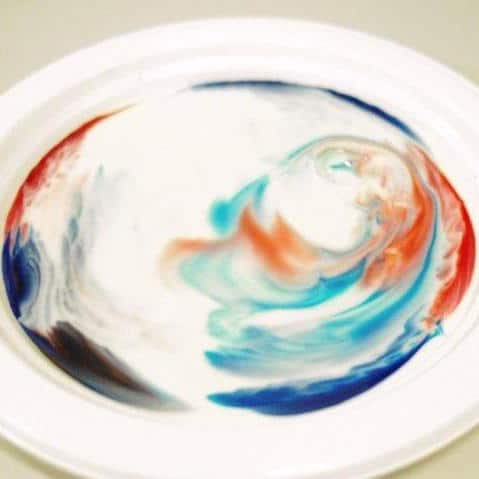
- Milk rainbows – Use food dye to track the interactions between detergent and milk
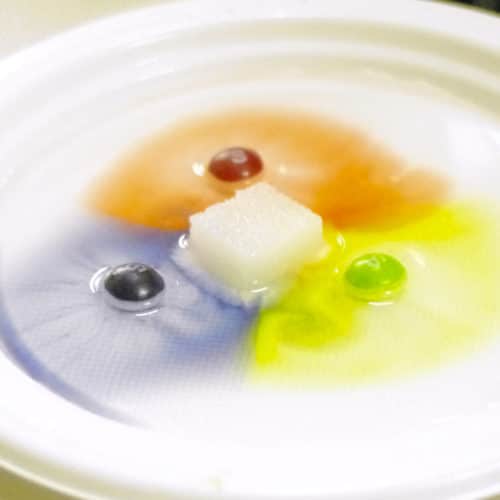
- Skittle science – It’s all about concentration!
- Cabbage chemistry – A fantastic way to create a natural pH indicator
- Mentos and coke – A bubbly volcano that’s a worldwide hit
- Sherbet (90 min program) – A chemical reaction in your mouth!
Science workshop content
What Students Experience: Hands-on Chemical Science
Students step into the role of a research chemist, using common kitchen chemicals to uncover the extraordinary science of the material world. This workshop is highly structured to move from dramatic demonstrations to individual student-led inquiry.
1. The Spark of Inquiry
The session begins with a high-energy introduction. We demonstrate the visible indicators of chemical reactions—such as gas production, colour changes, and temperature shifts—contrasting them with simple physical changes to establish baseline observations.
2. Guided Investigation
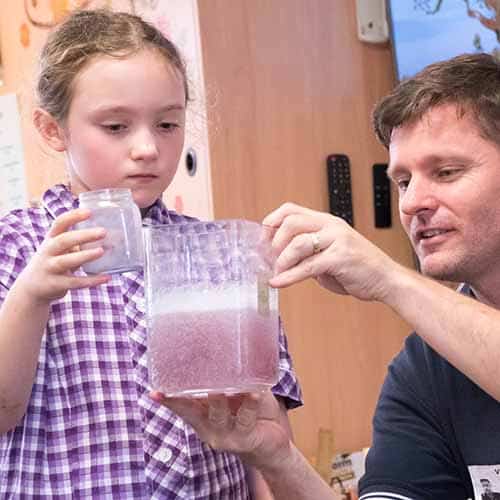
Students conduct a series of investigations using household chemistry. The presenter roves through the groups, facilitating deep-dive questions and encouraging students to record their observations before gathering to debrief findings after each experiment.
3. Synthesis & Application
We wrap up with advanced demonstrations of chemical reactions that highlight the power of science. The session concludes with a discussion on how chemistry is applied in daily life, from cooking and cleaning to industrial manufacturing and environmental science.
Our students became research chemists for the day! It was wonderful to see them so engrossed in their experiments and making such clear scientific observations. A highly engaging and educational experience for all.
View on FacebookKitchen chemistry at its best! From indicator tests to gas-producing reactions, these students did an amazing job investigating the science hidden in their cupboards.
View on FacebookOur Commitment to Quality Science Education
A Trusted School Partner for 20 years.
Fizzics Education delivers reliable, syllabus-aligned visits that engage students and meet the practical requirements of the Australian classroom.
Using safe, relatable materials to teach rigorous scientific concepts and laboratory safety.
Highly rated by teachers for excellent classroom management and high student engagement.
Experienced educators trained to facilitate deep-dive inquiry and student discovery.

Australian Curriculum Mapping
Australian National Curriculum Mapping for all our science incursions
Australian ACARA Content Outcomes:
Science F-10 Version 9.0
Foundation
- recognise that objects can be composed of different materials and describe the observable properties of those materials AC9SFU03
- explore the ways people make and use observations and questions to learn about the natural world AC9SFH01
- pose questions and make predictions based on experiences AC9SFI01
Year 2
- recognise that materials can be changed physically without changing their material composition and explore the effect of different actions on materials including bending, twisting, stretching and breaking into smaller pieces AC9S2U03
Year 1 & 2
- describe how people use science in their daily lives, including using patterns to make scientific predictions AC9S1H01, AC9S2H01
- pose questions to explore observed simple patterns and relationships and make predictions based on experiences AC9S1I01, AC9S2I01
- compare observations with predictions and others’ observations, consider if investigations are fair and identify further questions with guidance AC9S1I05, AC9S2I05
Year 3
- identify sources of heat energy and examine how temperature changes when heat energy is transferred from one object to another AC9S3U03
- investigate the observable properties of solids and liquids and how adding or removing heat energy leads to a change of state AC9S3U04
Year 4
- examine the properties of natural and made materials including fibres, metals, glass and plastics and consider how these properties influence their use AC9S4U04
Year 3 & 4
- examine how people use data to develop scientific explanations AC9S3H01, AC9S4H01
- consider how people use scientific explanations to meet a need or solve a problem AC9S3H02, AC9S4H02
- pose questions to explore observed patterns and relationships and make predictions based on observations AC9S3I01, AC9S4I01
- compare findings with those of others, consider if investigations were fair, identify questions for further investigation and draw conclusions AC9S3I05, AC9S4I05
Year 5
- explain observable properties of solids, liquids and gases by modelling the motion and arrangement of particles AC9S5U04
Year 6
- compare reversible changes, including dissolving and changes of state, and irreversible changes, including cooking and rusting that produce new substances AC9S6U04
Year 5 & 6
- investigate how scientific knowledge is used by individuals and communities to identify problems, consider responses and make decisions AC9S5H02, AC9S6H02
- pose investigable questions to identify patterns and test relationships and make reasoned predictions AC9S5I01, AC9S6I01
- compare methods and findings with those of others, recognise possible sources of error, pose questions for further investigation and select evidence to draw reasoned conclusions AC9S5I05, AC9S6I05
Australian National Curriculum Mapping for all our science workshops & shows

NSW K-10 Science Syllabus Mapping
NSW K – 10 Science Syllabus mapping
NSW Science Syllabus Content
A student:
- STe-4MW-ST identifies that objects are made of materials that have observable properties
- ST1-6MW-S identifies that materials can be changed or combined
- ST1-7MW-T describes how the properties of materials determine their use
- ST2-7MW-T investigates the suitability of natural and processed materials for a range of purposes
- ST3-6MW-S explains the effect of heat on the properties and behaviour of materials
- ST3-7MW-T explains how the properties of materials determines their use for a range of purposes
NSW Science and Technology K–6 Syllabus (Implementation from 2027)
For implementation advice, please visit the NESA Science site.
Early Stage 1
STE-SCI-01 identifies and describes characteristics of living things, properties of materials, and movement
- Recognise that properties of materials can be observed using the senses
- Observe and manipulate materials to describe their properties using Tier 2 vocabulary
- Pose questions about materials and describe how they are used in everyday objects
STE-PQU-01 poses questions based on observations to collect data
Stage 1
ST1-PQU-01 poses questions based on observations and information to investigate cause and effect
Stage 2
ST2-SCI-01 uses information to investigate the solar system and the effects of energy on living, physical and geological systems
- Recognise that matter is anything that has mass, takes up space and consists of very small particles
- Observe examples of matter that exist as a solid, which has a defined shape and volume; a liquid, which has a definite volume but not a definite shape; and a gas, which has neither a definite shape nor a definite volume
ST2-PQU-01 poses questions to create fair tests that investigate the effects of energy on living things and physical systems
Stage 3
ST3-SCI-01 uses evidence to explain how scientific knowledge can be used to develop sustainable practices
- Recognise that in a fair test, an independent variable is changed, a dependent variable is measured, and controlled variables remain the same
- Pose questions to determine whether substances dissolve in water by identifying variables and conducting and evaluating fair tests
ST3-PQU-01 poses questions to identify variables and conducts fair tests to gather data
NSW K-10 Science Syllabus Mapping
Print a PDF detailing NSW K-6 mapping

VIC Science Syllabus Content
VIC Curriculum F–10 Version 2.0
For implementation advice, please visit the VIC Curriculum F-10 site.
Foundation to Level 2
- objects can be made of one or more different materials; these materials have observable properties. VC2S2U04
- materials can be combined in a variety of ways for particular purposes; the properties of objects and mixtures can differ from the properties of the materials from which they are made. VC2S2U05
- experiences can be used as a basis for posing questions to explore observed patterns and relationships, and to make predictions. VC2S2I01
- observations, findings and ideas can be shared with others by using everyday and some scientific vocabulary. VC2S2I06
Levels 3 and 4
- solids, liquids and gases have observable properties; adding or removing heat energy leads to a change of state between solids, liquids and gases. VC2S4U04
- the properties of natural and made materials, including fibres, metals, glass and plastics, influence their use and re-use. VC2S4U05
- heat energy can be generated from different sources; temperature changes may happen when heat is transferred from one object to another. VC2S4U09
- scientific investigations to answer questions or test predictions can be planned and conducted using provided scaffolds, including identifying the attributes of fair tests, and considering the safe use of materials and equipment. VC2S4I02
Levels 5 and 6
- the observable properties of matter (solids, liquids and gases) can be explained by modelling the motion and arrangement of their particles; mixtures (including solutions) can be formed by combining 2 or more different substances. VC2S6U03
- changes to substances may be reversible, in which case the substance may be recovered, or irreversible, in which case new substances are formed; for most substances a change of state or dissolving in water is reversible, while irreversible changes include cooking and rusting. VC2S6U04
- repeatable scientific investigations can be planned and conducted, including deciding the variables to be changed, measured and controlled in fair tests. VC2S6I02
VIC F – 6 Science Syllabus Mapping
Print a PDF detailing VIC P-6 mapping
Session Requirements
🧪 Workshop Capacity
👥 Attendance: Max 32 students per class.
🏫 Target: Appropriate for Years K to 6.
⏰ Duration: 60 mins (+60 min set/pack).
🪑 Seating: Not required for this session.
🧼 Cleanup: We use safe, common household chemicals. While we take every care, we recommend a space that is easy to wipe down.
📍 Space & Utilities
🏗️ Tables: 7 tables are required for experiment setup.
🔌 Power: Access to 1 standard electrical power socket.
🚰 Water: Access to a sink or water source is preferred.
🌳 Outdoors: Required only for the Mentos geyser experiment.
Go Further!
Complete Units of Work to Support Your Teaching
Support your classroom with 270+ syllabus-linked lessons, high-quality videos, and marking rubrics.
Save time and engage students in STEM with high-quality videos, printable experiments, and full marking rubrics for your Chemistry unit.
Extend the Experience
Pair this workshop with a larger stage show for groups of up to 240 students:






