




Science Show Activities
- Boomwhackers – Colourful tubes that create assorted sounds on impact.
- Chladni Plate – A violin bow running across a metal plate creates very strange patterns in sand.
- Croaking frogs – Create croaking sounds with this Asian musical device
- Doppler effect – Demonstrations on why ambulances sound different as they pass you by.
- Elephant tubes – Large tubes that resonate loudly whilst emulating how frogs croak. Very funny!
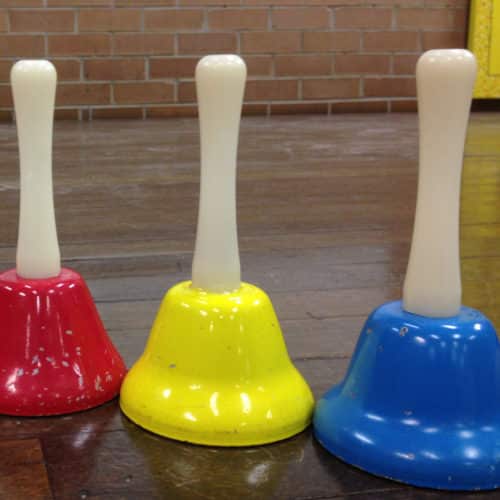
- Ghante bell – A Nepalese bell that vibrates loudly when given the right touch.
- Insect clickers – A simple device used in communications during wartime
- Music Box – An investigation into sound traveling through different materials.
- Rijke tube – A special metal tube vibrates loudly when heated air rushes through it. Great!
- Screaming rod – Rubbing this rod makes a very high pitch! A classic demonstration on octaves.
- Slinky shake – A visual depiction on how soundwaves propagate through the air.
- Sonic Boom – A very Australian way to create a sonic boom in your hall. Think bullwhip!
- Squawking science – A simple instrument that students can replicate at home or class.
- Straw flute – A simple yet effective way of demonstrating a standing wave. Students love it!
- Superposition – What happens when sound waves are superimposed?
- Theremin – Create spooky sound effects using the palm of your hand!
- Thunder drum – A demonstration on amplifying sound and blocking vibrations.
- Twirl tubes – Students work together to create chords of varying pitch. Great fun!
- Voice changer – Modulate the pitch of your voice and you’ll get strange sounds!
- Wave generator – The audience participates in changing the waveform created by an oscilloscope.
- Xylophones – Compare different xylophones and their pitch
Science workshop content
What Students Experience: A Symphony of Physics
We dive deep into the mechanics of frequency and amplitude to understand how our ears and brain perceive the world of noise. The journey begins with a fundamental question: What makes sound? Through live demonstrations, students observe how the speed of a vibration dictates its pitch and how the size of a wave (amplitude) determines its loudness.
Visualising Waves
Using real-time oscilloscopes and Chladni plates, students see sound waves turn into geometric sand patterns and digital traces, making the invisible visible.
Acoustic Propagation
Students test how sound travels at different speeds through air versus solids and investigate how playground “speaking tubes” focus energy over long distances.
Resonance & Beyond
From standing waves on massive slinkies to breaking the speed of sound with a stock whip crack, we push the limits of wave physics.
Real Classroom Highlights
A fantastic day of learning! Our students loved seeing sound waves come to life on the oscilloscopes and investigating how pitch changes with vibration speed. A high-quality STEM visit.
Watch the stock whip crack break the sound barrier! A spectacular way to finish our sound unit and discuss sonic booms and acoustic energy.
⬅️ Swipe to see more examples ➡️
Professional Acoustic Lab
A Trusted Science Partner for Over 20 Years
Fizzics Education brings specialised equipment including thunder drums, resonance demonstrators, and signal generators to ensure every student hears—and feels—the science of sound.

Australian Curriculum Mapping
Australian National Curriculum Mapping for all our science incursions
Australian ACARA Content Outcomes:
Science F-10 Version 9.0
Foundation
- explore the ways people make and use observations and questions to learn about the natural world AC9SFH01
- pose questions and make predictions based on experiences AC9SFI01
Year 2
- explore different actions to make sounds and how to make a variety of sounds, and recognise that sound energy causes objects to vibrate AC9S2U02
Year 1 & 2
- describe how people use science in their daily lives, including using patterns to make scientific predictions AC9S1H01, AC9S2H01
- pose questions to explore observed simple patterns and relationships and make predictions based on experiences AC9S1I01, AC9S2I01
- compare observations with predictions and others’ observations, consider if investigations are fair and identify further questions with guidance AC9S1I05, AC9S2I05
Year 3 & 4
- examine how people use data to develop scientific explanations AC9S3H01, AC9S4H01
- consider how people use scientific explanations to meet a need or solve a problem AC9S3H02, AC9S4H02
- pose questions to explore observed patterns and relationships and make predictions based on observations AC9S3I01, AC9S4I01
- compare findings with those of others, consider if investigations were fair, identify questions for further investigation and draw conclusions AC9S3I05, AC9S4I05
Year 5
- explain observable properties of solids, liquids and gases by modelling the motion and arrangement of particles AC9S5U04
Year 5 & 6
- investigate how scientific knowledge is used by individuals and communities to identify problems, consider responses and make decisions AC9S5H02, AC9S6H02
- pose investigable questions to identify patterns and test relationships and make reasoned predictions AC9S5I01, AC9S6I01
- compare methods and findings with those of others, recognise possible sources of error, pose questions for further investigation and select evidence to draw reasoned conclusions AC9S5I05, AC9S6I05
Design and Technologies F-10 Version 9.0
Years 5 & 6
- explain how electrical energy can be transformed into movement, sound or light in a product or system AC9TDE6K02
Australian National Curriculum Mapping for all our science workshops & shows

NSW K-10 Science Syllabus Mapping
NSW K – 10 Science Syllabus mapping for all our incursions
NSW Science & Technology Syllabus Content
A student:
- describes common forms of energy and explores some characteristics of sound energy ST1-8PW-S
- investigates how forces and energy are used in products ST1-9PW-ST
- describes the characteristics and effects of common forms of energy, such as light and heat ST2-8PW-ST
- explains how the properties of materials determines their use for a range of purposes ST3-7MW-T
NSW Science and Technology K–6 Syllabus (Implementation from 2027)
For implementation advice, visit the NESA Science and Technology site
Stage 1
ST1-SCI-01
- Recognise that light and sound can travel through air, water and some solids and are affected by those materials
- Recognise that sound is created and carried by vibrations
- Test how different materials and actions affect the volume and pitch of sound
ST1-PQU-01 poses questions based on observations to investigate cause and effect
Stage 2
ST2-PQU-01 poses questions to create fair tests that investigate the effects of energy
Stage 3
ST3-PQU-01 poses questions to identify variables and conducts fair tests to gather data
Print a PDF detailing NSW K to 6 science visits

VIC Science Syllabus Content
VIC Curriculum F–10 Version 2.0
Science
Foundation to Level 2
- Sound can make materials vibrate and vibrating materials can make sound; pitch and volume variations. VC2S2U12
- Objects can be made of one or more materials with observable properties. VC2S2U04
- Observations and ideas shared using everyday and some scientific vocabulary. VC2S2I06
Levels 3 & 4
- The properties of natural and made materials influence their use and re-use. VC2S4U05
- Scientific investigations planned using scaffolds to identify fair tests and safe use of equipment. VC2S4I02
Levels 5 & 6
- Repeatable scientific investigations identifying changed, measured and controlled variables. VC2S6I02
Design and Technologies
Levels 5 & 6
- Explain how electrical energy can be transformed into movement, sound or light in a product or system. VC2TDE6C01
Session Requirements
👥 Capacity & Timing
👨🎓 Workshop: Max 32 students per class.
🎭 Show Version: Max 64 students per class.
🏫 Target: Appropriate for Years 1 to 6.
⏰ Duration: 60 or 90 minutes + 45 min set/pack.
🔊 Sensory Note: Please cater for students particularly sensitive to loud or high-pitched noises. During Shows, we require fire alarm isolation for the Rubens Tube demo.
📍 Space & Setup
🏗️ Layout: 2 tables required and ability to darken the room.
🔌 Power: Access to 2 electrical power sockets.
🪑 Seating: Chairs are not required for students.
Go Further!
Complete Units of Work to Support Your Teaching
Support your classroom with 270+ syllabus-linked lessons, high-quality videos, and marking rubrics.
Save time and engage students in wave physics with high-quality videos, printable experiments, and full marking rubrics for your Sound unit.
Extend the Experience
Pair this workshop with a larger stage show for groups of up to 240 students:






