

STEM workshop content
What Students Experience: The Electronics Hive
This immersive electronics workshop transforms your students into junior engineers. The session begins with a deep dive into circuit theory, where students identify the critical differences between series and parallel circuits and learn to recognize the specific functions of each electronic component.
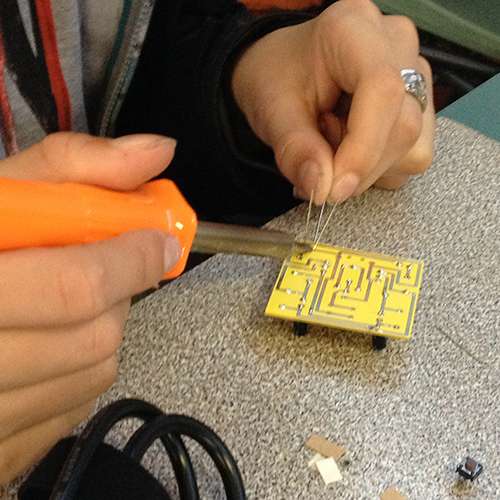
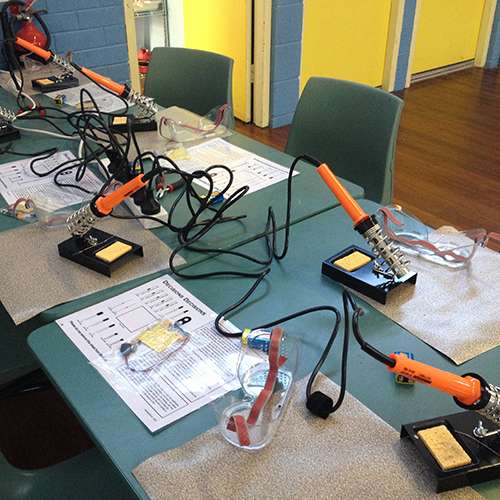
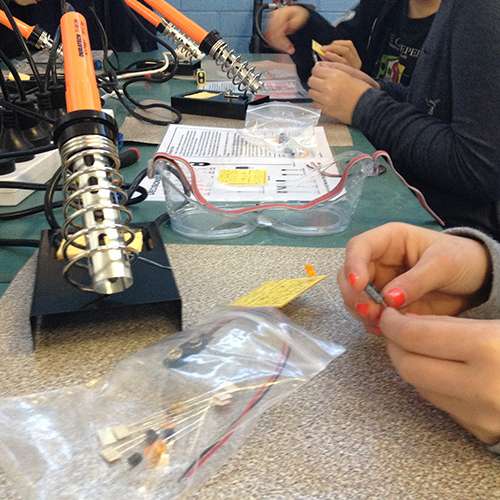
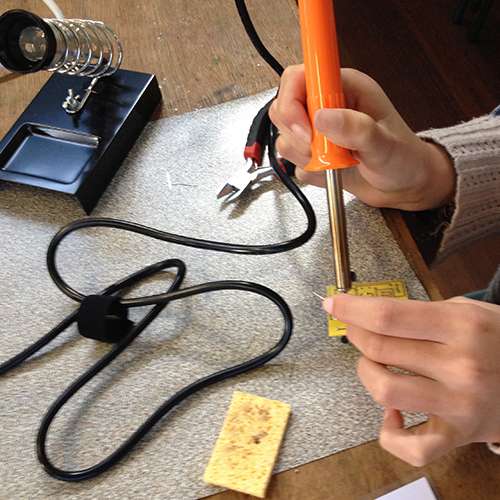
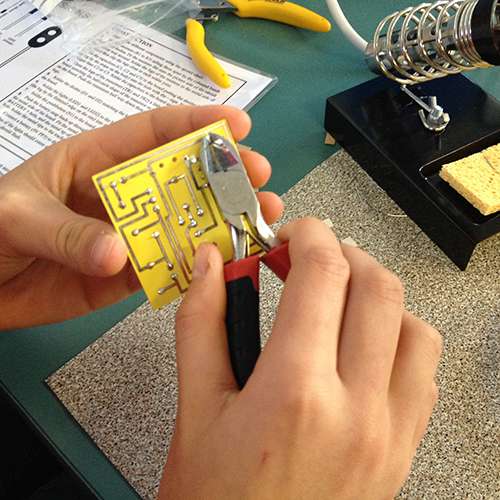
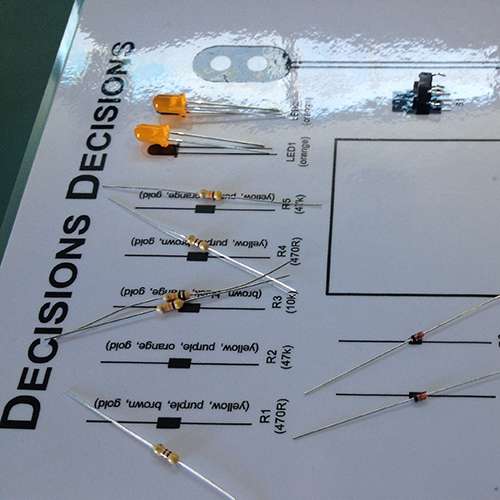
Safety is our priority; we provide comprehensive training on soldering iron protocols and the physics of creating a reliable electrical join. Following the Madlab instructions, students then meticulously assemble their own functional devices. It is an authentic STEM experience where classroom theory meets industrial practice—and every student keeps the circuit they create!
Wonky Wire
A classic test of patience and steady hands! Students build the circuitry required to detect contact on a challenging wire path.
Stop Thief!
Students construct a functional burglar alarm, learning how light sensors and break-beam logic can trigger an alert.
Lie Detector
Discover the science of skin conductivity! Students build a device that detects moisture changes to “detect” the truth.
Which Electricity Workshop is right for you?
Covers fundamentals, magnetism, and static electricity. Best for starting a new topic.
Focuses on complex circuit arrangements using lights, capacitors, and batteries.
The engineering choice. Students use soldering irons to build permanent circuits to keep.
Focuses on power generation, sustainability, and comparing solar/wind to fossil fuels.
Studying Energy Transformations? If you need Potential vs. Kinetic energy and solar conversions, choose
Exploring Energy.
Professional STEM Facilities
A Trusted School Partner for 20 Years
Fizzics Education brings specialized tools and components to your classroom, facilitating high-success engineering projects in a safe environment.
Official kits used worldwide in science festivals, ensuring quality and success for every student.

Australian Curriculum Mapping
Australian National Curriculum Mapping for all our science incursions
Australian ACARA Content Outcomes:
Science F-10 Version 9.0
Year 6
- investigate the transfer and transformation of energy in electrical circuits, including the role of circuit components, insulators and conductors AC9S6U03
Year 5 & 6
- investigate how scientific knowledge is used by individuals and communities to identify problems, consider responses and make decisions AC9S5H02, AC9S6H02
- pose investigable questions to identify patterns and test relationships and make reasoned predictions AC9S5I01, AC9S6I01
- compare methods and findings with those of others, recognise possible sources of error, pose questions for further investigation and select evidence to draw reasoned conclusions AC9S5I05, AC9S6I05
Design and Technologies F-10 Version 9.0
Years 5 & 6
- explain how electrical energy can be transformed into movement, sound or light in a product or system AC9TDE6K02
Australian National Curriculum Mapping for all our science workshops & shows

NSW K-10 Science Syllabus Mapping
NSW K – 10 Science Syllabus mapping for all our incursions
NSW Science & Technology Syllabus Content
A student:
- explains how energy is transformed from one form to another ST3-8PW-ST
- plans and uses materials, tools and equipment to develop solutions for a need or opportunity ST3-2DP-T
NSW Science and Technology K–6 Syllabus (Implementation from 2027)
For explanatory points & implementation advice for each dot point, please visit the NESA Science and Technology K–6 Curriculum site
Stage 3
ST3-SCI-01
uses evidence to explain how scientific knowledge can be used to develop sustainable practices
- Recognise that an electrical circuit transfers electrical energy from a source, through a pathway, to a device that transforms electrical energy into other forms of energy
- Plan and construct simple electrical circuits to model the transfer and transformation of energy
- Pose questions, identify variables and safely conduct fair tests to identify materials that act as electrical conductors or insulators
- Explain how electrical insulators can ensure electrical safety in everyday life
ST3-PQU-01 poses questions to identify variables and conducts fair tests to gather data
Print a PDF which details K to 6 mapping of all our NSW science visits

VIC Science Syllabus Content
VIC Curriculum F–10 Version 2.0
Science
For explanatory points & implementation advice for each dot point, please visit the VIC Curriculum F-10 site.
Levels 5 & 6
- materials may be electrical insulators or conductors; energy can be transferred and transformed in electrical circuits where the components of a circuit play particular roles in the function of the circuit. VC2S6U09
- repeatable scientific investigations to answer questions can be planned and conducted, including, as appropriate, deciding the variables to be changed, measured and controlled in fair tests, considering potential risks, planning for the safe and ethical use of equipment and materials, and obtaining permissions for investigations conducted on Country and Place or in protected areas. VC2S6I02
Design and Technologies
Levels 5 & 6
- explain how electrical energy can be transformed into movement, sound or light in a product or system VC2TDE6C01
- select, explain and use suitable materials, components, tools and techniques to safely make designed solutions VC2TDE6D03
- negotiate design criteria that address ethical considerations, including sustainability, to evaluate design ideas, processes and solutions VC2TDE6D04
- develop project plans that include consideration of resources to individually and collaboratively make designed solutions VC2TDE6D05
Session Requirements
👥 Capacity & Timing
👨🎓 Attendance: Max 20 students per class.
🏫 Target: Appropriate for Years 5 and up.
⏰ Duration: 2 Hours (120 minutes).
🛠️ Set/Pack: 45 mins setup + 30 mins pack down.
📍 Space & Power
🏗️ Layout: Access to at least 7 tables is required.
🔌 Power: Access to 3 electrical power sockets.
🪑 Seating: Chairs are not required but are useful.
⚠️ Important Safety & Session Note:
Soldering irons are used throughout this session. While comprehensive safety precautions are taken, it remains the school’s responsibility to select students suitable for this technical program.
The nature of this workshop means that completion times will vary based on individual ability; some students may finish early, while others may complete approximately 75% of their circuit.
Go Further!
Complete Units of Work to Support Your Teaching
Support your classroom with 270+ syllabus-linked lessons, high-quality videos, and marking rubrics.
Deepen the learning with high-quality videos, printable experiments, vocabulary lists, and marking rubrics designed to engage students in long-term STEM projects.
Did you know about our larger stage shows?
Designed to engage up to 240 students, pair this workshop with one of these school favourites:






