

Science Show Activities
- Filter my water – How do natural filters help to keep our water catchments clean?
- Disappearing water – Where did it go? And how can we get it back?
- Magnetic attraction – Use magnets to find fortified iron in a common food!
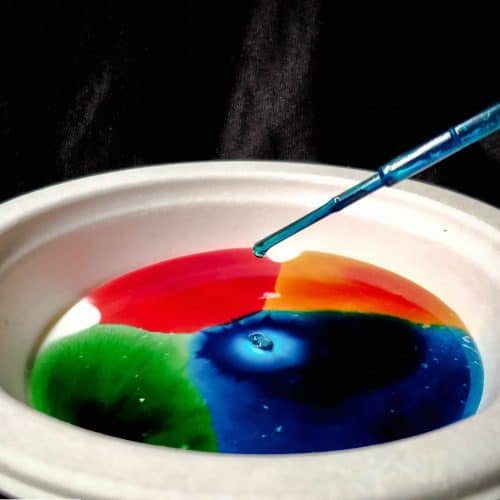
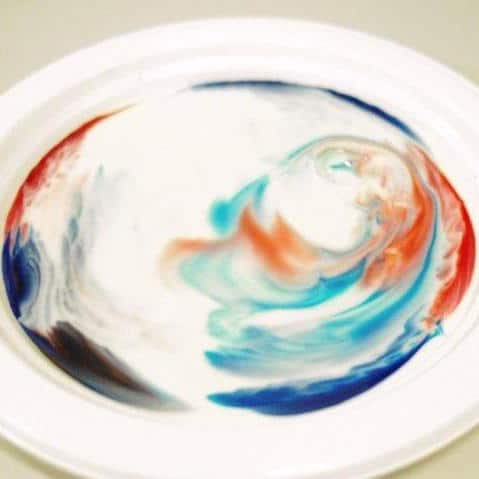
- Kitchen chemistry – Mix up some colourful science experiments and watch them change!
- Strange suspension – Shake the bottle and the beads mix…wait a minute… they separate & then float back together!
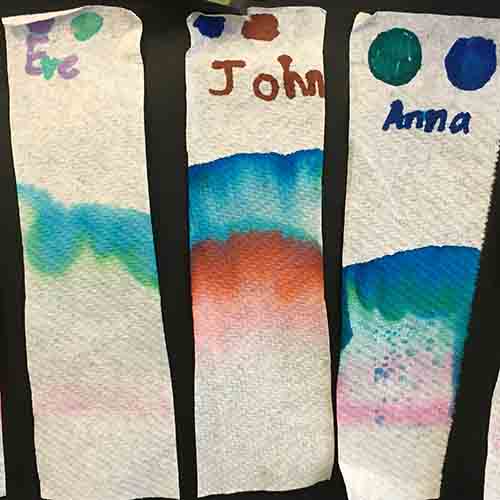
- Ink chromatography – Find the hidden colours in marker ink.
- Salty science – How can we take the salt out of saltwater?
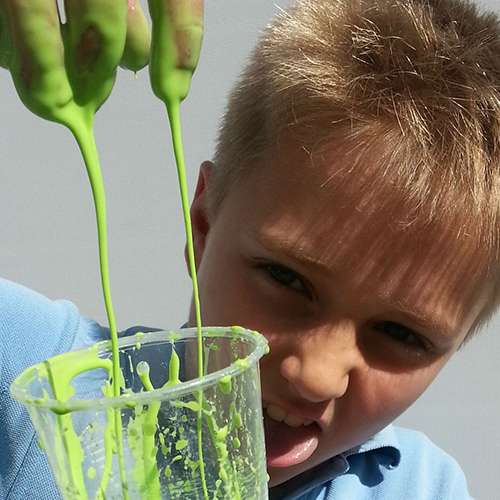
- Slime (90 min program) – Really, who doesn’t like slime?
Science workshop content
What Students Experience: The Separation Lab
The workshop begins with an essential question: how do scientists obtain pure substances? We discuss why the ability to separate mixtures is the cornerstone of modern science, allowing us to isolate materials to understand their unique properties and potential uses.
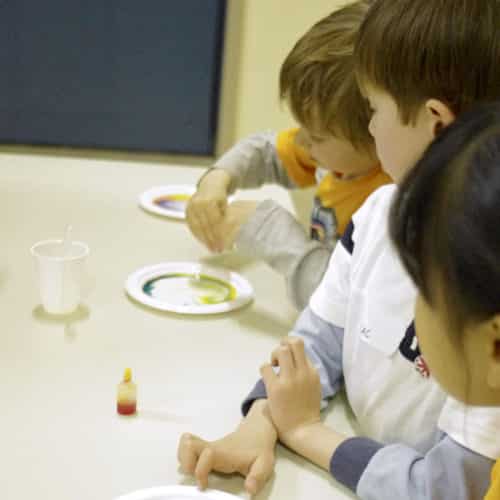
Through high-impact demonstrations of chemical separation, filtration, and precipitation, students witness matter changing state and being pulled apart before their eyes. In our guided experiments, students take the lead—using chromatography to reveal the hidden components of ink, isolating proteins through the chemical separation of milk, and utilising magnetism to sort complex mixtures.
1. Analytical Chemistry
Students explore concentration gradients and molecular movement, observing how chemicals behave differently within varied mixture types.
2. Industrial Techniques
We simulate advanced industrial processes, demonstrating centrifugation and crystallisation to show how mixtures are refined on a large scale.
3. Magnetic Isolation
Using high-strength magnets, students learn how physical properties allow for the rapid sorting and recovery of specific materials from a mixture.
Real Classroom Feedback
A fantastic hands-on session! Our students loved the chromatography experiments and learning how to separate complex mixtures using real scientific techniques.
Stage 1 science excursion is so exciting! Super cool experiments separating materials. The students were highly engaged throughout the visit!
The Separation Lab really challenged our students to think like chemists. Testing different methods to isolate substances was a highlight of our STEM programme this term.
⬅️ Swipe to see more examples ➡️
Rigorous Chemical Inquiry
A Trusted STEM Partner for 20 Years
Fizzics Education brings professional lab equipment to your classroom, facilitating safe and engaging chemical experiments that align with the Australian K-6 science syllabus.

Australian Curriculum Mapping
Australian National Curriculum Mapping for all our science incursions
Australian ACARA Content Outcomes:
Science F-10 Version 9.0
Foundation
- recognise that objects can be composed of different materials and describe the observable properties of those materials AC9SFU03
- explore the ways people make and use observations and questions to learn about the natural world AC9SFH01
- pose questions and make predictions based on experiences AC9SFI01
Year 2
- recognise that materials can be changed physically without changing their material composition and explore the effect of different actions on materials including bending, twisting, stretching and breaking into smaller pieces AC9S2U03
Year 1 & 2
- describe how people use science in their daily lives, including using patterns to make scientific predictions AC9S1H01, AC9S2H01
- pose questions to explore observed simple patterns and relationships and make predictions based on experiences AC9S1I01, AC9S2I01
- compare observations with predictions and others’ observations, consider if investigations are fair and identify further questions with guidance AC9S1I05, AC9S2I05
Year 3
- identify sources of heat energy and examine how temperature changes when heat energy is transferred from one object to another AC9S3U03
- investigate the observable properties of solids and liquids and how adding or removing heat energy leads to a change of state AC9S3U04
Year 4
- examine the properties of natural and made materials including fibres, metals, glass and plastics and consider how these properties influence their use AC9S4U04
Year 3 & 4
- examine how people use data to develop scientific explanations AC9S3H01, AC9S4H01
- consider how people use scientific explanations to meet a need or solve a problem AC9S3H02, AC9S4H02
- pose questions to explore observed patterns and relationships and make predictions based on observations AC9S3I01, AC9S4I01
- compare findings with those of others, consider if investigations were fair, identify questions for further investigation and draw conclusions AC9S3I05, AC9S4I05
Australian National Curriculum Mapping for all our science workshops & shows

NSW K-10 Science Syllabus Mapping
NSW K – 10 Science Syllabus mapping for all our incursions
NSW Science Syllabus Content
A student:
- identifies that objects are made of materials that have observable properties STe-4MW-ST
- identifies that materials can be changed or combined ST1-6MW-S
- describes how the properties of materials determine their use ST1-7MW-T
NSW Science and Technology K–6 Syllabus (Implementation from 2027)
For explanatory points & implementation advice for each dot point, please visit the NESA Science and Technology K–6 Curriculum site
Early Stage 1
STE-SCI-01
identifies and describes characteristics of living things, properties of materials, and movement
- Observe and manipulate materials to describe their properties using Tier 2 vocabulary
- Pose questions about materials and describe how they are used in everyday objects
STE-PQU-01 poses questions based on observations to collect data
Stage 1
ST1-PQU-01 poses questions based on observations and information to investigate cause and effect
Stage 2
ST2-SCI-01
uses information to investigate the solar system and the effects of energy on living, physical and geological systems
- Observe examples of matter that exist as a solid, which has a defined shape and volume; a liquid, which has a definite volume but not a definite shape; and a gas, which has neither a definite shape nor a definite volume
- Describe how the properties of materials and transfer of heat energy impact everyday life
ST2-PQU-01 poses questions to create fair tests that investigate the effects of energy on living things and physical systems
Print a PDF which details K to 6 mapping of all our NSW science visits

VIC Science Syllabus Content
VIC Curriculum F–10 Version 2.0
For explanatory points & implementation advice for each dot point, please visit the VIC Curriculum F-10 site.
Foundation to Level 2
- objects can be made of one or more different materials; these materials have observable properties. VC2S2U04
- materials can be combined in a variety of ways for particular purposes; the properties of objects and mixtures can differ from the properties of the materials from which they are made. VC2S2U05
- experiences can be used as a basis for posing questions to explore observed patterns and relationships, and to make predictions. VC2S2I01
- observations, findings and ideas can be shared with others by using everyday and some scientific vocabulary. VC2S2I06
Levels 3 & 4
- solids, liquids and gases have observable properties; adding or removing heat energy leads to a change of state between solids, liquids and gases. VC2S4U04
- the properties of natural and made materials, including fibres, metals, glass and plastics, influence their use and re-use. VC2S4U05
- scientific investigations to answer questions or test predictions can be planned and conducted using provided scaffolds, including identifying the attributes of fair tests, and considering the safe use of materials and equipment. VC2S4I02
Session Requirements
👥 Capacity & Timing
👨🎓 Attendance: Max 32 students per class.
🏫 Target: Appropriate for Years K to 4.
⏰ Duration: 60 or 90 minutes.
🛠️ Set/Pack: 45 mins setup + 45 mins pack down.
📍 Space & Power
🏗️ Layout: 7 tables arranged around the room to support hands-on stations.
🔌 Power: Access to 1 electrical power socket.
🪑 Seating: Chairs are not required for students.
💡 Experience Note: To ensure the best learning experience, materials may vary to suit conditions and the audience. Please chat with our presenter regarding any specific focus areas.
Did you know about our larger stage shows?
Designed to engage up to 240 students, pair this workshop with one of these school favourites:






