
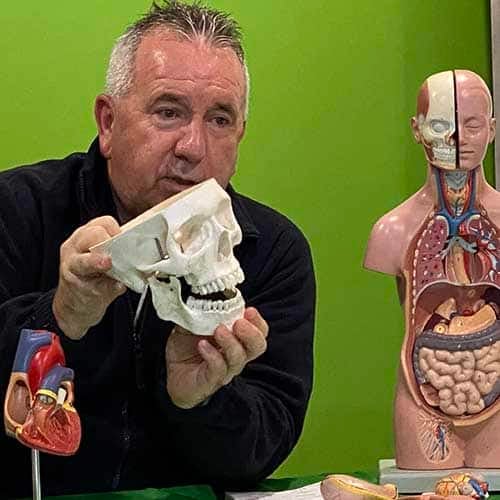

Hands-on Science Incursion on our major body systems!
Students will gain an appreciation of the complexity of the human body and life in this fun school science workshop when your classroom becomes a biology lab!
In this anatomy workshop, we;
- Explain the interrelationship among cells, tissues and organs
- Identify the role of the digestive, circulatory, respiratory and excretory systems of humans, and name the major organs
- Annotate representations of models of organ systems to describe their processes and functions
- Describe how the structures of organ systems, and the specialised cells within these systems, enable them to carry out their functions
- Describe how the components of each body system interact to allow the efficient functioning of an organism
Full risk assessments are available on request. Available as a high school science incursion within Australia or as a video conference to any school around the globe!
Online Class Version
We’ve run live interactive distance programs since 2010 and are highly experienced in making online classes engaging for students on a variety of web conferencing platforms.
- All of the same curriculum points will be covered, but the activities may vary from those listed for face-to-face incursions.
- Our online classes include demonstrations, Q&A, and hands-on activities (you will receive a materials list upon booking).
- Full child protections are in place
- We usually connect to classes & homes via Zoom, however if you wish to use a different software we can work with you on getting the connection live.
If you connect with us via Zoom
- Full system requirements for Zoom here
- Each student should test their Zoom connection here.
- Once the date & time is arranged, we will send you simple connection instructions (one click & you’re in!)
Science Show Activities
- Operation – Identify the major human body organs & where they are
- Inflate the lungs! – A model of how the diaphragm works
- Spirometer – Measure your lung capacity
- Heart rate – Link exercise with your heartbeat rate
- Pulse Oximetry – How much oxygen is in your blood?
- Blobs ‘o’ blood – Look at blood under the microscope, which cells are which?
- Blood components – Plasma, white/red blood cells and platelets all visually represented
- Squeezing through – Learn how food is squeezed through the intestines
- Digestion demonstration – How is food digested in the body?
- Sweating it out – A demonstration on why we sweat to cool down
- Excretion – How does the kidney function?

Australian Curriculum Mapping
Australian National Curriculum Mapping for all our science incursions
Australian ACARA Content Outcomes:
Science F-10 Version 9.0
Year 8
- analyse the relationship between structure and function of cells, tissues and organs in a plant and an animal organ system and explain how these systems enable survival of the individual AC9S8U02
Year 7 & 8
- explain how new evidence or different perspectives can lead to changes in scientific knowledge AC9S7H01 AC9S8H01
- examine how proposed scientific responses to contemporary issues may impact on society and explore ethical, environmental, social and economic considerations AC9S7H03 AC9S8H03
- develop investigable questions, reasoned predictions and hypotheses to explore scientific models, identify patterns and test relationships AC9S7I01 AC9S8I01
- analyse data and information to describe patterns, trends and relationships and identify anomalies AC9S7I05 AC9S8I05
- construct evidence-based arguments to support conclusions or evaluate claims and consider any ethical issues and cultural protocols associated with using or citing secondary data or information AC9S7I07 AC9S8I07
Year 9
- compare the role of body systems in regulating and coordinating the body’s response to a stimulus, and describe the operation of a negative feedback mechanism AC9S9U01
Year 9 & 10
- explain how scientific knowledge is validated and refined, including the role of publication and peer review AC9S9H01 AC9S10H01
- Investigate how advances in technologies enable advances in science, and how science has contributed to developments in technologies and engineering AC9S9H02 AC9S10H02
- develop investigable questions, reasoned predictions and hypotheses to test relationships and develop explanatory models AC9S9I01 AC9S10I01
- analyse and connect a variety of data and information to identify and explain patterns, trends, relationships and anomalies AC9S9I05 AC9S10I05
- construct arguments based on analysis of a variety of evidence to support conclusions or evaluate claims, and consider any ethical issues and cultural protocols associated with accessing, using or citing secondary data or information AC9S9I07 AC9S10I07

NSW K-10 Science Syllabus Mapping
NSW Science 7–10 Syllabus (2023)
Stage 4
A student:- identifies questions and makes predictions to guide scientific investigations SC4-WS-02 – Identify questions and problems that can be investigated scientifically – Make predictions based on scientific knowledge and observations
- describes the role, structure and function of a range of living systems and their components SC4-LIV-01 – Explain the interrelationship among cells, tissues and organs – Identify the role of the digestive, circulatory, respiratory and excretory systems of humans, and name the major organs – Describe how the structures of organ systems, and the specialised cells within these systems, enable them to carry out their functions – Describe how the components of each body system interact to allow the efficient functioning of an organism
Stage 5
- asks questions or makes predictions using observations SCLS-WS-02 – Ask questions about familiar objects and events based on observations – Make predictions based on observations
- explains how an understanding of the causes of disease can be used to prevent and manage the spread of disease SC5-DIS-01 – Identify the importance of maintaining stable internal conditions in the body – Investigate examples of an organism’s observable response to a stimuli






