


Science Show Demonstrations
- Operation – Identify the major human body organs & where they are
- Inflate the lungs! – A model of how the diaphragm works
- Spirometer – Measure your lung capacity
- Heart rate – Link exercise with your heartbeat rate
- Pulse Oximetry – How much oxygen is in your blood?
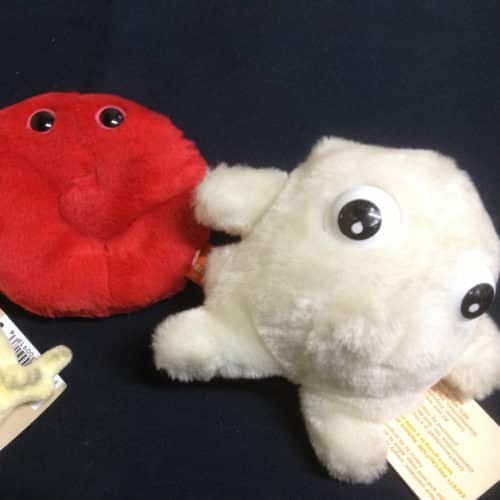
- Blobs ‘o’ blood – Look at blood under the microscope, which cells are which?
- Blood components – Plasma, white/red blood cells and platelets all visually represented
- Squeezing through – Learn how food is squeezed through the intestines
- Digestion demonstration – How is food digested in the body?
- Sweating it out – A demonstration on why we sweat to cool down
Science workshop content
What Students Experience: The Anatomy Lab
In this immersive biology workshop, students explore the internal mechanics of life. By investigating how specialized organs form coordinated systems, they move beyond basic diagrams to understand the real-world physiology that powers the human body.
1. The Systemic Tour
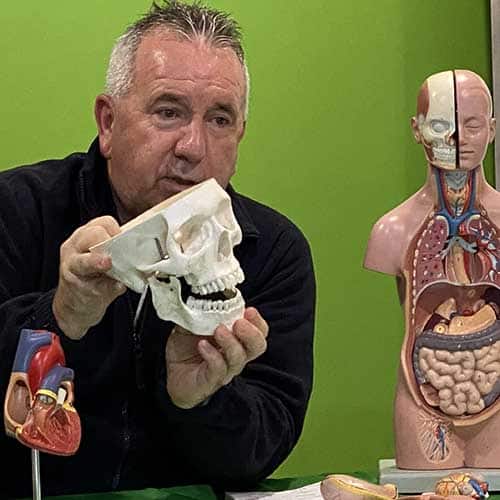
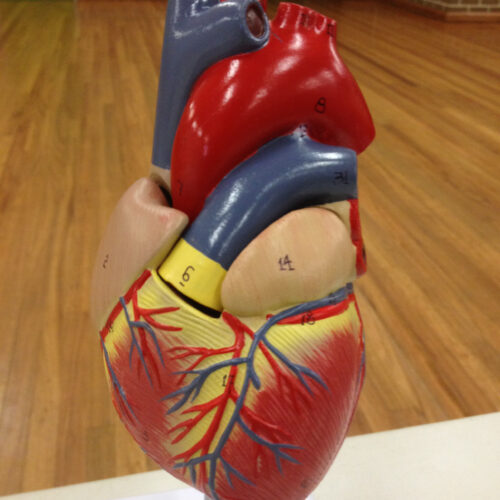
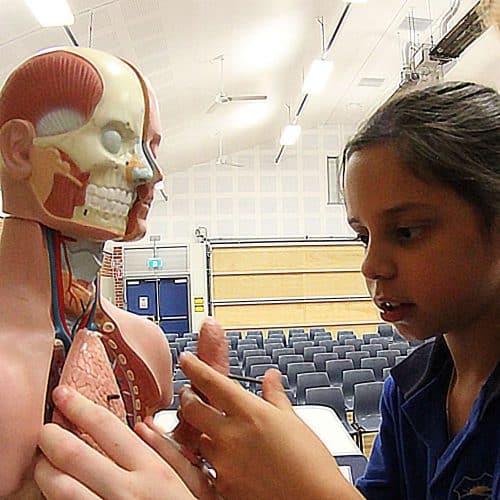
Guided by our expert presenter, students conduct a deep-dive exploration of a professional torso model. We map the pathways of the cardiovascular, digestive, and urinary systems, while investigating how the brain acts as the master controller.
2. Diagnostic Stations
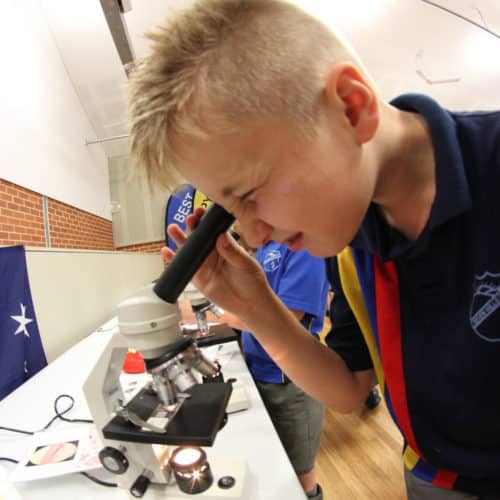
Students rotate through hands-on testing zones. They measure lung capacity using professional spirometers, operate lung models to see pressure in action, and use microscopy to examine safely prepared slides of organ and blood samples.
3. Synthesis & Health
We conclude by connecting cellular biology to lifestyle. Students discuss how specialized cells form the organs they’ve just studied and how we can protect these systems through nutritional science, exercise, and safety-first choices.
Our Commitment to Quality Anatomy Education
A Trusted School Partner for 20 Years
Fizzics Education delivers reliable, syllabus-aligned visits that provide students with access to high-end scientific tools usually reserved for secondary labs.
✓
We use detailed, durable anatomical torsos and system-specific models for tactile learning.
✓
Providing safe, professionally prepared tissue slides for authentic cellular observation.
✓
Students record real biological data using spirometers and reaction timers to see science in themselves.

Australian Curriculum Mapping
Australian National Curriculum Mapping for all our science incursions
Australian ACARA Content Outcomes:
Science F-10 Version 9.0
Year 5
- Examine how particular structural features and behaviours of living things enable their survival in specific habitats AC9S5U01
Year 5 & 6
- Investigate how scientific knowledge is used by individuals and communities to identify problems, consider responses and make decisions AC9S5H02, AC9S6H02
- Pose investigable questions to identify patterns and test relationships and make reasoned predictions AC9S5I01, AC9S6I01
- Compare methods and findings with others, recognise possible sources of error, pose questions for further investigation and select evidence to draw reasoned conclusions AC9S5I05, AC9S6I05
Australian National Curriculum Mapping for all our science workshops & shows

NSW K-10 Science Syllabus Mapping
NSW K – 10 Science Syllabus mapping
Current NSW Syllabus Content
A student:
- ALS2.6 (PDHPE) discusses the relationship between regular and varied physical activity and health
- ST3-4LW-S (Science) examines how the environment affects the growth, survival and adaptation of living things
NSW Science and Technology K–6 Syllabus (Implementation from 2027)
For implementation advice, visit the NESA Science and Technology site.
Stage 3
ST3-SCI-01 uses evidence to explain how scientific knowledge can be used to develop sustainable practices
- Identify the main organs and their functions in the human digestive, respiratory and circulatory systems
- Recognise that the human digestive, respiratory and circulatory systems work together
- Identify variables and conduct fair tests to describe ways systems respond to physical activity
- Investigate how structural and behavioural adaptations in humans aid survival
- ST3-PQU-01 poses questions to identify variables and conducts fair tests to gather data
NSW PDHPE K–6 Syllabus (Implementation from 2027)
Stage 3
- PH3-IHW-01 examines and explains factors that influence identity, health and wellbeing of individuals and groups
Session Requirements
👥 Capacity & Timing
👨🎓 Attendance: Max 32 students per class.
🏫 Target: Appropriate for Years 5 & 6.
⏰ Duration: 60 minute workshop.
🛠️ Set/Pack: 45 mins setup + 45 mins pack down.
📍 Venue Requirements
🏗️ Tables: 7 tables arranged around the room for intensive rotation stations.
🔌 Power: Access to 2 electrical power sockets for microscopy and digital tools.
🪑 Seating: Chairs are not required for students.
Go Further!
Complete Units of Work to Support Your Teaching
Support your classroom with 270+ syllabus-linked lessons, high-quality videos, and marking rubrics.
Save planning time with high-quality videos and experiments designed for senior primary learners to engage with the science of anatomy and body systems.
Extend the Experience
Pair this workshop with a larger stage show for groups of up to 240 students:






