



Science Show Activities
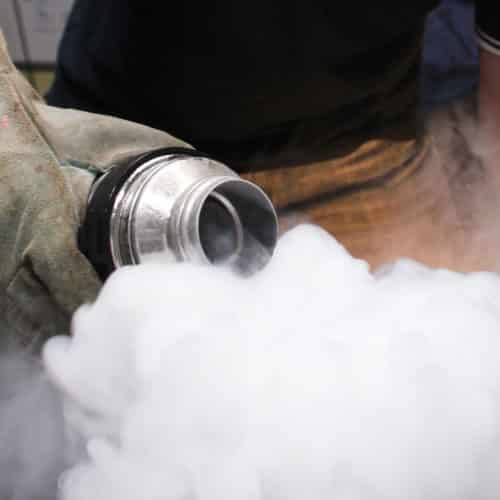
- Safety of cryogenic substances – Liquid Nitrogen is – 196˚C, so what equipment must be used?
- Fog breath – Is water present in your breath? Condensation demonstration.
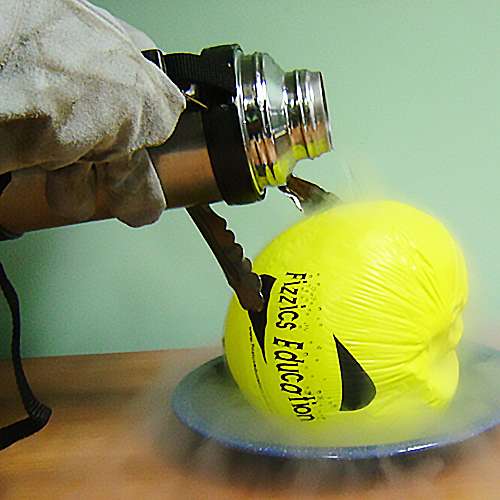
- The shrinking balloon – What happens to gases when rapidly cooled? Air pressure demo
- Balloon blow up – Blowing balloons up from the outside! Transferring heat energy.
- Ball smasher – Why can rubber shatter? Glass transition phase demonstration
- Nitinol wire – Also known as memory wire: this changes shape with heat
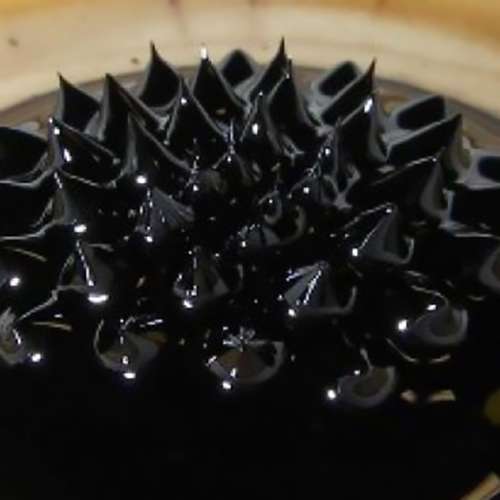
- Ferrofluid – Using magnetic nanoparticles this fluid reacts in strange ways!
- The crusher – Create a fair test to see what forces paper can withstand
- Super absorber – Check out this super absorbent polymer used in magic tricks
- Playing with polymers – Investigate a number of polymers from slime to bouncing putty
- Heat conductor blocks – A counter-intuitive experiment where ice melts on the ‘colder’ block
- Under the scope – We look a variety of materials under the digital microscope
- UV beads – Why do they react to UV light?
- Radiating energy – This safe material is radioactive… how does this work?
- Impact tester – Test a number of materials for their impact resistance just like in a lab
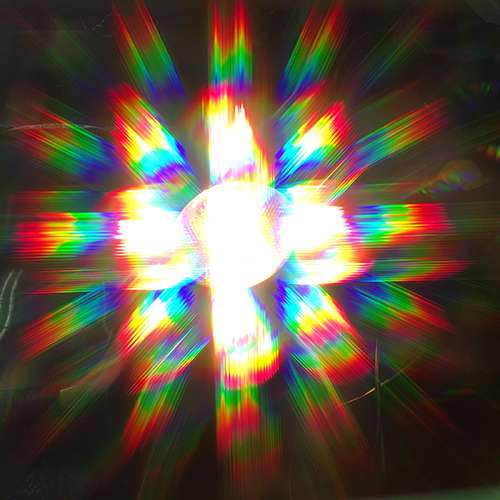
- Polarising lenses – Use polarised light can be used to study materials
- Colour changing ducks – Thermochromism is used in kids toys, including these cute ducks 🙂
- Hand boiler – This devices shows that boiling doesn’t just happen at 100 deg C.
Science workshop content
What Students Experience: The Materials Testing Lab
In this immersive workshop, students step into the role of industrial scientists. We investigate a vast array of material properties, from the visible to the microscopic. Students explore absorbency, magnetism, fluorescence, and thermochromic (colour-changing) reactions, discovering how engineers select specific materials for specialised tasks.
Destructive Testing
Just like a real quality-control lab, students use “The Crusher” to perform destructive tests on paper arrangements to analyse structural integrity and load-bearing limits.
Light & Optics
We examine the effect of UV light on different substances and demonstrate how polarising light is utilised to detect internal stress and analyse material composition.
Advanced Alloys
Students witness the incredible “memory” of Nitinol (a shape-changing alloy) and use specialised hand boilers to prove that boiling temperatures vary between materials.
The session concludes with a series of dramatic liquid nitrogen demonstrations. By rapidly removing heat energy, we investigate how extreme cold changes the physical properties of solids and gases, turning familiar objects into brittle, alien-like materials.
Real Classroom Highlights
A brilliant video showcasing our students investigating material properties! The hands-on destructive testing was a highlight, giving them a real sense of engineering logic.
Our students loved the Materials Testing Lab. From Nitinol memory wire to UV exploration, it was a scientifically rigorous and highly engaging incursion.
A fantastic day of chemical inquiry! The girls were fascinated by the extreme cold demonstrations and the way physical properties change under pressure.
⬅️ Swipe to see more examples ➡️
Professional Lab Equipment
A Trusted STEM Partner for 20 Years
Fizzics Education brings high-level equipment including polarising filters, Nitinol samples, and liquid nitrogen to ensure a safe yet scientifically rigorous exploration of the Chemical World.

Australian Curriculum Mapping
Australian National Curriculum Mapping for all our science incursions
Australian ACARA Content Outcomes:
Science F-10 Version 9.0
Year 2
- recognise that materials can be changed physically without changing their material composition and explore the effect of different actions on materials including bending, twisting, stretching and breaking into smaller pieces AC9S2U03
Year 1 & 2
- describe how people use science in their daily lives, including using patterns to make scientific predictions AC9S1H01, AC9S2H01
- pose questions to explore observed simple patterns and relationships and make predictions based on experiences AC9S1I01, AC9S2I01
- compare observations with predictions and others’ observations, consider if investigations are fair and identify further questions with guidance AC9S1I05, AC9S2I05
Year 3
- identify sources of heat energy and examine how temperature changes when heat energy is transferred from one object to another AC9S3U03
- investigate the observable properties of solids and liquids and how adding or removing heat energy leads to a change of state AC9S3U04
Year 4
- examine the properties of natural and made materials including fibres, metals, glass and plastics and consider how these properties influence their use AC9S4U04
Year 3 & 4
- examine how people use data to develop scientific explanations AC9S3H01, AC9S4H01
- consider how people use scientific explanations to meet a need or solve a problem AC9S3H02, AC9S4H02
- pose questions to explore observed patterns and relationships and make predictions based on observations AC9S3I01, AC9S4I01
- compare findings with those of others, consider if investigations were fair, identify questions for further investigation and draw conclusions AC9S3I05, AC9S4I05
Year 5
- explain observable properties of solids, liquids and gases by modelling the motion and arrangement of particles AC9S5U04
Year 6
- compare reversible changes, including dissolving and changes of state, and irreversible changes, including cooking and rusting that produce new substances AC9S6U04
Year 5 & 6
- investigate how scientific knowledge is used by individuals and communities to identify problems, consider responses and make decisions AC9S5H02, AC9S6H02
- pose investigable questions to identify patterns and test relationships and make reasoned predictions AC9S5I01, AC9S6I01
- compare methods and findings with those of others, recognise possible sources of error, pose questions for further investigation and select evidence to draw reasoned conclusions AC9S5I05, AC9S6I05
Australian National Curriculum Mapping for all our science workshops & shows

NSW K-10 Science Syllabus Mapping
NSW K – 10 Science Syllabus mapping for all our incursions
NSW Science Syllabus Content
A student:
NSW Science and Technology K–6 Syllabus (Implementation from 2027)
For implementation advice, visit the NESA Science and Technology site
Stage 2
ST2-SCI-01
- Recognise that matter has mass, takes up space and consists of particles
- Observe matter in solid, liquid and gas states and their defined properties
- Describe water changing states using Tier 2 and Tier 3 vocabulary
- Describe how heat energy affects the movement and arrangement of particles
- Recognise heat transfer via conduction, convection and radiation
- Measure temperature in degrees Celsius using thermometers
- Conduct fair tests on how materials absorb or reflect heat energy
ST2-PQU-01 poses questions to create fair tests investigating energy effects
Stage 3
ST3-PQU-01 poses questions to identify variables and conducts fair tests to gather data
Print a PDF detailing NSW K to 6 science visits

VIC Science Syllabus Content
VIC Curriculum F–10 Version 2.0
Foundation to Level 2
- Objects can be made of different materials with observable properties. VC2S2U04
- Materials can be combined; properties of mixtures differ from base materials. VC2S2U05
Levels 3 & 4
- Solids, liquids and gases change state when adding or removing heat. VC2S4U04
- Properties of natural and made materials influence their use and re-use. VC2S4U05
- Temperature changes happen when heat is transferred from one object to another. VC2S4U09
Levels 5 & 6
- Model the motion and arrangement of particles to explain matter properties. VC2S6U03
- Distinguish between reversible changes (state change) and irreversible changes (rusting). VC2S6U04
- Plan repeatable investigations identifying changed, measured and controlled variables. VC2S6I02
Session Requirements
👥 Capacity & Timing
👨🎓 Attendance: Max 32 students per session.
🏫 Target: Appropriate for Years K to 6.
⏰ Duration: 60 or 90 minutes.
🛠️ Set/Pack: 45 mins setup + 45 mins pack down.
📍 Space & Setup
🏗️ Layout: 7 tables arranged around the room.
🌬️ Environment: Workshop requires a well-ventilated area.
🪑 Seating: Chairs are not required for students.
Did you know about our larger stage shows?
Designed to engage up to 240 students, pair this workshop with one of these school favourites:






