


Science Show Activities
- Hand generators – Create a buzz with different dynamos
- Hydropower – Harness the kinetic energy of moving water.
- Lights & lux meters – Which light wastes more electrical energy?
- Ozone depletion – Make a phosphorescent screen glow with UV light
- Radiometer – Energy in the palm of your hand. How does it work?
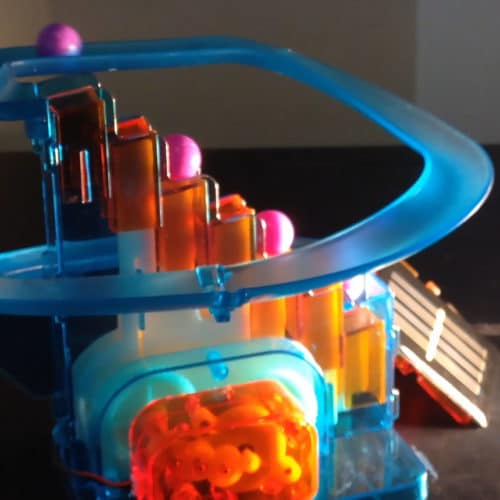
- Storing Energy – Can you guess which car will win the race?
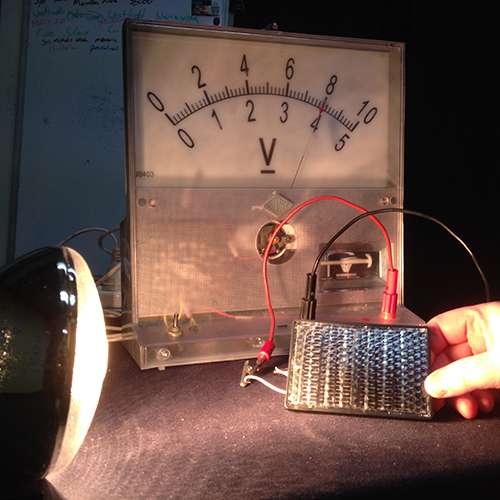
- Solar Power – Convert light energy into kinetic energy.
- The greenhouse effect – Do we really need it? Is it getting hot in here?
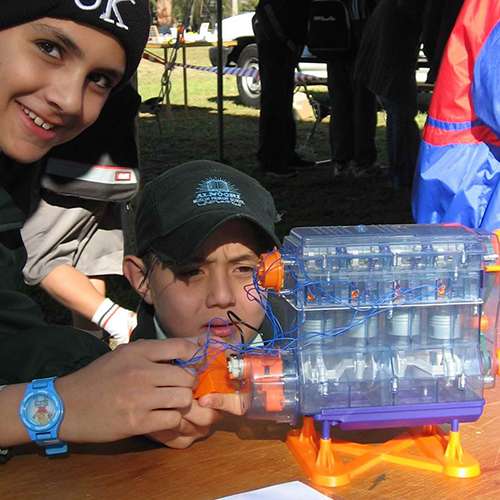
- Measure that motor! – How much greenhouse gas is produced by cars?
- Wind turbine – Windy days can blow you away!
Science workshop content
What Students Experience: The Future of Energy
We start by examining the fundamental differences between renewable and non-renewable energy. Students delve into the “why” behind modern materials science, investigating how carbon dioxide emissions contribute to the enhanced greenhouse effect and why reducing our carbon footprint is a global scientific priority.
Generation Stations
Students rotate through hands-on experiments with solar cells, wind turbines, and hydroelectricity, measuring how natural forces are converted into usable power.
Physics & Climate
We model the difference between kinetic and potential energy while addressing common misconceptions about the roles of carbon dioxide and ozone in our atmosphere.
Smart City Planning
The session concludes by analysing the redundancies needed in a modern city, discussing the pros and cons of different energy types for a stable, sustainable grid.
Real Classroom Highlights
Our students loved exploring the future of energy! The hands-on stations with solar panels and turbines provided a fantastic practical look at sustainability and power generation.
A brilliant day of science. The students were fascinated by the hydroelectric models and learning about the greenhouse effect through experiments. Fizzics Education always delivers!
⬅️ Swipe to see more examples ➡️
Specialised STEM Equipment
A Trusted STEM Partner for 20 Years
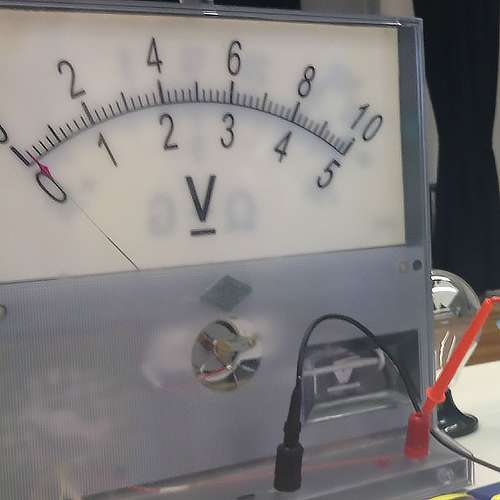
Fizzics Education brings high-tech solar monitors, wind anemometers, and hydroelectric models to your classroom, providing an authentic scientific experience.
Which Electricity Workshop is right for you?
Covers fundamentals and static electricity. Best for starting a new topic.
Focuses on complex circuit arrangements using lights, capacitors, and batteries.
Focuses on power generation, sustainability, and comparing solar/wind to fossil fuels.

Australian Curriculum Mapping
Australian National Curriculum Mapping for all our science incursions
Australian ACARA Content Outcomes:
Science F-10 Version 9.0
Year 4
- examine the properties of natural and made materials including fibres, metals, glass and plastics and consider how these properties influence their use AC9S4U04
Year 3 & 4
- examine how people use data to develop scientific explanations AC9S3H01, AC9S4H01
- consider how people use scientific explanations to meet a need or solve a problem AC9S3H02, AC9S4H02
- pose questions to explore observed patterns and relationships and make predictions based on observations AC9S3I01, AC9S4I01
- compare findings with those of others, consider if investigations were fair, identify questions for further investigation and draw conclusions AC9S3I05, AC9S4I05
Year 6
- investigate the transfer and transformation of energy in electrical circuits, including the role of circuit components, insulators and conductors AC9S6U03
Year 5 & 6
- investigate how scientific knowledge is used by individuals and communities to identify problems, consider responses and make decisions AC9S5H02, AC9S6H02
- pose investigable questions to identify patterns and test relationships and make reasoned predictions AC9S5I01, AC9S6I01
- compare methods and findings with those of others, recognise possible sources of error, pose questions for further investigation and select evidence to draw reasoned conclusions AC9S5I05, AC9S6I05
Design and Technologies F-10 Version 9.0
Years 5 & 6
- explain how electrical energy can be transformed into movement, sound or light in a product or system AC9TDE6K02
Australian National Curriculum Mapping for all our science workshops & shows

NSW K-10 Science Syllabus Mapping
NSW K – 10 Science Syllabus mapping for all our incursions
NSW Science Syllabus Content
A student:
- describes the characteristics and effects of common forms of energy, such as light and heat ST2-8PW-ST
- explains how energy is transformed from one form to another ST3-8PW-ST
- investigates the effects of increasing or decreasing the strength of a specific contact or non-contact force ST3-9PW-ST
NSW Science and Technology K–6 Syllabus (Implementation from 2027)
For implementation advice, visit the NESA Science and Technology site
Stage 2
ST2-SCI-01
- Recognise that matter is anything that has mass, takes up space and consists of very small particles
- Observe and describe water changing from solid to liquid to gas and back again
- Recognise that heat energy can be transferred via conduction, convection and radiation
- Pose questions and conduct fair tests to compare how different materials absorb or reflect heat energy
ST2-PQU-01 poses questions to create fair tests that investigate the effects of energy
Stage 3
ST3-SCI-01
- Recognise that an electrical circuit transfers electrical energy from a source to a device that transforms it into other forms
- Plan and construct simple electrical circuits to model the transfer and transformation of energy
- Explain how electrical insulators can ensure electrical safety in everyday life
- Explain the effects of natural events and human activities on climate
ST3-PQU-01 poses questions to identify variables and conducts fair tests to gather data
Print a PDF detailing NSW K to 6 science visits

VIC Science Syllabus Content
VIC Curriculum F–10 Version 2.0
For implementation advice, visit the VIC Curriculum F-10 site.
Levels 3 & 4
- Weather events and climate have impacts on the land, air, water and living things; human activity can affect climate. VC2S4U08
- Heat energy can be generated from different sources; temperature changes may happen when heat is transferred. VC2S4U09
- Forces affect the motion (speed and direction) of objects. VC2S4U10
Levels 5 & 6
- Energy can be transferred and transformed in electrical circuits where components play particular roles. VC2S6U09
- Explain how electrical energy can be transformed into movement, sound or light in a product or system. VC2TDE6C01
- Scientific investigations can be planned and conducted identifying changed, measured and controlled variables. VC2S6I02
Session Requirements
👥 Capacity & Timing
👨🎓 Attendance: Max 32 students per session.
🏫 Target: Recommended for Years 3 to 6.
⏰ Duration: 60 minutes.
🛠️ Set/Pack: 45 mins setup + 45 mins pack down.
📍 Space & Power
🏗️ Setup: 2 tables required for experiment stations.
🔌 Electrical: Access to 3 electrical power sockets.
🪑 Seating: Chairs are not required for students.
Did you know about our larger stage shows?
Designed to engage up to 240 students, pair this workshop with one of these school favourites:






