

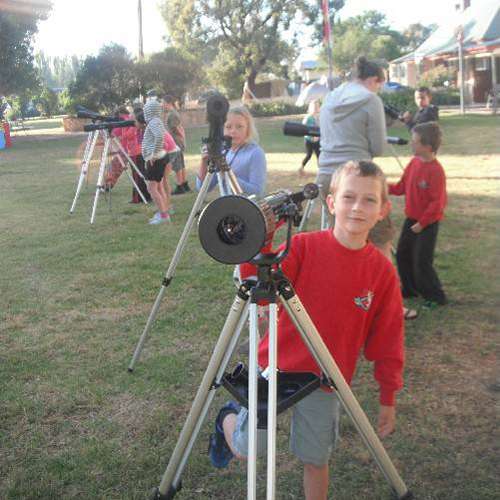
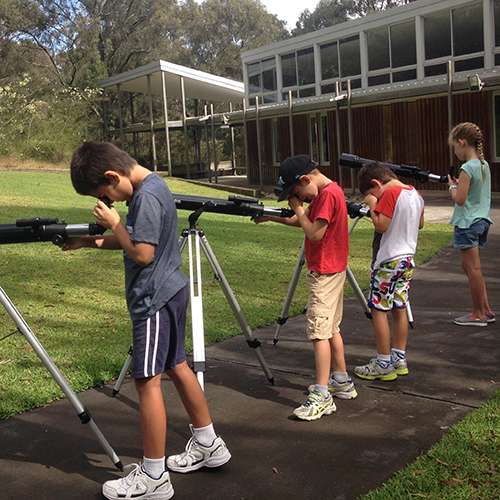
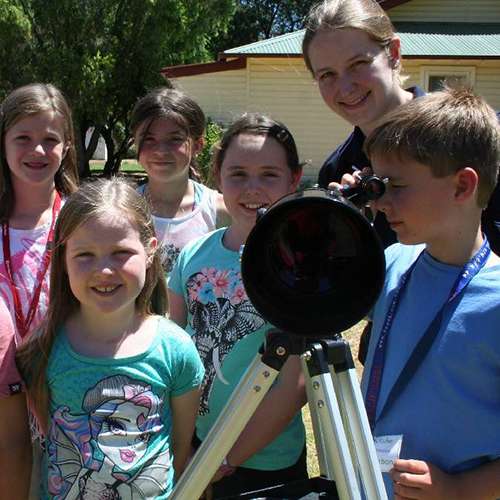
Your students become astronomers with this evening telescope workshop.
Students will discover;
- How to find the south celestial pole
- Constellations of the zodiac and how to identify them
- The Milky Way and Magellanic clouds
- Planetary orbits and ring features
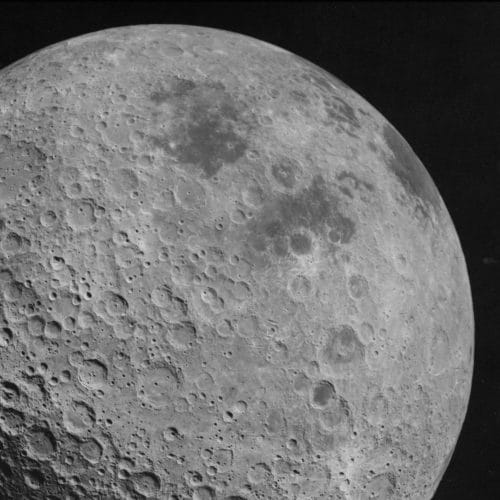
- Surface features of the moon
- Learn about the dynamic nature of astronomy
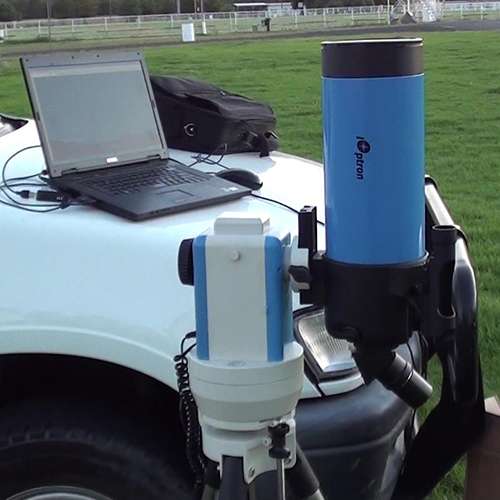
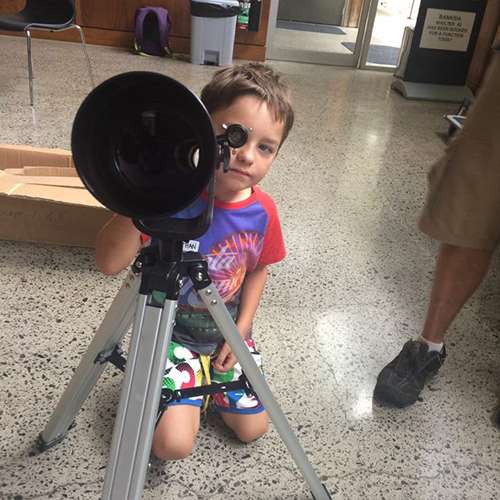
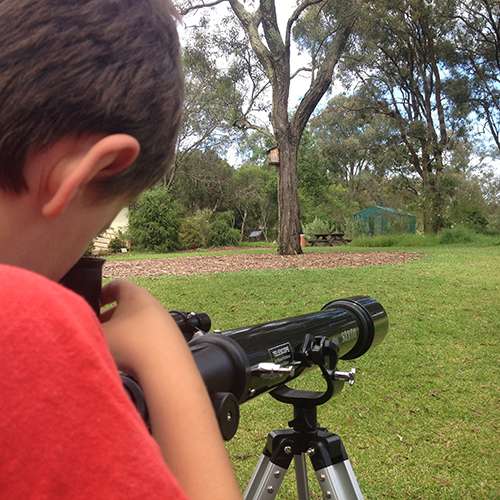
Working in pairs or threes, students use one of 7 telescopes to observe the night sky as well as have the opportunity to use a motor driven telescope with GPS capabilities.
 Rated Excellent on Trustpilot – read our reviews
Contact us
Science workshop content
Workshop Logistics & Planning
Group Size
Ideal for 21 students
(Groups of 3)
Equipment
7 Professional
Telescopes
Duration
60 Minute
Sessions
While best offered alongside a school camp or our daytime Stars & Planets workshop, this session can run as a standalone experience. If you have a larger cohort, we can cycle students through stations or pair the evening with free space science experiments run by teachers and parents.
Mastering the Night Sky
Check Moonrise for your location. A full moon is best! Allow 60 mins after moonrise for the moon to clear buildings and trees.
Students should bring a torch covered in red cellophane. This preserves night vision while allowing them to navigate safely.
Long pants, covered shoes, and mosquito repellent are essential. In case of clouds, we transition to an indoor orientation using astronomy software.
Which space workshop or show should I choose?
Our Commitment to Quality Science Education
A Trusted School Partner for 20 Years
Reliable, syllabus-aligned visits that engage students and meet the practical requirements of the classroom.
Highly rated for managing groups in outdoor settings.
Over 4 million students reached since 2004.

Australian Curriculum Mapping
Australian National Curriculum Mapping for all our science incursions
Australian ACARA Content Outcomes:
Science F-10 Version 9.0
Year 3
- Investigate the observable properties of solids and liquids and how adding or removing heat energy leads to a change of state AC9S3U04
Year 3 & 4
- Examine how people use data to develop scientific explanations AC9S3H01, AC9S4H01
- Consider how people use scientific explanations to meet a need or solve a problem AC9S3H02, AC9S4H02
- Pose questions to explore observed patterns and relationships and make predictions based on observations AC9S3I01, AC9S4I01
- Compare findings with those of others, consider if investigations were fair, identify questions for further investigation and draw conclusions AC9S3I05, AC9S4I05
Year 5
- Identify sources of light, recognise that light travels in a straight path and describe how shadows are formed and light can be reflected and refracted AC9S5U03
Year 6
- Describe the movement of Earth and other planets relative to the sun and model how Earth’s tilt, rotation on its axis and revolution around the sun relate to cyclic observable phenomena AC9S6U02
Year 5 & 6
- Investigate how scientific knowledge is used by individuals and communities to identify problems, consider responses and make decisions AC9S5H02, AC9S6H02
- Pose investigable questions to identify patterns and test relationships and make reasoned predictions AC9S5I01, AC9S6I01
- Compare methods and findings with those of others, recognise possible sources of error, pose questions for further investigation and select evidence to draw reasoned conclusions AC9S5I05, AC9S6I05
Australian National Curriculum Mapping for all our science workshops & shows

NSW K-10 Science Syllabus Mapping
NSW K – 10 Science Syllabus mapping for all our incursions
NSW Science & Technology Syllabus Content
A student:
- describes how contact and non-contact forces affect an object’s motion ST2-9PW-ST
- investigates regular changes caused by interactions between the Earth and the Sun ST2-10ES-S
- investigates the effects of increasing or decreasing the strength of a specific contact or non-contact force ST3-9PW-ST
- explains regular events in the solar system and geological events on the Earth’s surface ST3-10ES-S
NSW Science and Technology K–6 Syllabus (Implementation from 2027)
For implementation advice, visit the NESA Science and Technology site
Stage 2
ST2-SCI-01
- Model Earth’s revolution around the Sun and recognise that a complete revolution takes 365.25 days
- Describe features of our solar system using multimodal representations
- Demonstrate that gravity is a force of attraction between objects and Earth
- Recognise that the force of gravity keeps moons and planets in their positions
ST2-PQU-01 poses questions to create fair tests that investigate energy effects
Stage 3
ST3-SCI-01
- Recognise stars, galaxies, nebulae, exoplanets and black holes as astronomical features
- Research how living things can travel and survive in space
- Examine discoveries and technologies that benefit humankind
ST3-PQU-01 poses questions to identify variables and conducts fair tests
📄 Print a PDF detailing NSW K to 6 science visits

VIC Science Syllabus Content
VIC Curriculum F–10 Version 2.0
For implementation advice, visit the VIC Curriculum F-10 site.
Level 3 & 4
- forces, including gravitational and magnetic, can be exerted through contact or from a distance. VC2S4U10
- scientific investigations can be planned and conducted identifying the attributes of fair tests. VC2S4I02
Level 5 & 6
- the force of gravity keeps Earth and other planets in the solar system in orbit around the Sun. VC2S6U07
- repeatable scientific investigations can be planned and conducted identifying changed, measured and controlled variables. VC2S6I02
Session Requirements
👥 Capacity & Timing
👨🎓 Attendance: Max 21 students per class.
🏫 Target: Year 3 to Year 12.
⏰ Duration: Variable (organized with office).
🛠️ Set/Pack: 45 mins setup and 45 mins pack up.
🌙 Evening Prep: Essential to check the Moonrise Calculator before booking to ensure viewing visibility.
📍 Setup & Supervision
🏗️ Location: Best run in winter as part of an overnight science camp.
🔌 Power: Access to 1 electrical power socket is required.
🤝 Supervision: Parents are encouraged to help supervise groups.
Go Further!
Complete Units of Work to Support Your Teaching
Support your classroom with 270+ syllabus-linked lessons, high-quality videos, and marking rubrics.
Save time and engage students in STEM with high-quality videos, printable experiments, and full marking rubrics for your Earth & Space unit.
Extend the Experience
Pair this workshop with a larger stage show for groups of up to 240 students:






