


Science Show Demonstrations
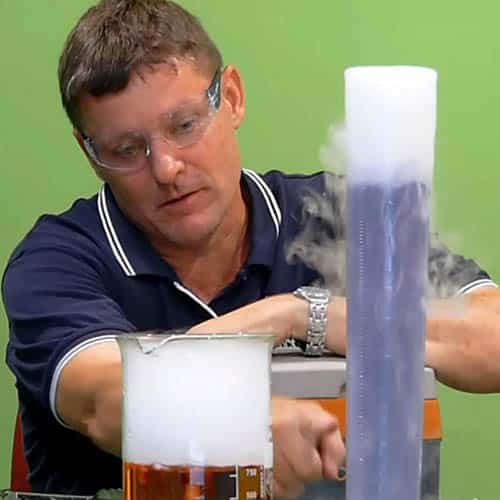
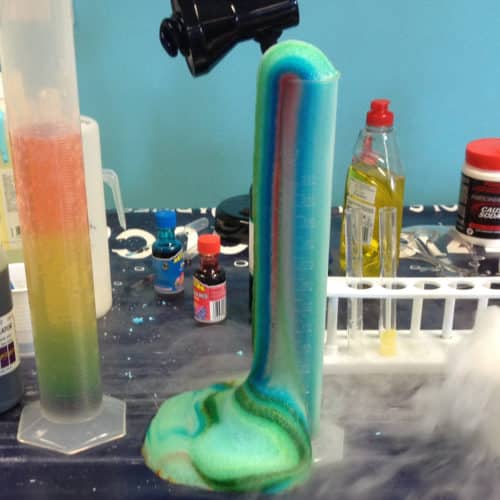
- Elephants toothpaste – A foaming chemical reaction that needs a ‘helper’ chemical
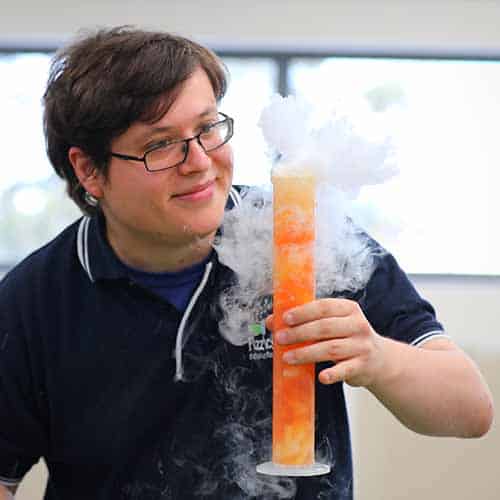
- Dry ice rainbows – See colours form in water when an acid indicator is added
- Impossible to burn paper – An old magic trick, showing that evaporation keeps materials cool
- Coloured flames – Different materials burn with different colours… link to fireworks
- The fire triangle – Oxygen is needed for fires… let’s prove it with a fireball!
- Stringy slime – A polymerisation reaction
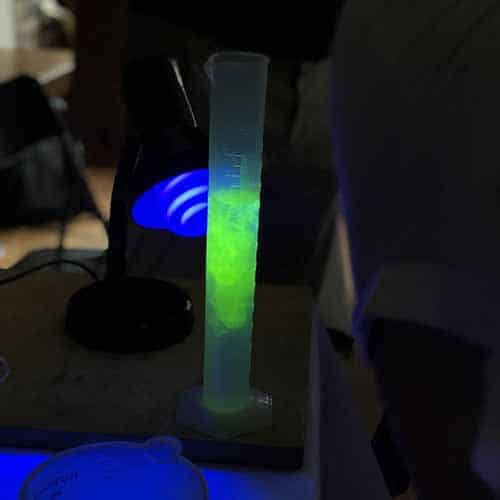
- Glow chemistry – Glowing salts and glowing shadows! Fluorescence in action.
- Precipitate chemistry – Clear solutions mixed together can produce surprising results
- Super absorber – Check out this super absorbent polymer used in magic tricks
- Dry ice chemistry – Is sublimation physical or a chemical reaction?
Science show content
A Chemical Journey
This performance takes students on a journey through the building blocks of our world. By combining stage flare with rigorous science, we demonstrate that chemistry isn’t just in a lab—it’s everywhere.
1. Foundations of Change
We define the critical difference between physical changes and permanent chemical reactions. Students discover how chemical properties are utilised across dozens of different industrial and home applications.
2. Visual Indicators
We explore pH science using vibrant colour-changing indicators to measure acidity and alkalinity. This is followed by a dramatic look at gas release through our signature “elephant’s toothpaste” demonstration.
3. Advanced States
The show pushes further into material science, covering polymer chains through slime making, chemiluminescence (glowing chemicals), and the formation of solids from liquids (precipitates).
Chemistry Highlights & Reviews
Our students were amazed by the Spectacular Chemistry show! It was a fantastic way to engage everyone in the wonders of science with such visual and exciting demonstrations.
Thank you Fizzics Education for a brilliant chemistry session. The students loved the elephant’s toothpaste and the colour-changing experiments!
Our Commitment to Quality Science Education
A Trusted School Partner for 20 Years.
Fizzics Education delivers high-impact stage shows that are safe, syllabus-aligned, and designed to inspire the next generation of scientists.
Rigorous protocols for all chemical demonstrations in a school environment.
Bridging the gap between spectacular effects and daily life applications.
Delivered by science specialists skilled in large-group primary school engagement.

Australian Curriculum Mapping
Australian National Curriculum Mapping for all our science incursions
Australian ACARA Content Outcomes:
Science F-10 Version 9.0
Year 7
- use particle theory to describe the arrangement of particles in a substance, including the motion of and attraction between particles, and relate this to the properties of the substance AC9S7U05
Year 8
- compare physical and chemical changes and identify indicators of energy change in chemical reactions AC9S8U07
- classify matter as elements, compounds or mixtures and compare different representations of these, including 2-dimensional and 3-dimensional models, symbols for elements and formulas for molecules and compounds AC9S8U06
- compare physical and chemical changes and identify indicators of energy change in chemical reactions AC9S8U07
Year 7 & 8
- explain how new evidence or different perspectives can lead to changes in scientific knowledge AC9S7H01 AC9S8H01
- examine how proposed scientific responses to contemporary issues may impact on society and explore ethical, environmental, social and economic considerations AC9S7H03 AC9S8H03
- develop investigable questions, reasoned predictions and hypotheses to explore scientific models, identify patterns and test relationships AC9S7I01 AC9S8I01
- analyse data and information to describe patterns, trends and relationships and identify anomalies AC9S7I05 AC9S8I05
- construct evidence-based arguments to support conclusions or evaluate claims and consider any ethical issues and cultural protocols associated with using or citing secondary data or information AC9S7I07 AC9S8I07
Year 9
- model the rearrangement of atoms in chemical reactions using a range of representations, including word and simple balanced chemical equations, and use these to demonstrate the law of conservation of mass AC9S9U07
Year 10
- model the rearrangement of atoms in chemical reactions using a range of representations, including word and simple balanced chemical equations, and use these to demonstrate the law of conservation of mass AC9S9U07
Year 9 & 10
- explain how scientific knowledge is validated and refined, including the role of publication and peer review AC9S9H01 AC9S10H01
- Investigate how advances in technologies enable advances in science, and how science has contributed to developments in technologies and engineering AC9S9H02 AC9S10H02
- develop investigable questions, reasoned predictions and hypotheses to test relationships and develop explanatory models AC9S9I01 AC9S10I01
- analyse and connect a variety of data and information to identify and explain patterns, trends, relationships and anomalies AC9S9I05 AC9S10I05
- construct arguments based on analysis of a variety of evidence to support conclusions or evaluate claims, and consider any ethical issues and cultural protocols associated with accessing, using or citing secondary data or information AC9S9I07 AC9S10I07
Australian National Curriculum Mapping for all our science workshops & shows

NSW K-10 Science Syllabus Mapping
NSW Science 7–10 Syllabus (2023)
Stage 4
A student:
- identifies questions and makes predictions to guide scientific investigations SC4-WS-02
– Identify questions and problems that can be investigated scientifically
– Make predictions based on scientific knowledge and observations - explains how the properties of substances enable separation in a range of techniques SC4-SOL-01
– Identify the 3 main states of matter and how they are represented in the movement of water on earth
– Represent changes in the state of matter in terms of particle arrangement and movement
– Compare the properties of dilute, concentrated, saturated and supersaturated solutions
– Classify matter as pure substances, including elements and compounds, and impure substances, including mixtures based on their particle composition - explains how uses of elements and compounds are influenced by scientific understanding and discoveries relating to their properties SC4-PRT-01
– Identify some common elements in everyday objects
– Conduct a series of investigations to identify and compare the physical properties of metals, non-metals and metal - explains how energy causes geological and chemical change SC4-CHG-01
– Undertake experiments to identify the indicators of physical and chemical changes
– Describe the initial and final changes that are observed in a chemical reaction, including writing a word equation to represent a chemical reaction
– Investigate and observe energy changes in different chemical reactions
– Define open and closed systems to describe how energy is transferred into and out of systems, and how it cycles within a system
Stage 5
- asks questions or makes predictions using observations SCLS-WS-02
– Ask questions about familiar objects and events based on observations
– Make predictions based on observations
NSW K – 10 Science Syllabus mapping for all our NSW incursions

VIC Science Syllabus Content
VIC Curriculum F–10 Version 2.0
For explanatory points & implementation advice for each dot point, please visit the VIC Curriculum F-10 site.
Levels 7 and 8
- the particle and kinetic theories of matter can be used to describe the arrangement and motion of particles in a substance, including the attraction between particles, and to explain the properties and behaviour of substances, including melting point, boiling point, density, compressibility, gas pressure, viscosity, diffusion, sublimation, and expansion and contraction. VC2S8U05
- matter can be classified as pure substances such as elements and compounds or impure substances such as mixtures (including solutions), and can be modelled using the particle model; mixtures may have a uniform (homogeneous) or non-uniform (heterogeneous) composition and can be separated based on the properties of their components using techniques including filtration, decantation, evaporation, crystallisation, magnetic separation, distillation and chromatography. VC2S8U06
- physical changes can be distinguished from chemical changes; a chemical change can be identified by a colour change, a temperature change, the production of a gas (including laboratory preparation and testing of oxygen, carbon dioxide and hydrogen gases) or the formation of a precipitate. VC2S8U08
- investigable questions, reasoned predictions and hypotheses can be developed in guiding investigations to identify patterns, test relationships and analyse and evaluate scientific models. VC2S8I01
- scientific methods, conclusions and claims can be analysed to identify assumptions, possible sources of error, conflicting evidence and unanswered questions. VC2S8I06
- evidence-based arguments can be constructed to support conclusions or evaluate claims, including consideration of ethical issues and protocols associated with using or citing secondary data or information. VC2S8I07
- chemical reactions are described by the Law of Conservation of Mass and involve the rearrangement of atoms; they can be modelled using a range of representations, including word and simple balanced chemical equations. VC2S10U08
Levels 9 and 10
- chemical reactions include synthesis, decomposition and displacement reactions and can be classified as exothermic or endothermic; reaction rates are affected by factors including temperature, concentration, surface area of solid reactants, and catalysts. VC2S10U09
- investigable questions, reasoned predictions and hypotheses can be used in guiding investigations to test and develop explanatory models and relationships. VC2S10I01
- the validity and reproducibility of investigation methods and the validity of conclusions and claims can be evaluated, including by identifying assumptions, conflicting evidence, biases that may influence observations and conclusions, sources of error and areas of uncertainty. VC2S10I06
- arguments based on a variety of evidence can be constructed to support conclusions or evaluate claims, including consideration of any ethical issues and cultural protocols associated with accessing, using or citing secondary data or information. VC2S10I07
Session Requirements
👥 Capacity & Timing
👨🎓 Attendance: Max 60 students per class.
🏫 Target: Appropriate for Years 7 to 10.
⏰ Duration: 60 mins (+60 min set/pack).
🔄 Restock: 15 mins required between shows.
📍 Space & Safety Needs
🏗️ Setup: 2 tables and 1 electrical power socket.
🪑 Seating: Chairs are not required.
⚠️ Fire Alarms: The ability to turn off smoke alarms is required for some experiments.
Tailored Experience
Materials used may be varied to suit the conditions and audience. Please chat with our presenter for any specific focus areas.
Extend the Experience
Pair this workshop with a larger stage show for groups of up to 240 students:






