
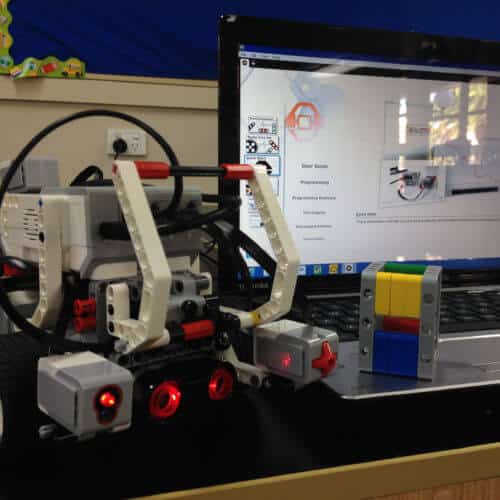

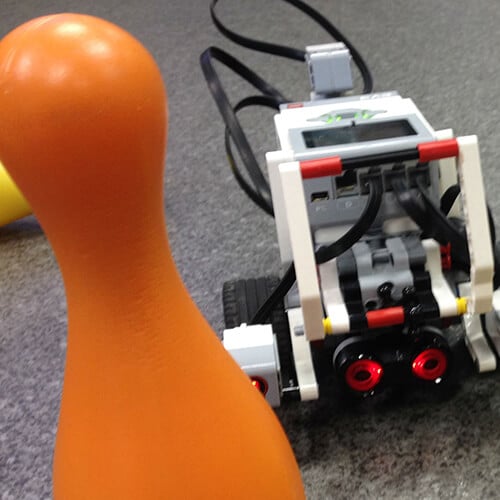
An interactive hands-on workshop designed to demonstrate how a robot really works.
This engaging workshop offers students a chance to learn real-time programming in a fun atmosphere.
Using laptops and the Lego Mindstorms robots, students are asked to complete a variety of tasks whilst learning about basic programming. The programming itself is based on Lego’s easy to understand computer program, whereby students intuitively use the simple ‘drag and drop’ icons to form their code. Students are guided step by step by an experienced presenter on how to program their robot to perform precise movements as well as how to operate environmental sensors such as light and sound.
Working in pairs or threes, students are guided step by step on how to program their robot to perform precise movements as well as how to operate environmental sensors such as light and sound. The workshop concludes with students creatively programming their own robots to perform a short dance routine or another separate fun challenge chosen based on student’s abilities and interests.
This performance can also be viewed as a LIVE web conference anywhere in the world!
 Rated Excellent on Trustpilot – read our reviews
Contact us
Engaging for students!
Specific tasks that are possible (based on student ability)
– Use motors to accelerate, brake, reverse in the correct sequence
– Vary motor power to perform a point and curve turn
– Use loop based programming to drive the robot in a square
– Clear a table of light obstacles using a basic programming sequence.
– program the robot to stop on the sound of a loud hand clap.
– Use a light sensor to detect light levels in the room.
– Use logic-based programming to make the robot follow a black line.
– Use a touch sensor or ultrasonic sensor to detect a solid wall
– program the robot to react to differing light levels in the room.
– Use a combination of motors and light detectors to hit a golf shot
– Determine the correct force required to score an ice hockey goal
– Negotiate a maze of solid objects
– Sensor calibration
…..and more (it’s only limited by time and imagination!)
Posts about this school robotics incursion

Australian Curriculum Mapping
Australian Curriculum Outcomes (ACARA)
Digital Technologies
| Code | What students learn |
|---|---|
| ACTDIP026 | Analyse and visualise data using a range of software to create information, and use structured data to model objects or events |
| ACTDIP029 | Design algorithms represented diagrammatically and in English, and trace algorithms to predict output for a given input and to identify errors |
| ACTDIP030 | Implement and modify programs with user interfaces involving branching, iteration and functions in a general-purpose programming language |
| ACTDIP037 | Analyse and visualise data to create information and address complex problems, and model processes, entities and their relationships using structured data |
| ACTDIP040 | Design algorithms represented diagrammatically and in structured English and validate algorithms and programs through tracing and test cases |
| ACTDIP041 | Implement modular programs, applying selected algorithms and data structures including using an object-oriented programming language |
Science
| Code | What students learn |
|---|---|
| ACSIS125 | Collaboratively and individually plan and conduct a range of investigation types, including fieldwork and experiments, ensuring safety and ethical guidelines are followed |
| ACSHE121 | Science understanding influences the development of practices in areas of human activity such as industry, agriculture and marine and terrestrial resource management |
| ACSIS133 | Communicate ideas, findings and solutions to problems using scientific language and representations using digital technologies as appropriate |
| ACSHE158 | Advances in scientific understanding often rely on developments in technology and technological advances are often linked to scientific discoveries |
| ACSHE195 | Advances in science and emerging sciences and technologies can significantly affect people’s lives, including generating new career opportunities |
Australian National Curriculum Mapping for all our science workshops & shows

NSW K-10 Science Syllabus Mapping
NSW K – 10 Syllabus mapping for all our incursions
NSW Information and Software Technology Years 7–10 Syllabus
A student:
- 4.1.1 recognises and uses software programs that are suitable for specific tasks
- 4.2.1 identifies and uses problem-solving processes when creating solutions
- 4.2.2 designs, produces and evaluates appropriate solutions to a range of problems
- 4.2.3 justifies decisions made when creating information and software technology solutions
- 5.1.1 selects and justifies the application of appropriate software programs to a range of tasks
- 5.2.1 describes and applies problem-solving processes when creating solutions
- 5.2.2 designs, produces and evaluates appropriate solutions to a range of challenging problems
- 5.2.3 critically analyses decision-making processes in a range of information and software solutions
NSW Science 7–10 Syllabus
For explanatory points & implementation advice for each dot point, please visit the Science 7 -10 Curriculum site
A student:
- identifies questions and makes predictions to guide scientific investigations SC4-WS-02
- follows a planned procedure to undertake safe and valid investigations SC4-WS-04
- uses a variety of ways to process and represent data SC4-WS-05
- uses data to identify trends, patterns and relationships, and draw conclusions SC4-WS-06
- identifies problem-solving strategies and proposes solutions SC4-WS-07
- develops questions and hypotheses for scientific investigation SC5-WS-02
- follows a planned procedure to undertake safe, ethical, valid and reliable investigations SC5-WS-04
- selects and uses a range of tools to process and represent data SC5-WS-05
- analyses data from investigations to identify trends, patterns and relationships, and draws conclusions SC5-WS-06
- selects suitable problem-solving strategies and evaluates proposed solutions to identified problems SC5-WS-07
NSW K – 10 Science Syllabus mapping for all our NSW incursions

VIC Science Syllabus Content
Victorian Curriculum F–10 Version 2.0- Digital Technologies
- define and decompose real-world problems by taking into account functional requirements and constraints. VC2TDI8C01
- design algorithms involving nested control structures and represent them using flowcharts and pseudocode, and use tracing techniques to test and identify errors. VC2TDI8C02
- implement, modify and debug programs involving control structures and functions in a general-purpose programming language. VC2TDI8C04
- define and decompose real-world problems, taking into account functional and non-functional requirements and by interviewing and surveying stakeholders to identify needs. VC2TDI10C01
- design algorithms involving logical operators and represent them as flowcharts and pseudocode, and validate algorithms and programs by comparing their output against a range of test cases. VC2TDI10C02
- implement, modify and debug modular programs, applying selected algorithms and data structures, including in an object-oriented programming language. VC2TDI10C04
Requirements
- Appropriate for Years 7 to 10 with a maximum of 30 students per class.
- 7 tables needed.
- Access to at least 2 electrical power sockets with a wide floor space.
- Chairs are not required.
- Duration 90 minutes, half-day or full day.
- Set up time 30 minutes and pack up time 30 minutes






